

An open-ear audio spec sheet is short, and every line on it is doing less work than the line appears to do. Open ear audio glasses smart glasses spec sheet explained is a reading method: it takes the rows a supplier publishes for this family, works out what each one can settle on its own, and shows where the sheet stops being a specification and starts being a feature list. It also covers the unit traps — the doubled cell, the runtime without a workload, the charge time without a starting state — and the translation step where a row becomes a phrase you can put on a purchase order.
Open ear audio glasses: commitments, not features
The single most useful thing a spec sheet can tell you is not what the product is. It is what the supplier is prepared to be held to. Those are different documents, and they are easy to confuse because a sheet is designed to look complete.
Three kinds of content share the page. Configuration facts name what the unit is: the model code, the Bluetooth version, the charging interface, the cell configuration, the battery count in the box. These are settled by the build, and two suppliers who publish them are describing something you can compare. Measured results report a number obtained under conditions: a charge time, a rated runtime, a figure for leakage at a distance. These are the most valuable rows on any sheet and the most dangerous to compare, because the conditions travel with them and the conditions are rarely printed. Names label a feature: surround sound, slim temple, ultra-thin, detachable. A name tells you the feature exists. It tells you nothing about the result, and it is the easiest thing on the sheet for a supplier to write and for a buyer to over-read.
Why the sheet reads as complete and behaves as empty
A sheet with seven rows looks like a specification. It behaves like a summary, because the seven rows are the rows that are easy to state and the rows that decide the purchase are the ones with no number attached at all. When a buyer reads a sheet straight through in one sitting, the density of printed information creates a feeling of sufficiency that the content does not support. The remedy is not more reading. It is reading in a fixed order, so that the absence of a row registers as a fact rather than as an oversight on your part.
The buyer at the desk usually holds two or three supplier sheets, a target price, a channel description and possibly a sample. What they do not hold is a way of separating a configuration fact from a measured result and from a name, and in this category those three sit next to each other in the same table with the same typography. That is why the reading order below is fixed rather than a matter of taste.
There are four red flags worth naming in advance, because each one is invisible to a reader who is scanning for numbers. A sheet with no revision date cannot be matched against the sample you received, so every figure on it is provisional. A sheet whose figures are identical across every model is a range-level document and cannot settle anything model-specific. A sheet with an adjective in the value column — clear, advanced, premium, ultra — is describing a position rather than a result. And a sheet that quotes a weight without naming what was weighed is the flag to watch in this family specifically, because a body weight and a frame weight are different numbers, and a buyer who accepts the wrong one will discover the difference in a shipping calculation or a returns conversation.
Reading the electrical block, one line at a time
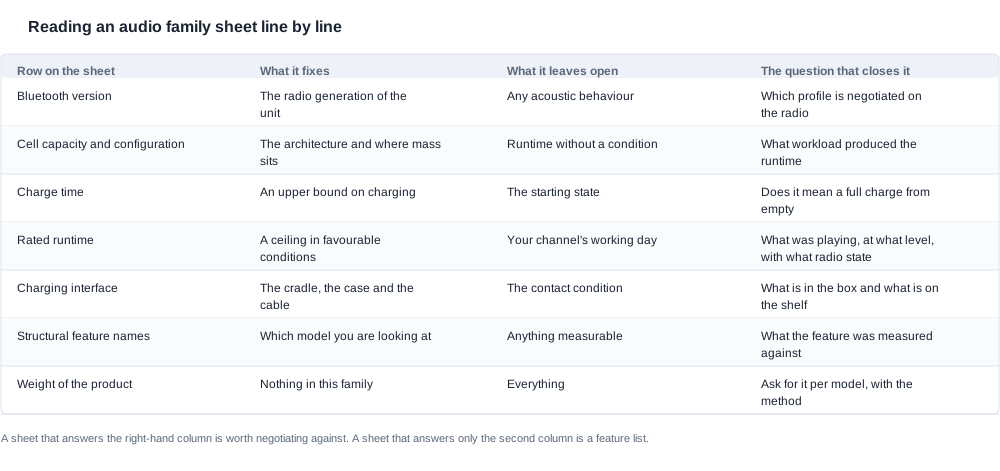
The electrical block of an audio sheet carries four rows that read like numbers and behave like commitments with missing halves. Working through them in order tells you exactly which questions each one raises.
The Bluetooth version row says 5.3 or 5.4. It fixes the radio generation of the unit and settles the protocol vintage you are buying. It settles nothing about audio behaviour, because the protocol version is a property of the chipset and the implementation behind it is a property of the firmware, and the two are routinely confused on sheets. If a sheet pairs a version number with a word like "advanced" or "low latency", the adjective carries no measurement and should be removed from your comparison rather than scored.
The charge time row reads two hours or less across this family. It is an upper bound and it needs one question attached: does it mean a full charge from an empty cell, and does the charge happen while the product is off? A charge time quoted from a partially charged state describes a different operation and will not reproduce. The honest reading of an unconditioned charge time is that it bounds the operation and defines nothing else, and the phrase to carry into an order is the one that names the starting state.
The charging interface row reads magnetic on six of the eight models in the family and Type-C on the other two. This is the row most often read as a customer preference, and it is really a packaging and tooling decision: a magnetic interface fixes the cradle geometry and the case geometry, decides what has to be in the box, and hands the customer a charging routine they did not previously own. A Type-C interface lets the customer charge from a power bank already in their pocket, which in markets where charging anxiety is a purchase objection is a retail argument rather than a technical one. Both readings are true and they belong in different columns of your comparison.
The structural feature rows name the things that differentiate models when the electrical rows will not: a surround sound configuration on the D11, a slim temple with a surround sound configuration on the YK12, and an ultra-thin and detachable temple as a configuration option on the G07. Each is a real row, and each is a name. The question that converts a name into a specification is always the same: what was it measured against, and against what reference. One row is missing from that list altogether, and the gap is worth naming: no model in the range publishes a touch row, so whether the temple carries a control surface, and how that surface behaves, is a question for the supplier.
The cell row: capacity, configuration and the question each one raises
The cell row carries two numbers at once and the second one changes what the first one means. 90 mAh in two cells on the K01 and the K02, 55 mAh in two cells on the YK12, the LC-105-1 and the LC-105-2, and the G07, and a single 100 mAh cell on the D11 and the D12.
The doubled configuration is a structural signal rather than a capacity figure. The models with two cells are the two-earbud architecture, so the row tells you how many devices are in the box. Reading it as a capacity comparison is the most common error on this row, and it produces a wrong answer twice over: it totals the charge and compares totals, and it treats a two-device box as a one-device box with a bigger battery.
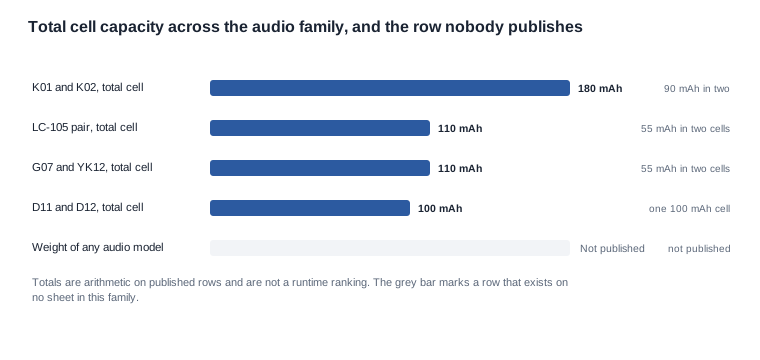
Two questions follow from the row and both are worth asking. What is the management behaviour across the two cells — balanced, or does one carry the load? And what is the charge current path, since that determines whether a magnetic cradle charges both cells simultaneously or in sequence, which determines whether a two-hour charge figure covers the whole box. Neither answer is on the sheet, and both change what a buyer should ask for.
The runtime row: a number with no workload behind it
The rated runtimes in this family cluster around six, seven and eight hours: about six on the G07 and the YK12, about seven on the D11 and the D12, about eight on the K02 and the LC-105-2, and the K01 and the LC-105-1. On the sheet, these read like the column that ranks the models. They are not, and treating them as a ranking is the second most common error.
A runtime is a quotient, and a quotient without its conditions is not comparable with another quotient. It needs a workload, a volume level, a radio state and a starting charge state to mean anything. A figure produced with continuous playback at a moderate level is not comparable with one produced with intermittent use at a higher level, and the second is usually the one your channel will experience. The reading that survives is: these are published ceilings under favourable conditions, and the number you need is the ratio between the published figure and the figure you measure on your own units under your own workload.
This also explains why a lower runtime in one architecture is not evidence that the architecture is worse. A doubled 55 mAh and a single 100 mAh are close in total charge, and the doubled configuration splits that charge across two cells with different management behaviour. Comparing them on the published runtime compares two measurements taken under two different workloads and calls the result a product ranking.
The interface row: a packaging decision dressed as a preference
It is worth separating what the interface row fixes from what it leaves open, because the second list is where the accessory cost hides. The row fixes the cradle, the case and the cable. It leaves open the contact condition, the charger supplied, the thermal behaviour during charge, whether the case is included at all, and the minimum order quantity on the accessory items.
For a procurement buyer the last of those is the consequential one. Accessory items carry their own minimum order quantity, and that minimum rarely matches the unit minimum of the product they belong to. A sheet that publishes an interface but not the accessory scope has told you what the unit needs and nothing about what has to accompany it, and that omission becomes a margin problem once the order is placed rather than a specification problem before it.
The rows that are missing and the question that closes each one
The acoustic rows are absent across the family, and so is a weight for any model in it. On weight our published position is specific and we would rather state it exactly than round it into a convenient sentence: the only product weight published anywhere in our catalogue is the MT6 glasses body at 158 g, which includes the fitted battery and the camera and excludes the folding charging case; that case holds 1200 mAh and its own weight is not published. No bare frame weight is published for any model, including every model in this audio family. A sheet in this family offering a frame weight should therefore be asked which body was measured, with the method attached, because the two answers are not interchangeable.
The absent rows each close with a question of the same shape, and the shape matters more than any single row. Output level and leakage close with a number at the output, a number at a stated distance, the volume setting attached to both, and the environment named. Microphone pickup closes with a distance, an orientation and a statement of whether the noise reduction is a hardware front end or a processing stage, because those are materially different products. Frequency response closes with a measurement taken on the finished frame rather than on a bare driver, or with a reference the buyer can hear side by side.
Translating a row into a phrase that can go on a purchase order
Reading a sheet is worth nothing until it changes what you write. The translation step takes a published row and turns it into an instruction a supplier will be measured against, and it is the step most programmes skip because the sheet already looked like a specification.
The three questions each absent row should carry
A row becomes usable when it carries three things. The condition, which is the light level or the volume or the workload or the temperature under which the figure was obtained. The method, which is the instrument, the geometry or the procedure, so that the figure can be reproduced rather than merely trusted. The pass criterion, which is the threshold at which you would reject the unit, written by you rather than inherited from the supplier's marketing.
A row that carries all three is a specification. A row that carries only the value is a claim. A row that carries the value and the condition but no criterion is a measurement that you will argue about later, and a row that carries nothing is an absent row, which is a legitimate thing for a sheet to have as long as it is visible.

The five-pass order that makes two sheets comparable
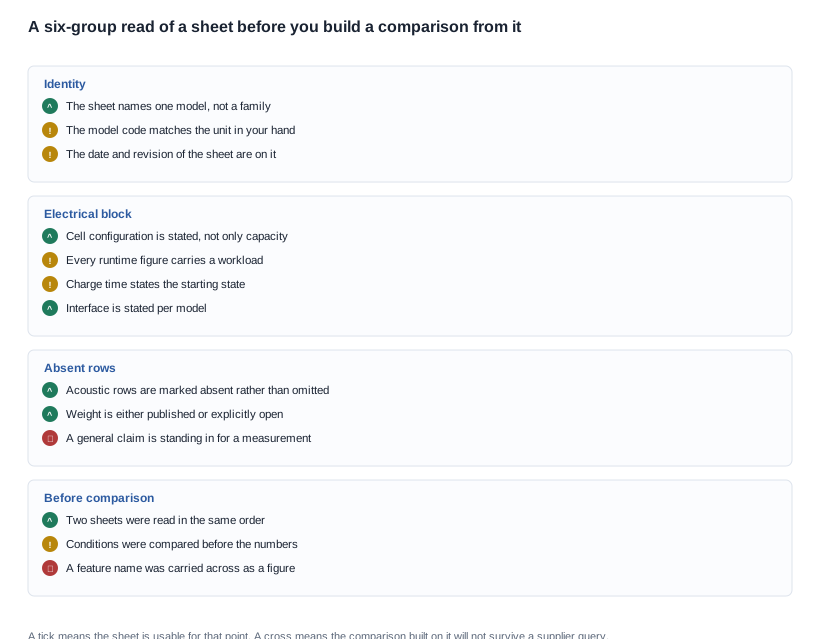
Two sheets can only be compared row by row if both are read in the same order. The order that produces the best result starts with identity, because a sheet that names a family rather than a model cannot be compared to anything. It moves to the electrical block and asks what condition each figure was taken under. It then reads the structural rows and asks what each name was measured against. It reads specifically for the rows that are absent, since absence is where the two sheets are most likely to differ and least likely to be noticed. And it ends by translating every row you intend to rely on into a phrase that can appear on the order.
The fifth pass is the one that produces the output. The first four produce the questions that make the fifth meaningful, and a buyer who runs only the fifth has turned a marketing sheet into a specification by assertion — which is exactly the outcome the reading method exists to prevent.
What to ask when a supplier hands you a sheet
Seven questions close the gaps that a sheet leaves, and they are worth sending as a single written request rather than as a sequence of follow-ups, because a supplier who answers all seven in one reply has told you something about how the product was developed. Ask what the runtime workload was and what the charge time's starting state was. Ask whether the leakage and output figures were taken on the finished frame or on a bare driver, and at what volume and distance. Ask how many microphones contribute to the pickup and whether the noise reduction is a hardware front end or a processing stage. Ask which profiles and codecs the radio negotiates. Ask what the reported weight covers — the body, the body with the case, or the frame alone — and whether the case weight is published separately. Ask what happens to the figure set when the model code changes, since that is the question that tells you whether you will get a sheet for your configuration or an inherited document.

Four reading habits that stop a sheet being misread
Read the identity block before the numbers. Model code, configuration, colour and packaging all have to be settled before a single figure means anything. In a family where several models share electrical rows, the model code on the sheet is the only line that distinguishes the units you are comparing, and the habit of reading it first catches a mismatch that reading it last will not.
Read the condition before the value. This single habit removes most of the misreadings in this category, because the condition is the part a supplier omits first. A runtime without a workload, a charge time without a starting state, a figure without a distance, a version number next to an adjective — in each case the value is plausible and the condition is missing, and the condition is the whole of the meaning.
Read for the rows that are absent. Most comparisons are built from what the sheets contain, which means the gaps are invisible by construction. List the absent rows explicitly, in writing, and the comparison stops being a comparison of what two suppliers chose to publish and becomes a comparison of two products.
Read a feature name as a name. Surround sound, directional audio, ultra-thin, detachable — these are labels for engineering decisions, and a label is a legitimate thing to buy. It is simply not a measurement, and the moment it is scored against another supplier's label the comparison has stopped being about products. Where no row is published at all there is no label to read, and a temple control surface has to be established with the supplier in writing before it can enter a comparison.
What a completed read changes about the shortlist
The point of the method is not the sheet. It is the shortlist, and the criteria you apply to it after reading. Two suppliers whose sheets read identically can turn out to be quoting different products, and two suppliers whose sheets read thin can turn out to be quoting the same product with one of them answering more carefully. Reading properly is what separates those two cases, and it is what lets you build a shortlist on evidence rather than on which document was better laid out.
Three outcomes are common. The first is that the shortlist shrinks, because a supplier who cannot name the acoustic method cannot sign an acceptance criterion and therefore should not be in a shortlist that ends in an order. The second is that the shortlist reorders, because a sheet with open rows on both sides leaves the decision with your measurement programme, and a sheet with closed rows on one side hands you a comparison you did not have to build. The third is that the total cost of the programme becomes visible, because reading the interface row and the accessory scope tells you what else has to be quoted and ordered alongside the units — and that, rather than the unit price, is usually what decides whether the programme works at the volume you planned.
The pitfalls worth naming at this point are the ones that are cheap to avoid. Comparing before the model codes match. Ranking on runtime without a workload. Accepting a feature name as a specification. Reading a body weight as a frame weight. And treating the shortest sheet as the least credible one, when in this category the shortest sheet is often the only one that says which of its figures are conditions and which are not.
What we put on a sheet, and what we refuse to
We publish the rows we hold for the audio family and mark the ones we do not, and we would rather show you a short sheet than a padded one. What we publish is the Bluetooth version, the battery capacity together with its configuration, the charge time, the charging interface, the rated runtime and the structural feature names. What we do not publish, for any model in this family, is a driver size, a frequency response, an output level, a leakage figure, a microphone pickup distance, a negotiated profile or codec, a device pairing sequence, an app name, a multipoint position or a reset procedure.
We will not convert a feature name into a measured claim, and we will not present the MT6 body weight as though it were a frame weight for an audio model. We will also not tell you that one of these products sounds better than another on the strength of the approach it uses, because the published data does not let us and a confident answer there would be a guess with a purchase order attached.
What we can do is take a supplier's sheet and yours, read both in the same five passes, and mark the rows where the comparison is real, the rows where it is a wording difference, and the rows where the gap between them is the entire commercial argument. The background is under open-ear audio, the published rows in more detail are in open-ear key specifications, the measurement protocol is in how to measure open ear audio, and the range is Bluetooth audio glasses.
Related reading
- The published rows in detail — open-ear key specifications
- The measurement protocol — how to measure open ear audio
- Bluetooth audio glasses range
Send us two sheets and we will mark the rows where the comparison is real.


