

Verifying an open-ear audio supplier is hard for a reason specific to this category: the specification you would normally verify against does not exist. Open ear audio glasses smart glasses supplier verification is therefore not a comparison exercise. It is a construction exercise, and it runs on three tracks — who the counterparty is, what they can evidence, and whether the unit they sell is the unit they make — with a fourth track that converts all of it into something enforceable. A supplier who passes only the first track has a good business licence and an uncharacterised product, and in this category that is the more common of the two outcomes.
Our published data for the audio tier covers Bluetooth 5.3 and 5.4, cell configurations at 55 mAh × 2, 90 mAh × 2 and 100 mAh, charge times of two hours or less, runtimes of roughly six to eight hours, magnetic or Type-C charging, no published touch row on any model, and features including surround sound and slim detachable temples. No acoustic figure is published for any of them.

Open ear audio glasses: evidence, not factory tours
Buyers tend to assume that verifying a supplier means inspecting a factory. It does not, and the assumption costs money, because a factory visit produces reassurance rather than evidence. A line walk shows you that a line exists and that somebody is willing to show it to you. It does not show you that the acoustic design in the quotation is the acoustic design in the unit, that the per-lot records exist, or that the unit you receive is the unit that was approved.
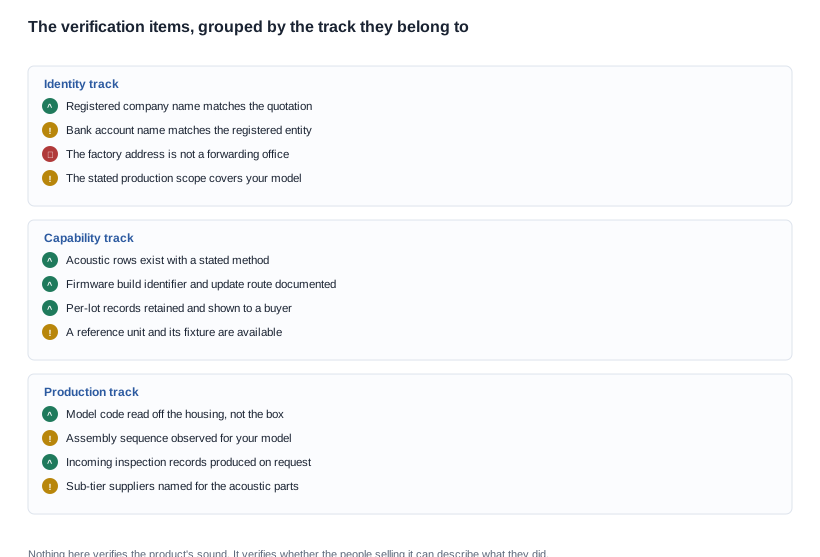
What actually separates a supplier you can buy from one you cannot is documentary and can be produced from your desk in days. Four tracks do the work: the identity track establishes who you are contracting with and what their production scope actually is. The capability track establishes whether they measured the product they are selling or received it finished. The production track establishes whether the quoted configuration is made in the building they claim. The agreement track converts the findings into acceptance criteria that travel with the purchase order.
The distinction between the tracks is worth stating plainly, because most verification requests collapse them into one. A supplier can be entirely legitimate and still unable to answer the capability questions, because the acoustic design sits one tier above the assembler. A supplier can be an excellent manufacturer and still be the wrong counterparty for your programme, because their production scope does not include the model you want. And a supplier can pass all three tracks and still be unsuitable, because the fourth track was never written and there is nothing to hold them to when the first lot is wrong.
What a business licence does and does not tell you
A business licence proves that an entity exists, that it is registered, and that it has been issued a scope of activity. It proves nothing about capacity, nothing about whether the entity makes anything at all, and nothing about whether the address on the quotation is where the goods come from.
The distinction that catches buyers is between a registered entity and a manufacturing entity. A trading company can hold a licence whose scope permits wholesale and export. That licence will be genuine, current and entirely irrelevant to whether the goods were made by them or bought in from someone else. A licence is the floor of the identity track, not the answer to it.
The identity track: proving the counterparty is who it says it is
The identity track asks five questions, and every one of them has a document behind it. None of them is difficult to answer, and a supplier who cannot answer all five is telling you something before you spend any money on a sample.
Does the registered company name on the quotation match the entity on the bank account? A mismatch here is not a clerical error in the way people describe it. It means the payment is going to a party that is not the party you contract with, and it is the single most common structural problem in cross-border sourcing. This is the one question in the track that can end the process on its own.
What is the registered production scope, and does it cover your model? A scope that permits assembly is not a scope that permits acoustic design. If the supplier's registered activity is wholesale, retail or trading, then whatever they quote is bought in, and your questions about the acoustic tier need to be directed elsewhere.
Is the factory address a production site or a forwarding office? This is checkable without travelling: the address on the quotation, the address on the licence, the address on the business registration and the address on the conformity documents should be reconcilable, and when they are not, the differences are worth understanding before the deposit.
Who are the named sub-tier suppliers for the acoustic parts? A supplier who cannot name the transducer and the chamber source is selling a configuration they do not control, which is a normal arrangement, but it has to be a known arrangement rather than a surprise at the first article.
What is the payment account and the settlement currency, and does the arrangement match the incoterms on the order? A buyer who does not reconcile the payment path with the shipping terms has not finished the identity track, and the mismatch surfaces at the border rather than in the office.
Five questions that expose a reseller posing as a manufacturer
Resellers posing as manufacturers are not rare and they are not fraud in the ordinary sense; they are usually a trading company with good relationships and no factory of their own. The five questions that separate them are specific. Ask for per-lot production records with dates and quantities against them. Ask for the firmware build identifier and how a shipped unit is updated — a trading company can quote a build but cannot explain a release process. Ask to see the incoming inspection record for the acoustic sub-tier. Ask whether the model is built to the buyer's brand, and if so whether the tooling belongs to the buyer or the factory. And ask what the supplier's own house models are, because a manufacturer can answer and a reseller cannot.
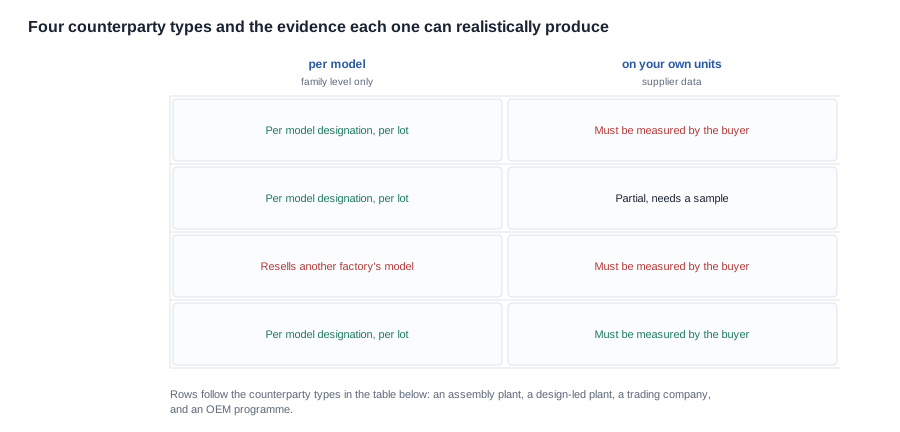
None of these questions is confrontational, and all of them are answerable from documents. The reason to ask them before the sample rather than after is sequencing: each answer either opens the next question or closes the track. A supplier who answers the first two and goes quiet on the third has told you the third answer.
What to do with an answer you do not like
Verification produces two kinds of bad result, and they need opposite responses. The first is a gap, where the supplier simply does not have the document or the record. Gaps are frequently closable: the document may exist in a different form, the record may be created once a build schedule is agreed, and the per-lot set may only become complete after the first production run. The correct response to a gap is a condition attached to the order — the records arrive before the second shipment, or the acceptance holdback is released against them.
The second is a contradiction, where two answers cannot both be true. A registered scope that permits trading, paired with a claim to build to your specification, is a contradiction. A quoted firmware build with no release history behind it is a contradiction. A business registration in one name and a bank account in another is a contradiction. Contradictions do not close by negotiation and the response is to stop, which is why this track is run first and why it is run on documents rather than in a meeting.
The distinction is worth holding because a buyer who treats every gap as a failure will disqualify sound suppliers, and a buyer who treats every contradiction as a gap will fund a programme that ends badly.
The capability track: proving the supplier measured the product it sells
The capability track asks a single question in five forms: does this supplier know things about this product that only someone who worked on it would know? In a category where no acoustic figure is published, this is the only route to evidence about the acoustic result short of measuring it yourself.
The three records that separate a measured product from a received one
The acoustic measurement file. Not a summary — the file, with the method, the conditions and the instrument. If a supplier holds this, they built or commissioned the acoustic design and they can defend a number. If they hold only a summary, they have been given a number and cannot answer a question about how it was obtained.
The firmware build record. A build identifier, a release history and an update mechanism. This is the document that answers what happens to a shipped unit when something is corrected, and it is also the document that tells you whether the acoustic behaviour can change after you have approved it. A supplier without a build record cannot tell you what is running on your units, and if they cannot tell you what is running on your units then they cannot have measured them.
The per-lot record set. Production dates, quantities, cell batches and inspection outcomes, held per lot. This is the record that lets a buyer answer a question two years later about a warranty claim on a specific batch, and it is also the record whose existence tells you whether the supplier's own quality control exists at all.
What is absent across the whole audio family is as informative as what is present. There is no published driver size, no frequency response, no leakage figure, no microphone pickup distance, no codec and no standby current for any model we sell. That absence is a structural condition of the category rather than a shortcoming of one supplier, and it is the reason the capability track exists: in the absence of published data, the supplier's own records are the only evidence there is.
One row deserves separate attention because it is asked constantly and answered badly. The microphone architecture — how many microphones contribute to the pickup, and where they sit relative to the mouth and relative to the speaker. A supplier describing a single microphone as having intelligent noise reduction is describing a processing stage and presenting it as hardware, and those are materially different products with materially different call behaviour. The question is verifiable without a laboratory, and a supplier who cannot answer it has not opened the acoustic design.

The production track: checking that the quoted unit is the made unit
The production track exists because the configuration you approve and the configuration you receive are the same only if somebody checks. In this family the check is unusually cheap because the model code can be read off the housing, and unusually important because several models share electrical rows.
What a line walk can and cannot settle
A line walk settles three things. It confirms that the building is producing, and at roughly what volume. It shows the assembly sequence for your model, which tells you whether your configuration is a normal build or a special one. And it lets you see the incoming inspection arrangement in operation, which is a better answer than any document about incoming inspection.
A line walk cannot settle whether the acoustic design matches the one in the quotation, because that design is not visible on the line. It cannot settle whether the per-lot records are complete, only that some exist. And it cannot settle the cell configuration of a specific unit, because cells are assembled into the housing and the variant markings are often internal.
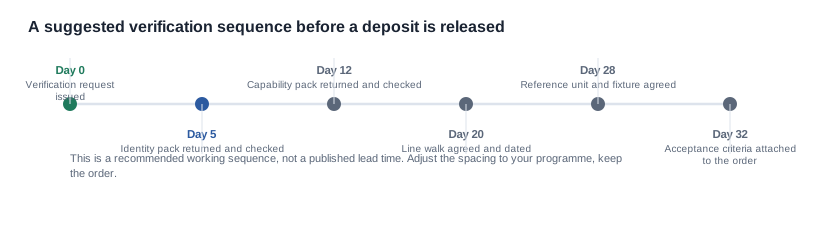
What the walk does produce is a reference unit and its fixture, and that is worth more than it appears. A golden sample the buyer holds is the reference against which every incoming lot can be compared for the rest of the programme, and a supplier who is willing to release one has made a statement about consistency that no document makes. It is also the thing most often forgotten to ask for, and it is the thing a warranty claim two years later will need.
The identity check itself is a single line on a sheet: the model code read off the housing, compared character by character with the code on the paperwork. In a family where the K01 and the K02 share their Bluetooth version and their cell configuration, and where the LC-105-1 and the LC-105-2 share theirs, this is the check that catches a substitution. It should be treated as a stop condition rather than a query, and it should be run on the sample and again on the production lot.
Two production questions settle the cost side of this track, and both are cheaper to ask in the first request than to discover afterwards. Who carries the accessory programme — the cradle, the case and the cable, whether those are made in the same building or brought in, and whether the accessory minimum order quantity is the same as the product minimum order quantity. What the unit weight actually covers, because the shipping cost model and the return-rate model both depend on it. On weight our published position is one figure across the whole catalogue, and it is a figure about a body rather than a frame: the MT6 glasses body is published at 158 g including its fitted battery and camera and excluding the folding charging case, that case holds 1200 mAh and its own weight is not published, and no bare frame weight is published for any model. A supplier quoting a frame weight for an audio model is quoting a number we cannot check, so ask what body was weighed and with what method.
The agreement track: what verification is worth once it is written down
Verification that produces findings and no obligations is a study. The fourth track is what converts the first three into something a supplier is accountable for, and it is the track most programmes leave until after the first shipment.
Four things belong in the purchase order. The model designation and its full configuration, so that the identity check on receipt has something to check against. The acceptance criteria, with the script, the environment, the pass criterion and the sample size, so that a failing lot can be refused rather than argued about. A notice obligation covering any change of transducer, chamber geometry, temple design, cell configuration, DSP tuning, default processing state or firmware, because each of those changes the acoustic result the buyer approved. And the retained unit and the fixture, with a clause that they remain available for the buyer's audit.
The commercial terms that follow from a successful verification are ordinary and worth stating plainly. The acceptance criteria and the test protocol are negotiable documents, and a supplier willing to sign yours is one who expects to pass. Minimum order quantity is negotiable. Packaging and insert design, including the market labels and the language of the documentation pack, is a low-cost negotiation with no tooling implication for an electronic product. Payment points are a standard area, and a deposit taken at contracting, a balance payable when the inspection is closed, and a retention against the paperwork pack all protect the failure that costs most — a product arriving with paperwork that does not cover it.
What does not move is worth naming too, because pressing on it produces a longer schedule rather than a shorter one. Certification cost and certification time are fixed per product family and set by the test laboratory and the review queue. Tooling is a one-off that is normally amortised across the first order, and the questions worth asking are over what volume and what happens to it if the programme is discontinued. And the acoustic design itself is not a commercial variable at all: a supplier who will not change the transducer, the chamber geometry or the signal chain is telling you the product is fixed, and the programme should be built around that fact rather than against it.
Where our verification stops and yours begins
We publish the acoustic methods our catalogue states and the empty measurement rows beside them, and we will not fill those rows with values from a typical device. We publish no driver size, no frequency response, no leakage figure, no microphone pickup distance, no codec, no multipoint behaviour and no standby current for any model in the audio range. On weight, the published position across the catalogue is one figure only: the MT6 glasses body at 158 g, including the fitted battery and the camera and excluding the folding charging case, which holds 1200 mAh and whose own weight is not published. No bare frame weight is published for any model.
We will also not tell a buyer that a supplier's product is good, because the published data does not let us and a guarantee we cannot support is worse than no answer.
Three things are yours and cannot be verified for you: how the frame sits across the head shapes in your channel, how the acoustic result behaves in your environment, and how the product is received by your customer. Those are the buyer's rows, and the reason to run them before the order rather than after it.
What we can do is take a specific configuration and tell you which of the verification items our documentation already answers, which need a document from the supplier, and which need a measurement on your own units. The background is under open-ear audio, the published rows are in open-ear key specifications, the microphone protocol is in what to ask a supplier about microphone quality, and the range is Bluetooth audio glasses.
Related reading
- The rows in the catalogue — open-ear key specifications
- The microphone questions — what to ask a supplier about microphone quality
- Bluetooth audio glasses range
Send us a supplier's responses and we will tell you which of the verification items are still open.


