

Photochromic smart glasses care instructions are not a paragraph to be pasted into a manual at the end of a project. For a lens that is driven electrically, the instruction set describes an electrical state machine, and the buying decision is whether the supplier has documented that state machine at all.
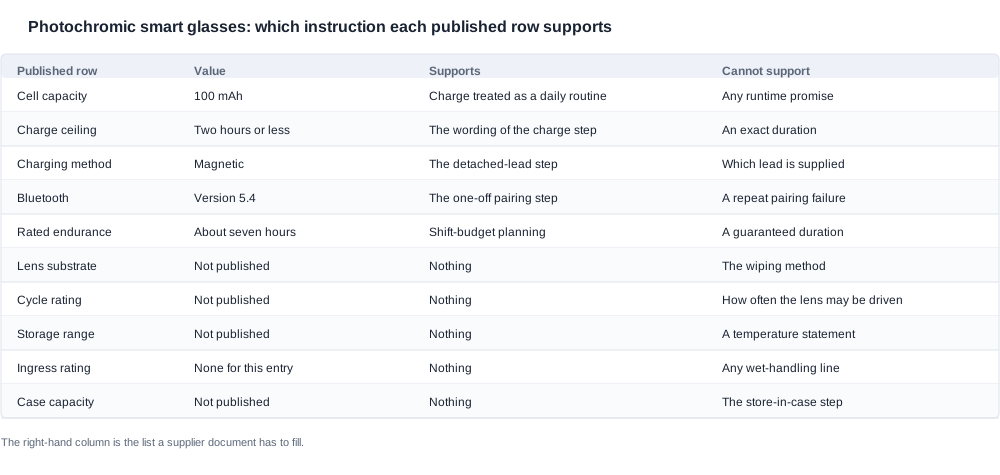
Our catalogue publishes one entry in this category — an electrochromic smart glasses line published without a model designation — and for it the published record amounts to five fields: a 100 mAh cell behind a magnetic lead, an endurance of roughly seven hours, a charging session capped at two hours, and a Bluetooth version 5.4 radio. There is no lens substrate, no lens thickness, no cycle rating, no storage temperature range, no ingress rating, and no charging-case capacity for this entry. Every one of those absences lands directly on the sheet that has to ship in the carton.
The practical consequence is worth stating plainly. An importer who writes the instruction set alone will be inventing it, and an importer who prints a generic one will be issuing instructions that belong to a different product. The route that works is narrower: obtain the supplier's own material and handling statements, then build the instruction set around the electrical rows that genuinely exist.
What follows walks that route in order — why the sheet is a procurement document, what the storage state does to the next morning, how the wiping sequence and the prohibited substances have to be written, how one shift of use is ordered around the published numbers, and the checklist the finished sheet has to pass before the carton is printed.

Photochromic smart glasses: why the instruction sheet is a procurement document
The instruction set is the document that converts a set of product features into a set of promises. When a user wipes the lens with the wrong substance, or leaves the product in a tinted state for a month, the question of who authorised that handling is a procurement question, not a customer-service question. An importer who authored the sheet alone has effectively warranted the surface of a lens whose substrate and coatings nobody documented.
What can be built directly from the published rows is more than a first impression suggests. The 100 mAh cell tells the sheet that charging is a routine daily event rather than an occasional one, and it fixes the vocabulary — a charge, a charged state, a flat state. The two-hour-or-less charge figure sets the ceiling that the sheet is allowed to state, and the wording has to stay a ceiling: "two hours or less" is the supplier's claim, and a sheet that promises a strictly shorter window asserts something the catalogue does not support. Magnetic charging tells the sheet that a specific lead is involved and that a charge session has a physical form. Bluetooth version 5.4 tells the sheet that the radio connection is a one-off setup step rather than a recurring one, and that a product which will not reconnect after a battery change is behaving normally.
What cannot be built from the published rows is where the instruction set earns its keep. The lens substrate and thickness are unpublished, so the wiping step has no documented basis. There is no cycle rating, so the sheet cannot state how many times the lens may be driven. There is no storage temperature or humidity range, so the storage step has nothing to state. There is no ingress rating for this entry — the catalogue publishes one for the V06 and the S7 only — so no wet-handling or rain instruction can be asserted. The catalogue publishes no charging-case row for this line, so a "store it in the case" instruction has no published foundation, and a case sourced by the importer as a separate accessory is a component nobody has documented at all.
This is where the commercial judgement sits, and it is a negotiation with a clear trade-off on both sides. A sheet written by the importer covers the gaps by asserting them. A sheet written by the supplier, referencing the supplier's own material and handling statements, transfers the burden of any surface or state claim to the party that holds the underlying data. Asking for that statement is a negotiation item with real value, and it is frequently cheaper to obtain than a price adjustment that nobody will honour on the second order.
Two further properties of the sheet matter more than its content at first glance. It has to be issued in the language of the destination market, and the version actually shipped has to be the version referenced in the conformity file, because those two documents are read together at a customs inspection and during any later claim. And the sheet needs a revision number, because a product whose documentation has moved on while its hardware has not is a recurring source of confusion in the field.
Storage state and what it does to the next morning
A passively switching lens has only a physical state: it is either dark or it is not, and it decides that on its own. A driven lens has an electrical state as well, and that distinction is the single most useful thing a procurement team can hold on to when reading a candidate instruction sheet.
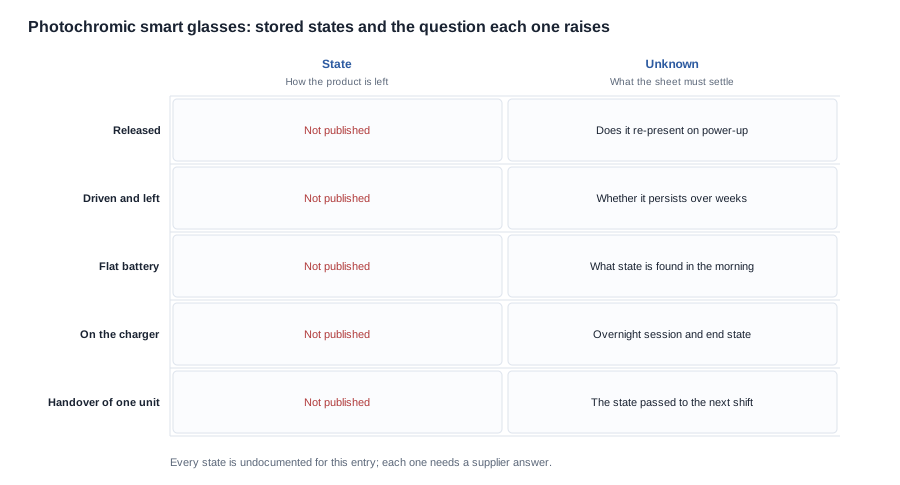
The state a product is stored in is therefore a decision with a consequence. If the product is stored in a driven state, the question is what happens to that state over weeks of disuse — whether it persists, whether it drifts, and what the product presents on the next power-up. If the product is stored in the released state, the question becomes whether the product can be relied on to release itself after a flat battery or an unplanned interruption. Both questions are about behaviour over time, and neither is answered by the five published rows.
The answer to both depends on an attribute that the catalogue does not publish: the control policy. Whether the lens follows ambient light automatically, whether it responds to a command from the product, and whether a manual override exists are three separate behaviours, and each of them produces a different storage instruction. A product that darkens on its own needs no storage instruction for the lens at all, because there is no persistent lens state to manage. A product that holds a commanded state needs an explicit release step, and the sheet must say what the release is. The category name tells you the lens is electrically driven; it does not tell you who decides when it changes.
The flat-battery case deserves its own line in the sheet. At the end of the rated runtime the product is found in a defined state, and the person opening the case in the morning will describe anything else as a fault. Until the supplier documents what that state is, the instruction set cannot state it, and the importer should record the gap rather than filling it with a plausible guess. A guess here is expensive, because the guess will be contradicted by the first unit in the field and the supplier will then treat it as a disagreement rather than as an absence.
The same applies to the charger. Whether the product may be left connected overnight, what the charge indication does at the end of a session, and what state the lens is in while the product sits on the lead are all unpublished. Overnight charging is common enough in a work environment that the sheet has to address it, and if the sheet cannot, the importer is making the decision for every customer in the field.
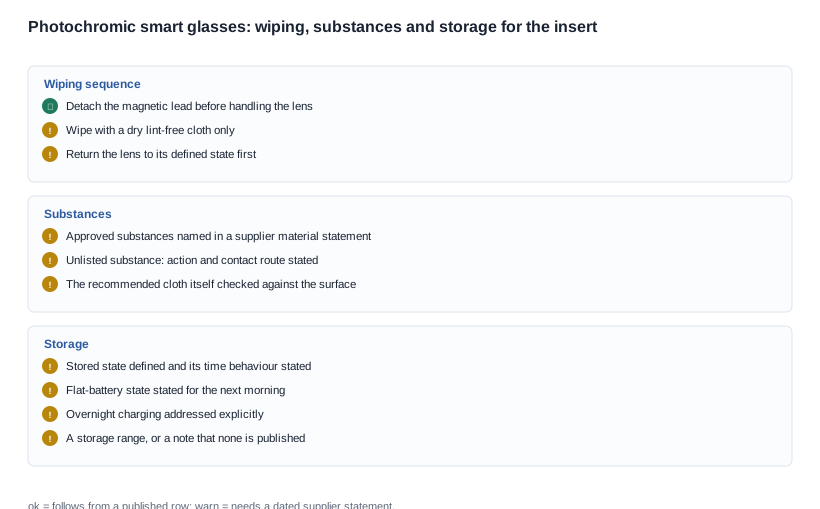
The temperature and humidity question is often mis-handled by simply being omitted. With no storage range published for this entry, the conservative instruction is not a made-up range; it is a statement that no range has been published for this product, together with the practical guidance that it should not be left in a vehicle or an unheated store. This is a case where describing the state is more useful than describing a range, and where honesty about the absence is more protective than a plausible-sounding number. The common pitfalls in this area are all of the same kind: a figure appears in a sample pack, a reference copy of a leaflet, or a conversation with a technical contact, and it migrates into a purchase specification without anyone taking responsibility for it.
A related trap deserves mention. The catalogue publishes no charging-case row for this line, which means the instruction "store the product in its case" is an instruction about a component that may not be documented anywhere in your supply chain. If the importer is bundling a case purchased from a third party, the storage step of the sheet is being written for a product that no party in the chain has taken responsibility for.

The wiping sequence and the substances to keep away from the lens
Two different things live in this section of the instruction set, and they have different sources. The sequence is procedural and can be written from the published electrical rows. The prohibition list is material and cannot be written at all until the supplier supplies a statement about the lens surface.
The sequence has to answer a small number of concrete questions in order. Is the product detached from its magnetic lead before the lens is wiped, and is that necessary because the lead is attached to a powered surface. Is the lens returned to a defined optical state before wiping, or does the sheet say that the product should be in whatever state it is in. What is the wiping material — a dry, lint-free cloth, with nothing that has a surface of its own, no kitchen paper, no terry cloth. How often, and with what frequency limit. And what the user should do if the product has been in contact with something unknown, which is the most common real event and the one the sheet will be consulted for most often.
The prohibition list cannot be written from what is published here. The substrate, any coating, and the lens edge treatment are all unpublished for this entry, and the substances that are safe for one driven lens are not automatically safe for another. This is the point at which importers most often over-reach, by importing the instruction set of a different lens product and assuming the surface behaves the same way. The damage does not always show immediately: it shows as a haze, a banding artefact, an uneven state across the lens, or a change in how the lens clears — all of which are the kind of fault that is difficult to attribute after the fact.
The artefact worth requesting from the supplier is a written material and handling statement that names the approved substances for the lens surface and states the handling regime that applies to the driven state. Once that statement exists, the instruction set can be written against it and, more importantly, referenced by it. A sheet that cites a dated supplier statement is defensible. A sheet that lists prohibitions from the importer's own imagination is a warranty the importer has just given itself.
Agreeing the verification method alongside the statement is what turns a document into a control. Three checks are worth putting in the sample order: a wipe test on each candidate substance, watching for any visible change in the driven state; an abrasion check using the cloth the sheet intends to recommend, since the cloth is what actually touches the surface; and a check of the lens edge and the temple-side surfaces, which are handled more roughly than the front of the lens and are rarely the subject of a specification.
Before sending that request, the due diligence question is simple: can the supplier produce the statement for the product you are buying, dated, and naming the model? The questions to ask are not about chemistry, they are about the existence and ownership of a document. A supplier that has a material statement for a different product, or for an earlier revision of the same product, has not answered you, and the difference between the two cases is the difference between a control and a hope.
The last item in this section is the one that gets left out and then needed. The sheet should say what to do after an accidental contact with an unlisted substance, and it should say who to contact. That line is only credible if it comes from the supplier, which is a further reason to request the material statement before the carton artwork is finalised rather than after.
Ordering charge, use and storage across a single shift
The instruction set becomes concrete when it is written against a working day, and the published rows make that day easy to lay out. Take a warehouse or field operation with a first issue in the morning, an eight-hour shift, and a return to the store in the evening.
The unit comes out of the store on a charge. The cell is 100 mAh and the rated endurance is roughly seven hours, so a single charge covers a little less than a shift, and the gap has to be closed by a second charge whose ceiling is two hours. A practical interruption budget therefore has to assume a charge session of up to two hours, and if the break that contains it is only an hour, the arithmetic has to be redone on the assumption that the product is returning to service before the charge has finished. This is planning, not performance: the rated figure is published without a test condition, so it is an envelope to design against rather than a number to promise.
What makes the shift useful is not the arithmetic but the state questions it raises at each point, because the sheet has to answer them in order rather than as a single list of warnings.
- In what optical state is the product when it comes off the charger, and does that state depend on the charge level or on the last command.
- What state does the product present when the rated runtime is exhausted, and does that state persist into the next shift.
- Is the lens driven automatically from ambient light, on command from the product, or by both, and does the answer change with the remaining charge.
- What is the product's state after an unplanned interruption — a flat battery, a disconnected lead, a flat battery during a shift.
- Is it acceptable to leave the product connected to the charger beyond the charge ceiling, and what happens at the end of that session.
- Does the optical state survive a power cycle, or does the product re-present a default state on the next power-up.
- How long may the product sit unused before the stored state should be re-checked.
- What must be inspected before the product goes back into service after a wet or contaminated surface incident.
The handover between two people using the same unit is the case that most often defeats an insert. If a unit passes from one shift to another, the sheet has to define the state it is supposed to be handed over in, and the inspection that accompanies the handover. Where the sheet does not define that, each side develops its own assumption and the disagreement surfaces as a quality complaint rather than as a documentation gap.
A second practical test, worth running on the sample, is the drawer test. Leave the unit in the stated storage state for the interval your customer will actually leave it idle — two weeks is not unusual for equipment issued intermittently — then check that it behaves on the next power-up as the sheet claims. If it does not, the storage instruction is wrong, and no amount of wording will fix it.
Note that the ordering of these steps is not arbitrary. The charge step has to precede the wiping step, because the sheet tells the user to detach the product from its lead before handling the lens. The release or reset step, if there is one, has to be defined before the storage step, because the stored state is the outcome of it. And the state questions have to be answered before the prohibition list is written, because the substances that are safe may depend on the state the product is in when it is wiped.
How to choose which of these questions to put to the supplier first is a matter of what your deployment actually depends on. A unit that sits idle for weeks between shifts puts the storage state at the top of the list. A unit that changes hands twice a shift puts the handover state there. A unit that is charged in a vehicle puts the state during charging at the top. The red flags to watch for are consistent across deployments: a supplier who declines to name the state, who answers with a photograph of a lens, or who points at a document belonging to a different model. The total cost of leaving these unanswered shows up later as returns, and returns are charged against the product you chose rather than against the specification you never wrote.
What the instruction sheet has to contain before the carton is printed
By the time the artwork is ready, the following should be settled in writing, and each line should be traceable either to a published row or to a dated supplier statement. This checklist is short on purpose: an insert that carries thirty instructions is an insert nobody reads, and the signs that a sheet has grown past the useful point are the same in every category.
- The state in which the product is stored, and what happens to that state over time.
- The charge instruction, worded as a ceiling of two hours or less, and the magnetic lead that the instruction implies.
- The connection instruction for Bluetooth version 5.4, and what a failed reconnection after a battery change does and does not indicate.
- The wiping method, the material to be used, and the frequency.
- The prohibited substances, sourced from the supplier's material statement rather than from a generic product insert.
- The action to take after accidental contact with an unlisted substance, and the contact route.
- The storage limits, or an explicit statement that no range has been published for this product.
- The model designation, the batch reference, and the revision number of the sheet itself.
- The fault-reporting route, and what the customer should have available when using it.
- A statement of the published endurance as a rated figure, not as a guaranteed duration, and of the charge time as an upper bound.
Two of those lines deserve one more sentence each. The model designation on the sheet has to be the same string as the designation on the conformity documentation, because a mismatch between the physical product and its paperwork is expensive to unwind. And the revision number has to be cross-referenced in the conformity file, so that a product, its paperwork and its insert can be reconciled to a single point in time — which is exactly what a recall or a customs query requires.
We can be precise about the limits here. Our catalogue publishes five fields for the AI electrochromic smart glasses entry, and no more: a 100 mAh cell behind a magnetic lead, an endurance of roughly seven hours, a charging session capped at two hours, and a Bluetooth version 5.4 radio. The substrate, the thickness, the cycle rating, the storage range, the ingress rating, the case capacity and the weight are all absent, and we will not supply typical values to make the sheet appear complete. What we can do is tell you which of the ten lines above can be written today from the published rows, and which ones have to arrive with a supplier document before the carton goes to print.
The service-life note for this category covers the measurable aspects of service life, and the conformity note covers the paperwork that a revised insert has to be reconciled against. If you are assembling this product for a specific market, tell us the destination and the shift pattern, and we will tell you which parts of the photochromic handling instructions can be written from published data and which parts are waiting on a supplier statement.


