
Photochromic smart glasses durability is normally asked as a single question, and it is answered as a single word, usually some number of months. That answer is useless, because the product contains two components with completely different service lives and completely different failure modes, and they are governed by evidence that has to be gathered separately.
One of the two is the lens, which in this category is an electrically driven optical element. It has a switching cycle, and the number of cycles it survives is a property of the cell structure, the electrolyte and the driving arrangement, none of which the catalogue describes. The other is the frame, which is a mechanical assembly of temples, hinges, fasteners, a magnet, a cell and a small amount of electronics, and whose service life is a function of materials, geometry and joint design.
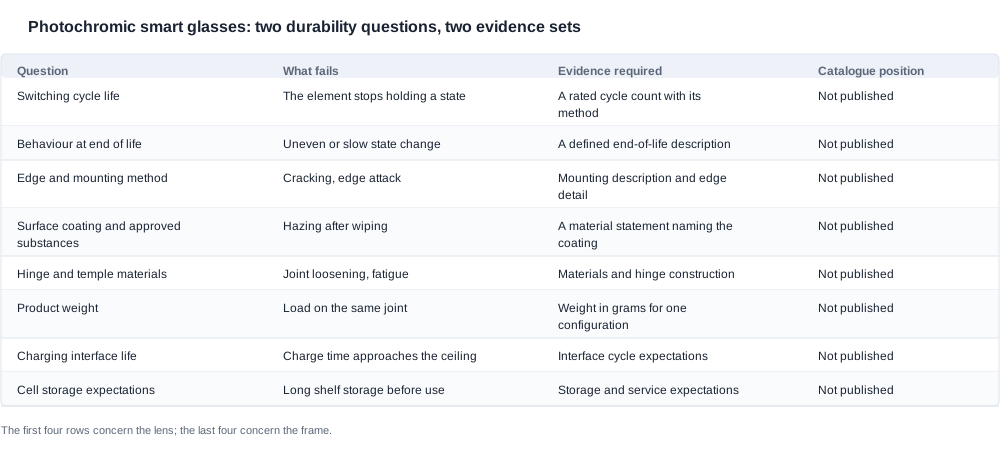
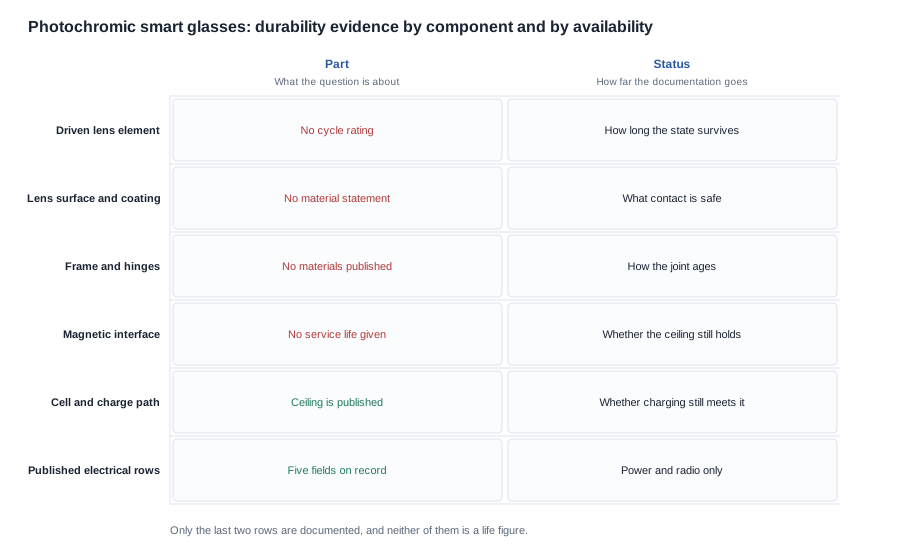
What the catalogue publishes for the entry in question is a cell of 100 mAh charged over a magnetic contact, about seven hours of rated endurance, a charge limit of two hours, and a Bluetooth version 5.4 radio. Every one of those five fields describes power and connectivity, and not one of them says anything about how long the product lasts. There is no cycle rating, no substrate, no thickness, no material, no weight, no ingress rating and no warranty term for this entry, and the two durability questions therefore have to be split, stated separately, and sent to the supplier as two different requests.
This article takes the two questions apart, sets out what the catalogue can and cannot answer for each, shows how to convert them into a single acceptance protocol at incoming goods inspection, and explains what a warranty conversation in this category is really about. The shortlist note covers the wider selection sequence, and the handling guidance note covers the routine that protects whatever the supplier's answer turns out to be.
Photochromic smart glasses: two durability questions that are not the same question
The reason these two questions get merged is that they fail in front of the same customer. A customer whose lens has stopped switching properly and a customer whose temple hinge has loosened both ring the same support line and produce the same sentence: it is not working properly. From the buyer's side, though, the two are separated by everything that matters: the supplier who can answer, the test that reveals the problem, the evidence that has to exist, the cost of the failure, and whether the item is replaceable.
The lens question is an electrical and chemical question dressed as an optical one. The element changes state because a voltage is applied across it, and the things that end that ability are the ones that end the life of a reversible electrochemical system: the number of switching cycles it tolerates, the stability of the active layer, the effect of heat and of sustained drive, and the behaviour at the end of that life. A lens that has been cycled many thousands of times may still appear perfectly clear and still no longer hold a state. Nothing about the appearance tells you, which is why the only useful answer is a rated cycle figure with a stated test method attached.
The frame question is a mechanical and materials question. A frame assembly in this category carries more than it used to: a cell, a magnetic charging interface that has to hold alignment, a pair of hinges, and a driven lens that makes the front of the product heavier than a plain audio frame would be. The failure modes are ordinary engineering ones — joint loosening, fatigue in a repeatedly bent temple, cracking at a stress concentration, a connector that no longer holds — and the evidence for them is conventional: materials, dimensional tolerances, cycle testing and drop testing.
There is one more distinction that matters commercially, and it cuts across both questions. Optical durability and electrical durability are not the same property. A lens can remain optically acceptable while the driving electronics behind it have degraded, and a frame can remain structurally sound while the charging contact has been worn to the point where the charge time stretches beyond its stated ceiling. The catalogue's charge figure is a ceiling on a charge cycle, so a worn contact does not break a published claim; it quietly consumes the margin the ceiling was designed to give. That is exactly the kind of degradation that a buyer only discovers through a lifecycle test, and it is why the acceptance protocol below is built around repeated cycles rather than a single inspection.
The lens durability question and what the catalogue cannot answer
Start from the published record, because it is the honest starting point and it is short. For this entry the catalogue names the drive type, the cell, the charging method, a charge limit of two hours, about seven hours of rated endurance, and a Bluetooth version 5.4 radio. It publishes no lens substrate, no lens thickness, no coating description, no cycle rating, no operating temperature range, no tint depth and no statement of how the lens is held in the frame.
Each of those absences is a question, and the questions are sharper than they look.
- What is the rated switching cycle life, and under what test? A cycle figure with a drive condition, a temperature and a duty ratio is a usable answer. A cycle figure with no condition is a marketing number, and the two are separated often enough to be worth asking about explicitly.
- What is the behaviour at the end of that life? Does the element stop switching, switch unevenly, or slow down? Each of those produces a different customer complaint and a different disposition at the supplier, and the answer determines what a reasonable warranty statement can even say.
- Is the element bonded, framed or mounted, and what protects it at the edge? The edge of a lens is where mechanical stress and chemical attack start, and the answer tells you how much handling the product tolerates before the failure moves to the optical surface.
- What coating is present, if any, and what is approved for contact with it? This is the same question the handling regime has to answer, and the two have to agree. A supplier that states a coating in one document and prohibits a different substance in another has a documentation problem, not a product problem, and the handling instructions for this category explain how the routine and the material statement have to be reconciled.
- What does temperature do over time? A driven element is affected by heat, and the effect is not only on speed. The temperature-effects note covers the mechanism; the durability question is narrower, which is whether the published behaviour holds across a range or only at a reference point, and whether repeated cycling in a hot condition ages the element faster.
The answer to all five comes from the supplier, and the form of the answer matters more than the content. A supplier that can produce a cycle rating and its test method has an engineering file, and the rest of the conversation becomes straightforward. A supplier that cannot has either not tested the element or has decided not to disclose the result, and both of those are grounds for asking a different set of questions about how the product is validated at all.
The frame durability question and what the catalogue cannot answer
The frame question is older, cheaper to answer and, for a buyer running a volume programme, usually the one that produces more service cost.
- What are the frame and temple materials, and what is the hinge construction? Materials determine a great deal about how a product ages, and the hinge construction determines whether a loose joint is a serviceable adjustment or a warranty replacement. Neither is published for this entry.
- What is the product's weight? Not published, and the absence is directly relevant to durability, because a heavier product with a driven front end puts more moment into the same joint. The catalogue publishes a weight figure for exactly one product in the range, and it is not this one, so any durability statement built on a weight for this entry would be borrowed from elsewhere.
- What is the ingress position? No ingress rating is published for this entry. Two products elsewhere in the range carry one, and a rating for those two says nothing about this one. For a product whose principal low-light territory includes evenings outdoors, the absence narrows the environments in which the product can be used and removes any water or sweat claim from the listing.
- What is the charging interface's service life? A magnetic interface is an abrasion item, and its life determines whether a product in the field still charges within the stated ceiling after a season of use. The catalogue publishes the ceiling and the method, and not the life of the interface that the ceiling depends on.
- What are the cell's storage and service expectations? A 100 mAh cell is small enough that cell behaviour is rarely the first failure, but the storage expectations still matter for a product that spends time on a shelf between uses, and they are not published.
The honest way to state this section is that the frame durability question is the one the catalogue cannot help with at all, and the lens durability question is the one the catalogue cannot help with at all either, but for entirely different reasons. The frame is undocumented because the catalogue is a product record rather than a test record. The lens is undocumented because the catalogue has no row for it in the first place.
There is a further asymmetry that affects how a buyer should spend its diligence budget. Frame durability is the cheaper question to answer, because the tests are conventional, the samples are cheap, and a supplier with an engineering function can usually answer within a few weeks without any disclosure risk. The lens durability question is the expensive one, and it is expensive for a reason that is not always obvious: a cycle rating tied to a specific element and a specific drive condition is closer to a product characteristic than to a test result, and a manufacturer that has not characterised it will say so rather than produce a number. A buyer that assumes both questions will be answered in the same way will end up waiting on the wrong one, and the trade-off between a shortlist built on frame data and one built on lens data is a real cost that belongs in the decision rather than in the background.
For the same reason, it is worth deciding early which of the two questions the commercial proposition actually depends on. If the product is being sold on a switching feature, the lens question is the one that has to be answered before the launch date, because it governs whether the feature can be described at all. If the product is being sold as a general smart-glasses line with the lens as one attribute, the frame question governs the service cost model and can be answered alongside the first production run. Mixing the two together into a single request is what produces a slow and vague answer, because a supplier who cannot answer the hard question will answer the easy one instead.

Combining the two into a single acceptance test
A buyer who wants service-life assurance has to build the evidence, and building it is straightforward once it is separated into the two questions. The protocol below is designed to run on a small number of units rather than on a production sample, because lifecycle evidence is expensive to gather and the objective is a decision, not a statistical study.
- Establish the baseline. Measure and photograph the lens in each of its settled states, and record the frame geometry, the hinge tension, the charge time and the magnetic retention on a unit that has not been used. Without a baseline, any later reading is an opinion.
- Run a switching cycle. Put the lens through a defined number of state changes at a defined drive condition, and record the state and the transition behaviour at intervals rather than only at the end. The intermediate readings are where degradation first becomes visible.
- Run a hinge and temple cycle. Open and close the product, and flex the temples, a defined number of times, then re-measure the same baseline values. This is the frame half of the same test.
- Run a charging cycle set. Charge and reconnect repeatedly, and record the charge time each time against the published ceiling of two hours or less. A contact that is worn will show up here as a ceiling that is being approached rather than met.
- Store and recover. Leave the units in the storage state the handling regime specifies for the interval the customer actually experiences, then repeat the baseline measurements. This is the step that connects durability to the documentation.
- Write the disposition. For each failure mode, decide in advance whether it is a warranty item, a supplier credit, an incoming rejection or an accepted limitation, and record the evidence required for each. A disposition written after the failure is always written to suit the outcome.
The documentary half matters as much as the mechanical half. A lifecycle result is only useful if the supplier commits to reproduce it on a production run, which means the test protocol, the sample size, the pass criterion and the re-test frequency all belong in the supply agreement. Without that, the protocol has produced a fact about a sample and nothing about the product, and the buyer has paid for the privilege of knowing something it cannot act on.

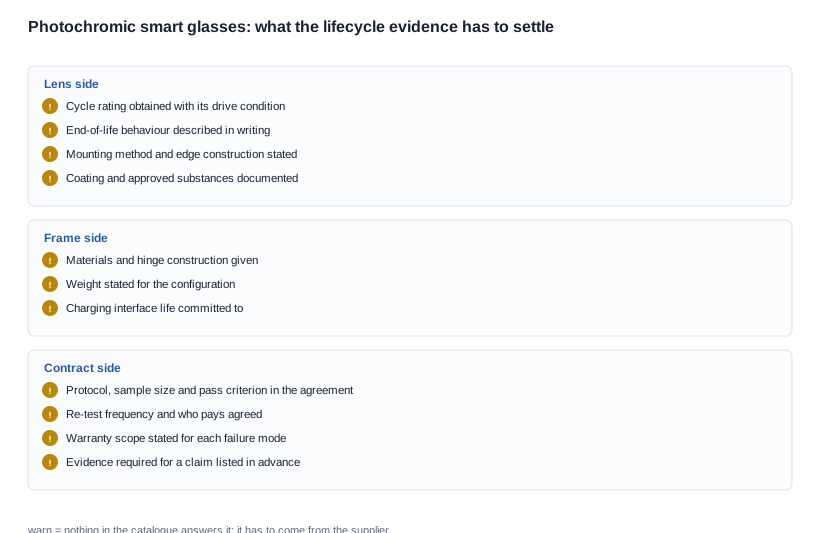
The negotiation point is straightforward. A supplier willing to commit to a protocol, a sample size and a re-test frequency has effectively priced the risk of an early field failure into the agreement, and a buyer can compare that commitment alongside price. A supplier that treats lifecycle testing as a one-off favour is signalling that the result will not be repeatable, and the price difference between the two kinds of supplier is usually far smaller than the cost of a field failure that the buyer had to absorb alone. The criteria to negotiate against are the same ones used everywhere else in this category: what is specified, what is measured, against what threshold, and who bears the result if the threshold is not met.
What a warranty conversation in this category actually turns on
Buyers tend to assume that a warranty in this category covers the interesting component, and in most consumer electronics that assumption is roughly right. Here it is likely to be wrong, and it is worth planning around the possibility.
The frame is a conventional assembly and the cell is a conventional cell; both are the sort of component a manufacturer covers routinely. The driven lens is the differentiating component, and it is the one most likely to be excluded, precisely because it is the part with a finite cycle life that nobody has published. The commercial consequence is that a buyer may end up with a warranty that responds to the failure that is cheap to fix while excluding the failure that ends the product's usefulness.
That is not an argument against buying the product. It is an argument for going into the negotiation with the two questions already separated, because the questions are what makes the answer possible. A supplier that has a cycle rating for the element and a test method can be asked to commit to it; a supplier that has neither is telling you, in advance, that the question will be answered by an exclusion clause later.
The other half of the warranty conversation is procedural and is worth settling in the agreement rather than at the first claim. What is covered, what evidence the customer has to produce, what the turnaround is, who pays the freight, and whether a replaced unit is a new unit with a fresh cycle life or a refurbished one. Those five points are ordinary, they are cheap to agree at the outset, and they are the difference between a claim that is handled and a claim that is argued.
The trade-off to watch for is a warranty that is generous on paper and narrow in practice, which is what happens when the scope is written around the component that is cheap to replace and around the failure that is easy to evidence. The written scope of a warranty does not settle the question; the evidence rules do. A clause that requires a supplier test report for a claim will quietly exclude the consumer who simply reports that the lens stopped changing, however genuine the fault. If the product is sold to end users, the evidence requirement is a design decision about the after-sales model, and it should be reviewed by whoever owns the service operation rather than by the purchasing team alone.
One further point belongs in the same conversation. The catalogue publishes a rated endurance of roughly seven hours, and a rated figure with no stated test condition is a planning number. A warranty that extends to the cell is therefore a warranty against a number the supplier has published without the conditions that produced it, and the two documents will not agree in detail. The way to handle that is not to avoid the clause but to define the test condition alongside it, so that the warranty measures the same thing the catalogue describes. Where a buyer wants a defensible service-life commitment, that definition is the only place it can start.
Our own position on the published side is the same as elsewhere in this category, and it is worth stating plainly rather than leaving to be discovered. The catalogue record for the AI electrochromic smart glasses entry contains five fields — a cell of 100 mAh charged over a magnetic contact, about seven hours of rated endurance, a charge limit of two hours, and a Bluetooth version 5.4 radio — and nothing about cycle life, materials, weight, ingress, spare parts or warranty terms. We hold no lifecycle test data for this entry and we will not present a figure from another product as if it applied here. What we can do is set out the two questions separately, show which of them the published record can help with, and say which parts of the photochromic smart glasses durability answer have to be produced by the supplier before they can be relied on in a contract.


