
A case study template for a light-responsive lens product has an unusual problem to solve, and the problem is that the category's data is thin enough that the most interesting part of any project is the evaluation rather than the product. That is unusual, and it is not a problem for the template, because it is exactly what makes the template reusable. A case study that documents a product launch teaches a reader very little. A case study that documents how a buyer established a performance baseline in a category where none was published teaches a reader how to do the same thing.
Photochromic smart glasses case study template is therefore a template for documenting an evaluation, not a launch, and the template's value is concentrated in its third section. What we publish in this range is what the template has to work from: the dedicated electrochromic entry publishes Bluetooth 5.4, a 100 mAh cell, charging in two hours or less, roughly seven hours of rated runtime, magnetic charging and electrochromic lenses, with no model designation published, and no switching time, no transmission range, no temperature behaviour, no uniformity figure, no cycle durability and no coating detail. There is no second light-responsive platform with published lens data to compare it against either, because the V03 Pro is published with a photochromic lens configuration and carries no lens figure of its own.

Photochromic: a template for evaluations, not launches
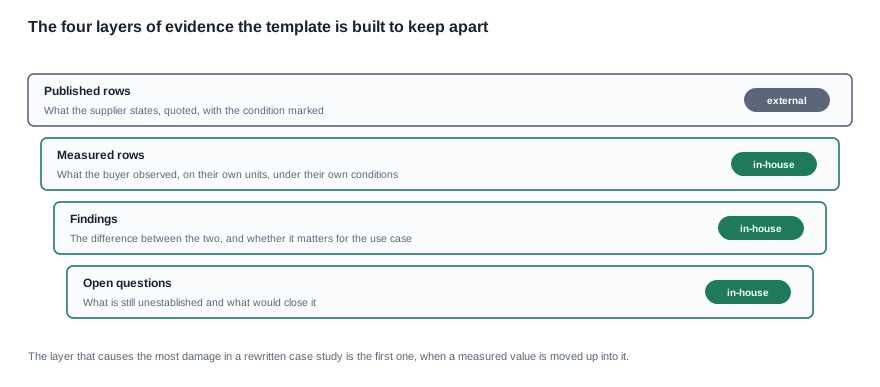
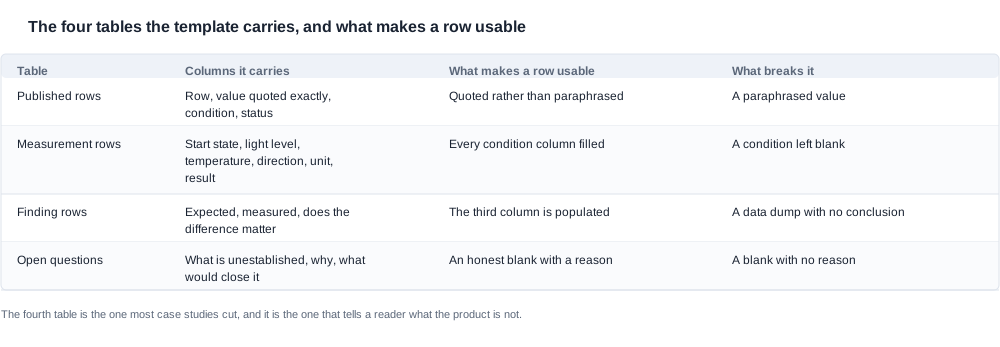
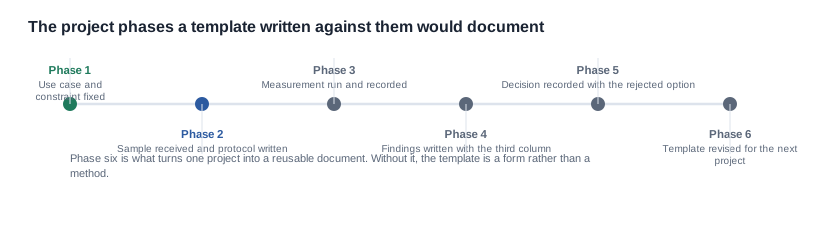
The template is a six-section document carrying four tables. Its purpose is not to be published — it is to be reused by whoever runs the next project, which is why the protocol section is written to be copied rather than read.
The six-section structure and which audience each section serves
There are two audiences and they want different things from the same project. A team running the next project wants a protocol, and the protocol is the whole of the value to them. A customer, a channel partner or a colleague outside the programme wants to know what was decided and why. Writing one document for both audiences is the most common failure, because the protocol section is exactly what makes it useful to your own team and exactly what makes it look dry to an outside reader.
The way out is to separate them structurally rather than stylistically. Section one, the situation and the constraint, and section two, the unresolved decision, are the narrative. Section three, the protocol, is the reusable artefact. Section four, the findings, section five, the decision and the rejected option, and section six, what would change next time, are the narrative again, and they are the part an outside reader will actually read.
The three questions to answer before you start writing are: is there a real project, and do we have the right to describe it? What was actually measured, and is the protocol recorded well enough to reproduce? What was the decision, and is it documented? And is there anything in the document that could not be published? The first of those four is the one that decides whether the document is a case study at all.
What the template needs from procurement and engineering before it is filled
A template filled from one side only is a marketing document, and the two sides contribute different things. Procurement contributes the commercial frame: the request for quotation as it was issued, the configuration count that was committed, the minimum order quantity and price tier that were agreed, the sample order that was placed, the delivery split against the acceptance milestone, the payment structure, the warranty period that was written and the certification position the supplier held at the time of the order. Engineering contributes the technical frame: the specification as it stood before the measurements, the protocol as written, the readings with their conditions, the instrument and the method reference, and the pass criteria.
The value of recording both is that the two are usually out of step with each other, and the gap is the finding. A programme where engineering asked for a uniformity tolerance and procurement never wrote it into the request has discovered a process failure that would otherwise be rediscovered at the first article. A programme where procurement agreed a per-configuration minimum that engineering did not know about has discovered a constraint that will shape the next design. Neither of these is visible if only one side fills the template, which is why the template assigns columns to both rather than leaving the commercial frame to a footnote.
Sections one and two: the situation and the unresolved decision
Why a document with no unresolved decision reads as marketing
Section one describes the situation and the constraint that made it hard. In this category the constraint is usually the same in a different form: the customer's use case required a lens that adapts to light, and no lens performance figure was published to select against, so the buyer had to build the baseline themselves. Stating that plainly is more credible than describing the project as a search for the best lens, because a reader who knows the category will recognise the first framing and distrust the second.
Section two is the decision that was genuinely unresolved. Whether to accept a product with no published lens data at all, and what would have to be established before proceeding. This is the section that most often gets skipped, and skipping it is what turns a case study into a product launch with extra steps. A document with no open decision in it describes a project that was never actually a decision, and a reader who can tell the difference stops trusting the rest of the document.
Two writing rules keep section two honest. The decision has to be stated as a question with more than one possible answer, not as a problem that was obviously going to be solved a particular way. And the criteria that would settle it should appear here, in narrative form, before they appear in section three as a table — so that the reader understands why the protocol is shaped the way it is.
| Section | What it carries | What makes it usable | What breaks it |
|---|---|---|---|
| One, situation and constraint | The environment, the channel, the constraint | A named constraint, not a general difficulty | A project described as a routine purchase |
| Two, the unresolved decision | The question, the options, the criteria that would settle it | More than one possible answer, with criteria stated | A decision presented as predetermined |
| Three, the protocol | What was measured, on how many units, with what method | Every column a reader can copy into their own sheet | A protocol described in prose only |
| Four, findings | Expected, measured, does the difference matter | The third column populated | A data dump with no conclusion |
| Five, decision | The choice and the rejected option, with the reason | The rejected option named specifically | A decision with no alternative visible |
| Six, what changes next time | The sequencing, the criterion set too late | Something specific and actionable | A statement that the team will communicate better |
Section three: the protocol, which is the transferable part
Section three is the substance of the template. In a category where no lens performance figure is published, the protocol is the deliverable and the product description is context. A reader who can copy the columns can repeat the work, and that is worth considerably more than a launch story.
The condition columns that make a measurement reusable
A measurement without its conditions is an anecdote, and the conditions are what make it transferable. Every measurement row in the template carries at least these columns: the starting state, the light level, the temperature, the direction of travel, the unit number, and the result. Adding the instrument or the grid reference and the measurement location makes it reproducible rather than merely repeatable.
| Column | Why the template insists on it | What a missing value means |
|---|---|---|
| Starting state | Whether the lens was in its clear or dark state before the run | The figure cannot be reproduced from it |
| Light level | Whether the run was in daylight or under an artificial source | The figure is not comparable with another supplier's |
| Temperature | Both mechanisms behave differently in heat and cold | The figure describes one climate only |
| Direction of travel | Darkening and clearing are separate behaviours | The figure covers at most one of them |
| Unit number | Whether one unit or several were measured | A single result is an observation, not a characteristic |
| Result | The measured value itself | Nothing to write down |
| Instrument or method | How the value was obtained | The value cannot be challenged or reproduced |
The method for the measurements themselves is published in how to measure photochromic smart glasses, and the template deliberately does not restate it. That is the difference between a template and a duplicate of somebody else's protocol: a template gives you the columns your project needs to record, and points at the method rather than freezing it.

Sections four to six: findings, decision and what changes next time
The findings table and its third column
The findings table has three columns and the third one is the one that changes a decision. What was expected, what was measured, and whether the difference matters for the use case. A findings table with the third column empty is a data dump, and a data dump does not help the next reader because it does not tell them what to do with the number.
The expected column matters more than it looks, because it records the prior. A team that wrote down what they expected before measuring can later show how far the expectation was off, and that is the single most useful thing a second project inherits. It also exposes the case where the expectation was simply wrong, which is the finding most worth publishing and the one most likely to be edited out.
Section five records the decision and the option that was rejected, with the reason. The rejected option has to be named specifically. "We decided not to proceed with the alternative supplier" is not a decision record; "we chose the ultraviolet-reactive route over the electrically driven one because the channel is a commuter audience and the windscreen behaviour was decisive" is. The reason transfers even when the outcome does not, because the next project will be facing the same trade-off.
Section six turns one project into a better next one. It should name the sequencing that was wrong, the criterion that should have been set earlier and the question that should have been asked at the quotation stage. Generic entries do not help; the value is in the specificity.

The hypothetical walk-through of a filled template
This is a hypothetical case rather than a client project. It is written to show the template in use and the decision sequence it captures. No customer, quantity, result or commercial arrangement described below is real, and none of the figures attributed to the buyer are measurements of any product we supply.
Assume a European outdoor brand with four colourways, an existing camera platform, three destination markets and a spring line to plan. The channel is trail runners and cyclists, the constraint is that the customer's day is mostly outdoors with two transitions a day, and the team's own listing reviewer rejected a claim in the previous cycle because the supplier's datasheet had no measurement behind it. The brand does not want to repeat that.
Section one, situation and constraint. The environment is outdoor with variable light; the channel expects a lens that darkens outdoors and returns to clear indoors without a charging routine; and no lens performance figure was available to select against, so the team decided to establish its own baseline rather than to specify against a supplier's marketing claim.
Section two, the unresolved decision. Whether to accept a product with no published lens data, and on what basis. Two options were open: proceed on a passive ultraviolet-reactive lens, whose figures are widely published in the wider eyewear market but not for this assembly, or proceed on an electrically driven lens, whose behaviour is channel-controlled but which introduces a cell, a driver, a firmware function and a flat-battery state. The criteria that would settle it were written down first: a defensible transmission range, a timing figure with conditions, a uniformity tolerance agreed before the first article, and a claim the channel could demonstrate.
Section three, the protocol. Two units of each candidate, measured on a fixed grid, with the starting state, the light level, the temperature and the direction of travel recorded for every row. Six measurements were run per unit. The instrument was the same for both candidates and the pass criterion was written before the first reading, including the zone-to-zone uniformity limit and the transmission value that would count as a failed lens.
Section four, findings. In the team's expectation, the passive route would darken adequately outdoors and clear slowly indoors. What was measured was that the passive route darkened adequately and cleared as expected in warm conditions, while the electrically driven route reached a deeper state and cleared to a lower indoor transmission. The third column reads that the difference does not matter for this use case, because the channel's customers wear the product outdoors for the majority of the day and the indoor transition is brief. The team's original expectation was wrong about which route mattered, and that wrong expectation was the most useful row in the table.
Section five, decision. The passive route was selected, and the electrically driven route was rejected on the flat-battery state and the claim scope rather than on performance. The reasoning transfers: for a channel with long outdoor exposure and short indoor transitions, a mechanism that removes the power path and the charging routine is worth more than a deeper tint.
Section six, what changes next time. The brand's finding was that it had begun the selection with a preference for a deeper tint rather than with the use case, and had written the criteria after it had formed a view. The sequencing change for the next project is to write the pass criterion before the first reading, and to start the claim discussion from the demonstration rather than from the mechanism.
What this document must never contain
Four things disqualify a case study in this category, and all four are common. A buyer-run measurement presented as a manufacturer specification — the label is lost the moment the figure is reused, so every measurement carries its label and the label repeats wherever the figure appears. A single unit's result presented as a production figure, which is the same error with a different emphasis. A claim the documentation does not support, which in a category with no published performance data means almost every performance claim. And an invented client, quantity or result, which in a category where buyers talk to each other will be found, and which converts a document into a liability.
Where our own rows sit inside a template like this
Concretely, we publish the rows we hold and mark the rest as open, and in this category the template is more useful to a buyer than a product description is. We publish no photochromic performance figure for any model in our range, which means that a buyer who documents their evaluation properly is producing something more valuable to the next buyer than we could publish ourselves.
Within the template's first table, the rows we can fill are the published rows — quoted exactly, with the conditions marked as not published where they are absent. The rows we cannot fill are the measured rows, the findings rows and the open questions rows, and those belong to the buyer's own units and the buyer's own conditions. We will fill in the first table and mark the second, the third and the fourth as open rather than estimating them.
There is a commercial dimension to the template as well, and it is the part most likely to be dropped when a project closes. The agreement with the supplier is the document that actually binds, and in this category the clauses that matter are the ones a narrative document never mentions: the model designation and its full configuration attached to the purchase order, the acceptance criteria from the protocol with the conditions and the sample size, a notice obligation for any change of lens, coating or tint range, a re-issue obligation for the documentation pack on a configuration change, and a warranty written against the agreed failure criterion rather than a cycle count. A template that records the protocol but not the clauses is a document that tells the next team what was measured and not what they are entitled to.
The negotiation position is worth recording too, because it does not survive in a procurement file. What was negotiable and what was not is a finding, and in this category the division is fairly clear. The minimum order quantity, the per-configuration minimums, the artwork round count, the market list, the delivery split against the acceptance milestone, the payment node structure and the lens specification as a document were all negotiable. Certification cost and certification time, the tooling amortisation question and the lens itself were not.
The background is under photochromic lens technology, the measurement method is in how to measure photochromic smart glasses, the boundaries are in photochromic limitations and drawbacks, the rows are in photochromic spec sheet explained, and the range is photochromic smart glasses.
Where the template comes from
Send us a project you are running and we will give you the template filled with the rows our documentation can answer.


