

Photochromic smart glasses spec sheet explained comes down to a single structural observation that most buyers arrive at only after two quotations are already on their desk: there is no industry-standard way to publish a photochromic performance figure. Every maker fills the rows in the order their own lens supplier fills them, and the row that decides your purchase may be missing from all of them. Our own catalogue is the extreme case. It publishes the electrical rows for two light-responsive products and it publishes no photochromic performance figure for any model in the range — no switching time, no transmission value, no temperature band, no cycle life, no frame weight with a lens fitted.
That absence is not a reason to avoid the category. It is a reason to stop reading spec sheets as finished documents and start reading them as questions that have been answered, partly answered, or quietly left out. A specification sheet in this category is a map of what a supplier is prepared to be held to, and the gaps are as informative as the entries.
Photochromic: what a thin spec sheet tells you
The three questions to ask when you read a photochromic spec sheet
A photochromic spec sheet is read by asking whether the lens technology is named, because if it is not, nothing else on the sheet can be interpreted. The next question is whether the performance figures arrive with their measurement conditions, because a transmission value without a method and a switching time without a light level cannot be compared with any other supplier's. The third question is whether the model designation is a stable identifier, because a sample, a certificate and a purchase order all have to align against something, and our own dedicated colour-change entry does not carry one.
If the answer to the first question is no, the sheet is not a specification sheet — it is a product page with a table on it, and you should treat everything below it as marketing until proven otherwise.
Who is holding the sheet, and what they already know
The buyer reading this kind of sheet is usually a brand-side product manager, a channel buyer, or an e-commerce selector. They are holding two or three supplier sheets, a target price band, a market list, and a deadline. What they are not holding is the conversion step: the practical routine of reducing every sheet to the same three comparable quantities — a clear-state transmission, a dark-state transmission, and a switching time with both light levels stated.
That conversion step is the whole job. A supplier who can produce those three numbers in a comparable form has done the measurement work and you can build an acceptance criterion on top of it. A supplier who cannot has a marketing sheet, and a marketing sheet is still worth reading carefully — not for the numbers, but because it tells you what the product is being sold as, and therefore what your customer will expect to receive.
The reason this matters more in this category than in most is that the buyer is usually making the decision before anyone has a sample in hand. A camera platform can be evaluated on a printed specification because the specification is mechanical. A lens cannot, because the four rows that define it are the four rows the industry has never agreed how to publish.
Three things that break a comparison before a single number is compared
The two technologies are sold under one word. An ultraviolet-driven lens reacts to the light arriving at the lens and needs no power. An electrochromic lens reacts to an applied voltage, needs a cell, a driver circuit and a control path, and can hold a state. They behave differently behind a car windscreen, they cost differently to engineer, and they fail in different ways. Until the mechanism is named, every other row is ambiguous.
The clear-state figure is the row most often omitted, because a seller quoting only the darkened figure has quoted the part that photographs well. The indoor experience — the part a customer notices for the first four hours of every working day — is usually the part that is missing.
A switching time quoted without the light levels is a number about a laboratory, not about your channel. A lens that reaches a moderate darkness in under a minute in strong sun may take several minutes to reach a deeper darkness in weak winter light, and the winter case is the one your customer stands in when they complain.

The ten rows to request, in the order that makes them readable
The request, and what each row has to settle
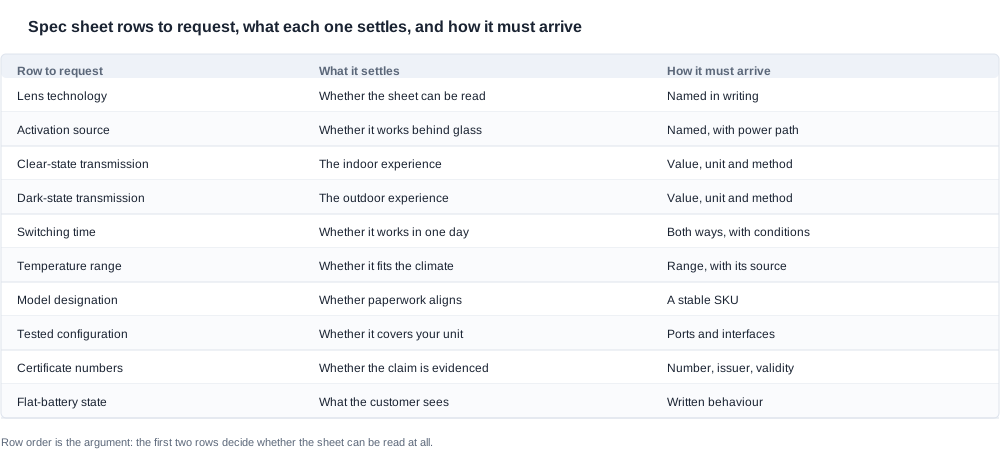
Ask for these ten rows in writing, in this order, from every supplier on the shortlist, using the same wording for each. The order is the argument: the first two rows decide whether the sheet can be read at all, the middle rows decide the product, and the last three decide whether you can ship it.
- Lens technology — ultraviolet-driven or voltage-driven, named, with the power path described if it is powered.
- Activation source — what actually initiates the change, and whether that source is present behind glass.
- Clear-state transmission — a percentage, with a reference and a method.
- Dark-state transmission — a percentage, with the same reference and method.
- Switching time — both directions, each with the light level it was measured from, the level it was measured to, and whether the target was full darkness or a stated percentage.
- Temperature range — the band over which the reaction still functions, and the source of the figure.
- Model designation — a stable identifier, not a family name.
- Tested configuration — which ports, contacts and interfaces were fitted when the figures were taken.
- Certificate numbers — numbers naming the exact model, with the issuing body and the validity dates.
- Flat-battery state — a written statement of what the lens does when the cell is empty.
Treat an omission as a finding rather than an oversight. The supplier who leaves out row 6 has told you something about the range they intend to sell into, and that is more useful than a guess would have been.
The five rows that carry the comparison
Of those ten, five do the real work.
The mechanism and the activation source together decide the in-car case, which is the single most common customer disappointment in the whole light-responsive category. An ultraviolet-driven lens does nothing meaningful behind a windscreen, because the glass has already filtered out most of the ultraviolet that drives the reaction. If your channel includes driving, this is not a specification detail — it is a product decision.
The two transmission figures, taken together, decide whether a sunglasses positioning was ever available. A lens moving from ninety per cent transmission to twenty per cent, and one moving from ninety per cent to forty-five per cent, are different products sold with the same story. Quoting only one of the pair is worse than quoting neither, because it implies a range you cannot describe.
The switching time with its conditions decides whether the product works in a normal day. The threshold to hold is two figures, one per direction, each with a light level and a temperature, and a written statement of whether the figure is typical or a best case.
The model designation decides whether the paperwork can name the product at all. A product without a formal identifier cannot be correctly listed on a certificate, correctly packaged, correctly described at customs, or correctly aligned against the units in your warehouse.
The certificate numbers decide whether anything you publish is evidenced. A number is the only part of a compliance document that a broker, a marketplace reviewer or your own compliance team can check independently, months later. An attached PDF is a claim; a reference number is a record.
Reading what arrives: three sheets of different quality
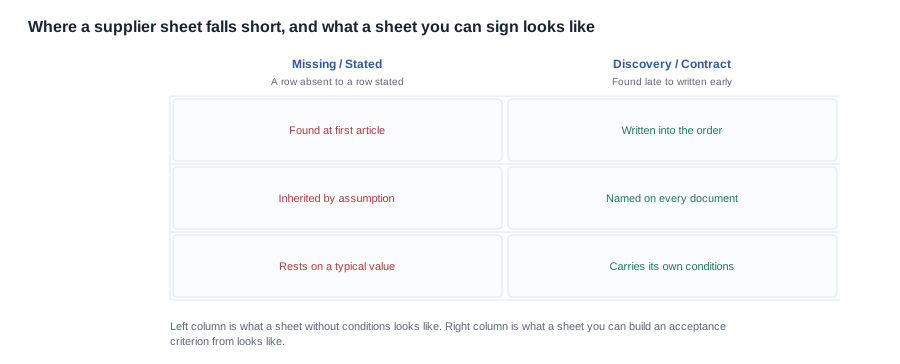
Sheet one: the mechanism is named and nothing else is
This is the most common sheet. It names the technology, it lists the electrical rows for the platform, it may include a nominal transmission range, and it stops there. It is not necessarily dishonest — many suppliers have exactly this information and no more.
The practical problem is that a sheet like this cannot be compared against another sheet like this. You can compare the two products on the platform rows, and you have no basis at all for comparing the lens. If two suppliers are quoting at very different prices, this sheet is the reason: one of them has done measurement work and one has not, and the price difference reflects that rather than any difference in the lens.
The right response is not to reject the sheet. It is to send the ten-row request back with the four performance rows marked as the ones you need, and to set a date by which you need them.
Sheet two: the method is present and the conditions are absent
This sheet is a step better and it is more dangerous, because it looks complete. It has transmission figures with a method and a switching time with an instrument. But the light level is not stated, the temperature is not stated, and the direction of travel is not stated.
A switching time is a function of at least three variables: how hard the light is driving the lens, how warm the lens is, and which way the change is going. Strip those three out and the number becomes a property of a laboratory setup rather than of the product. Two suppliers can both be entirely honest and still be 40 per cent apart, because one measured into the sun and one measured out of it.
This is the sheet that produces a first-article dispute. The supplier did nothing wrong, the sample did nothing wrong, and the figure in the purchase order describes a condition that did not exist on the day.
Sheet three: the conditions are present and attached
This is what a comparable sheet looks like, and it is rarer than the category suggests. It states the direction of travel, the light level at each end, the temperature, the method, the configuration under test, and the tolerance or the spread across samples rather than a single number. It often also names the lens maker.
When a supplier sends this, the conversation moves forward immediately: the remaining work is commercial rather than technical. The comparison is already made for you, and the pricing conversation becomes about volume, configurations and documentation rather than about which number to believe.

Turning the rows into acceptance criteria you can enforce
The sample protocol
A specification only becomes usable when it is attached to something you can check. The protocol that converts the ten rows into acceptance criteria is short and can be written in an afternoon:
- Write the criteria before the sample ships, in the same terms the supplier used. A criterion written after the reading is a description of what you saw.
- Run a timed transition in both directions, from a stated starting light level to a stated ending light level, and record the stopwatch reading and the ambient conditions on the same page.
- Run the same transition behind a windscreen or a window, and record what the lens did. This is the observation that identifies the mechanism, and it costs nothing.
- Run a comparison photograph against a printed reference, in the same light, at the same moment, and keep the reference card. A photograph is the only method a channel team can repeat when a customer disputes the effect.
- Run a cold and a hot exposure, and record how long the lens takes to respond at each end of the range.
- Compare a second unit from a later production date against the first. This is the observation that tells you whether you are buying a lens or a batch.
Each of those six steps closes a specific row, and the record of each one becomes a page in the file that travels with the purchase order.

The failures a thin sheet produces
A quotation is compared line by line and the ranking is wrong. The root cause is that one sheet carried a clear-state figure and the other did not, so the comparison is between a measured product and an assumed one. The prevention is the three-number request, sent identically to every supplier.
A customer in December says the lens is too slow. The root cause is a switching time quoted for strong sun, with no winter condition attached. The prevention is both light levels stated, and a cold run on the sample before the order.
A customer in a car says the lens never changes. The root cause is that the activation source was never established, or the product measures cabin light rather than the light that drives the lens. The prevention is the activation-source row, and the in-car observation.
The sample, the certificate and the purchase order cannot be aligned. The root cause is the absence of a stable identifier, or a family-level document being treated as coverage for a branded configuration. The prevention is the model designation as a condition of the order, and a character-by-character comparison against the units on receipt.
A quoted transmission turns out to be a component figure. The root cause is a lens maker's vocabulary used without stating the measurement geometry, so the figure describes a loose lens rather than the product. The prevention is to ask for the product-level figure with the method, and to run the comparison against a printed reference.
A published figure cannot be substantiated later. The root cause is that the figure travelled without its condition. The prevention is simple and absolute: the condition travels with the figure, or the figure does not travel.
The commercial terms this sheet governs
The specification is not only a technical document. It decides which lines in the quotation are negotiable and which are structural.
The request itself is the first negotiation, because a supplier who answers the ten rows in the terms you set has done the measurement work that would otherwise fall on your own sample programme. Where that work has not been done, the cost of closing the rows is yours, and it is worth naming it in the quotation discussion rather than discovering it later.
The number of configurations is the line worth pushing on. A lens option applied across a four-colour range creates four new combinations, each with its own minimum, its own artwork, and its own documentation question. A supplier who prices the combination rather than the lens is worth negotiating with; a supplier who prices the lens and leaves the combination count implicit is not.
Minimum order quantity, per-configuration minimums, the artwork round count, the market list and the packaging and insert design are all negotiable, and they are all larger numbers than the unit price. Delivery splitting against the sample-approval milestone is often granted more readily than a price concession, and the milestone that matters is the protocol above.
What is not a commercial lever is the certification cost and the certification elapsed time. The fee is per product family and the queue belongs to the test laboratory; pressing on either produces a longer schedule rather than a shorter one. Tooling is a one-off cost normally amortised across the first order, and the useful questions are over what volume it is amortised and what happens to it if the programme is discontinued. And the mechanism is not a variable at all: if the requirement needs a wearer-controlled tint, no negotiation turns a passive lens into a controllable one.
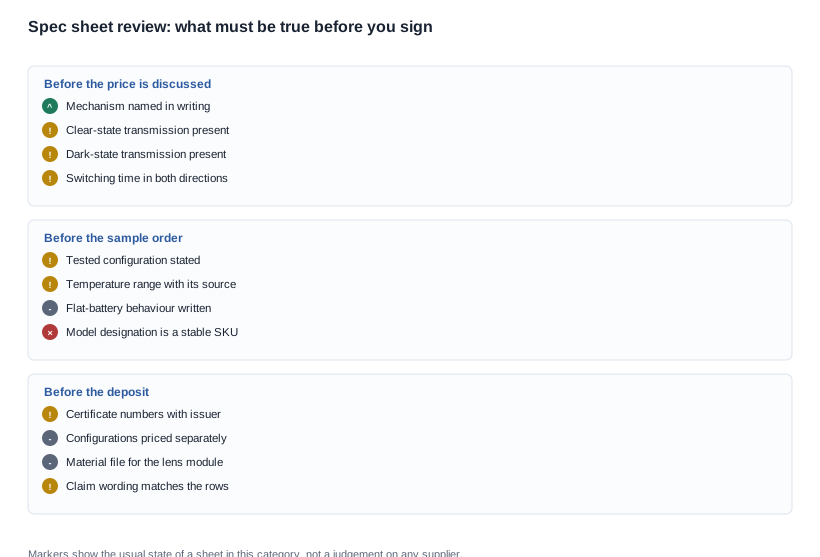
Before the deposit, the documents to request are the lens technology and the power path, the four performance rows with their conditions, the model designation, the certificate numbers with the issuing body and the validity dates, the flat-battery behaviour, the material documentation for the lens module, and the configuration list with the minimums.
In the purchase order, the clauses that matter are the lens specification and the model designation attached to the order; the acceptance criteria from the protocol, with the conditions and the sample size; a notice obligation before any change of lens, coating, tint range or frame material, because each of those invalidates the configuration; a re-issue obligation for the documentation pack after a configuration change; and a statement of who bears the cost when a sample fails the criteria.
What our catalogue publishes for a light-responsive lens
Our position
The boundary we hold: we publish the rows we hold and mark the rest as open, and we would rather show you empty fields than plausible values. We do not publish a switching time, a transmission value, a tint depth, a uniformity tolerance, a temperature range or a cycle life for any model in our range, and we will not quote them from the general behaviour of photochromic or electrochromic lenses. A typical value quoted as if it were ours is a number nobody can verify and everybody will quote back at us.
The V03 Pro lists a photochromic lens configuration on an existing 8 MP camera platform, with a 220 mAh cell, charging in two hours or less, a rated runtime of five to eight hours, Type-C charging, flexible temples and three published colour options. That is the cheapest route into the feature, because the platform exists and the lens is a variant. It is also a change to the optical description of the product, which has consequences for the technical file.
The dedicated colour-change entry publishes Bluetooth V5.4, a 100 mAh cell, a charge time of two hours or less, roughly seven hours of rated runtime, magnetic charging, and an electrochromic lens listed as its key technology. It carries no model designation, and it carries none of the performance rows above. We treat the missing designation as a real operational limitation for a private-label programme rather than as a documentation quibble, and it is better established at the start of a project than discovered at the artwork stage.
Across the whole range, one unit weight is published — 158 g for the MT6 camera platform, excluding its foldable charging case — and no model publishes a weight with a light-responsive lens fitted. For a product whose listing leads on comfort and on all-day wear, that is a gap we would rather name than fill.
We make no efficacy claim about vision, health or eye protection for anything we quote. A device that detects a position or a distance and reminds is not a clinical intervention, and a listing implying otherwise is a regulatory exposure rather than a marketing decision. If your channel is built on an eyesight concern, this is the wrong category, and we would rather say so before the sample order than after the copy is written.
Two supplier sheets, and what they let us compare
Send us two supplier sheets and we will tell you which rows are comparable and which are not — which is usually a question about conditions rather than about the lenses.
Where we can do something genuinely useful is arrange the sample observations that close the rows neither of us currently holds: the window run, the cold run, the comparison photograph and the second-date unit. The technology background is under photochromic lens technology, the selection question is in how to choose photochromic smart glasses, the commercial consequences of adding the feature are in photochromic smart glasses upgrade considerations, the failures to avoid are in the photochromic buying mistakes to avoid, and the rows a sheet cannot carry are in what the spec sheet does not tell you.
Where the reading method comes from
Send us two supplier sheets and we will tell you which rows are comparable and which are not.


