

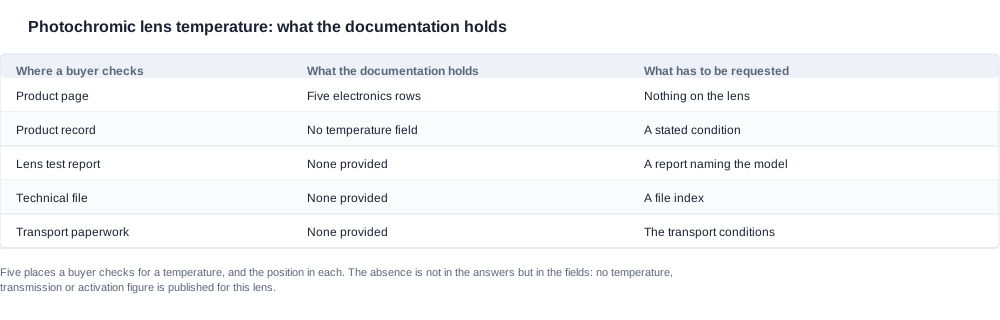
Temperature is the one variable in this category that appears nowhere in the documentation. That is a precise statement rather than a rhetorical one: across the thirty-three pages of the product catalogue the word for temperature does not appear, the degree symbol does not appear, and none of the nineteen fields in our product record carries a temperature either. There is no figure to ask for, no band to quote and no test report to request, because there is no line for any of it to sit on.
That makes this a different kind of gap from the one every other missing specification creates, and the difference decides what a buyer has to do. A missing value is a document request: the supplier holds the number, and the buyer asks for it. A missing field is a specification decision: nobody has written the number down anywhere, so the buyer has to introduce it, define what it should mean, and then ask for it in that shape. Temperature in this category is the second kind, which is why the useful output of this article is not a number and not a comparison against other lens technologies, but a set of conditions that have to be written into a request before a sample is ordered.
There is a fourth question hiding inside the published rows, and it is the one most likely to be overlooked: the endurance figure was measured under some state of the lens, and nobody has published which state.
The variable that appears nowhere in the documentation
The catalogue page for the photochromic entry is short. What the page publishes is a power budget — a cell of one hundred milliamp hours, a charge limit of two hours or less and an endurance figure of about seven hours — plus a magnetic charge mode and a radio line reading V5.4. Five rows, all of them about the electronics and the power budget, and not one of them about the lens, which is the subject of the category.
Searching the catalogue for temperature-related content returns nothing at all. The words for temperature and the degree symbol are absent from every page, which means the question a buyer would ask first — between which temperatures does this lens behave as described — has no counterpart in the catalogue at all. The same is true of the product record. Its nineteen columns cover specifications, the evidence grade behind them, key technologies, configuration fields, certification positions, differentiation notes, the marketing files, the product page reference and the outstanding questions, and temperature appears in none of them. The closest the record comes is a cell of naming three indicators that would decide a lens of this type — the speed of the colour change, the uniformity of that change and the transmission of the lens — while stating in the same cell that the catalogue publishes no performance parameter for this category at all, and that no differentiation claim can be made from the page.
That distinction between a missing value and a missing field is worth holding on to, because it changes who does the work. Where a value exists and is withheld, the buyer's task is a request and a deadline. Where the field does not exist, the buyer's task is a decision: what would this number have to mean, under what conditions, measured on what unit, so that when it arrives it can be used. A temperature band with no definition is worse than no band at all, because it will be copied into a listing by somebody who has not decided what it means, and it will be read by somebody who will assume it means a tested range.
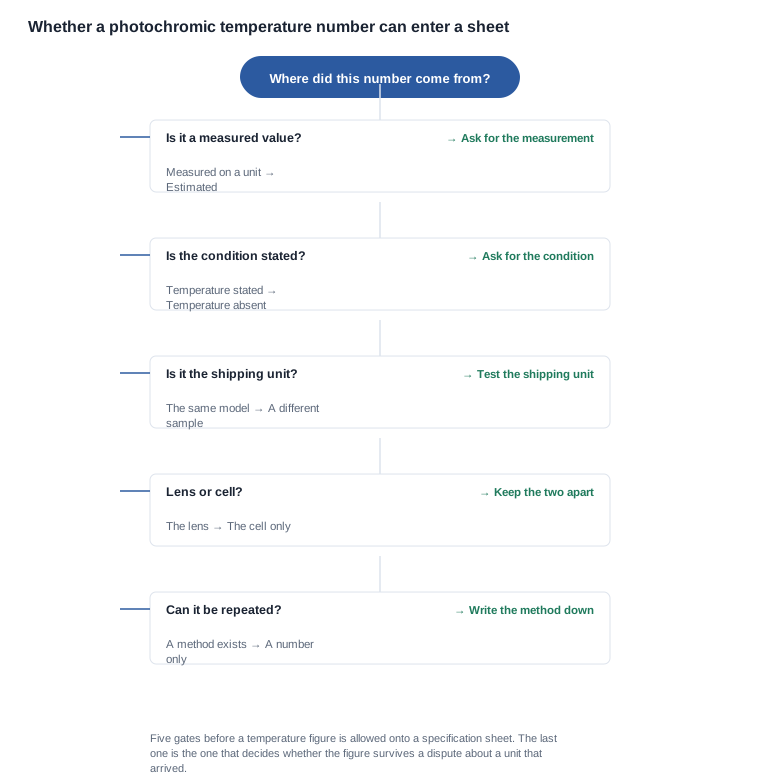
Deciding what a missing field ought to have meant is a specification decision, and it is worth making in a particular order. Start with the use, because the use decides how to choose the shape of the number: a value that has to appear on a listing needs a unit a customer can relate to, while a value that has to appear on an approval sheet needs a unit an engineer can test. Then check it against four criteria. Can somebody outside the supplier measure it with equipment they already have? Is it stable enough to be written onto a sheet and read again when goods arrive? Does it change a decision somebody has to make, rather than merely describing the product? And can it survive being quoted by a channel partner who has never seen the test? A value that fails any one of those four will not survive an approval meeting, however confident it sounds in a supplier's reply, and the cost of asking for it in the wrong shape is a second round of questions.
Two more structural details point the same way. The record's optional-configuration column for this entry is explicitly empty, while the customisation column in the same row names three configuration axes for the category as a whole, which is the same shape as the temperature gap: one column full of names, another with nothing in it. And the entry carries no model code at all, with a formal code marked as outstanding, which is the precondition for every other question in this article. The photochromic smart glasses response time piece sets out why identity comes first, while the photochromic smart glasses tint depth piece takes the transmission indicator in detail.
What buyers carry over, and where the expectation breaks
The gap in this category is not only in the documentation. It is also in what a buyer arrives with. Buyers in this product category carry a working model from ordinary photochromic lenses, and that model is built on the assumption that the lens responds to ambient light on its own, with no power of its own, and that its behaviour therefore follows the ambient conditions: cold and bright versus warm and bright, inside a vehicle, behind glass that filters some of the light, at altitude, under indoor lighting. None of that is published for this product, and none of it should be written down as though it were.
There is a second description in play, and it comes from our own record rather than from the buyer's expectation. The catalogue's category name uses the term for a lens whose colour change is driven rather than triggered by light alone, while the use-case column in the record describes the category in terms of adapting between indoor and outdoor light. Two descriptions of the same behaviour, sitting in two documents, with no performance figure published that would let anyone check which one a unit actually does. That is not an argument that either description is wrong. It is an argument that the description is not yet evidence, and that the mechanism has to be confirmed in writing before a lens statement appears anywhere a customer can read it.
The commercial risk follows directly from that. A listing that says the lens adapts to changing light, sold into a market where the customer tests the behaviour on a warm afternoon or behind a windscreen, produces a dispute that the seller has to settle with the product in one hand and a specification in the other. The seller will lose that argument by default, because the specification contains nothing. The cheap alternative is to make the mechanism and its conditions part of the sample request, so the answer arrives with the unit rather than after the first complaint. The photochromic lens technology notes set out the mechanism differences that a buyer should have confirmed rather than assumed.
That changes the sample request as much as it changes the listing, because what to ask for determines what comes back. A request that asks for a lens sample and nothing else will come back with a unit, and the unit will answer nothing, because the behaviour a customer will question is not visible from the outside in the time it takes to open a box. A request that asks for the mechanism in writing, for the conditions under which any published figure was taken, and for the state of the lens during the endurance measurement will come back with something a buyer can check. The red flags in this exchange are recognisable: a supplier who describes how the lens behaves without being asked which mechanism drives it has answered the easy half of the question; a supplier who quotes a temperature without naming the light level or the condition has offered a number rather than an answer; and a supplier who replies to a mechanism question with the same sentence that appeared in the catalogue has offered the catalogue back instead of a confirmation.
There is a third place the expectation lands, and it is the one a buyer controls most easily. A carton carries claims, and every claim on it needs a line of evidence behind it before it goes to print. The lens claim on this category needs three lines — the conditions, the range and the mechanism — and the catalogue currently supplies none of them, which means a claim written today would be written from a category name rather than from a specification. That is not a reason to leave the carton blank. It is a reason to decide, before artwork is commissioned, which of the three lines will be in the supplier's file by the date the print run starts, and to treat the ones that will not be available as claims that do not get made.
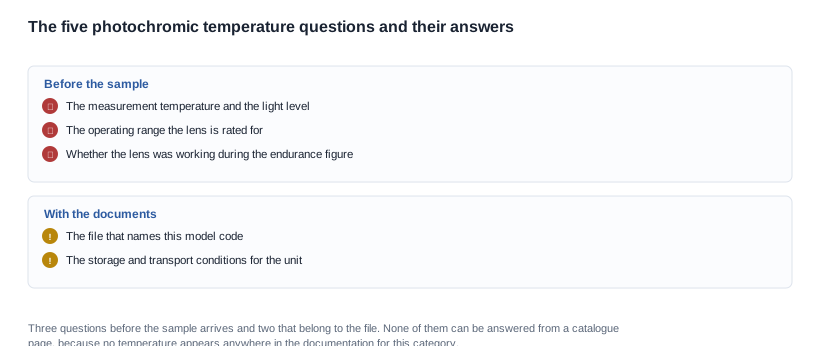
The five temperature questions and where their answers belong
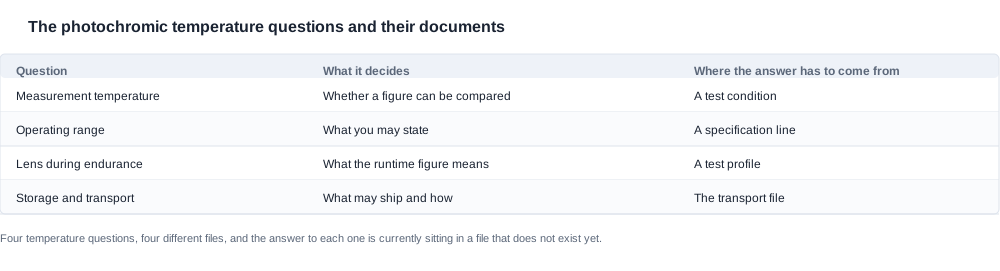
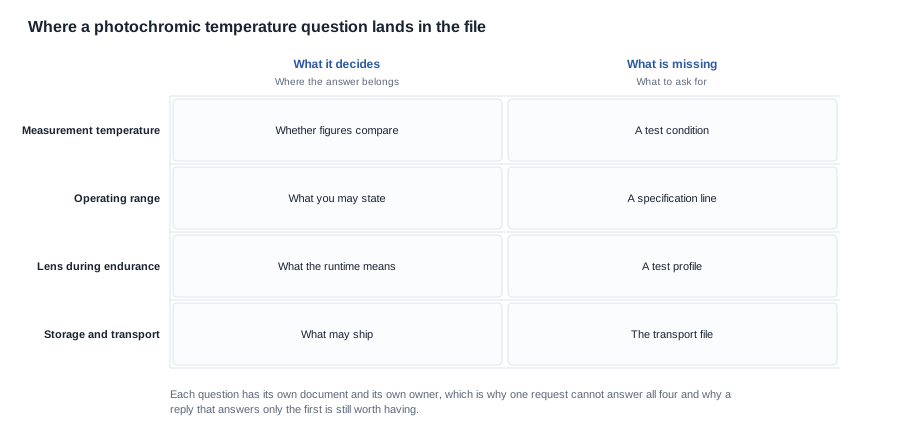
Five questions, and the reason to write them separately rather than as one request is that each one belongs to a different document with a different owner. A single reply that answers the first of them and is silent on the other four has still told you something useful, but only if you asked in a way that makes the other four visible.
- At what temperature, and at what light level, was the measurement taken? This is a condition, not a value, and it has to arrive attached to whatever number it describes. A figure with no condition is not comparable with another figure, so it cannot be used in a comparison, a claim or an approval.
- What operating range is the lens rated for? This is a specification line rather than a measurement, and it is the one that has to appear on the sheet your own operation works to, because it is the number that decides whether a unit can be sold into a market with a seasonal range.
- Was the lens working during the endurance figure? This one is treated separately below, because it sits inside a published row rather than in a missing one.
- What storage and transport conditions apply to the unit? This belongs in the transport file that travels with the product, alongside the paperwork for the cell. A unit that is fine on a shelf in a temperate warehouse and a unit that has spent a week in a container are different commercial objects, and the conditions belong to the file rather than to the listing.
- Which document names this model code rather than the family? Every answer above is attached to a model. A figure that names a family cannot be inherited by a unit, and the category currently has no code of its own, so this question is not a formality — it is the question that decides whether the other four answers can be used.
There is a trade-off worth naming, because a conditions-first request does slow a programme down. A buyer who insists on all five answers before ordering a sample waits longer for a first shipment and carries more open questions into the selling season. A buyer who skips them ships sooner and settles the same questions by argument later, in a returns conversation and in a channel review. For a category where the lens is the proposition rather than an accessory, the trade is usually worth taking once and at the beginning, because the answers do not go stale while the request sits unanswered.
None of this requires a supplier to have measured anything before the buyer can start. The identity question can be sent on its own this week, the five conditions can be written into the request file as placeholders with named owners, and the acceptance sheet can be created with the profile columns empty and the pass criteria marked as pending. A buyer who does that has converted a category with no temperature data into a programme with three named questions, one named file per question, and a sample that arrives with the answers attached rather than without them. The gap in this category is not unusual and it is not fatal. It is a field that nobody has filled in yet, and the cost of filling it is a week of correspondence rather than a season of argument. Which of the questions to ask and the order to ask them in follows a simple rule: a question that a claim on the listing depends on is a first question, a question that only affects a specification sheet can wait for the sample, and a question that decides whether a unit can be shipped at all belongs in the transport conversation immediately.
There are four answers to refuse, and they are worth naming because each of them sounds like an answer in a supplier's email. A temperature band with no test condition attached. A temperature quoted for a neighbouring model. A typical value from elsewhere in the industry, which describes nobody's product. And a temperature quoted for the cell and applied to the lens, which is the most likely of the four because the cell is the component with a documented operating range and the lens is the one without. Keeping the two apart is the single cheapest discipline in this exchange, and it costs one sentence in the request.

The endurance figure and the fourth question
The published endurance for this entry is about seven hours from a one hundred milliamp hour cell; the charge limit is two hours or less and the charge mode is magnetic. No test condition accompanies it, which is true of every endurance figure in this catalogue — there is no laboratory, no load, no ambient description and no method anywhere in the range. In most models that gap is annoying. In this one it has a specific and answerable form.
If the colour change in this category is driven, as the category name indicates, then the lens draws power while it works. A runtime figure measured with the lens idle is a different product from a runtime figure measured with the lens active, and a buyer who receives the first and sells the second has a problem that no amount of documentation afterwards will repair. Nobody has published which state applies here, and that silence is the single most consequential missing condition in this category's specification.
The action is small and it belongs in the same request as the temperature questions: state the profile. Lens on or off, camera on or off, radio connected or not, and the ambient temperature during the run. Then measure it on your own unit, because a profile you wrote down can be repeated on incoming goods and a figure you inherited cannot. The same profile written next to the charge cycle, which you can time yourself on a sample, gives you a charge-and-run procedure that belongs to your operation rather than to the supplier's literature.
The profile is only half of it, and the other half is the recording. A reading that is not written down is a reading that will be argued about, so the table has to exist before the first unit arrives: one row per unit, one column for the lens state, one for the camera state, one for the radio state, one for the ambient temperature and one for the elapsed time. That table is the checklist that turns a runtime claim into an incoming goods check, and it is the same artefact that lets a second unit be compared with the first. It is worth asking the supplier whether they hold a profile of their own for the published endurance figure, because the answer tells you something useful either way: if they do, adopting it makes your readings comparable with the published number, and if they do not, the number on the page has no method behind it and yours will be the first.
There is one more thing to carry into that request. The endurance figure is the only endurance figure published for this category, and it is the number a channel partner will quote back at you. Whatever profile you agree, write the profile next to the figure rather than beside the marketing copy, so that the number and its condition travel together. The smart glasses battery life notes cover how runtime figures should be written and read, and the neighbouring question of what a change between two states should be called in a listing is covered in the transitions comparison for this category piece.
What the photochromic record supports on temperature
We will not state a temperature band, a transmission figure, an activation time or an operating range for a lens we hold no data for, and we will not borrow a typical figure from the wider industry to cover a gap the record itself has flagged. We will not choose between the two descriptions of how this category behaves — the one in the catalogue's category name and the one in our record's use-case column — on the buyer's behalf, and we will not describe a lens mechanism in the terms a buyer expects rather than the terms the document uses. We will not let a temperature quoted for the cell stand in for one quoted for the lens. And where a category has no model code, we will say so, because a condition attached to no unit cannot be inherited by one.
What the record does support is a request that can be sent this week and a method that can be written down before the sample arrives. The entry publishes five rows, all of them electronic, and the category publishes no lens parameter of any kind. It names three indicators that would decide a lens of this type and states that no values exist for them and that the category therefore has no room for a differentiation claim. It carries a file position of one catalogue image and no detection report, and it carries an outstanding question about the model code that has to be closed before any of this can be certified, warranted or ordered. Those four facts are enough to write a precise request, and a precise request is the only thing that turns a missing field into a number you can use.
The practical sequence is short. Close the identity question, because everything else hangs off it. Send the five questions with the documents named against each one. Agree the profile for the endurance reading before the sample is measured. Then write the conditions into your own sheet next to the figures, so that the next unit can be checked against them. The photochromic smart glasses range is where this entry sits in the catalogue, and the photochromic certification notes apply the same claim-by-claim reading to the certification position of this category, standing as the closest precedent for the lens.
Send us the markets you are shipping into, whether the lens proposition is central or supporting in your range, and the five questions you plan to ask, and we will tell you which one has to be closed before the listing goes live and which can wait for the sample.


