

Photochromic smart glasses export considerations are usually reduced to two things: a certificate and a certificate of origin. For this category that reduction is wrong, and it is wrong in a way that is expensive to discover late, because the thing most likely to stop a shipment is not the absence of a document but the presence of an unnamed product.
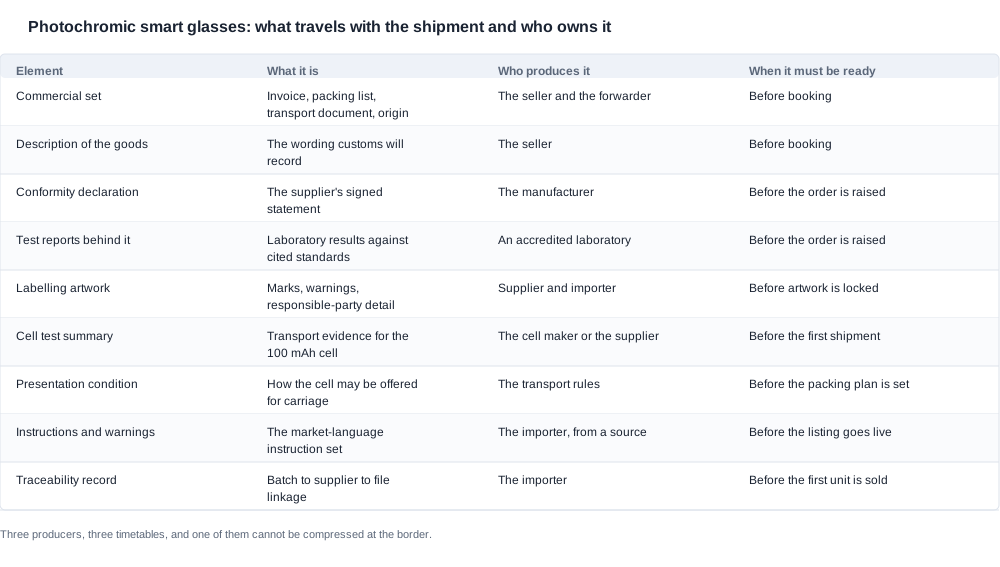
Three separate things travel when a product like this crosses a border, and they are governed by different people. The goods travel under transport rules, and they include a 100 mAh lithium cell, which means the battery question follows the product into every mode and every route. The paperwork travels, and for this category most of it has to be obtained from the supplier before an order is raised, because no per-model conformity row exists in our catalogue and the product has no model designation to be named on. And the responsibility travels too, in the sense that it stays behind: in most destination markets the party that places the product on the market becomes the party responsible for it, and that party is whoever imports it.
That third element is the one buyers budget least often and pay for most often. The published record for the entry in question is a 100 mAh cell charged over a magnetic contact, roughly seven hours of rated endurance, a ceiling of two hours on one charge, and a Bluetooth version 5.4 radio, and every one of those five fields describes the device rather than the transaction. Nothing published describes who signs, who stores, who answers a regulator or who pays for a recall.
What follows separates the three, sets out what actually varies between markets, deals with the cell specifically, and gives a sequence that catches the mismatch before a container is booked. The compliance file note covers how the conformity file itself is assembled, and the price comparison covers how the responsibility question changes the landed cost.
Photochromic smart glasses: who is actually responsible for the product in each market
The first thing to establish is that responsibility for a product does not stay with the factory once the goods are sold. It moves, and in most markets it lands on the importer, and that is a change of legal character rather than a change of address.
The mechanism is worth understanding because it determines almost every other decision. A manufacturer who places a product on a market has obligations to that market's authorities and to consumers in it. A business that imports a finished product for sale, under its own name or its own label, is treated in most regimes as the party that has placed that product on the market, whether or not the manufacturer was. Once the importer is the responsible party, the obligations attach to the importer's name, and they include the traceability of the product, the information supplied to the consumer, the handling of a safety incident, and the withdrawal of the product if it turns out to be unsafe.
Three practical consequences follow, and a buyer who has not thought about them usually discovers them at the worst possible moment.
The first is naming. The importer is the party named on the paperwork, which means the importer's legal entity, address and contact have to appear on documents, on packaging, on the product itself or in its labelling, and on the online listing. A company that imports through a distributor, or sells through a marketplace, frequently discovers that the party whose name is on the listing is not the party whose name is on the documentation, and that mismatch has to be closed before the listing goes live rather than after a complaint arrives.
The second is record retention. Traceability obligations mean the importer has to be able to connect a unit in the market back to its batch, its supplier and its conformity file. That is a record-keeping obligation with a real cost in a small team, and it is a cost that a supplier's file does not discharge on the importer's behalf.
The third is the recall question. If the product has to be withdrawn from a market, the party that has to do it is the one the market regards as responsible, and the cost of that operation — the reverse logistics, the customer communication, the write-off — is the importer's. Which is why a buyer who is importing under an arrangement that leaves the importer unable to identify the batch, or unable to reach the supplier, is carrying a risk it has not priced.
This is also where the absence of a model designation becomes a cross-border problem rather than a paperwork one. A traceability system keyed to a model designation cannot be built for a product that has none, so either the importer creates a designation of its own and accepts that it is not the manufacturer's, or it introduces an internal batch code, or it does nothing and accepts that its records describe a category rather than a product. All three are workable; only one of them is defensible when a market authority asks which units came from which file.

The importer's role and the documents that travel with the shipment
The documents for a shipment of this product fall into three groups, and it is worth keeping them separate because they come from three different places and are assembled at three different times.
The first group is the commercial set: the commercial invoice, the packing list, the transport document and the certificate of origin. These are produced by the seller and the forwarder, and they are routine. The one point of care is that the description of the goods on the commercial invoice has to match what the documents elsewhere say the product is, and a description written from a catalogue line that carries no model designation gives the customs authority nothing to record. The criteria to apply are simple: the invoice, the packing list, the declaration and the artwork should all name the same object, and the check takes minutes if it is done before the shipment rather than hours if it is done after a hold.
The second group is the conformity set, and it has to come from the supplier: the written declaration of conformity, the test reports behind it, the labelling artwork, and the material declarations the supplier is able to issue. Every one of them has to be issued against a model designation, and every one of them has to name the party responsible for the product in the destination market. The order in which to request this set, and what each document has to contain to be worth filing, is set out in the certification piece for this category.
The third group is the transport set, which is specific to the cell. A lithium cell of 100 mAh travelling inside a device brings the battery rules into the shipment, and they bring two things: a test summary for the cell, and a condition on how the battery may be presented for carriage. The test summary comes from the cell maker or the supplier, and it has to exist before the first shipment rather than being requested in transit. The condition on presentation depends on the mode and the route, and it is set by the transport rules rather than by the product, so the question to put to the forwarder is specific: what does this route permit for a cell shipped in equipment, and at what state of charge. The answer changes the packing plan, and packing plans are much cheaper to change before a production run than after.
The instruction and warning set belongs with the conformity set rather than with the commercial one, and this is where the market-by-market variation actually bites. A product sold to end users has to reach those users with instructions and warnings in a language they read, and the importer is normally the party that arranges that translation, because the manufacturer will not do it for each market. A translation is not a typesetting job. It is a legal document that has to say the same thing as the source, which means the source has to exist first, which means the supplier's instruction set is a precondition for the market rather than a finishing touch. The handling regime for this category sets out what a source instruction set for this product has to contain, and for this entry the source cannot be finished from the catalogue alone, because the material statement it depends on has not been published.

Market-by-market variation, and what actually changes
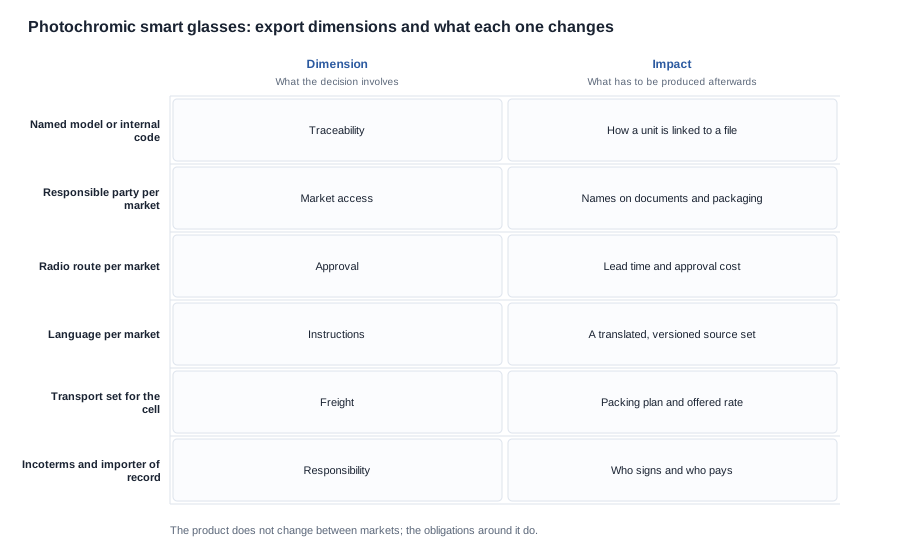
Buyers often assume that a second market is a copy of the first with a different address on the paperwork. For a product with a driven lens, that assumption is wrong in three specific ways, and it is worth knowing which three before planning a multi-market launch.
The responsible party is the first variation. Each destination market has its own rules about who has to be identifiable there, and the answer is not always the same entity. In some markets it is the importer; in others it is a representative appointed for that market. The practical consequence is that a launch plan with four markets is a plan with four naming decisions, and each one has to be made before the documentation is produced, not after.
The radio route is the second variation. Some markets operate a type-approval route administered by a national authority before the product may be sold; others accept the manufacturer's own declaration. The two routes have different lead times, different costs and different consequences for a launch schedule, and the correct one has to be established per market. It is a question for the supplier's file and for local counsel, and it is one of the few places where the catalogue's silence is not the constraint — the constraint is simply that nobody has asked yet.
The instruction language is the third variation, and it is the one that quietly multiplies. Every market that needs its own language needs its own translated instruction set, and every translated set needs to be checked back against the source for accuracy. The cost is per market, and it is a cost that a supplier is generally unwilling to carry, because the supplier does not know which markets a given order is for.
What does not vary, and this is worth stating, is the product itself. The catalogue record for this entry describes one configuration, and the same five fields apply in every market, and it is the same configuration in every market. The things that multiply are the obligations around it, not the product. Buyers who plan a launch as one product plus several markets have the right model; buyers who plan it as several products end up re-running the same engineering and documentation work several times over, and they pay for it in schedule rather than in unit price.
There is a fourth, cross-cutting point that is easy to miss: the product's own documentation has to be consistent across every market it enters, and consistency becomes much harder to hold as the number of markets grows. A single later revision of the supplier's material statement invalidates the translated instruction sets derived from the earlier version, and the rework falls on the importer. The mitigation is unglamorous — a single controlled source document, a version number on everything derived from it, and an agreement with the supplier that a change to the source is notified before it is implemented.
The checklist below is the practical form of that mitigation, and it is worth reading once per market rather than once per shipment. The shortlist is not about whether a market is enterable; it is about which documents have to be produced for that market specifically, who produces them, and whether they can be produced from the controlled source or have to be recreated. A market that requires a re-created instruction set is a market that will consume disproportionate attention on every subsequent revision, and that is a fact worth knowing before the market is added to the plan rather than after the first revision.

The battery question that follows the goods wherever they go
The 100 mAh cell deserves its own section because it is the one element of this product that is subject to a separate set of rules on every journey it makes, and because the rules apply to the product rather than to the buyer.
Three things follow from the cell being present. The first is the test summary, which has to exist for the specific cell in the specific configuration and which is a supplier document. The second is the presentation condition, which is a transport rule rather than a product characteristic, and which is where the packing plan is decided. The third is the documentation that has to accompany the goods when they are offered for carriage, and which is assembled by the shipper rather than by the manufacturer.
The commercial dimension is easy to underrate. The cell is small, and a small cell in a small device is still a regulated item in a shipment, and the consequence of getting it wrong is that a consignment is held, unloaded, re-packed or refused, and the cost of that is borne by the party the transport terms name. A forwarder who has never handled a device with an integrated cell will quote a routine freight rate, and the routine rate is not the rate that applies once the documentation is complete and the packing has changed. The useful discipline is to have the transport set resolved before the freight quotation is accepted, so that the quotation describes the shipment that will actually be made.
There is a fourth, less obvious consequence, which is the end-of-life position. A product whose cell is integrated rather than removable is harder to recycle, and some markets have expectations or requirements around the collection and treatment of devices with integrated batteries. Nothing about that is published for this entry, and a buyer that discovers the question at the point of designing the retail packaging has no time to answer it. Asking early is cheap; asking late is expensive. The same applies to any take-back commitment the buyer makes in a retail contract, because a take-back promise is a promise about a product whose service life the documentation does not describe.
A sequence that reduces rework at the border
The order below is arranged so that the cheapest checks happen first and the irreversible commitments happen last.
- Name the product. Establish a model designation with the supplier, or an internal code if the supplier will not issue one, and record which is being used. Nothing downstream can be filed without it.
- Choose the destination markets, explicitly. Not the ones you would like and not the ones the distributor prefers, but the ones with a named responsible party and a known radio route.
- Open the conformity file with the supplier, in the order set out in the certification article, and have the declarations issued against the designation.
- Resolve the transport set for the cell, including the test summary and the presentation condition for the intended mode and route.
- Fix the commercial terms and the responsibility split. Which party is the importer of record, which is the seller, and where responsibility passes under the chosen incoterms. This decision determines who signs the documents that the previous three steps produced.
- Produce the market-facing documentation, with the instructions and warnings in the language each market requires, translated from the controlled source and checked back against it.
- Confirm the labelling and packaging, which have to carry the marks, the warnings, the instructions and the responsible-party identification in the right place.
- Only then quote the freight, because the freight depends on the transport set, the packing and the incoterms, and those depend on everything above. The freight is the last commitment, not the first.

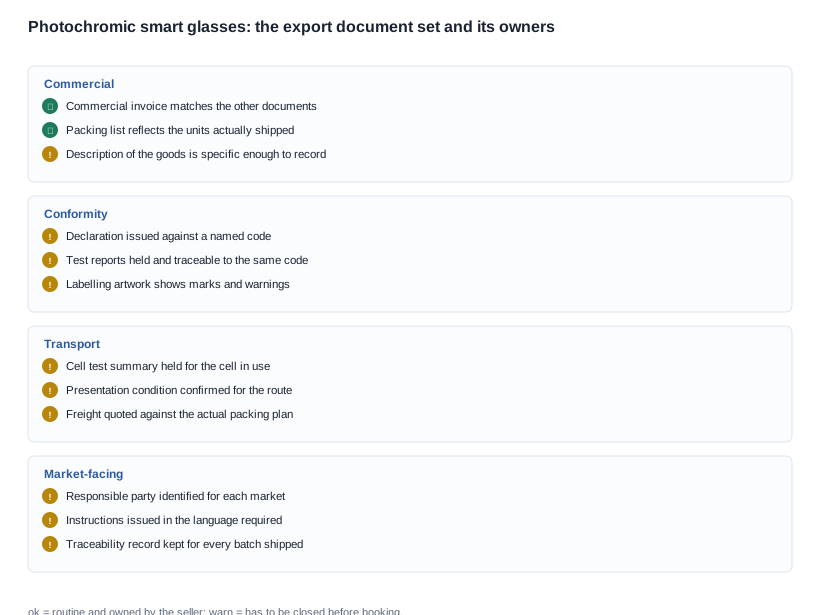
The commercial argument for this order is the same argument the whole category requires. The failure that costs the most is not a missing document but a mismatch discovered at the border, where the goods are already loaded, the buyer has already paid for them, and the options are re-packing, storage, demurrage or a return. Each of those is a negotiation with someone who is not the supplier, at a moment when the supplier has no commercial reason to help.
Our own position on what is published is unchanged. For the AI electrochromic smart glasses entry the catalogue gives five fields — a 100 mAh cell charged over a magnetic contact, roughly seven hours of rated endurance, a ceiling of two hours on one charge, and a Bluetooth version 5.4 radio — and no per-model conformity row, no model designation, no lens data, no weight and no ingress rating. The company-level export-certification page is images rather than text, and the ten certificates on it are eight that protect appearance and two that protect a mechanism, which is not the same thing as a conformity file. We will not tell you that a shipment is compliant, because compliance is a fact about a named product in a named market and we do not publish the named product. What we can do is set out the sequence, mark the four points that require a supplier document, and point out which decisions have to be made before the others. If you tell us the destination markets and whether the goods will be sold under your own label, we will tell you which of the photochromic smart glasses export considerations are fixed for you already, and which ones are still open questions that need a decision before anything is booked.


