

A photochromic smart glasses price comparison in this category cannot be a table of numbers, because the catalogue does not publish a price, a minimum order quantity or a delivery schedule for the entry in question — and we are not going to invent a range to fill the gap. What can be done is more useful than a price list, and it is what this article does: it sets out the cost structure that the published rows point at, the places where two quotations can legitimately differ, the places where a difference means one of them has quietly changed the specification, and the checklist that lets a buyer do the comparison themselves.
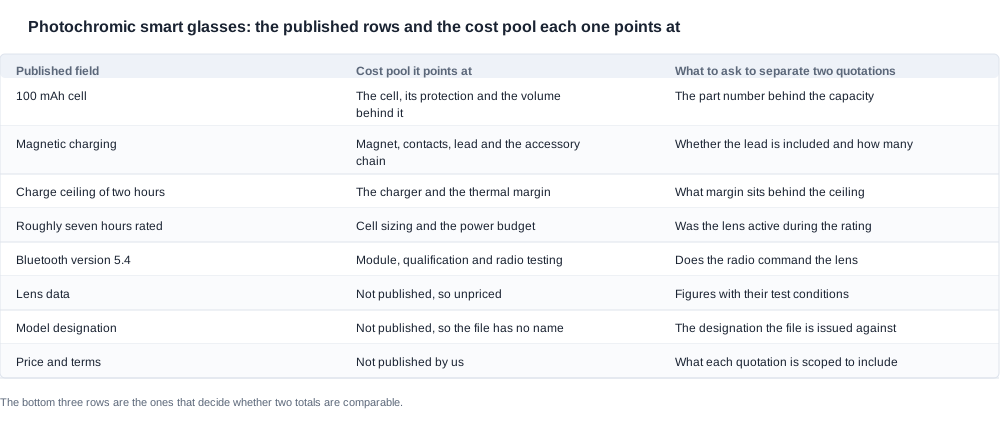
The starting point is the published record, because it is the only part of this product that is common to every quotation a buyer will receive. The entry is an AI electrochromic smart glasses line with no model designation, and its documented specification is five fields: a magnetic charging method, a 100 mAh cell, an endurance of roughly seven hours, a ceiling of two hours for one charge, and a Bluetooth version 5.4 radio. Everything else about the lens — its drive arrangement, its speed, its transmission, its tint, its substrate, its thickness — is absent from the record and therefore absent from any comparison until a supplier puts it in writing.
That is the whole difficulty in one sentence. A price comparison needs a common specification, and this category does not publish one.
Photochromic smart glasses: what a price comparison can be based on in this category
When a category does not publish a price, the temptation is to substitute a proxy — a range, a typical figure, a competitor's number carried across. In this category that substitution is actively dangerous, because the thing being priced is a product whose defining feature is undocumented, and a proxy price attaches itself to a specification that nobody has agreed. A buyer comparing two proxies is comparing two assumptions, and will discover the difference between the assumptions only when the goods arrive.
There is a better basis, and it is the one the published record already provides. Each of the five published fields points at a cost pool, and a buyer who can name the cost pools can interrogate a quotation line by line without ever being shown a price list. The criteria for a usable comparison are therefore already written: a common specification, an itemised scope, and evidence attached to the parts of the product that are not published. Where those three exist, the comparison is sound even though the number is not comparable in the ordinary sense. Where they do not, the total cost of the order is unknown, and the price is the least informative thing in the document.
The 100 mAh cell points at the cell itself, its protection and charge management, and at the volume commitment behind it. A cell specification in a quotation is rarely the same thing as the cell in the product: what matters is the cell grade, the number of cells, whether the cell is supplied with its own protection board, and whether the quoted figure is tied to a specific part number. A quotation that quotes a capacity without a part number is quoting a class of cell, and two suppliers quoting the same capacity are not necessarily quoting the same cell.
The magnetic charging method points at a cost pool that is routinely forgotten, because it does not appear in the product. It is the magnet, the contact geometry, the proprietary lead, and the whole accessory supply chain behind it. A magnetic charging method also carries an operational cost that never appears on an invoice: the lead has to be stocked, replaced and counted, and a buyer who has not included that in the comparison will find it in the service budget instead.
The ceiling of two hours for one charge points at the charger and at the thermal design around the cell. A product that has to reach a defined charge level within a bounded time needs margin, and margin is bought with a larger cell, a faster charger or a more capable protection circuit. Two quotations can therefore differ legitimately in price while quoting the same ceiling, because one of them has engineered the margin and the other has specified the ceiling. That is a question to put to the supplier, and the answer is more informative than the price.
The rated endurance of roughly seven hours points at the cell sizing and, in a driven-lens product, at the power budget as a whole. This is the field where the cost consequence of the missing lens data appears most directly. If the lens draws power, then a product that achieves the published rating with the lens active is a different product from one that achieves it with the lens settled, and the two are not built the same way. Nothing published distinguishes them, so the question has to be asked directly: was the rating measured with the lens in its active state?
The Bluetooth version 5.4 radio points at the module, at the protocol qualification, and at the radio testing that sits behind the module in the documentation. It also points at a cost that is easy to overlook: the radio and the lens are coupled in a driven product, because the radio may be the path by which the lens is commanded. A quotation that prices the radio as a commodity item and the lens as a component has not priced the two together, and that is where the interesting differences hide.

The published rows and the cost pools they point at
Read together, the five fields describe a product whose cost is concentrated in a small number of places, and a buyer who understands that can tell whether a quotation is priced against the same product.
The cell is the first concentration point, and the charge ceiling is really the same pool seen from the other side. The endurance figure, meanwhile, is a design output rather than a cost input, which is why it is the most useful of the five for a buyer: it constrains what has to be built. A product with a 100 mAh cell and roughly seven hours of rated endurance has a particular cell, a particular radio duty cycle and a particular power budget, and all three are fixed by the combination rather than by any one of them. Two quotations that quote the same cell and the same endurance are quoting a similar architecture; two that quote the same cell but different endurance are quoting different products, and the cheaper one is not better value, it is a different specification.
The charging method is the second concentration point, and it is the one that produces the largest gap between the product price and the total cost of owning the product. Magnetic charging is cheap in the product and expensive in the field. A buyer comparing two quotations for this category should always add the accessory cost to both sides before concluding which is cheaper, because a quotation that omits the lead is quoting a product that cannot be charged.
The third concentration point is the lens, and this is where a comparison becomes impossible without the supplier. The catalogue publishes nothing about it, which means two quotations can differ on lens architecture, on the control path, on the number of electronic parts in the product, and on the documentation burden, and the descriptions can be identical while the products are entirely different. The comparison cannot be made from the description. It has to be made from the evidence: the drive arrangement in engineering terms, the state behaviour, the figures with their test conditions, and the conformity documentation issued against them.
That is why the price comparison in this category is really an evidence comparison. A quotation backed by a documented lens, a test report with a named laboratory, and a conformity file is a different commercial proposition from a quotation of the same number with none of them, and the difference between the two is not a margin. It is who carries the risk of the product not doing the thing it was sold to do. The evidence sequence note sets out the evidence sequence that leads to a comparable quotation, and the file assembly note covers the documentary half of it.

Where two quotations can legitimately differ
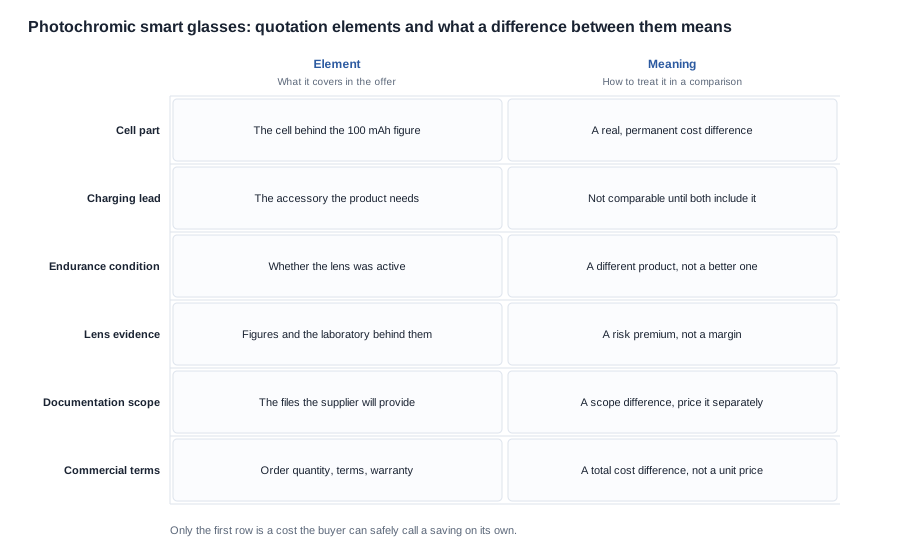
Two quotations for the same product in this category can differ by a large amount and both be honest. The differences that are legitimate fall into a small number of families, and a buyer who recognises them can negotiate on substance rather than on the number.
- Cell specification and volume. The same capacity can be quoted for different cell grades, different suppliers and different order quantities, and the difference in price is real and permanent rather than a margin.
- Lens architecture. A passive-tinted, a command-driven and a sensor-driven lens are three products, and the cost difference between them is not a rounding error. The quotations have to name which one they are pricing.
- Control path and software. Whether the lens is commanded over the radio, by an application, or by a control on the product itself determines how much of the product is firmware, and that is a development cost as well as a unit cost.
- Documentation scope. A quotation that includes the conformity file, the test reports and the translated instruction sets is not comparable with one that excludes them, and the difference in price is simply the cost of that scope.
- Packaging and localisation. Retail packaging, per-market artwork, per-market instruction sets and the labelling work that follows are all cost lines, and they scale with the number of markets rather than with the number of units.
- Commercial terms. Minimum order quantity, sample quantity, tooling where a custom part is involved, payment terms, incoterms and warranty scope all change the total cost of an order, and none of them appears in a unit price.
- Support scope. A supplier that supports a driven product with a defined failure-disposition process is carrying work that a supplier without one is not.
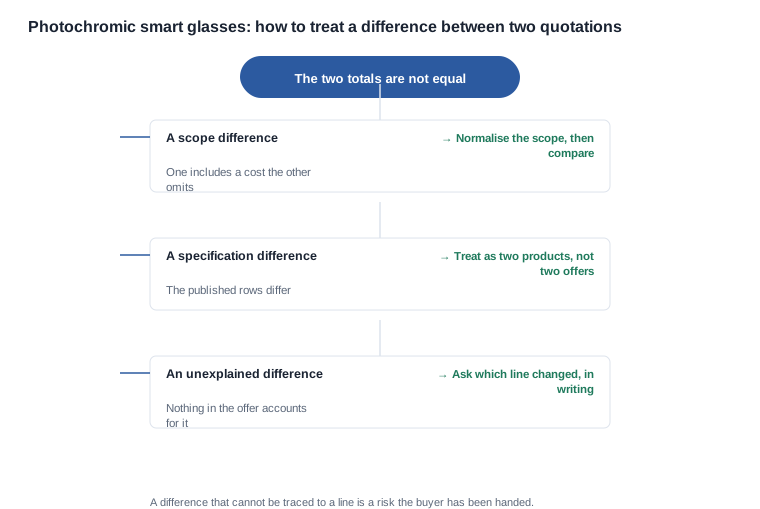
Against these, there are differences that are not legitimate, and they are the ones worth watching. A quotation that is materially cheaper while quoting the same published rows, the same cell and the same documentation scope has something removed, and the most common things removed are the lens evidence, the transport documentation and the after-sales commitment. A quotation that is materially more expensive for the same rows may simply be pricing a different lens and not saying so. The test in both cases is the same: ask which line of the specification changed, and require the answer in writing.
It is worth being precise about why a missing item is not the same as a cheaper item. The cost of a removed item does not disappear; it is transferred. A buyer who receives a product without a transport document has not saved the cost of producing one, they have taken on the risk that the shipment is held, and they will meet that risk at a moment when they have no leverage and the goods are already loaded. The same applies to a lens specification and to an after-sales commitment, and it applies most sharply to the conformity file, where the consequence of not having it is not a delay but an inability to place the product on the market at all. A price comparison that does not distinguish between a cost that has been removed and a cost that has been transferred is comparing an offer against a liability and calling the difference a saving.
A comparison table of quotation contents rather than prices
The table below is the working artefact for this category. It compares what the two quotations contain rather than what they cost, because what they contain is the only comparable part.
| Element to compare | Question to put to each supplier | A legitimate difference | A difference to challenge |
|---|---|---|---|
| Cell | Part number, grade and quantity behind the 100 mAh figure | Different cell part or volume tier | A capacity with no part reference |
| Charging | Lead supplied, quantity and replacement policy | A lead included in one and not the other | A different lead with no explanation |
| Charge ceiling | What margin sits behind the two-hour ceiling | A different charger or cell count | The same ceiling at a much lower price |
| Endurance | Condition attached to the rated figure | The rating measured with the lens active | The rating measured with the lens settled, undisclosed |
| Radio and lens | Whether the radio commands the lens | One includes a control path | Both claim a radio and a lens, neither connects them |
| Lens evidence | Figures with test conditions and a named laboratory | One has a full test file | Both describe the lens in adjectives only |
| Documentation | Conformity file, transport file, translated instructions | One includes a defined scope | One excludes the file and is cheaper |
| Commercial | Minimum order, sample quantity, incoterms, warranty | Different terms, both stated | Terms that appear only in the small print |
Read the last column as a list of what to push back on rather than a list of disqualifications, because in a category with this much missing documentation the honest state of many quotations is simply incomplete rather than dishonest.
The sequence to use is the one below, and it is deliberately ordered so that the expensive conversations happen before the order is placed rather than after the goods are shipped. A buyer who follows it will end up with a comparison of two configurations rather than a comparison of two numbers, which is the only kind of comparison that survives a re-order.
- Put the five published rows on the table and confirm that both quotations are pricing the same configuration against them.
- Ask each supplier to name the drive arrangement in engineering terms, and to confirm whether the published endurance was measured with the lens active.
- Ask for the lens evidence in the form of figures with their test conditions, and for the conformity file that sits behind them.
- Ask for the commercial terms in a single document, with the minimum order quantity, the sample quantity, the incoterms, the payment terms and the warranty scope written down.
- Ask for the accessory and documentation scope to be priced separately, so that a difference in the device is not confused with a difference in the scope.
- Normalise the two quotations onto the same scope and the same terms before comparing the totals, and record what was changed to normalise them.
- Treat the residual difference as a risk difference if the documentation is incomplete, and price it accordingly rather than treating it as a saving.

The export considerations for this category cover the documentation and responsibility scope in more detail, because the scope is where most of the difference between two quotations turns out to live. The service-life note covers the other half of that scope, which is what happens to a driven element that has reached the end of its life.
What we do not publish about price, and what that changes for a buyer
The position on this is short and deliberate, and it is better to state it at the start of a price conversation than at the end of one.
We do not publish a unit price, a price tier, a minimum order quantity, a sample quantity or a delivery schedule for this entry, and we will not quote a range that we cannot substantiate. We also hold no lens performance data for it, so there is no way for us to tell you what a lens of a given specification should cost, which is the only way a price comparison in this category would normally be done. The published record for the AI electrochromic smart glasses line is five fields and nothing more, and the commercially honest consequence is that a buyer has to build the comparison from the quotations themselves rather than from a list of ours.
What we can do is tell you which lines of a quotation have to be made comparable before the totals mean anything, and which of them usually hold the difference. The cost of a magnetic charging method, the cost of a documentation scope, the cost of a control path and the cost of a warranty commitment are all real, all large enough to dominate a comparison, and all invisible in a device price. The two questions that most often separate a good quotation from a cheap one in this category are whether the lens evidence exists, and whether the published endurance was measured with the lens doing the thing the product is sold for.
The second thing a comparison can be based on is the supplier's own consistency, and it is worth a line of its own because it is available without any disclosure at all. A supplier that answers a question consistently across two rounds of enquiry, with the same wording and the same caveats, is telling you something about how its documentation is held. A supplier that gives two different answers to the same question in the same week is telling you something else. Neither observation is a substitute for a document, but both are cheap to collect and both materially change how much weight a document should carry when it finally arrives.
The other thing we can do is tell you which of the differences are not differences at all. A quotation that omits the charging lead, the transport documentation or the conformity file is not a cheaper product. It is the same product with the risk moved onto the buyer, and a price comparison that treats those two as equivalent is comparing a product against a liability. That distinction is the one worth being rigorous about, because it is the one that a spreadsheet cannot make for you.
If you are holding two quotations for this product and want them read side by side, send them with the destination market and the planned order quantity, and we will mark which lines are comparable, which are scope differences dressed as price differences, and which are unpriced risks. That is the useful shape of a photochromic smart glasses price comparison in a category where the catalogue publishes a specification and not a price.


