

If this is your first purchase in the category, the most valuable thing you can do in the first week is not to evaluate a supplier — it is to build the vocabulary that lets you evaluate one. Colour-change lenses are sold under one name and are supplied as at least two different products, they are specified in conditions rather than in adjectives, and the category has no published performance baseline to compare a supplier against. A first-time buyer who starts by comparing unit prices is comparing two things that may not be the same product, at a level of specification that cannot settle anything. This guide is written for a procurement team meeting the category for the first time: what you are actually buying, the six words that decide your answer, how to write a requirement a supplier can quote against, the three questions to put in the first email, and what a first contact with us should produce.
Photochromic: what a first-time buyer actually buys
Why the first question is not about the lens
A first purchase in this category is usually requested as a feature, and features are the wrong unit of thinking. What a procurement team is actually buying is three things at once: a product claim that can be defended when a customer tests it, a specification that a supplier can be held to, and a documentation position that survives the market you intend to enter. The lens is one implementation detail inside the second of those, and it is the cheapest of the three to get wrong and the most expensive to get wrong late.
The first question therefore belongs to the channel, not to the supplier. What light does the customer stand in, and what would the customer see if the lens did something? If the answer is that nothing visible would change, the correct output of the first week is a decision not to proceed, and that decision is cheaper than any quotation.
Two products with one name
The second thing to establish in the first week is that the retail name covers more than one product. Our catalogue publishes two routes. The first is a camera platform where the lens appears as a configuration alongside a defined set of rows: an 8 MP sensor, a 220 mAh cell, a rated runtime of 5–8 hours, Type-C charging, charging in two hours or less, flexible temples and three published colour options. The second is a dedicated colour-change entry with its own rows: the lens technology described as electrochromic, Bluetooth V5.4, a 100 mAh cell, charging in two hours or less, a rated runtime of about seven hours, and magnetic charging, with no model designation published for it.
Those two are different products with different bills of materials, different documentation obligations and different failure modes, and they are both sold as photochromic smart glasses. A first-time buyer who does not know this is at risk of comparing a camera configuration against a dedicated product and treating the price difference as a supplier margin rather than as a product difference.
The vocabulary that decides your answer
Passive and driven: the first fork
The first technical fork in the category is whether the lens reacts to the environment or is commanded.
A passive lens responds to ultraviolet in the incoming light. It needs no power, no driver, no firmware function and no charging arrangement, and it introduces no battery transport file. It also cannot be set to a particular tint, it does not hold a state, and its behaviour depends on the light reaching it, which is why it behaves differently behind a windscreen and differently in cold conditions.
A driven lens is actuated. It can be set to a tint, it can hold that tint, and its behaviour does not depend on ambient ultraviolet. The cost of that control is a power path, a control path, a firmware function, a charging interface and a cell, and the cost of that control in commercial terms is the difference between a configuration and a product.
Most first-time buyers find it useful to write the fork as a sentence they could put in front of a channel: does the customer need the lens to do what the light does, or do they need the lens to do what we say? Everything about the cost, the documentation and the claim follows from that sentence.
The words that hide a condition
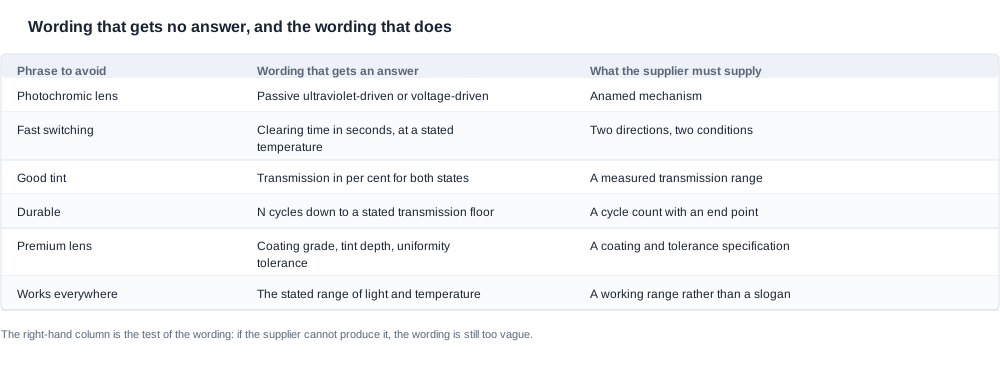
The second part of the vocabulary is the set of adjectives that sound decisive and settle nothing, because each one hides a condition that has to be written down before the word can be compared with another supplier's.
The table above is the working version. Read it as a translation sheet: each row on the left is a phrase you will hear, each row on the right is the same requirement written in a form that can be tested. A supplier who can answer the right-hand column can be held to it; a supplier who answers only the left-hand column has given you a marketing preference rather than a specification.
The most important of these is the first. "Photochromic lens" is not a specification, because it covers a passive reaction and a driven film, and those are different products with different power paths and different documentation obligations. Before anything else, ask which one you are buying.
Why a supplier answer is not a specification
The third part of the vocabulary is the distinction between an answer and a specification, and it is the distinction that a first-time buyer most often fails to make.
An answer is a response to a question. A specification is a document that a third party can check, that a lot can be judged against, and that survives a change of supplier. The test is whether the answer can be attached to a model designation, a measurement condition and a date. "The lens darkens quickly" fails all three. "The lens reaches its darkest state in under a stated number of seconds under direct midday sun at a stated ambient temperature" passes all three and can go straight into a purchase order as an acceptance criterion.
The practical consequence for a first purchase is that the request for quotation should contain conditions, not adjectives. A supplier who answers a conditional request with adjectives is telling you something about how the conversation will go, and it is cheaper to learn that before the sample than after it.
How to write a requirement a supplier can quote
Start from the outcome, not the feature
Requirements written as features are the reason this category produces so many vague quotations. A requirement written as an outcome produces a specification, because it states what has to be true at the end of the process rather than what has to be present in the product.
The test for an outcome-based requirement is whether it could be written by somebody in the channel who has never seen the product. If the requirement can only be expressed by somebody who already understands the mechanism, it is a feature requirement, and it will come back as a specification that describes the mechanism rather than the outcome.
The five layers a requirement has to pass through
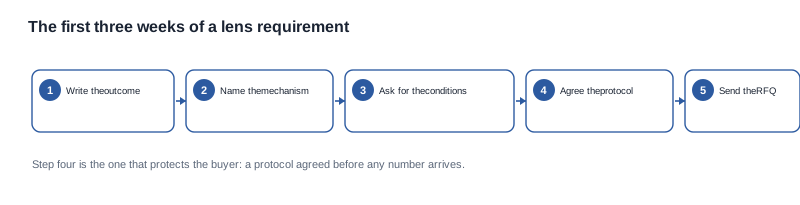
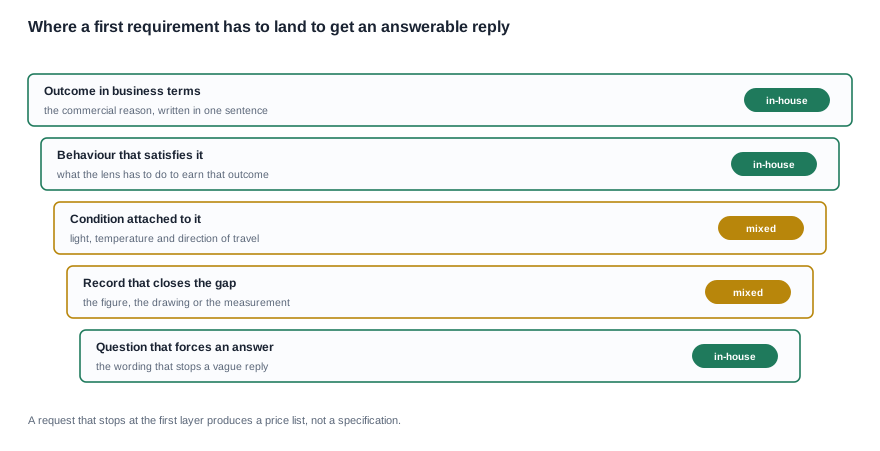
A requirement becomes answerable only when it has passed through five layers. The outcome states the commercial reason. The behaviour states what the lens has to do to earn that outcome. The condition attaches the light, the temperature and the direction of travel. The record names the figure, the drawing or the measurement that will close the gap. And the question is the wording that stops a vague reply and forces an answer.
Most first-time requests stop after the second layer, and every supplier in the market will then answer with a product and a price, which is exactly what happens when the request has not yet said what it is asking for.
A worked requirement, rewritten
Take the requirement most first-time buyers write: we want a lens that adapts to sunlight so the customer does not have to switch glasses.
Read it against the five layers and the gaps are visible. The outcome is implied rather than stated, the behaviour is the feature restated, the condition is missing entirely, and the record does not exist. Rewritten in a form that can be quoted against, the same requirement becomes: for outdoor channels, the lens shall change its light transmission in response to ambient light, with the darkening and clearing behaviour measured under direct daylight at a stated ambient temperature, the clear-state transmission stated for the indoor end, and the results recorded on the first article against a written acceptance criterion.
The rewritten version is longer, and that is the point. The length is where the cost of the lens appears, and where the supplier's price for measurement and documentation appears, and where the claim in your listing appears. Every clause added is a clause that can later be checked, and a specification that cannot be checked is not one.
What to write into the request for quotation itself
The requirement and the request for quotation are different documents, and the second one is where a first-time buyer most often leaves value on the table. A requirement describes what the product must do. A request for quotation describes what the supplier has to price, and it is the document that decides whether two quotations can be compared.
Six clauses earn their place in the first request, and they are worth writing before any supplier is approached rather than after the first reply arrives:
- The configuration count the price is to assume, including colourways and markets. Without it, the minimum order quantity and the documentation scope are meaningless.
- The lens mechanism, with the power path described where there is one, so that the two routes are not quoted against each other.
- The coating grade and the transmission range you expect to be priced, so that the element is not quoted as an undifferentiated item.
- Whether the documentation is priced per model or per family, and what happens to the price when a second market is added.
- The acceptance criteria you intend to write into the purchase order, listed in the request so the supplier can price the measurement rather than discovering it later.
- The unit price at each price tier, with the volume boundary stated, plus the payment terms and the incoterms.
A request carrying those six clauses returns a comparable answer. A request that asks for the unit price returns a number that only its own previous quotation can be compared against.

The three questions to put in the first email
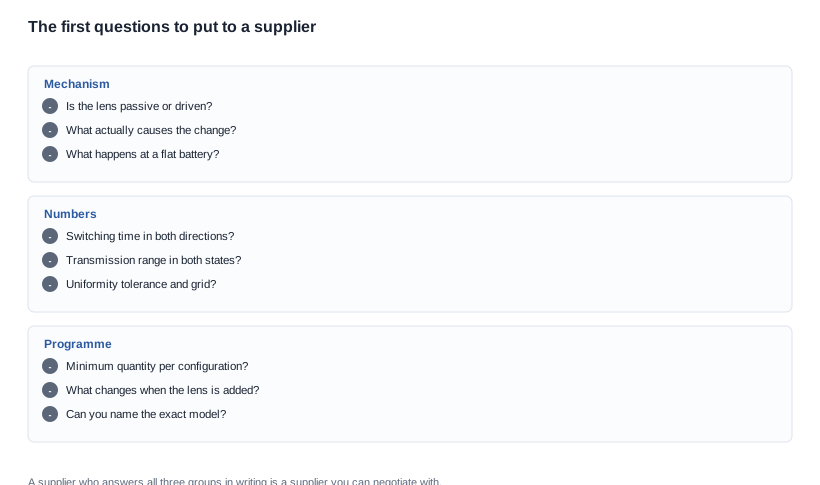
The mechanism question
The first question asks which of the two mechanisms you are buying, in a form that cannot be answered with a brand name: is the change driven by ultraviolet in the incoming light, or by an applied voltage, and what is the power path in the second case. If the reply names the technology but not the mechanism, ask again. A supplier who cannot describe the power path has not specified the product.
This one question settles more of the commercial position than any price comparison, because it determines whether you are buying a configuration or a product, whether a cell and a battery transport file are involved, and whether the state at a flat battery has to be specified.
The evidence question
The second question asks what measurement exists behind the lens behaviour, and in what form: switching times in both directions with their conditions, the transmission range in both states, a uniformity tolerance with the grid it is measured on, a temperature range, and a cycle count with a stated end point. We publish none of these for any model in our range, and we would rather say so than quote a figure you cannot verify.
The form of the question matters. Ask what is published and what would have to be measured, rather than asking for the numbers directly. A supplier who has measurements will explain the conditions, and a supplier who has marketing will offer the nearest adjective.
The programme question
The third question asks what happens to the programme when the lens is added: which documents are reopened, whether the documentation is priced per model or per family, what the minimum order quantity is per configuration, and whether a model designation exists that can be listed on a certificate. The dedicated colour-change entry in our catalogue publishes no model designation, which is precisely the kind of gap that is cheap to close at the quotation stage and expensive to close after the artwork is approved.
Red flags in a first reply
A first reply tells you more about the supplier than a quotation does, because a quotation is a negotiation document and a first reply is a description of how the supplier works. Four patterns are worth recognising, and each of them tells you what to change in your own request before the second exchange.
A mechanism answered with a brand word. The reply names a lens brand rather than a mechanism and a power path. It tells you that the supplier is managing the ambiguity rather than resolving it, and that the question will need to be asked again in a narrower form.
A figure with no condition. A switching time arrives without a light level, a temperature or a direction. Treat it as absent rather than as a number with missing detail, because a figure without a condition cannot be compared with another supplier's figure and cannot be written into an acceptance criterion.
A family string where a model was asked for. A document that names a series rather than a model designation is covering something other than what you are buying. In this catalogue one route publishes no model designation at all, so this pattern has a specific and immediate cause: there is nothing to name yet, and the programme needs to fix one before the paperwork can be right.
A price that assumes a configuration count nobody stated. The quotation arrives with a minimum order quantity and a documentation scope attached to a configuration count that only the supplier knows about. That is not a price for your programme; it is a price for the supplier's default, and the first negotiation should be about the configuration count rather than about the unit price.
The rule that produces all four: before you order, take the reply and mark every line as either a number with a condition, a document with an identifier, or an open item. The open items are the real content of the reply, and they are what your next request should be built from.
What we can answer on the first contact
What a first contact should produce
A first contact with a supplier in this category should produce four things, and if it produces fewer, the contact was too early in your own process rather than too early in the supplier's.
- A named mechanism, with the power path described.
- A written statement of which performance figures are published and which are not.
- A model designation for the exact configuration, or an explicit statement that none exists.
- A price structure that separates the per-unit elements from the per-configuration elements.
If you get all four, you have enough to build a comparison table. If you get one, you have a product page. The difference between those two outcomes is the entire purpose of the first contact.
It is worth deciding in advance what a second contact is for, because the most common failure in this category is a supplier relationship that accumulates questions without ever reaching a specification. The second contact should be a shortlist against the four outputs above: this supplier has closed the mechanism and the documentation scope but not the lens performance rows, that one has published rows but no model designation, and a third has a model designation and a price tier structure but has declined to price the measurement work. With that shortlist in hand, the third conversation is about which gaps you can close yourself on a sample and which ones have to be closed by the supplier before an order is placed.
Where to go next
Stated plainly: we publish the rows we hold and mark the rest as open. For the camera platform with the colour-change lens configuration we publish the sensor class, the rated runtime, the charging interface, the cell capacity, the charging time, the temple design and the published colour options. For the dedicated colour-change entry we publish the lens technology, the Bluetooth version, the cell capacity, the charging time, the rated runtime, the charging interface, and the fact that no model designation is published. We do not publish switching times, transmission ranges, uniformity tolerances, temperature ranges, cycle life figures, coating specifications or lens model designations, and we do not publish unit prices or lead times for any model in this range, because those are commercial terms that change with volume, configuration count and market rather than properties of the product.
The full selection method is in how to choose photochromic smart glasses. The measurement protocol that would close any of the open rows is in how to measure photochromic smart glasses, and the requirement differences between working environments are in photochromic smart glasses for different use cases. The category background sits under photochromic lens technology.
If your team has never bought in this category, send us the channel, the working environment and the number of colourways and markets you intend to launch with. We will tell you which of the six questions above has an answer today and which ones need a sample to close.


