

There is no standard for a light-responsive lens in smart glasses, and the reason is worth understanding before you spend a week looking for one. The category sits outside the frameworks that would otherwise cover it. It is not an eyewear standard, because the lens is an active component rather than a piece of optical glass. It is not a lighting standard, because the product emits rather than illuminates. And it is not a medical device standard, because nothing in the lens makes a claim about a person's health. What remains is the general product safety and radio regimes, the battery transport regime and the material regime — and then a gap in the middle where the product's own performance sits, unstandardised and unpublishable.
That gap is the most commercially important thing in this article. A buyer who expects a category standard to settle the switching time, the tint depth or the durability of a lens will spend weeks looking and find nothing. A buyer who knows the gap exists spends the same week writing the criterion instead, and arrives at the supplier with a document rather than a question.
Our published position in this range is the whole of what we hold: Bluetooth 5.4, a 100 mAh battery, charging in two hours or less, roughly seven hours of runtime, magnetic charging, and electrochromic lenses. There is no model designation published, and no switching time, no transmission range, no temperature behaviour, no uniformity figure, no cycle durability and no coating detail. There is also no second light-responsive platform with published lens data to compare against — the V03 Pro carries a photochromic lens configuration and no lens figure of its own — which means the buyer is not choosing between two data sets; they are building the first one.
The practical answer to photochromic smart glasses industry standards is therefore a map rather than a citation: four frameworks that apply and can be verified, one vacuum that does not, and a written criterion that has to fill the vacuum before the deposit.
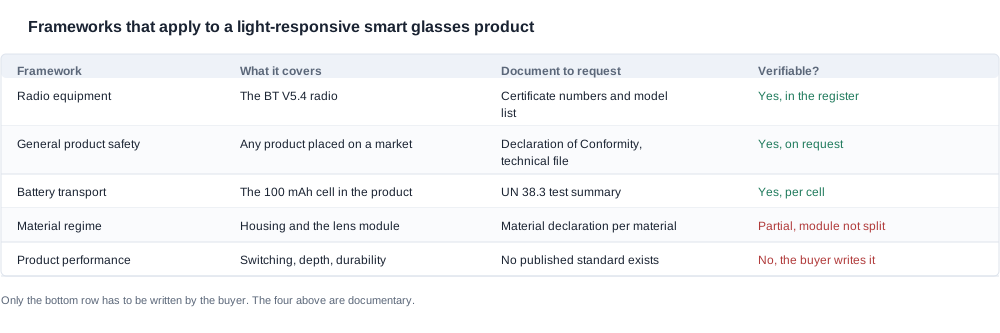
The photochromic smart glasses industry standards map is four frameworks and one vacuum
Why the category sits outside every framework that looks relevant
Standards follow the function of the thing being regulated, and the function of a light-responsive lens in a smart glasses product is ambiguous in a way that eyewear is not. Conventional optical lenses are regulated as optical material with a focus on the finished lens, the prescription, the mounting and the wearer. A photochromic lens in a glasses product is a component with a drive circuit, a control strategy, a material stack and a state machine, and it is bought as part of an electronic device rather than as a lens. The frameworks that would cover it as eyewear do not describe it, and the frameworks that cover it as an electronic device do not describe the lens.
The second reason the category sits outside is that the two available lens routes have different regulatory shapes. A passive ultraviolet-driven lens is closer to optical material, even though it changes. A powered electrochromic lens is closer to an electronic display, because the product decides its state. The platform published in our range is the electrochromic one, so the buyer is carrying an active component inside a wearable, and the frameworks that apply are the ones that apply to the wearable.
The four frameworks that do apply
The map is short, and it is worth having on one page before the first supplier call.
- Radio equipment. The product carries a Bluetooth 5.4 radio, so the radio regime applies in each destination market. In the European Union that is the Radio Equipment Directive (EU) 2014/53/EU, with the EN 18031 series cited into it for the cybersecurity requirements, and the EN 18031 series has been a component of radio equipment conformity since 1 August 2025. In the United Kingdom the UKCA route applies with a framework that has already begun to diverge from the European one. In the United States the FCC equipment authorisation route covers the radio, and the Bluetooth SIG qualification applies to the implementation.
- General product safety. The General Product Safety Regulation (EU) 2023/988 has applied since 13 December 2024 and layers general safety obligations on top of the sector rules, including the economic operator, the technical file, the traceability, the labelling and the information supplied to the user.
- Battery transport. The product contains a 100 mAh lithium cell, and the UN 38.3 test summary has to cover that specific cell. If a charging case is supplied it is a second cell and the transport scope has to cover it too.
- Materials. RoHS and REACH are written for materials rather than for finished products, which is why the material documentation arrives per material and has to be matched against the actual bill of materials.
The fifth row is not a framework. It is the product's own performance — switching time, transmission range, uniformity, temperature behaviour, cycle durability, coating — and no published standard in any market specifies it for a light-responsive lens in smart glasses.
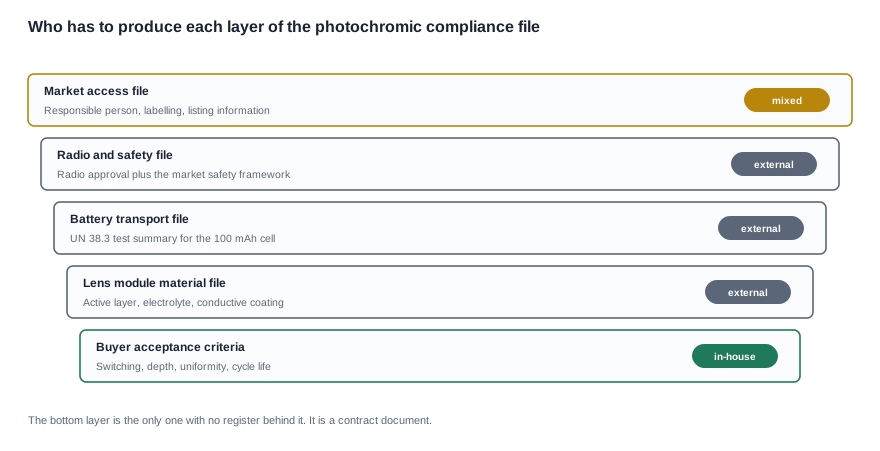
The part of the file nobody can produce for you
The layers chart is the most useful artefact in this article for a buyer, because it shows that four of the five layers are documents somebody else produces and one of them is yours. The market access file, the radio and safety file, the battery transport file and the lens module material file are produced by a supplier, a test laboratory, a module maker or, in a brand-led programme, by your own economic operator, and all four can be checked against a register or a file. The buyer acceptance criteria — the switching time, the depth, the uniformity, the cycle life — has no producer other than the buyer, and that is not a defect in the category. It is the normal state of affairs for a specification that no one has written yet.
A specific warning follows from the layers chart, and it is the one that catches experienced buyers. The catalogue cover of our own range carries a company-level export certification line. That is a statement about the manufacturer's capability to export certified goods across markets, not a per-model conformity statement. A company-level capability cannot be read across to a specific model, and it certainly cannot be read across to a claim that a particular model carries a children's, medical or sector-specific approval. If your programme needs a per-model approval, it has to be established for the per-model configuration.
What each framework actually asks a buyer to produce
The table below is the one-page version, and the fifth row is the one that decides how much of the programme the buyer has to run themselves.
| Framework | Document to request | What it proves | What it does not prove |
|---|---|---|---|
| Radio equipment | Certificate numbers, model list, issuing body, validity dates | That a radio of this configuration has been assessed | Anything about the lens, or the difference between two models |
| General product safety | Declaration of Conformity, technical file, economic operator | That a product was placed on a market with a named responsible party | That the lens module was separately characterised |
| Battery transport | UN 38.3 test summary for the fitted cell | That the cell in this product can be shipped | That a case cell, if one is added later, is covered |
| Materials | Material declaration per material, matched to the bill of materials | That the declared substances are present in the declared parts | That the three materials in the lens module were assessed |
| Product performance | No published standard exists | Nothing | The switching time, the depth, the uniformity, the cycle life |
Radio equipment and the Bluetooth qualification
The radio framework asks for a document that names a model. That single requirement shapes most of the rest of the work, because a product without a model designation cannot appear on one. The platform published in our range has no published model designation, so the first radio question to a supplier is not about bands or test reports — it is whether a formal designation can be issued, and when.
The Bluetooth SIG qualification is a separate thing from the market's radio approval, and the two are often confused in a quotation. The qualification applies to the implementation and is what allows the brand to use the Bluetooth mark in marketing. The market's radio approval covers the product. A supplier who sends a Bluetooth SIG listing in answer to a question about the Declaration of Conformity has answered the wrong question, and the buyer should ask again for the document that names the model and the issuing body.
The general product safety regime and the technical file
The technical file is where the lens appears as a component with its own characteristics, and this is where the material question becomes concrete. The file is expected to describe the product well enough that a market surveillance authority can establish what was placed on the market and under whose responsibility. For a product with an electrochromic lens, the file needs to describe the drive circuit, the control strategy and the lens module, because those are the parts that differ from a standard Bluetooth glasses product.
The economic operator requirement is the other half. In a brand-led programme the economic operator is often the importer rather than the factory, and the difference matters for the launch sequence: the factory's file and the importer's file are different documents with different holders and different deadlines. Buyers routinely assume the factory's documentation pack covers the importer's obligations. It does not.
Battery transport and the 100 mAh cell
The UN 38.3 test summary has to correspond to the cell that is actually fitted. A 100 mAh cell is a small cell and the transport documentation for it is a routine item, but the point that catches people is scope: the summary has to match the cell specification, and the specification has to match the bill of materials. Where a charging case is supplied, the case cell is a second cell in the same consignment and it needs its own coverage.
The lens platform published in our range does not publish a case, so the transport scope for that configuration is the product cell alone. Where a case is supplied elsewhere in the range, the case capacities are published and they are large — the CY03, CY05 and L1 Pro each carry a 1400 mAh case, the L2 Utral carries 900 or 1400 mAh, and the MT6 carries a 1200 mAh foldable case — which means a transport scope built for the glasses cell alone is incomplete on those models.
The material regime, where the lens module becomes a problem
RoHS and REACH are written for materials, and an electrochromic lens is three materials behaving as one component: an active layer, an electrolyte and a conductive coating. None of the three is separately characterised in our published file. The framework that covers the housing covers the lens in principle, and covers it in name only in practice.
This is where the buyer's diligence has to go deeper than the supplier's own paperwork, because the supplier may be able to produce a housing declaration without having ever handled a lens module declaration. The question to ask is not "do you have a RoHS declaration" but "which materials are in the lens module, and who holds the declarations for them". A supplier who cannot name the module maker is telling you that nobody in the chain has characterised the lens.

The product performance vacuum and who has to fill it
A criterion written by the supplier is a tautology
The reason the vacuum matters commercially is that acceptance criteria are usually inherited from the supplier by default, and a criterion written by the supplier and then compared against the supplier's own figure tests nothing at all. This is not a hypothetical failure mode. It is the normal outcome when a category has no standard: the only available figure and the only available criterion come from the same party, and the buyer ends up with a comparison that cannot fail.
The replacement is unglamorous and it works. The buyer writes the criterion, in advance, with the measurement conditions attached, and asks both parties to apply it. A supplier who agrees to be measured against a criterion the buyer wrote has agreed to something meaningful. A supplier who resists is telling you that the product has not been characterised against any agreed method, which is a finding in its own right.
What a buyer-run baseline has to look like
Because there is no second light-responsive platform with published lens data — the V03 Pro's photochromic configuration carries no lens figure either — there is no peer to compare against, and the buyer has to generate the reference themselves. A usable baseline has four properties. It is measured on units the buyer controls, on a protocol written before the first reading. It is recorded with the conditions, so the conditions travel with the number. It is retained as a physical reference unit, so that later units can be compared against a known-good article rather than against a number on a piece of paper. And it is labelled as the buyer's own measurement, because a number produced by the buyer under the buyer's conditions is the only figure that is comparable with the next supplier's buyer-run baseline.
The measurement method itself is set out in how to measure photochromic smart glasses, and this article only needs the point that the protocol has to exist before the first sample is opened, not after the first disagreement.
Why the absence of a standard is also an opportunity
There is a second, less obvious consequence of the vacuum, and it works in the buyer's favour if the buyer sees it early. When a category has no standard, the party that moves first and writes the criterion effectively sets the acceptance terms for the whole programme, and the same criterion can then be offered to every subsequent supplier. The buyer who arrives with a written criterion and a baseline negotiates from a different position than the buyer who arrives with a question.
The same logic applies to the documentation. In a category with a standard, the supplier supplies conformity and the buyer checks it. In a category with a vacuum, the buyer who has assembled a complete evidence file — numbers, registers, model strings, protocol, baseline — has built an asset that outlives the programme and is reusable against the next supplier.


Turning a framework name into a record you can check later
Step one, ask for the number and not the attachment
A certificate number is the only part of a compliance document that a broker, a marketplace, a customs agent or the buyer's own compliance team can independently check later. A PDF attachment is a claim about a document; a number is the document, in the form that can be verified. Ask for the list in the body of the email, with the issuing body and the validity dates, before the first sample ships. This costs one email and it converts an unverifiable assertion into a checkable one.
Step two, read the register and compare the model string
In the issuing body's register, confirm three things. That the model designation printed on the document matches the model being ordered, character by character. That the document covers the functions and the radio band being shipped. And that the validity date has not passed relative to the launch window, which matters more in this category than it appears to because the launch window is often set by a trade show rather than by production.
The character-by-character comparison is not pedantry. Several models in our own range share electrical rows that are identical or near-identical, which is exactly the condition under which a document for one model is offered for another. A mismatch here is a stop condition rather than a query, because the alternative is discovering it at the border, where the correction is a delay rather than an email.
Step three, put the criterion and the protocol into the purchase order
In a category with no standard, the contract is the standard. If the criterion and the measurement protocol live only in an email, they are not binding on anyone; if they are attached to the purchase order, they are the acceptance standard, and a lot that fails them is a lot the buyer can refuse. The practical content of that attachment is short: the measurement rows, the conditions attached to each row, the sample size, the treatment of a reading that falls outside the criterion, and who bears the cost when the sample does not meet it.
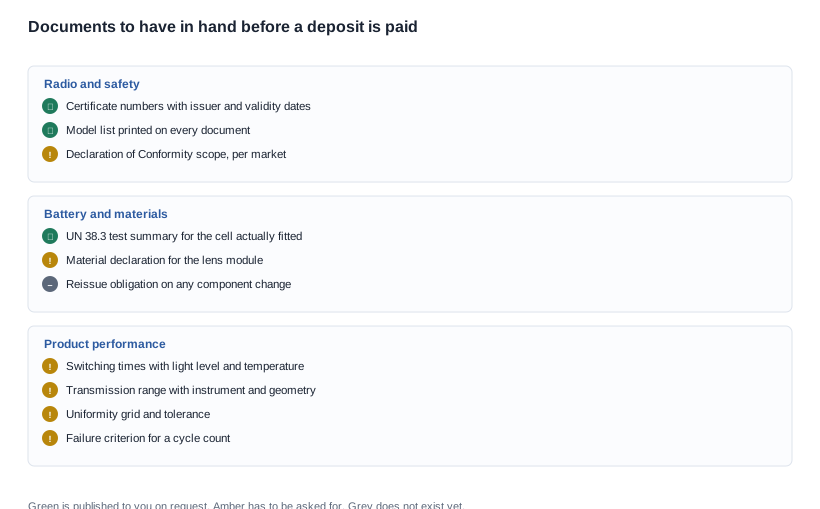
What the standards file costs, and what it cannot buy you
Certification cost and certification time are not commercial levers
The fee for a conformity route is a fixed cost per product family and the elapsed time belongs to the test laboratory and the review queue. Pressing on either produces a longer schedule rather than a shorter one, and a buyer who negotiates hard on certification cost usually ends up paying for it in a later delivery date. The useful questions are the ones about ownership and sequence: who holds each document, which market is the critical one, and what has to be reissued when a component changes.
Tooling is the other fixed cost, and the useful questions there are about amortisation rather than amount. Over what volume is the tooling amortised, what happens to it if the programme is discontinued, and who owns it in the meantime. What is genuinely negotiable in this category is the set of documents that do not involve a test laboratory: the acceptance protocol, the criteria, the packaging and insert design, the market labels, the language of the documentation pack, the artwork round count, the number of configurations committed to, and the structure of the payment nodes. Delivery splitting against a documentation-review milestone is frequently granted more easily than a price concession, and in this category the milestone is the only acceptance that means anything.
The clauses that keep the file true after the first order
Three clauses do most of the work. The first requires notice before any change of lens, coating, tint range, cell, case or artwork, because each of those invalidates the configuration that the documents name. The second requires the material documentation and the declaration to be reissued within a stated period after any component change, which in a powered-lens product is a recurring cost rather than a one-off, and a supplier who treats it as optional is telling you the file is not being maintained. The third attaches the criterion and the protocol to the order itself, with a named party responsible for the acceptance testing.
We will not fill a standards vacuum
The short answer: we publish the rows we hold for the electrochromic entry and mark the rest as open, and we will not fill a standards vacuum with a plausible value. We publish Bluetooth 5.4, a 100 mAh battery, charging in two hours or less, roughly seven hours of runtime, magnetic charging and the fact that the lenses are electrochromic. We publish no model designation for that entry, no switching time, no transmission range, no temperature behaviour, no uniformity figure, no cycle durability and no coating detail, and we will not infer a per-model certification position from a company-level export capability.
We will also not make a medical, a hearing or a vision-protection claim for any product in the range. A device whose function is to detect a position or a distance and to remind is not a clinical intervention, and a listing that implies otherwise is a regulatory exposure rather than a marketing decision.
What we can do is agree the protocol and the criterion with you, run them against samples, and hold the baseline so that the next supplier's figures have something to be compared against. The background is under photochromic lens technology, the measurement method is in how to measure photochromic smart glasses, the regulatory map is in how regulations affect this category, and the parallel treatment of the same problem in an adjacent category is in open-ear audio industry standards.
Send us the two suppliers you are comparing and we will write the protocol that makes their figures comparable.
Where the standards map comes from
Send us the two suppliers and we will write the protocol that makes their figures comparable.


