

The category sits outside the two frameworks you would expect it to sit inside. It is not an assistive listening device, so the medical device routes do not apply to it in the way they do to the bone conduction product in our range, where the 35 dB amplification gain puts the regulatory question at the boundary defined by the OTC hearing aid classification in the United States. And it is not a sealed earphone, so the measurement conventions of the headphone world do not transfer. Open ear audio glasses smart glasses industry standards is therefore a map of the frameworks that do apply, the four conventions that do not transfer, and — the part that matters commercially — the difference between a certificate, a test report, a declaration and a test summary, because a buyer who cannot tell those four apart will accept a file that does not cover the product.
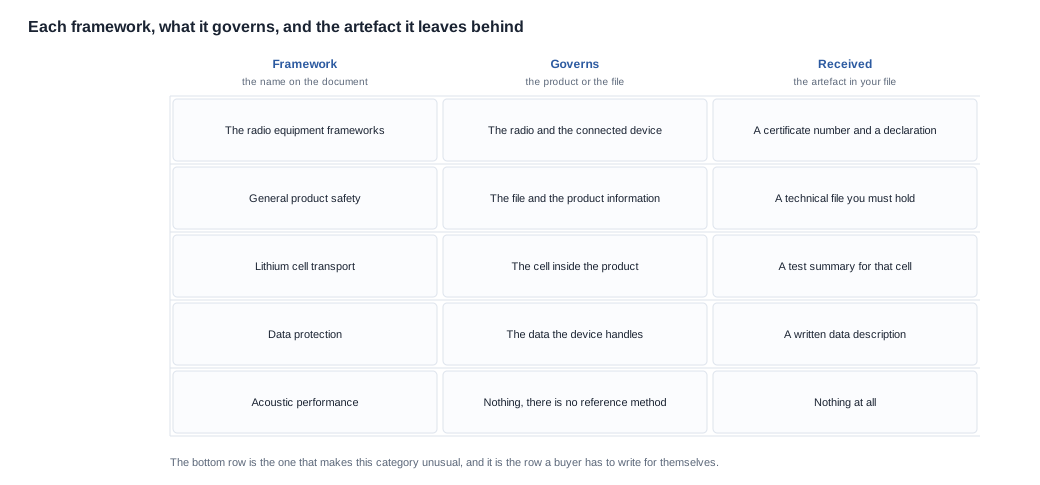
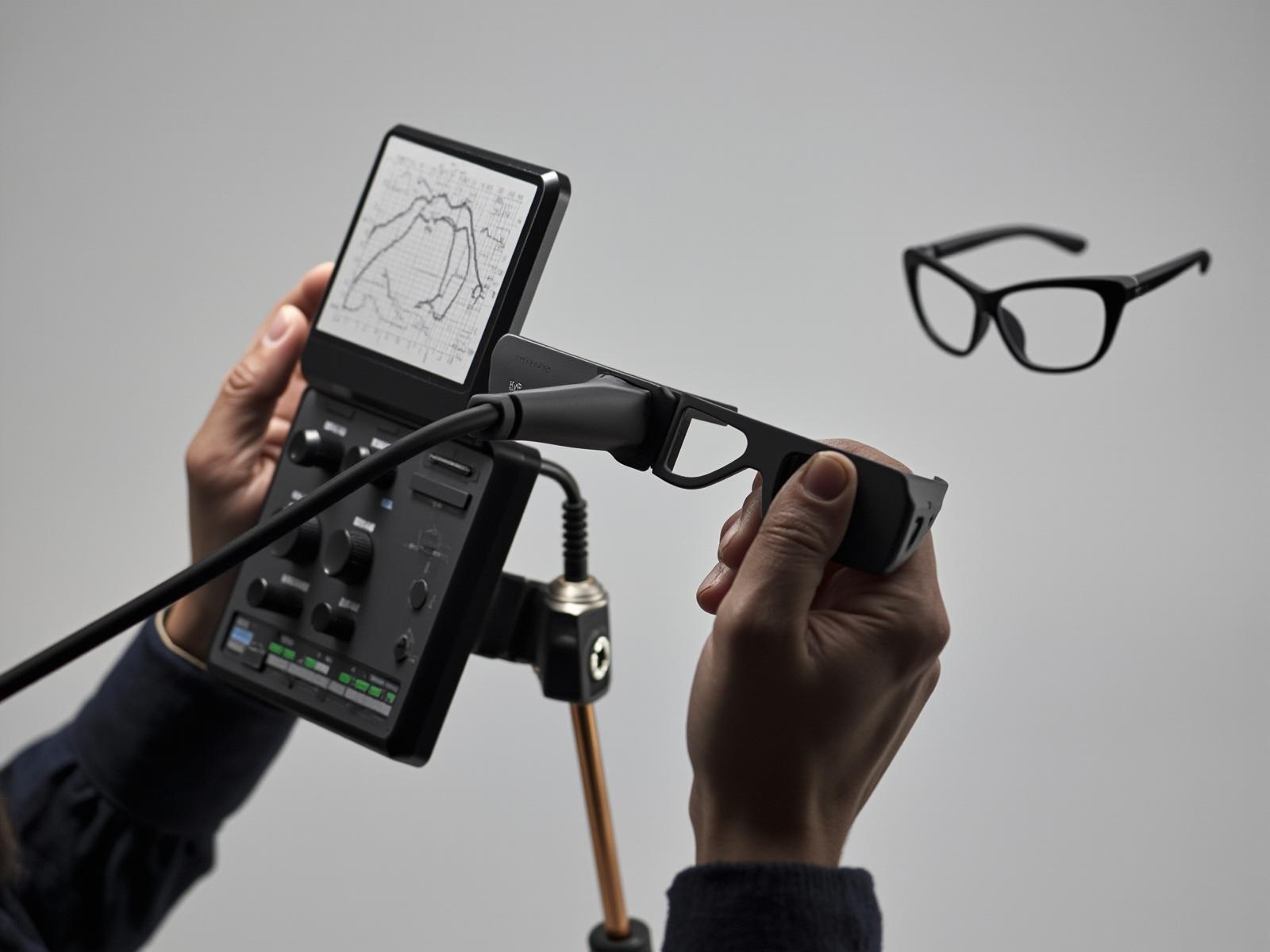
The absence of an acoustic standard is not a gap in the industry that will close on its own. It is a consequence of the format: an open-ear device has no seal and no coupler, so the reference points the headphone measurement world depends on simply do not exist for it. Any figure on a competitor's sheet that seems familiar is a figure measured under a convention that does not apply to the product in front of you, and the specification you write has to supply what the standard does not.
Open ear audio glasses: seven workstreams, and the missing standard
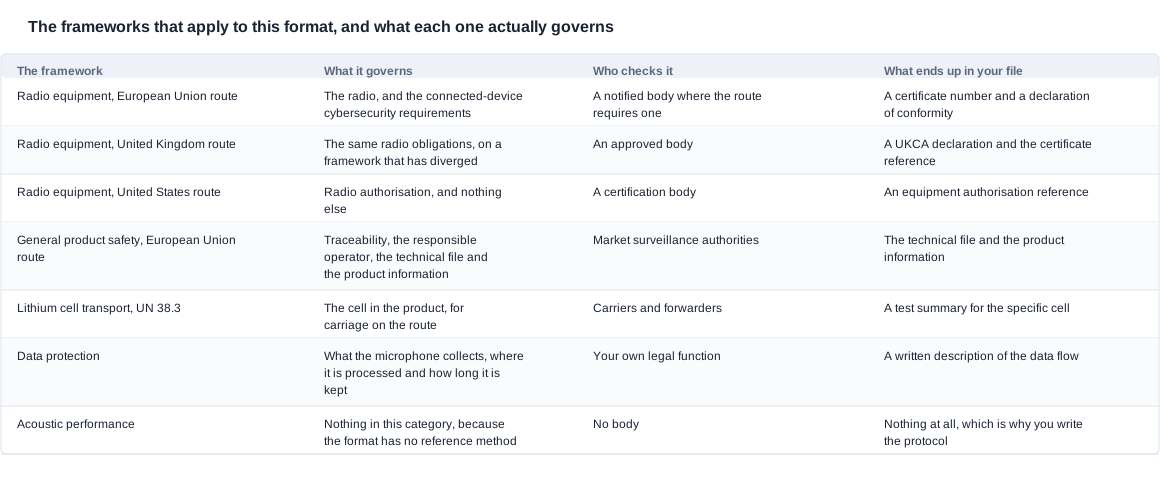
The frameworks, and what each one actually governs
Seven workstreams apply to a product of this kind, and they have different scopes, different checkers and different lead times. Four of them concern the radio, the general product safety of the product, the cell inside it and the data it handles. One concerns the acoustic performance, and it governs nothing, because there is no reference method to govern against.
The commercially useful way to read the table below is the third column. It answers a question buyers ask constantly and suppliers rarely address directly: who checks this, and when. A radio approval is checked by a notified body or an approved body. The general product safety file is checked by market surveillance authorities, after the product is on the market. The battery transport document is checked by carriers and forwarders, at the moment of shipment. Data protection is checked by your own legal function, before the copy is written. And the acoustic row is checked by nobody, which is why you have to write it yourself.
That last column is also the schedule. The workstreams do not run in parallel in the way a supplier's document list implies, because the cell document and the radio approval both depend on the final configuration being settled, and the artwork depends on both of them.
The published position in the audio tier
For reference, the published rows across this tier are: Bluetooth V5.3 on the K01 and the K02 and V5.4 on the other nine models; cell configurations at 55 mAh × 2, 70 mAh × 2, 90 mAh × 2, 100 mAh and 115 mAh; charge times at or under two hours on nine models and at or under one hour on two; rated runtimes of roughly six, seven and eight hours; magnetic charging on seven models and Type-C on four; no touch control row across the range; and feature rows including surround sound, remote control photography and a slim or detachable temple. On acoustic performance, the published position is that no third-party measurement supports any model in this tier.
That last sentence is the one that governs the rest of this article, because it means a buyer cannot close the acoustic question with a document. Everything else on the list can be closed with a document, and the documents differ from each other in ways that matter.

The radio frameworks, in three jurisdictions
The radio frameworks and what they cover
The radio framework is the one workstream where the supplier must already have done the work, because no radio product can be shipped into these markets without it. Three jurisdictions, three routes.
The European Union route is the Radio Equipment Directive (EU) 2014/53/EU. It governs the radio and, since the delegated act adding connected-device cybersecurity and privacy requirements, the software that supports the radio functions. The route is completed with harmonised standards cited into the directive — EN 300 328 for the 2.4 GHz wideband data transmission that a Bluetooth product uses, the EN 301 489 series for electromagnetic compatibility, and the EN 18031 series for the cybersecurity and privacy requirements that came into the directive in 2024. Where the route requires a notified body, the certificate is issued by one; where it does not, the manufacturer self-certifies and issues a declaration.
The United Kingdom route applies the same underlying radio obligations under the UK's own conformity framework, with the UKCA marking, and it has diverged from the European route rather than tracking it. The practical consequence for a buyer is that a European approval does not automatically cover the United Kingdom, and the two have to be checked separately against the current text of each scheme.
The United States route is an FCC equipment authorisation, and it covers the radio. It does not cover the general product safety obligations, the cell documentation or the data position, because those are separate regimes.
The question that matters at the quotation stage is the same in all three: does the certificate or authorisation name the exact model designation you are ordering, and does its scope cover the radio band and the functions you are shipping? A family-level document covering a range that spans two charging interfaces, several firmware builds and multiple applications is not automatically coverage for the configuration in your order.
What the radio route does not settle
Three things, and each of them is a source of confusion in this category.
It does not settle the acoustic performance. No radio document contains a figure for what the product sounds like, because that is not what radio conformity is about.
It does not settle the product's safety in the general sense. The general product safety obligations are a separate workstream, with a different file and a different authority.
It does not settle the cell. The radio approval says nothing about the lithium cell inside the product, which has its own transport document and, increasingly, its own documentation and labelling obligations under the EU battery regulation (EU) 2023/1542, with staged application dates that your compliance function should confirm against the current text rather than against a summary.
The general product safety route and the technical file
The general product safety framework — Regulation (EU) 2023/988 in the European Union, applicable from 13 December 2024 — covers traceability, the responsible economic operator, the technical documentation and the information supplied with the product.
For a buyer, the practical consequence is that the compliance file is your responsibility once you brand the product. The supplier can assemble the technical file and supply the product information, but the party that puts a branded product on the market is the party that holds the obligations. That is worth being clear about internally, because "our factory handles compliance" is a common source of confusion that surfaces at the first market surveillance query.
Alongside this sit the material and substance obligations that apply across the EU: the Restriction of Hazardous Substances regime for the components, the REACH framework for substances, the WEEE registration and marking for the electrical equipment, and the packaging obligations for the box. None of them is an acoustic question, all of them need a document, and all of them are checked at the market rather than at the factory gate.
The cell in the product, and the document the carrier asks for
A product of this kind ships with a lithium cell inside, and that cell has a transport document: the UN 38.3 test summary.
Two features of it cause confusion. First, it is checked by carriers and forwarders rather than by customs, so it appears on no product and no package, and a shipment can be held at the forwarder rather than at the border. Second, it is issued for a specific cell, so a programme that changes the cell has a new document, and the cell configuration is one of the fields most likely to be changed late in a programme.
The companion document is the one that covers the battery itself. In the EU that is the battery regulation's documentation and labelling obligations; elsewhere it is whatever the destination market requires. The rule of thumb is the same as for every other document in this list: ask for the number, the issuing body, the model designation and the validity date, and check it against the unit.
Data protection, which is a legal question wearing an acoustic costume
A microphone that processes personal data brings the product into the personal-data category, and the questions about what is collected, where it is processed, how long it is kept and how consent is handled are legal questions rather than acoustic ones. In the European Union the data protection framework applies alongside the EN 18031 privacy requirements that sit inside the radio route, and in the United Kingdom the corresponding framework applies under the UK route.
Two practical consequences follow for a procurement team. The first is scheduling: the data position is the workstream most often left until after the listing is written, and the listing is part of the information supplied with the product, so it cannot be finalised before the data position is settled. The second is the boundary between the acoustic and the legal: the noise reduction feature, the voice assistant and the call handling all touch data, and a supplier's acoustic description is not a data description. A supplier who can describe the audio path in detail and cannot describe what the device stores is telling you something about the operation.
The acoustic standard that does not exist
No body publishes an acoustic performance certification for open-ear audio glasses, because there is no reference method to certify against. A buyer who wants that certification cannot obtain it, and a supplier who offers it is offering something that does not exist.
What exists instead is a set of conventions from the sealed audio world, and every one of them fails to transfer. The frequency response and the seal: a figure of that kind assumes a coupling to the ear canal that an open-ear device does not have, and the response at the eardrum is a function of the person's head geometry and the position of the frame. The sensitivity and the maximum output level: both are measurable, but the relevant reference point in an open-ear device is a listener at a stated distance in a stated environment rather than a coupler. The noise cancellation depth: in a sealed headphone cancellation is a path-length problem, and the achievable depth in an open path is smaller. The microphone measurement: the pickup distance and the signal-to-noise ratio in a headset assume an ear-mounted microphone with a defined position, and in an open-ear frame the path to the mouth runs through the frame and through the air.
The four conventions do not transfer, and the consequence is a specification you have to write yourself.

Building the compliance file, and what each piece actually costs you
The per-market and per-product split
The first thing to get right is which documents travel with the product and which travel with the market, because the two have different lifetimes and different owners.
Per product, and tied to the configuration: the radio approval or authorisation, the declaration of conformity, the cell transport test summary, the electrical safety assessment for the exact model designation, and the technical file. These are tied to a configuration, which means they are tied to the decisions a buyer makes late — the cell configuration, the firmware build, the charging interface, the temple.
Per market, and tied to the destination: the market-specific registration and marking, the local language documentation pack, the battery and packaging labelling, the WEEE registration in each market, and the radio route where it is not the same as the European one.
The mistake this split prevents is the common one of building a single file for several markets and then discovering, at the first shipment to the second market, that the radio approval does not cover that jurisdiction or that the documentation pack is in the wrong language for the authority that will inspect it.
The criteria for deciding whether a document is good enough
There are five, and they apply to every document in the file regardless of type.
- It names the exact model designation. A family name, a series name or a description is not a designation.
- It carries a number that can be resolved. A number is the only part of a compliance document that a broker, a marketplace or your own compliance function can check later.
- It carries an issuing body and a validity date. A certificate without a validity date cannot be checked against a launch date.
- Its scope covers what you are shipping. The radio band, the functions, the configuration.
- It is legible to the person who will have to use it. A document that only the supplier can interpret transfers the work to you without transferring the control.
These five criteria are also the questions to ask a supplier before the deposit, and the order matters: ask for the numbers first, then the designations, then the scope. A supplier who answers the first two has given you most of what you need, and the third can be checked yourself in a register.
Who owns which obligation after you brand the product
This is the point that catches new importers more than anything else in the file, and it is worth stating plainly rather than leaving to a compliance opinion.
Once a product carries your brand, the party placing it on the market holds the obligations. The supplier can assemble the technical documentation, supply the product information, provide the test evidence and support the conformity assessment — and all of that is genuinely useful — but the obligations, the traceability and the market surveillance exposure sit with you. The practical consequence is that you need to hold the file even if you did not build it, which is why the criteria above are about being able to verify what you have been given rather than about having produced it yourself.
That is also why the acoustic row is the awkward one. There is no conformity document to obtain, no body to ask and no register to check, so the obligation is entirely yours: you have to write the acceptance protocol and hold the results, because nobody else is going to hold them for you.
The questions to ask a supplier, and the order that works
- Which radio route applies to each of our target markets, and which approval do you already hold for each?
- For each document, the number, the issuing body, the model designation it names and the validity date.
- Which of our models does each document cover, and which of ours is not covered by anything?
- Which documents are per configuration and which are per market?
- What changes in the file if we change the cell, the temple, the firmware build or the charging interface?
- Which market is the hardest to enter from this file, and what does it add to the schedule?
- Who assembles the technical file, and who holds it once the product is on the market?
A certificate, a test report and a declaration are not the same thing
Four documents that get confused with each other
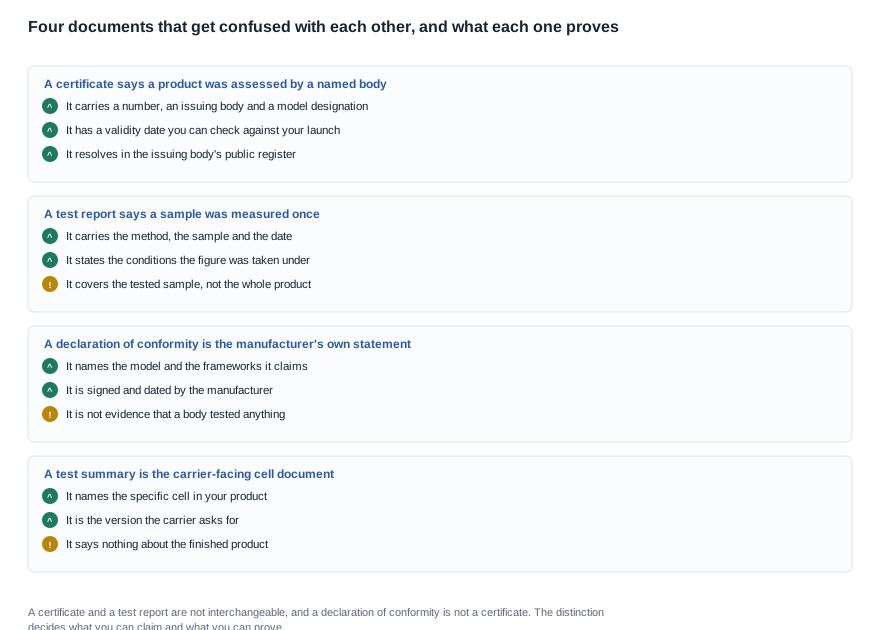
The four documents in that checklist are the ones a procurement team handles most often and distinguishes least often, and the confusion has a cost every time it happens.
A certificate says that a named body assessed a named product against a named standard. It has a number, an issuing body, a model designation and a validity date, and it can be resolved in the issuing body's public register. It covers what it says it covers, and it covers the model designation on it.
A test report says that a sample was measured once, against a method, on a date. It is a record of one measurement, not an approval of anything, and it covers the tested sample rather than the product generally. A test report is the right document for a factory's own incoming or end-of-line evidence, and it is the wrong document to hold as evidence of market conformity.
A declaration of conformity is the manufacturer's own statement that the product meets the frameworks it names. It is signed and dated and it is legally load-bearing, but it is not evidence that a body tested anything, and it is worthless as a substitute for a certificate where a certificate is required.
A test summary is the carrier-facing cell document for the UN 38.3 regime. It names a specific cell, it is the version the carrier asks for, and it says nothing whatever about the finished product.
How to tell them apart when they arrive
The test is not the document's title but its structure. Does it carry a number that can be resolved in an issuing body's register? Then it is a certificate and it can be verified. Does it carry a method, a sample and a date? Then it is a test report and it is reproducible but not verifiable against anything external. Is it signed and dated by the manufacturer and does it name the frameworks it claims? Then it is a declaration and it is the manufacturer's own word. Does it name a cell and reference the transport regime? Then it is a test summary and it belongs in the freight file rather than the compliance file.
The mistake that causes the most damage in this category is treating a declaration as though it were a certificate. It arrives, it is a PDF, it has the right letters on it, and it goes into the file — and then a carrier, a marketplace or a market surveillance authority asks for the certificate behind it and the answer is that nobody asked for one.
The document chain, and how to verify it yourself
The seven steps from a supplier's answer to a filed record

The order above is the point. Each step assumes the previous one passed, and a failure at any step tells you what the next step would have told you — which means a weak answer at step two is cheaper to discover than a weak answer at step six.
Step two is the one that catches a substitution, and step four is the one that catches a certificate issued for a scope the product does not occupy. Both are cheap, and both are routinely skipped because the file arrived and the launch was close.
Why a document pack that cannot be verified is worse than a small one
This is the point worth pressing, because it is counter-intuitive. A supplier with a small, complete and verifiable pack is in a better position than a supplier with a large, impressive and unverifiable one — and the buyer who cannot tell the difference will pay more for the second.
An unverifiable pack cannot be used in an audit, cannot survive a marketplace review, cannot be handed to a distributor's compliance function, and cannot be attached to a claim. Every one of those uses requires a document that somebody else can check, and the reason the pack is unverifiable is usually that the number is missing, which means the document exists but the claim about it does not.
There is a second-order effect that matters commercially. The document pack is one of the few areas where a buyer's diligence and a supplier's documentation maturity are the same thing, and it is therefore a reliable predictor of how the rest of the relationship will go. A supplier who volunteers certificate numbers with their issuing body and their validity dates is telling you how they run.
Our position, and what we will put in the file
We publish the technical methods our catalogue states and the empty measurement rows beside them, and we will not infer a driver size, a leakage distance or a frequency response from a method name. We publish no third-party acoustic measurement for any model in the audio range, and we will not present a design intent as a performance result.
We will also be direct that the absence of an acoustic standard is not a gap that will close on its own, and that a buyer waiting for a standard to compare against is a buyer who will compare marketing instead. The protocol is the standard, and it is yours to write.
What we can do is build the protocol with you — the environments, the script, the pass criterion and the leakage threshold — and run it against samples so that the result is reproducible by your own team. The published rows behind the comparison are set out at open-ear key specifications, the field behaviour of the same tier is at open ear audio real world performance, the technology background is under open-ear audio, and the range is at Bluetooth audio glasses.
The target market list, and the radio route
-
Send us your target market list. We will tell you which radio route applies where, and which of your documents are per-market rather than per-product.
-
Send us the file you have. We will mark which pieces are certificates, which are test reports, which are declarations and which are test summaries, and which of them name the exact model designation you are ordering.
-
Send us the acoustic criteria you intend to write. We will tell you which of them can be closed by a document, which cannot, and which have to be closed by a test you run yourself.
-
Ask us what we do not publish. A specification built on rows we will not supply is a specification you cannot close, and it is cheaper to know that at the quotation stage.
Related reading
- The published figures — open-ear key specifications
- Field behaviour — open ear audio real world performance
- Bluetooth audio glasses range
Send us the environments and we will write the acceptance protocol with you.


