

The lead time for a photochromic smart glasses product is not driven by the lens. It is driven by the fact that this platform has no published model number, which means the documentation that everything else depends on cannot be written yet. That sounds like a footnote and it is the whole schedule.
The published specification is Bluetooth V5.4, a 100 mAh battery, a charge time of up to two hours, a rated runtime of approximately seven hours, magnetic charging and an electrochromic lens. The customisation route for the platform includes lens colour range and transition speed, which tells you the lens is meant to be specified rather than merely fitted. But no model number, no certification status and no lens performance figure is published, and those three absences are what the lead time is made of.
This is the difference between a schedule that can be committed and one that is a hope. A factory can commit to an assembly date because assembly is something a factory controls. A brand cannot commit to a launch date because a launch depends on an artwork approval, a conformity document, a customs description and a listing review, and those four things are owned by people who are not in the factory.
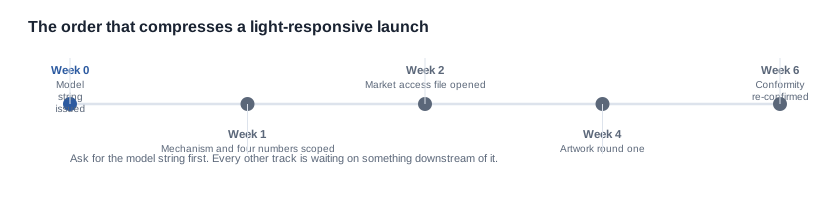
The photochromic smart glasses lead time is a document sequence, not a factory queue
The three lines that make up the schedule
A light-responsive programme is really three lines of work that a buyer tends to run as one, and the mistake is expensive.
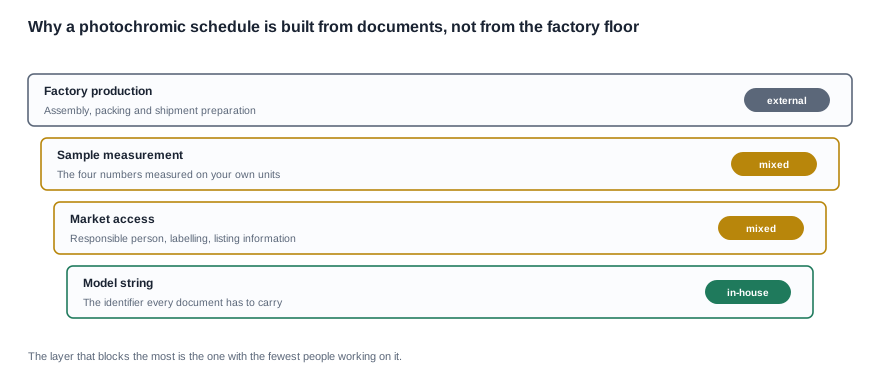
The first line is identification: the model string, the artwork, the packaging, the label copy and the customs description. Nothing on this line can be finalised without the string, and the string is what every other document has to carry. The second line is the lens: the mechanism, the four performance numbers, the coating, the material file and the lens module's place in the bill of materials. The third line is market access: the conformity route per market, the economic operator, the labelling, the listing information and the online marketplace review.
Only the first line blocks the others, and the reason is worth stating plainly: the market access file needs the model string to name, and the lens development needs the target configuration to aim at. Run the two lines in the wrong order and the lens work is aimed at a configuration that later changes, which is the most expensive form of rework in this category.
What the published rows do and do not tell you about timing
The six published rows — radio generation, charge time, cell capacity, runtime, charging interface and mechanism — settle the bill of materials but not the calendar. A cell capacity tells you that a component has been chosen. It does not tell you whether that component is a standard part that ships in four weeks or a custom part that is made to order with a twelve-week queue, and in a light-responsive product the lens module and the driver electronics are frequently the long-lead items rather than the radio.
The more important point is what the rows do not settle at all. No model number means the artwork cannot be printed, the certificate cannot be listed, the customs description cannot be written and the warranty cannot reference a product. The absence of a published certification position means the buyer cannot start the compliance clock from a known baseline, and the absence of any lens performance figure means the acceptance protocol has to be written before there is anything to accept.
There is a practical consequence that buyers consistently miss. A quote that lists a unit price and a delivery date is quoting the assembly date. The date a customer sees in the channel is the assembly date plus the artwork round count plus the conformity elapsed time plus the listing review plus the freight. In this category the last four items are routinely longer than the first, and the schedule that only names the first one is not a schedule.

The model identifier is the first task because everything else waits on it
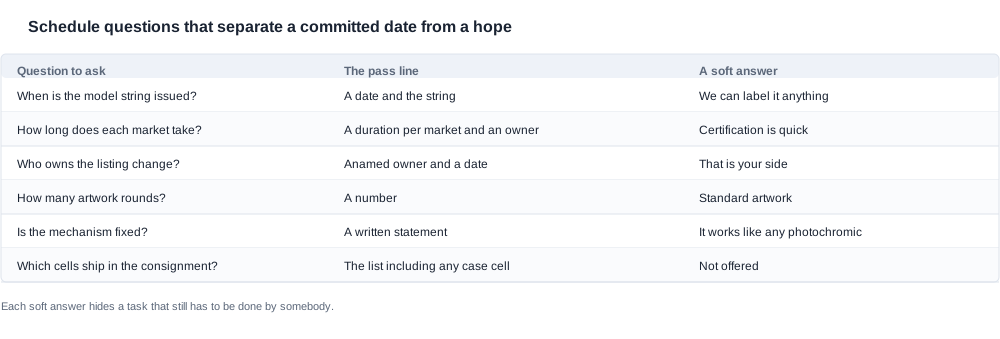
The schedule questions below are the ones that separate a date a supplier will stand behind from a date that is a wish. The third column is what a soft answer sounds like, and each soft answer hides a task that still has to be done by somebody.
| Question to ask | The pass line | A soft answer |
|---|---|---|
| When is the model string issued? | A date, and the string itself | "We can label it whatever you like" |
| How long does each market take? | A duration per market, and a named owner | "Certification takes a few weeks" |
| Who owns the listing change? | A named owner and a date | "That is on your side" |
| How many artwork rounds are included? | A number | "Standard artwork" |
| Is the mechanism fixed for the platform? | A written statement, with the flat-battery behaviour | "It works like any photochromic" |
| Which cells ship in the consignment? | The cell list, including any case cell | "Not offered" |
| What is the case capacity? | A figure, and the transport scope around it | "A case is included" |
| Is the final configuration re-confirmed? | A named step before the order | Not mentioned at all |
Why an identifier that differs between two documents creates a border problem
A product with no model number cannot be ordered against, declared in a customs file, printed on artwork, listed in a technical file or referenced in a warranty claim. Every one of those five is blocked by the same missing string, which is why the string is a schedule item rather than a paperwork item.
The compounding risk is a mismatch rather than an absence. If a supplier's document names one string and your artwork names another, the problem does not surface at the quotation stage. It surfaces at the border, where the description on the commercial invoice has to reconcile with the description on the technical file, or in a warranty claim, where the model named on the claim form has to match the model on the purchase order. Both are expensive and neither is traceable to the original one-character difference.
The instruction to give a supplier is therefore specific: the model string must be identical on the technical file, on the Declaration of Conformity, on the battery transport documentation, on the artwork, on the packaging and on the purchase order. Write that sentence into the purchase order as a condition, and check the string on the units when they arrive.
The naming lesson from a model in our own catalogue
The naming lesson is worth carrying into any category, and it does not need a light-responsive lens to illustrate it. The L2 Utral certification status piece works through exactly that problem, because that model carries a naming inconsistency in our own catalogue: the published entry reads L2 Utral with a case, and the programme line also carries an Utral Pro Max variant, and the two strings are close enough that a document can be issued for one and used for the other.
The general lesson is that a model designation is a controlled identifier, and like any controlled identifier it needs an owner, a version and a change rule. A brand that treats it as marketing copy will eventually have two live strings for one product. A brand that treats it as a controlled field on the purchase order will not.
The lens programme inherits this risk with an extra layer, because a lens configuration multiplies the number of strings. One platform, three colour options and a lens option is three configurations, and if each configuration needs its own string then the identification work is three times what a single-model programme assumes. Asking the supplier how many strings they will issue, and on what basis, is a question whose answer changes the schedule.

The four lens numbers are a development task, not a document to collect
Settle the mechanism before you settle the numbers
Four numbers have to be settled before the lens can be specified: the transition time, the tint depth, the light transmission in each state, and the operating temperature range. The mechanism has to be settled before any of them, because the two mechanisms in this category behave differently and the measurement programme is wrong for one of them.
A product-driven electrochromic lens needs power, a driver and a control strategy, and it can be commanded. An ultraviolet-driven photochromic lens needs none of that and barely changes behind a windscreen, because the glass blocks most of the ultraviolet that drives the reaction. The platform in our range is electrochromic. If a programme is specified against a different mechanism, the whole test programme is the wrong programme and the elapsed time doubles, because the first round of measurements has to be discarded.
There is a sequencing detail that saves a week. The mechanism fixes the control strategy, and the control strategy fixes the conditions under which the switching times are meaningful — the initiating light level, the ending light level, the temperature and the direction. So the mechanism is not one decision among four; it is the decision that makes the other four writable.
What a soft answer about lens customisation is hiding
The customisation route for this platform covers lens colour range and transition speed, and both are specification inputs rather than decoration. But a supplier who answers "the lens is customisable" has told you almost nothing, and the gap is worth naming because the answer determines whether the buyer is negotiating a lens selection or commissioning a lens development.
The distinction is concrete. A lens selected from a catalogue of available modules is a procurement decision with a lead time and a minimum. A lens developed to a buyer's transition time is an engineering project with a development cycle, a sample stage, a validation stage and a cost, and its schedule is not the same as the rest of the product's.
The questions that separate the two are short: what transition times are available from the existing module set, what is the minimum quantity per lens variant, how long is the lead time on a standard variant against a custom one, and does a custom variant trigger a new material file and a new conformity position. A supplier who answers all four is giving you a schedule. A supplier who answers one is giving you a brochure.


Market access runs in parallel and is usually what ends the programme
The European launch sequence and the listing change
The market access work is the same for this platform as for any other Bluetooth product in the range, and it is usually what determines the launch date, because it depends on documents the brand has to assemble rather than on things the factory can supply.
In the European Union the sequence starts with the general product safety regulation, which has applied since 13 December 2024, and it requires the economic operator, the technical file, the traceability, the labelling and the information supplied to the user to all be in place. The listing change is frequently the longest single lead item in the whole programme, because it sits with the brand's own team and with the platform's moderation rather than with the factory. The GPSR route sets out the sequence in detail.
The practical instruction that follows is simple and is the one most often missed: find out who owns the listing change, and put a date against it. A schedule that assumes the factory owns it is wrong by weeks, and it is the kind of error that surfaces as a launch date slipping with nobody able to explain why.
Battery transport scope as a second track
A charging case is a second lithium cell, and the transport documentation has to cover every cell in the consignment. On the platform published in our range there is no case, so the transport scope is the product cell alone — a 100 mAh cell, which is a routine scope. Elsewhere in the range the case capacities are published and they are substantial: CY05 and the CY03, and L1 Pro each carry a 1400 mAh case, the L2 Utral carries 900 or 1400 mAh, and the MT6 carries a 1200 mAh foldable charging case. A programme that adds a case late therefore adds a second cell to the transport scope at exactly the point where the paperwork is being closed.
The sequencing rule that follows is worth stating: fix the case decision, then write the transport scope, and put cell and case changes on the change-control list with a notice obligation attached. A cell substitution that happens in transit invalidates the transport paperwork, and that is an in-transit problem rather than a factory problem.
The requirement that arrives after your launch date
A product launched today will be on the market when a requirement arrives that it was never assessed against. The EN 18031 series is scheduled to become a mandatory component of CE marking for radio equipment from 1 August 2025, which is after this article's publication date, so it is not a requirement today. It will be one shortly.
The commercial point is not that the product is non-compliant. It is that the security documentation position for a connected product has to be asked about now, because the answer determines whether the programme needs a re-issue later, and a re-issue is a schedule item you can either absorb or plan for. Buyers who ask this question in the quotation stage get an answer; buyers who ask it after the technical file is closed get a schedule change.
Building a photochromic schedule you can commit a date against
The order to run the six steps in
- Get the model string, and get a date for it. Everything downstream of the string is blocked, and the string is the item most often left to the end.
- Confirm the mechanism in writing, including the flat-battery behaviour. A powered lens that stays dark on an empty cell is a product decision and a support-script line, and it has to be specified rather than discovered.
- Scope the four lens numbers, and start the compliance work in parallel. The compliance track does not depend on the lens and it is the track that usually ends the programme.
- Fix the case decision and write the battery transport scope around it. A case is a second cell and a second set of paperwork.
- Lock the lens specification, the artwork and the packaging, in that order. The lens specification feeds the artwork, and the artwork should not be approved twice.
- Re-confirm the conformity position against the final configuration. The configuration is what the document has to name, and the final configuration is the one that ships.
The checklist to run before you accept a delivery date
A supplier's delivery date is a claim about a sequence they control, and the questions to ask are the same every time. Run this list before you order, and again before you sign.
- Is the date an assembly date or a delivered date? If it is an assembly date, ask what the buyer-side tasks are and how long each takes.
- When exactly is the model string issued, and who signs it off? A date without a name attached to it will move.
- How many artwork rounds are included, and what triggers an extra round? In this category the triggers are lens configuration, colour count and market label count.
- Which market is the critical one, and who owns that market's file? For a multi-market launch there is usually one market that sets the date.
- Does the date assume a case, and is the battery transport scope written for that case?
- Is the mechanism fixed for the platform, and does a custom transition time change the date?
- What happens to the date if the sample fails the acceptance criteria? The answer separates a schedule with a feedback loop from one that assumes a first-time pass.
- Which part of the date is a commitment and which part is an estimate? This is the single most useful question on the list, because suppliers routinely give a single date made of one commitment and several estimates.
The total cost of the programme is not the unit price and it is not the elapsed time. It is the sum of the elapsed time, the number of artwork rounds, the number of configurations committed to, the cost of a sample that fails, and the cost of a re-issue after a configuration change. A buyer who negotiates the date without that total is optimising one term of the equation.
Which schedule terms can move and which cannot
The schedule is negotiable in sequence even when it is not negotiable in duration, and the distinction matters when a launch date is at stake. A supplier who will commit to the model string date, the artwork round count and the delivery split is giving the buyer the three things that actually move. The artwork round count is worth negotiating specifically, because each round is a week and the number of rounds is entirely a function of how early the brand engages.
Minimum order quantity is negotiable, as are the number of configurations committed to, the packaging and insert design, the market labels, the language of the documentation pack and the structure of the payment nodes — a deposit, a balance on inspection before shipment, and a retention held against the documentation package protects the buyer on the failure that costs most, which in this category is a product that arrives with paperwork that does not cover it.
What is not negotiable is the cost and the elapsed time of a conformity route, the amortisation of the tooling, and the model identifier itself. A supplier who will not issue a formal designation is telling you the documentation cannot be completed, and no commercial term changes that.
What we do and do not publish about lead time
Concretely, a platform without a model identifier and without a published certification position cannot be given a committed date, and the honest answer to a buyer asking about lead time is the three lines above rather than a number.
We do not publish lead times, prices, minimum order quantities or production capacity, and our internal documentation currently holds three conflicting minimum order quantity figures that have not been arbitrated. We would rather tell you that than quote a figure we cannot stand behind. What we will do is tell you which of the three lines is the binding constraint for your configuration and which of them we can close for you directly.
Send us the destination markets, the intended use, the configuration and the volume, and we will come back with what is available and what is not. The category is on our photochromic smart glasses range page, the lens numbers are covered in how to test photochromic, and the behaviour each number produces in use is in real world performance.
Related reading
- How to get the four lens numbers — how to test photochromic
- What each number means in use — real world performance
- The European launch sequence — GPSR route
Tell us the destination markets, the intended use, the configuration and the volume, and we will come back with what is available.


