

Comparing manufacturer claims in the photochromic category is difficult for a specific reason: there is so little parameter data in circulation that claims are the primary available information. When specification sheets are thin, marketing copy fills the space, and buyers end up comparing adjectives. Photochromic smart glasses manufacturer claims comparison therefore comes down to one procedure — classify each claim by the evidence that would make it usable, then check whether that evidence exists.
The procedure is worth doing properly because the categories have different consequences. A parameter claim with a method can go into a purchase order and become an acceptance criterion. A feature claim can go into a listing if it is described accurately. A certification claim can go on a box if it names a document. A comparative claim can go nowhere until somebody has measured the comparison, and until then it is a liability sitting in a document. Sorting them is what stops a sentence written for a brochure from ending up in a technical file.
The photochromic smart glasses manufacturer claims comparison is a sorting problem
Why thin data turns claims into the primary information
In a mature category, the datasheet is the primary document and the product page is a summary of it. In this category the relationship is inverted. The published electrical rows for the electrochromic entry are Bluetooth 5.4, a 100 mAh cell, charging in two hours or less, roughly seven hours of runtime, magnetic charging and the fact that the lenses are electrochromic. None of those rows tells a buyer how the lens behaves, and every one of them can be read off a product page in a sentence.
So the information a buyer actually has is the supplier's prose, and the prose is where the claims live. That is not a criticism of suppliers, who are describing their products in the only form available. It is a statement about where the diligence has to go: since the document will not tell you, the question has to.
Our own entry is a useful calibration point for this. We publish no lens parameter at all for the electrochromic entry, which means that any figure offered to you about this product came from somewhere other than us. That is worth knowing before the comparison starts, because it changes the question from "is this figure good" to "where did this figure come from and under what conditions".
The single most reliable supplier-quality signal
There is one behaviour that distinguishes a supplier who has measured from a supplier who has copied, and it costs a single question.
A supplier who has measured will usually volunteer the conditions. If you ask how quickly the lens changes, the answer comes back with a direction, a light level and a temperature attached, because those are the three things the supplier had to fix in order to take the reading in the first place. A supplier who has copied a figure from a datasheet cannot volunteer them, because the datasheet did not say.
The same behaviour shows up in a second, less obvious form. A supplier who has characterised their own product will have an answer for the flat-battery state, even if the answer is uncomfortable. A supplier who has only assembled a product from parts will not, because nobody asked them to look. The flat-battery question is therefore the fastest way to find out whether the product has been characterised or merely configured.
Six claim types and the evidence each one would need
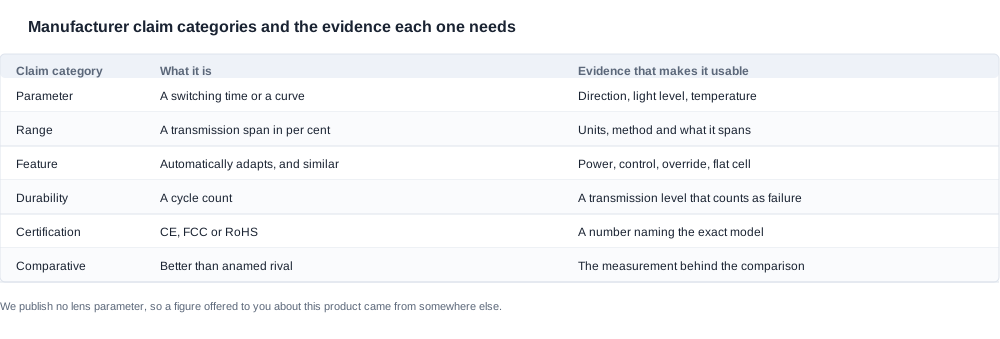
The classification is the whole procedure, and it is worth having in one table before any individual claim is examined.
| Claim category | What it is | Evidence that makes it usable |
|---|---|---|
| Parameter | A switching time, a response curve, a depth at a stated light level | Direction, light level, temperature |
| Range | A transmission span in per cent | Units, method, and what the range was measured across |
| Feature | "Automatically adapts", and similar | Power, control, override, flat-cell state |
| Durability | A cycle count | A transmission level that counts as failure |
| Certification | CE, FCC, RoHS, or a market approval | A number naming the exact model |
| Comparative | "Better than mineral lenses", "faster than a rival" | The named comparison and its measurement |
Parameter claims and range claims
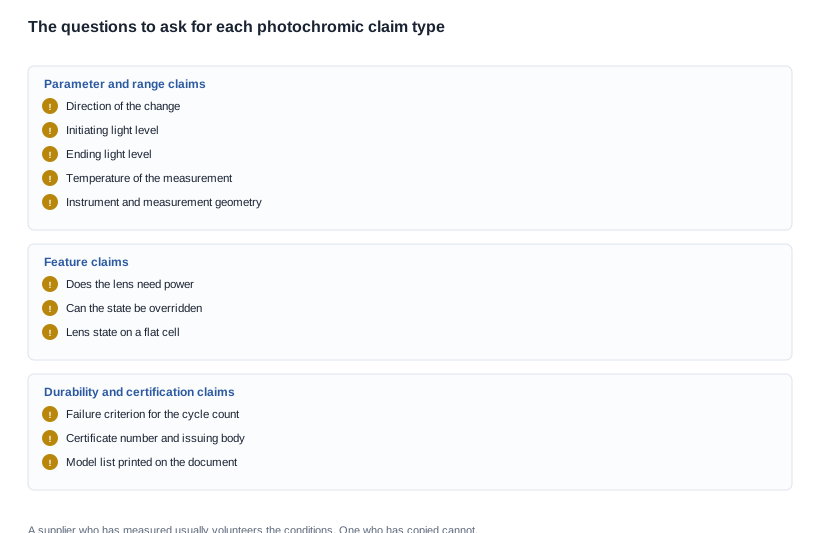
A parameter claim is a single measured value: a switching time, a response curve, a depth at a stated light level. The evidence that makes it usable is the direction of the change, the initiating light level, the ending light level and the temperature. Note that "how fast" is not a parameter claim at all; it is a phrase that is waiting for four conditions to be attached before it becomes one.
A range claim is a span rather than a point, usually a transmission range in per cent, and it has an additional requirement: the buyer needs to know what the range was measured across. A range measured across a full day of driving and a range measured in a controlled light box are both legitimate and they produce materially different numbers, because the first includes transitions and the second does not. A range claim that omits the method is not a narrower version of a specification. It is a different quantity presented under the same name.
There is a third variant that catches buyers, which is a range quoted with a narrow condition attached. "Darkens to ninety per cent" is a claim. "Transmits between a low figure and a high figure under stated conditions" is a specification. The former sounds impressive because it has a single number; the latter is what can go into an acceptance criterion.
Feature claims and the four questions behind them
A feature claim describes what the product does without giving a measurement, and the common ones in this category are "automatically adapts", "adapts to changing light" and "tint control from your phone". Each of those resolves into four concrete questions, and until all four are answered the claim is about the technology rather than about the product.
- Does the lens need power to change state?
- Is the state controllable by the wearer, or only by the product's own control strategy?
- Can the wearer override the product, and if so, how?
- What does the lens do when the cell is empty?
The fourth question is the one buyers skip and the one customers ask. A lens whose state depends on a battery behaves differently from a passive one, and that difference is invisible until the battery is flat — which is a support call, a return and a review, in that order.
Durability claims and certification claims
A durability claim is a cycle count, and the evidence that makes it usable is the end-of-life criterion: at what transmission level is the lens considered failed. A lens rated for a hundred thousand cycles might mean a hundred thousand shallow transitions or a fraction as many full ones, and the difference between those two readings is the difference between a product that lasts and a product that does not. Without the criterion, the supplier has not defined a durability warranty either, so the claim is incomplete in a second way as well.
A certification claim names an approval, and the evidence that makes it usable is a number and a model. Our own catalogue's export-certification page carries ten patent certificates, eight appearance-design patents and two utility-model patents, and names no CE, FCC or RoHS marking, which leaves every conformity document to be requested per model, and that is the honest formulation — a claim about shape or mechanism and a conformity document are two different things, and only the second one carries a model string. It is also exactly the formulation a buyer has to convert into a per-model document before the programme can be scheduled, because a company-level capability cannot be read across to a specific configuration.
Comparative claims and the liability they create
A comparative claim asserts that this product is better than another on some dimension, and the evidence that makes it usable is a named comparison plus the measurement behind it. The commercial risk here is the largest of the six, and it is asymmetric.
A supplier who writes "better than mineral photochromic lenses" is usually being friendly, and usually means it as a category reference. The problem is that the behaviours are genuinely different — a powered lens and an ultraviolet-driven lens do not behave the same way — so a comparison that is friendly in a quotation becomes a promise in a listing. And once the comparison is in the buyer's own copy, the buyer carries it. A copied comparison whose method does not match the original is the buyer's liability, not the supplier's, and the buyer is the party the customer will come back to.
The safe handling is narrow and practical: check the method, and if the method cannot be established, drop the comparison rather than rephrase it.


Running the two-question sort on a supplier page
Step one, name the type before you judge the wording
Take every claim you have been given and put it into one of the six types before you decide whether it is good, bad or exaggerated. This takes about an hour per supplier and it is the whole of the procedure.
The order matters, and it is the opposite of the intuitive one. Most buyers read a claim and decide immediately whether it sounds credible, then look for evidence afterwards. The problem is that credibility is exactly what the claim is designed to produce, so the first impression carries no information. Naming the type first tells you what to look for, and then you look.
The second reason to name the type is that it prevents a strong claim from cancelling a weak one. A supplier who writes one excellent, fully-conditioned parameter claim and four vague feature claims is not a supplier with a documentation problem; they are a supplier with one documented area and four undocumented ones, and the register is what shows you which is which.
Step two, ask for the evidence and check whether it exists
For each claim, ask what evidence would make it usable, and then ask whether that evidence exists. The two questions are asked in that order deliberately, because the first tells you what to ask for and the second tells you what to do next.
The third question — the one that actually decides the case — is whether the figure was measured on the configuration you are buying. A supplier may have characterised a different lens, a different platform or a pre-production build, and in this category the "same product" in a quotation and the product in the sample are not guaranteed to be the same build. Ask which unit the measurement came from and which unit you are being quoted.
A worked example of the sort on five claims from one supplier
The sort is easier to see on a concrete set than to describe in the abstract, so here is a representative five-claim extract from a quotation and what each one becomes. The wording below is the kind of language that arrives in this category; none of it is attributed to any named company.
- "Fast electrochromic switching for an instant change." A feature claim with a performance claim embedded in it. The four conditions are missing, so it is not yet a parameter. Asking for the direction, the light level and the temperature converts it into one, and the answer either produces a specification row or confirms that the phrase was decoration.
- "Transmission from 15% to 90%." A range claim with no method. The buyer has to establish what the range was measured across and over what period, because a range that includes transitions and a range that does not are different quantities. Until that is known, the figure cannot enter the specification file even though it is a number with units.
- "Tested to 100,000 cycles." A durability claim with no end point. The request is short: at what transmission level is the lens considered failed. A supplier that answers it has a warranty in mind; a supplier that does not has a marketing figure.
- "CE and RoHS certified." A certification claim with no document. The question is which model the certificate names, because a family-level document does not cover a specific lens configuration. This is the claim most often repeated from a catalogue line, and in a brand-led programme the buyer has to obtain the per-model document rather than rely on the line.
- "Unlike traditional photochromic glass, our lens changes under your control." A comparative claim. The comparison is fair in kind and unfair in practice, because the two mechanisms behave differently, and the sentence is one a customer will read as a promise. It stays in the positioning file only if it is rewritten to describe the mechanism without the comparison.
The result of sorting five claims is not a verdict on the supplier. It is a file: one claim that may become a specification row, three that need a request attached, and one that has to be rewritten before it goes anywhere near a product page. That is a far more useful outcome than a verdict, because each of the four open items has a named next action and an owner.
Step three, route the claim into one of two files
Every claim ends up in one of two places, and the rule between them is what stops the argument.
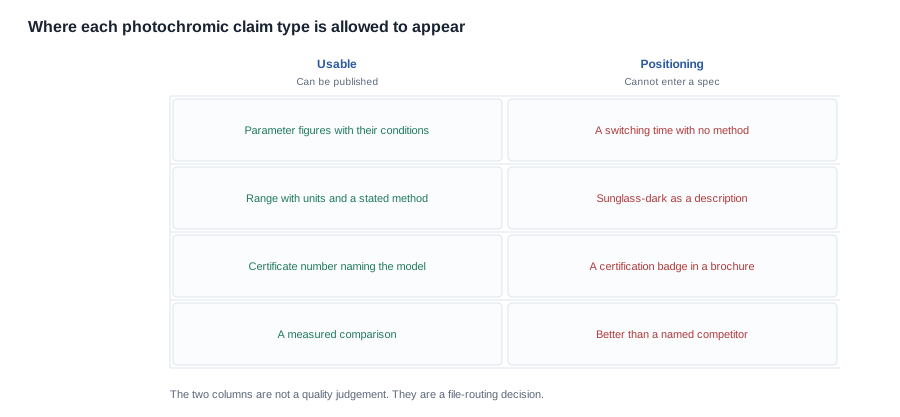
The specification file holds only claims that have evidence attached, and the evidence travels with the claim: the conditions, the method, the issuing body, the date. The positioning file holds everything else — the adjectives, the comparisons, the unconditioned figures, the category language. Nothing moves from the second file into the first without evidence behind it.
The value of the two-file rule is that it removes a recurring argument. In the middle of a programme, somebody will want to move a sentence from the positioning file into the specification because the programme needs a number. The rule says the sentence does not move; a measurement is commissioned instead, and the measurement takes the time it takes.
Where each surviving claim is allowed to appear
The specification file, the positioning file and the rule between them
A claim with evidence attached can appear in three places, and each place has its own discipline. In the purchase order it appears as an acceptance criterion, with the conditions written next to it so that a failing reading is defined. In the product page it appears as a customer-facing statement, which usually means the conditions are dropped and the wording is narrowed to what survives without them. In the technical file it appears as a characterised property, and only if the characterisation is traceable to the configuration being shipped.
That last point is the one most often missed. A claim that is true of a sample is not automatically true of a production unit, and in a category with no standard the technical file is the only place where the difference can be recorded. A claim in the specification file with a named measurement unit attached is a claim that can be re-checked at the first article; a claim without one is a marketing decision wearing a technical costume.
The clause that keeps your own copy inside the evidence
Most of the exposure in this category sits on the buyer's side of the transaction, because the buyer's name is on the product page and the buyer's marketplace is where the complaint lands. Three clauses and one internal rule contain it.
The first clause requires the marketing and label wording to match the documentation, and gives the buyer the right to require the copy be amended. The second requires notice before any change of lens, coating, tint range or control logic, because a change invalidates every parameter claim attached to the old configuration. The third sets the warranty against an agreed failure criterion rather than against a cycle count.
The internal rule is the one that does the most work: a line of copy does not go live until somebody has matched it against the specification file, and the reviewer's job is to ask "which claim in the file supports this sentence" rather than "does this sound right". A reviewer who asks the second question will approve an excellent sentence describing a product that does not do it.
What a photochromic claim register should contain, and what we will not fill
The claims register we would keep on our own side
A register is a spreadsheet with a strict column set, and the strictness is the point. For each claim: the exact wording as supplied, the supplier, the claim type, the evidence requested, the evidence received, the conditions attached, where the claim is permitted to appear, and the date of the last review.
Three columns do most of the work. Evidence received is free text but it has to contain the conditions, because a bare number in a cell will be quoted as a bare number later. Where the claim is permitted to appear is an enumerated field, not a comment, so that the copy review has something to check against. And the date of the last review is what stops a claim that was evidenced two years ago on a different build from surviving in a current specification.
The register also makes the commercial picture visible. When a supplier can only evidence a fraction of the claims they make, that fraction is the size of their documented surface, and it tells you what a quality dispute about that product will look like.
What we publish and what we refuse to repeat
It is worth being precise: we will publish the five parameters we hold for the electrochromic entry and state plainly that no lens performance figure is available to us, and we will not manufacture a model designation or a switching time to fill the gap. We will also not repeat a comparative or durability claim we cannot evidence, and we will not infer a per-model conformity position from our company-level export certification line.
We will also be direct about a comparison point that buyers find useful: a supplier claiming a figure for this product is claiming a figure from somewhere other than us, and the method question is how you find out where. The fastest route is the flat-battery question, followed by the three switching-time conditions.
If you have claims in front of you that you cannot place, send them and we will tell you which category they fall into and what evidence would be needed. The background is under photochromic lens technology, the measurement method is in how to measure photochromic smart glasses, the claim-reading companion is in photochromic red flags, and the selection method is in how to choose photochromic smart glasses.
Where the claim categories come from
Send us a claim you cannot place and we will tell you which category it falls into.


