

In the photochromic category, the red flags are unusually easy to spot because the specification is thin to begin with. There are very few published numbers to hide behind, so suppliers fill the gap with adjectives. Our own catalogue entry for electrochromic glasses publishes: Bluetooth 5.4, a 100 mAh battery, charging in two hours or less, about seven hours of runtime, magnetic charging, and the fact that the lenses are electrochromic. That is the entire entry. There is no model designation, no switching time, no transmission range, no temperature behaviour and no lens coating detail. Given that, photochromic smart glasses red flags are mostly about claims made to fill a specification sheet that is essentially empty.
A screen for red flags is therefore unusually cheap to run here, and unusually cheap to run early. In a category with a dense published specification, a buyer compares numbers and the red flags hide inside them. Here the numbers are six rows long, so every claim beyond them is visible, and a buyer who reads the text closely can find the gaps before a sample is opened or a deposit is paid.
The photochromic smart glasses red flags are visible in the copy before the sample arrives
Why thin published data makes the screen unusually cheap
The usual reason a red flag screen is not run is that the flags are hard to see. A supplier's datasheet is dense, every row looks like a specification, and separating a genuine characterised property from a plausible number requires domain knowledge and time. That argument does not apply to this category.
With six published rows and no second platform carrying lens data to compare against, a supplier's claim is either one of those six rows, a claim attached to a number that does not exist, or a claim that cannot be checked at all. There is no middle ground in which a number looks authoritative because it sits between two other numbers. That is what makes the screen cheap: it is a reading exercise, not an investigation.
The corollary is that the screen has to be run on the text rather than on the unit, because the text is where the flags are. A sample tells you whether the product works. It does not tell you whether the supplier's documentation will cover the configuration you ship, and it arrives far too late in the programme to be useful for that question.
The cost of finding a flag late
The economics of this are straightforward. A red flag found at the quotation stage costs one email. The same flag found after the artwork is approved and the packaging is ordered costs a re-approval cycle, a reprint, and possibly a new model string on every document that carried the old one.
There is a second cost, and it is the one that is easier to underestimate. A claim you publish without checking becomes your claim, with your name on it, in a market that may regulate it. So the red flag does not stay a supplier problem; it becomes a brand problem the moment the copy goes live, and brand problems of this kind are settled in public rather than in a meeting.
The third cost is a schedule cost, and it is specific to this category. A missing model designation, an unconfirmed material file or an unstated flat-battery behaviour is not a documentation detail — it is a task that has to be done before artwork, packaging and the conformity file can be closed. Finding that flag at the quotation stage means it can be scheduled. Finding it at the artwork stage means the schedule moves.

The eight flags and the question that replaces each one
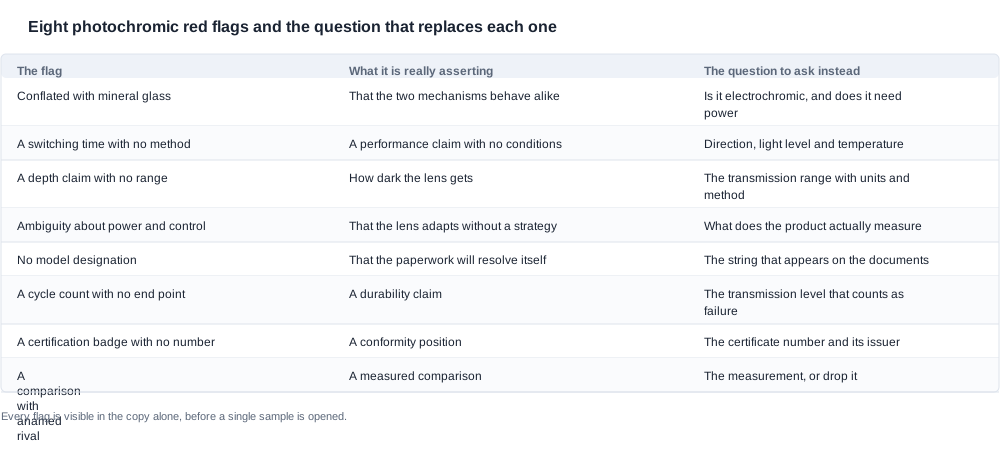
The eight flags are set out below. The third column is the point of the screen: every flag has a question that closes it, and the question is asked in a way that a supplier can answer.
| The flag | What it is really asserting | The question to ask instead |
|---|---|---|
| Conflated with mineral glass | That the two mechanisms behave alike | Is it electrochromic, and does it need power |
| A switching time with no method | A performance claim with no conditions | Direction, initiating light level and temperature |
| A depth claim with no range | How dark the lens gets | The transmission range, with its units and method |
| Ambiguity about power and control | That the lens adapts without a strategy | What does the product measure, and can the state be overridden |
| No model designation | That the paperwork will resolve itself | The string that appears on the documents that ship with the goods |
| A cycle count with no end point | A durability claim | The transmission level that counts as failure |
| A certification badge with no number | A conformity position | The certificate number, its issuer and its validity dates |
| A comparison with a named rival | A measured comparison | The measurement, or drop it from your material |
The three mechanism and control flags
Flag one: the claim conflates the product with mineral glass. A supplier who writes "photochromic, just like the classic lenses" is usually being friendly, and usually means it as a category reference. The problem is that the behaviours differ, and a buyer who carries the comparison into their own copy inherits a promise they cannot keep. The question that replaces the flag is whether the lens is electrochromic and whether it needs power, asked as a written request rather than read as a description.
Flag two: the power and control dependency is ambiguous. "Automatically adapts" describes a passive lens responding to light, or a powered lens under software control, and the two are different products. The second question a customer asks after "does it darken automatically" is "what happens when it is flat", and the second question a buyer should ask a supplier is what the product measures, whether the wearer can override it, and what the lens does at a flat battery.
Flag three: the flat-battery behaviour is not described at all. This is a separate flag from the second one because it is a specific omission rather than an ambiguity, and it is the omission that generates the most expensive returns. Our catalogue publishes magnetic charging and a 100 mAh battery for the electrochromic entry, which tells the buyer the product is powered; it does not tell the buyer whether the lens depends on that power. Silence on the subject is the flag.
The four number flags
Flag four: a switching time with no measurement behind it. The same product measured under different conditions produces materially different numbers, and a figure quoted without a direction, an initiating light level and a temperature is not a measurement. The question that replaces it is the three conditions asked as one question, and the answer is the fastest supplier-quality signal in this category: a supplier who has measured will usually volunteer them.
Flag five: a depth claim with no transmission figure. "Full sunglass darkness" and "like sunglasses outdoors" are claims about how dark the lens gets, and depth is measured as a transmission range. No transmission figure is published for our entry, so a buyer who repeats the claim is making a product performance statement they cannot substantiate. This one has consequences beyond marketing, because in a market that regulates dark lenses at the wheel an unsubstantiated depth claim puts the retailer in a difficult position. The question that replaces the flag asks for the range with its units and method, and "not published" is a legitimate answer to it.
Flag six: a uniformity figure with no grid. The maximum difference between zones is meaningless without the grid and the viewing geometry, and "even" is not a number. The question that replaces the flag asks for the grid, and a buyer who gets one has something that can be applied identically by both parties.
Flag seven: a cycle count with no end point. A lens rated for a hundred thousand cycles could mean a hundred thousand shallow cycles or a fraction as many full transitions, and without a failure criterion the supplier has not defined a warranty either. The question that replaces the flag asks for the transmission level at which the lens is considered failed.
The paperwork flags
Flag eight: no formal model designation. This one is easy to miss because it does not appear in the copy at all — it appears as the absence of a string on the artwork, on the certificate and on the customs description. A product with no formal string cannot be correctly listed on a certificate, correctly packaged or correctly described at customs. Our own entry has none, and we are not going to invent one, so this is a finding to resolve with the supplier rather than a reason to walk away on its own.
There are two related paperwork flags worth running alongside it. A certification claim with no document is the badge on the website rather than a number; our own catalogue's export-certification page carries ten patent certificates, eight appearance-design patents and two utility-model patents, and names no CE, FCC or RoHS marking, and the per-model conformity document is what a programme actually needs — a patent certificate is evidence that a design or a mechanism is ours, not evidence that a model string has been assessed for a market. And a comparative claim against a named product is a measured comparison until the measurement is produced, and until then it is a liability sitting in the buyer's marketing.

Running the screen on the text rather than on the unit
Pull the numbers onto one sheet first
The screen has an order, and the order is the difference between a screen and a reading. The first step is to pull every number on the supplier's material onto a single sheet with three columns: the number as written, the conditions attached to it, and the source of the claim. It takes twenty minutes per supplier and it is the step that makes the rest of the screen mechanical.
Once the numbers are on one sheet, the adjectives are no longer a matter of judgement. A claim that has a number attached can be checked against the second column. A claim that has no number cannot be checked at all, and the question is not whether it is credible but whether it is usable. The screen stops being an argument about tone and becomes a list of things to ask for.
Attach the condition to each number
For each number on the sheet, the buyer attaches the conditions that would make it meaningful, from a short list: the direction of travel, the initiating light level, the ending light level, the temperature, the unit, the instrument and the measurement geometry. A number that cannot take any of these is a marketing figure, and the screen's job is to move it out of the specification column.
This is also where the comparisons between suppliers get made properly. Two switching times measured in opposite directions, or at different temperatures, are two different measurements, and the sheet makes that visible at a glance. A buyer who has the sheet can rank; a buyer with two product pages is reading adjectives.
Check what the product page promises
The third step is the one that is about the buyer rather than the supplier: read the supplier's own product page and the draft of the buyer's listing side by side, and check the promises against the sheet. Anything on the page that has no row on the sheet is a promise the buyer cannot defend, and it will become the buyer's claim the moment the listing goes live.
The check is short and it is worth doing twice, once against the supplier's page and once against the buyer's own draft. Buyers find more problems in their own copy than in the supplier's, and they find them later, which is the expensive way to find them.


What the flag count tells you about the supplier
One flag is a question, three flags are a commercial decision
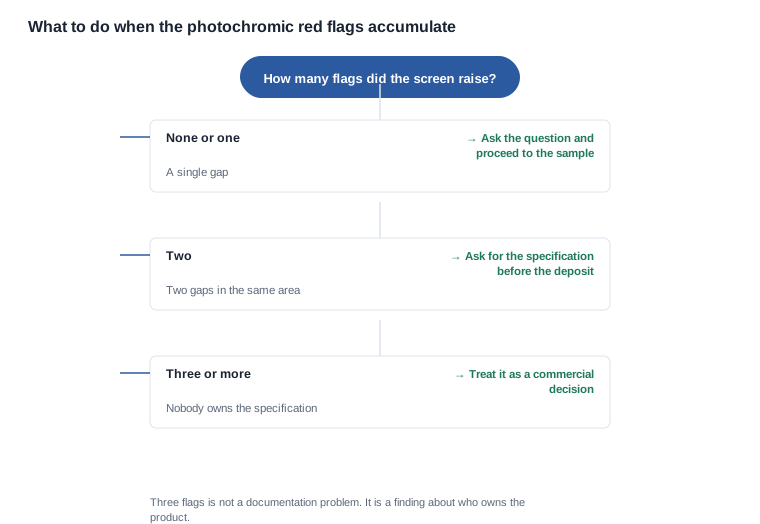
The flag count is the output that changes a decision, and it has three bands.
Zero or one flag is a normal supplier with a normal gap. The action is to ask the question and proceed to the sample. This is the ordinary case and it should not slow a programme down.
Two flags in the same area is a documentation gap rather than a capability gap. The action is to ask for the specification before the deposit, in writing, and to make the response a condition of the order. The reason for the "same area" qualifier is that two unrelated flags are usually two unrelated gaps, while two flags in the same area usually mean a document that has not been written at all.
Three or more flags is not a documentation problem. It is a sign that nobody with authority over the product specification has looked at it, and the commercial risk of proceeding is that the gap is discovered after the tooling, the packaging and the conformity work are committed. At that point the buyer is choosing between paying to fix a supplier's documentation and finding another supplier, and the second option is usually cheaper.
What a supplier with a maintained specification looks like
There is a positive form of this screen, and it is quicker to apply than the negative one. A supplier with a maintained specification answers, without being asked, the things a buyer would otherwise have to request: the model string appears on the documents; the flat-battery behaviour is stated; the figures arrive with their conditions; the material file is split at module level; and the end-of-life criterion for a cycle count is written down.
A supplier of this kind is rare in a thin category, and the rarity is not about capability. It is about whether anybody has been made responsible for the documentation. A supplier that answers all of these in a single reply has a documentation owner, and that is the single most useful thing a buyer can establish before the deposit.
The commercial reason to establish it early is the total cost. A supplier who has to commission a per-model document, a module material declaration and a written failure criterion after the programme has started will charge for that time, and the buyer pays for it in schedule rather than in money. The same work requested before the deposit is usually absorbed.
The two flags that only surface after the deposit
Most of the screen is run on text, and text covers most of the risk. Two items are not visible in the copy at all, and they are the two that cost the most when they go wrong.
The string that is not the same on every document. A supplier can have a model string on its website, a different one on its technical file and a third on the commercial invoice, and all three can appear on the material a buyer reads at the quotation stage. The mismatch only becomes visible when the goods are declared, and at that point the correction is a delay, a re-issue or a held consignment rather than an email. The check is simple and it belongs at the sample stage: compare the string printed on the units, the string on the artwork proof and the string on the certificate list, character by character, and treat a mismatch as a stop condition rather than a query.
The document that was issued for a different configuration. A family-level document is offered as coverage for a branded configuration, and it is not. The lens option, the colour count and the cell or case decision each create a configuration, and a document written for the platform rather than for the configuration does not cover it. The check is to ask which configurations the document names, and to compare that list against the configuration being ordered rather than against the product family in the catalogue.
Both of these are cheaper to find by asking one question in the quotation stage than by finding them at the border, and the question is the same in each case: which configuration do these documents cover, and what is printed on the units.
The document set that closes the flags you keep
The documents that close each flag
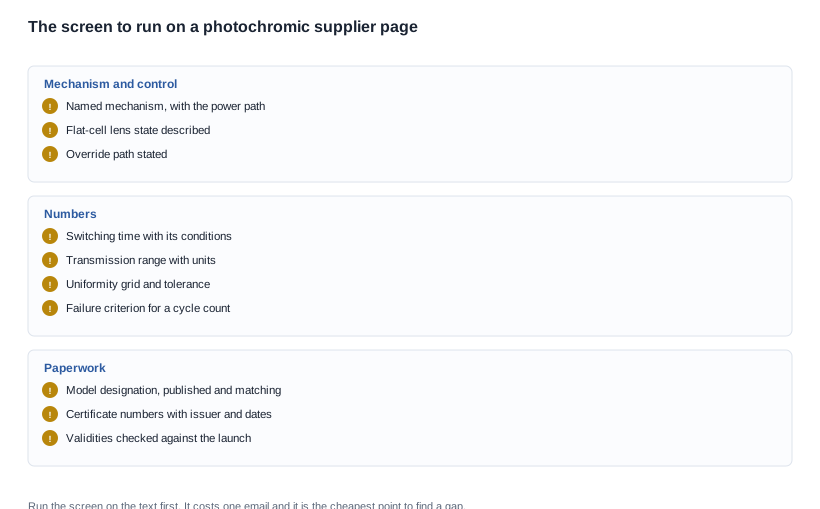
Each flag has a specific document that closes it, and the set is short enough to send as one request.
- The mechanism statement, naming electrochromic or photochromic and describing the power path if it is powered. Closes the first two flags and the flat-battery omission.
- The flat-battery lens state, in writing. Closes the third flag and belongs in the instructions.
- The switching times with their conditions, the transmission range with its units and method, the uniformity grid and tolerance, and the temperature range. Closes the four number flags.
- The end-of-life criterion for a cycle count, written as a transmission level. Closes the durability flag and gives the warranty an end point.
- The model string, and the list of models on every document. Closes the paperwork flags.
- The certificate numbers, with the issuing body and the validity dates, naming the exact model. Closes the certification flag.
The request is one email and it is better sent before the sample order than after it. Where the supplier answers "not published" to any of the number items, that is a usable answer, because it tells the buyer which figures have to be established on the buyer's own units and therefore which criteria have to be written.
What we publish, and what we will not infer
Here, we publish the rows we hold for the electrochromic entry and mark the rest as open, and a buyer who asks us for a lens figure we do not hold gets the honest answer rather than a plausible one. We publish Bluetooth 5.4, a 100 mAh battery, charging in two hours or less, about seven hours of runtime, magnetic charging and the electrochromic mechanism, and we publish no model designation, no switching time, no transmission range, no temperature behaviour and no coating detail.
We will also apply the screen to our own claims. Our catalogue carries an export certification at company level, and we will not let that be read across to a per-model conformity position for a specific lens configuration, because a company-level capability is not a per-model document. The claim categories are broken out in photochromic manufacturer claims, the wider supplier question list is in what to ask a supplier, and the counterparty question is in manufacturer versus trading company.
What we can do is run the screen on a supplier's product page with you and tell you which of the eight flags it raises, and which of them are closable with a document. The background is under photochromic lens technology.
Where the screen comes from
Send us a supplier's product page and we will tell you which of these eight flags it raises.


