

Photochromic lenses are the easiest product in this range to sell and the easiest to get wrong, because the buyer's mental model is built from a completely different technology. Almost everyone who buys photochromic lenses for the first time is thinking about glass photochromic lenses — the ones that darken in sunlight and clear indoors. Electrochromic lenses do something related and behave quite differently. Since photochromic smart glasses myths mostly cost money through bad channel positioning rather than through technical failure, they are worth naming directly.
The mechanism in our range is electrochromic, and the published configuration for that platform is Bluetooth 5.4, a 100 mAh battery, charging in two hours or less, roughly seven hours of runtime, magnetic charging, and the fact that the lenses are electrochromic. There is no published switching time, no transmission range, no temperature behaviour, no uniformity figure, no cycle durability, no coating detail and no model designation. That thin record is itself the reason the myths persist: a buyer with no figure to check a claim against has nothing to correct the claim with.
None of the four myths below is a technical error. All four are commercial errors, and all four are cheaper to fix before the product page is written than after it is live.
The photochromic smart glasses myths that start with a glass lens
Where the wrong mental model comes from
The glass photochromic lens has been in the market for decades and it is a good product. A buyer who has handled one — or who has simply bought a pair of sunglasses and seen them darken — arrives with a complete, accurate model of how a light-responsive lens should behave. That model says three things. The lens reacts to the sun, it needs no power, and it darkens and clears on its own.
An electrochromic lens in a smart glasses product breaks all three. It is driven by an applied electrical state, so it needs a cell and a driver. The product decides when it changes, so the wearer may not be able to control it. And the transition in each direction has its own timing, so "it changes" is not the same as "it changes when you expect".
The mistake is not that the buyer is wrong about glass lenses. The mistake is that the buyer's supplier, and often the buyer's own copy, treats the two as interchangeable — which is a framing decision rather than a technical one, and therefore entirely within the buyer's control.
Why the damage lands on the brand and not on the factory
The cost structure of this category is unusual. A technical failure in the factory is a factory problem, and it is caught at incoming inspection. A mental-model failure is not: the product behaves exactly as designed, the inspection passes, the units ship, and the customer finds out.
At that point the customer is not asking whether the factory built it wrong. They are asking why the product does not do the thing the listing said it would do, and the listing belongs to the brand. The evidence in front of the customer is a product page, a product page is under the brand's control, and the marketplace that hosts the review is the brand's storefront. So the return rate, the review score and the customer service cost all land on the party that wrote the copy, regardless of which party built the unit.
That is the practical reason to spend an hour on the copy before the sample order rather than an hour on the sample. A sample test tells you whether the product works. A copy review tells you whether the customer will expect something the product does not do, and that is the failure that costs money.
The mechanism difference behind every myth in this category
How a passive lens reacts to the environment
A glass photochromic lens darkens through a photochemical reaction in the glass itself, driven by ultraviolet light. The return is passive and gradual, the reaction continues while the light is present, and the lens clears on its own once the ultraviolet goes away. Two consequences follow that matter commercially. There is no battery state to manage, because there is no battery. And behind a windscreen the lens barely changes at all, because the glass blocks most of the ultraviolet that drives the reaction.
That last point is the one buyers most often miss, and it is not a defect — it is the single most common reason a customer concludes that a photochromic product does not work. The customer was in a car.
How a powered lens reacts to the product
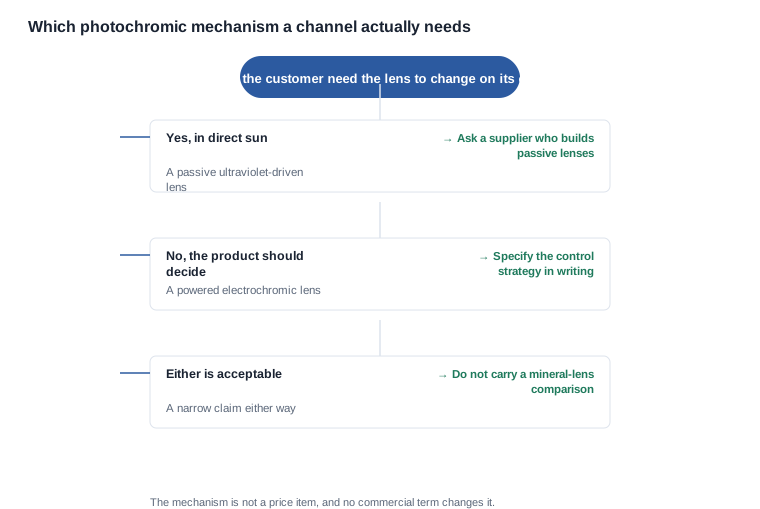
An electrochromic lens switches through an applied electrical state. It needs a cell, a driver circuit and a control strategy. Because the product decides when to change, the change can be repeatable and can be commanded, and the clear state is the default rather than a consequence of the ambient light. The trade-offs are the mirror image of the passive route: there is a battery state to specify, there is a behaviour to define when the cell is empty, and there is a decision to make about whether the wearer can override the product.
The measurement behaviour differs as well. A passive lens is a material property and tends to be characterised as a function of ultraviolet exposure and temperature. A powered lens is a system property and is characterised as a function of the control strategy, the drive conditions and the temperature. This is why a switching time quoted for one of them is not comparable with a switching time quoted for the other.
The four cases where the two behave differently
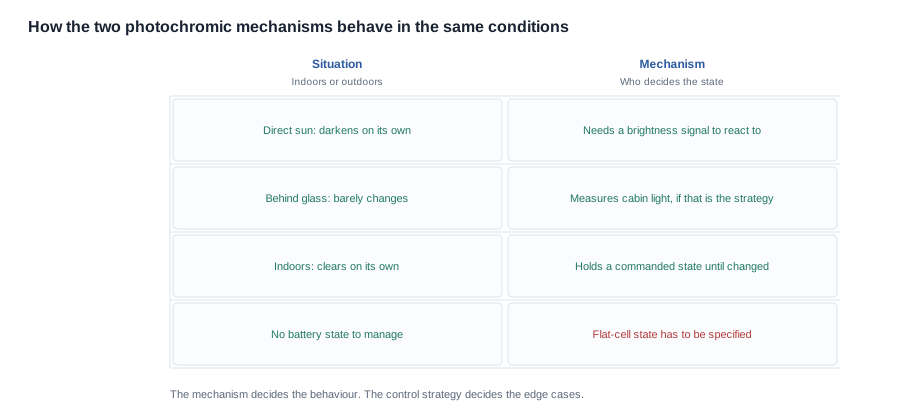
The table above is the shortest useful summary of the whole category, and it is worth keeping next to the copy review.
The first case is direct sun, where the passive lens darkens on its own and the powered lens does the same provided the product has a brightness signal to react to. The second is behind glass, where the passive lens barely changes and the powered lens measures cabin light if that is the control strategy — a strategy which is a written statement, not an assumption. The third is indoors, where the passive lens clears on its own and the powered lens holds whatever state it was commanded into. The fourth is the flat cell, where the passive lens has no state to manage and the powered lens has a state that has to be specified and written into the instructions.
None of these four is a defect. All four are behaviour, and all four are described by the mechanism.

The four myths and the commercial damage each one does
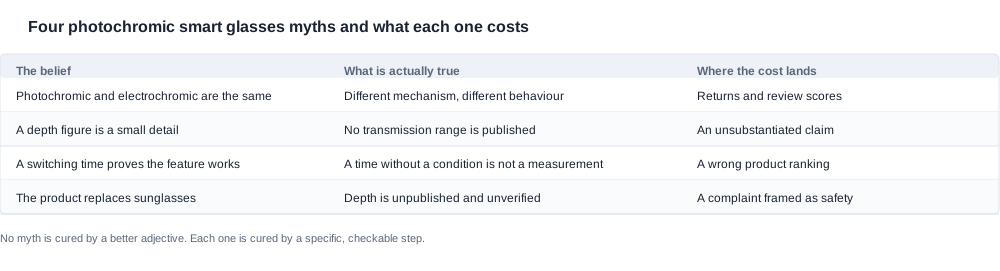
The four myths are set out below with the belief, the correction and the place the cost actually lands. Reading them together matters, because they are usually carried by the same listing rather than arriving one at a time.
| The belief | What is actually true | Where the cost lands |
|---|---|---|
| Photochromic and electrochromic are the same thing | Different mechanism, different behaviour, different power dependency | The return rate and the review score |
| A depth figure is a minor detail | Depth is a transmission range, and no range is published | An unsubstantiated claim in the buyer's own copy |
| A switching time proves the feature works | A time without a condition is not a measurement | A wrong shortlist and a wrong programme |
| The product replaces sunglasses | Depth is unpublished and unverified | A complaint framed as a safety issue |
Myth one, the two mechanisms are the same thing
The belief: a photochromic lens and an electrochromic lens are two names for the same product.
The correction: they are different mechanisms with different behaviour, different power dependencies, different measurement methods and different failure modes, and the published platform in our range is the electrochromic one.
Where the cost lands: on the return rate and the review score. A customer who owned mineral photochromic lenses carries a comparison point into the purchase, and a product that behaves differently generates a return against a product that was described accurately. The reviews that accumulate are not about defects, and they are read as defects.
The fix: the mechanism goes on the product page, in the manual and in the support script, in the same words in all three. The related mechanism background is in how the lens actually works.
Myth two, depth is a minor detail
The belief: the depth of the tint is a cosmetic detail that can be settled in the copy.
The correction: depth is a transmission range, and no transmission range is published for our entry — nor, so far as we know, for any other platform in this category. The published configuration is Bluetooth 5.4, a 100 mAh battery, charging in two hours or less, roughly seven hours of runtime, magnetic charging, and the fact that the lenses are electrochromic. Any supplier who states a depth figure is supplying a figure they have not sourced for you.
Where the cost lands: on the listing review, and potentially on the retailer. A depth claim without a transmission range behind it is an unsubstantiated performance statement, and in markets where driving with dark lenses is regulated, a retailer carrying that claim is in a difficult position.
The fix: publish only what your own measurement shows, and where the measurement does not exist yet, publish the narrower behaviour claim. A lens that adapts to light conditions is a defensible sentence; "sunglass-dark" is not.
Myth three, a switching time proves the feature works
The belief: a switching time on the page is evidence that the product does what the page says.
The correction: a switching time needs four conditions to have any meaning — starting illumination, ending illumination, temperature, and whether the figure is typical or best case. The same rule applies to every other decibels-style figure in this product class: a number without a condition is not a measurement. A switching time measured from bright sunlight to indoor light is not comparable with one measured from indoor to sunlight, and neither is comparable with a figure measured at 35 degrees against one measured at 5.
Where the cost lands: on the ranking. A buyer's shortlist is built on numbers, and a number that was measured under different conditions than the competing number produces a wrong shortlist. The buyer who is wrong here commits the whole programme to the wrong product.
The fix: ask for the four conditions, and compare only figures measured the same way. Where a supplier cannot state them, treat the number as positioning language and remove it from the comparison table rather than propagating it.
Myth four, the product replaces sunglasses
The belief: a light-responsive lens makes a pair of sunglasses unnecessary, so the listing can say so.
The correction: that claim is a depth claim, and it inherits everything from myth two. In addition, a powered lens that darkens on the product's schedule rather than on the light will darken in a meeting, which is a behaviour the buyer has to decide about rather than a defect to complain about.
Where the cost lands: in the framing of the complaint. A customer who expected a sunglasses replacement and found an adaptive tint does not describe that as a preference mismatch. They describe it as the product being unsafe to use in bright conditions, and that framing is very hard to recover from.
The fix: state the exclusion in the copy. The mechanism and the selection method are covered in how to choose photochromic smart glasses.
How the four myths compound in a single listing
The four myths are usually read as four separate errors, and fixing them one at a time understates the problem. A listing that carries all four produces a single, recognisable return pattern, and it is worth being able to describe it.
The customer buys on the promise of an automatic sunglass replacement. The product is a powered lens, so it is governed by the product's control strategy rather than by the sun, and the customer is not told that. The page quotes a switching time without its conditions, so when the lens appears slow on a weak winter afternoon the customer concludes the figure was false. The page also implies a depth, and the product does not reach that depth in the conditions the customer tried. Six weeks later the battery runs flat in a car park and the lens stays dark, and the customer concludes that the product is simply broken.
Every one of those four conclusions is wrong, and every one of them is the buyer's to answer. This is why the fix is not four edits to a product page but a single decision about what the product is. Once the mechanism is named in the copy, the depth claim narrows on its own, the switching time acquires its conditions or disappears, and the flat-battery behaviour becomes a documented feature rather than a surprise. The myth that is removed first is the one that makes the other three harmless.
The commercial reading is the same from the other side. A category with a thin published data set will keep generating this pattern for as long as the copy stays vague, and the brands that will hold their return rate in it are the ones whose product pages describe a mechanism rather than a benefit. That is a copy discipline, not a product advantage, and it is available to any brand that is willing to spend an hour on the review.

Rewriting a listing that inherited the wrong expectation
The five-step reset on a product page
A product page that inherited the mineral-lens expectation can be reset in five steps, and the order matters because each step constrains the next.
- State the mechanism, in the same words the manual and the support team will use. Not the category name — the mechanism.
- State the lens state on a flat cell, so that the most common early complaint has a scripted answer before it becomes a review.
- Publish only what your own measurement shows, with the conditions attached wherever the conditions survive translation into customer language. A figure without its conditions should not appear at all.
- Name the exclusion, in plain words, next to the feature rather than in a footnote. "It is not a substitute for sunglasses" is a sentence that protects the brand.
- Give the support team the same sentence, and put it in the first reply template. The first reply is what the customer quotes back when they escalate.

What the support team has to be able to say
The support script is where a myth either dies or reproduces itself, and the test is simple: can a support agent answer the flat-battery question, the "is it like my old sunglasses" question and the "how fast does it change" question from one page of approved wording?
The flat-battery answer is a single sentence and it should exist in writing before the first unit ships. The comparison answer is a mechanism description, not a denial. The timing answer is either a figure with its conditions or an honest statement that no figure is published — and both are acceptable, provided the agent knows which one they are giving. An agent who guesses is how an unevidenced claim becomes a customer expectation, because a customer believes an agent more readily than they believe a product page.
There is also a commercial point in the support script, and it is the reason the reset is worth the effort. A returns rate is a cost line and a review score is a ranking factor, and in a category where the feature is genuinely novel the returns come almost entirely from expectation mismatches rather than from defects. The reset is cheaper than either.
One further point belongs in the same place. The support team sees the pattern before the analytics do, because the first support reply is where a customer describes what they expected. A support template that records the expectation alongside the symptom gives the brand a running count of which expectation is wrong, and that count is more actionable than any review score, because it names the sentence that has to change.
What we will and will not publish about the electrochromic platform
The configuration and mechanism rows we publish
It is worth being precise: we publish the mechanism and the electrical rows and mark the performance rows as open, and we would rather a buyer publish a narrow true claim than a broad one they cannot defend. We publish Bluetooth 5.4, a 100 mAh battery, charging in two hours or less, about seven hours of runtime, magnetic charging, and the fact that the lenses are electrochromic, and we publish no switching time, no transmission range, no temperature behaviour, no uniformity figure, no cycle durability and no model designation.
We will also be direct about the sourcing point, because it is the fastest way to close a myth in a negotiation. A supplier who states a depth figure for this product is supplying a figure they have not sourced for you, and the most useful question you can ask is whether the measurement was taken on the model you are buying, on which unit, and under what conditions.
The claims we decline to make about lenses and eye protection
We make no vision, health or eye-protection claim for any product in the range, in any market. A device whose function is to detect a position or a distance and to remind is not a clinical intervention, and a listing that implies otherwise is a regulatory exposure rather than a marketing decision. If your channel is built on an eyesight concern, this is the wrong category, and we would rather say so before the sample order than after the copy is written.
The factory-versus-trading-company question is a separate one and it is covered in manufacturer versus trading company, because a buyer who has the wrong counterparty cannot fix any of the four myths above, however good the copy is.
What we can do is mark a supplier's claims as method, measurement or marketing, and tell you which ones can carry a listing. The background is under photochromic lens technology, the mechanism comparison is in how the lens actually works, and the selection method is in how to choose photochromic smart glasses.
Where the myth list comes from
Send us your draft listing and we will tell you which of these four myths it repeats.


