

The S7 is published with a 13-megapixel camera, a 260 mAh cell, magnetic charging, a runtime written as five to eight hours, a charge time of two hours or less, an ergonomic frame, a detachable inner frame and an IP54 marking. Its certification position is stated in one line: CE, FCC and RoHS, stated as company claims, with the record adding that the IP54 marking is a catalogue marking with no third-party report number behind it.
That one line describes a company. It does not file a product. The distinction matters here more than it does for most models, because the record for this model pulls in two directions at once: it prints the compliance marks on the page, and it also states that an ingress rating may only be claimed externally once a detection report stands behind it.
This page treats certification status as what it actually is on a buyer's desk: three layers of documents, with a gap between them. Layer one is what the manufacturer asserts. Layer two is what a document says about the model being bought. Layer three is what is physically in the carton. The catalogue is strong on the first, silent on the second, and leaves the third to the packing list. What follows sets out each layer, what the record does and does not say about this model, and the request that closes all three.
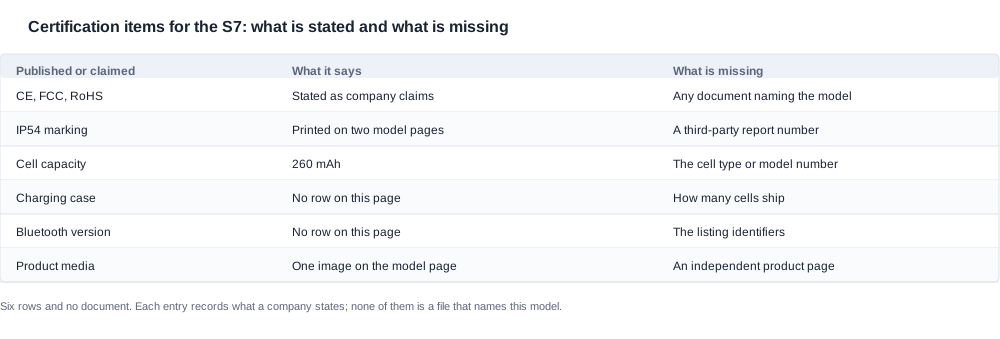
Certification status for the S7 is three layers, not one label
A compliance mark printed on a catalogue page is a statement by the manufacturer. A statement is a layer, not a file. It answers "what does the supplier say about this product" and nothing else. The object that answers "what does a document say about this model" is a different thing, and the two can disagree: the record for this model carries the CE, FCC and RoHS claim and, on the same row, records that the ingress marking has no third-party report number behind it.
The three layers fail independently, which is exactly why a single status line is not actionable. A claim can be perfectly accurate and still unusable in a customs file. A document can exist, be current, and still not name the model string that goes on your artwork. A carton can hold one cell or two, and the catalogue cannot tell you which. Each failure is silent — nothing in the paperwork announces that a layer was never reached.
The S7 does not share one certification position with the rest of the range. The record holds four positions across its catalogue entries, and this model sits in the third.
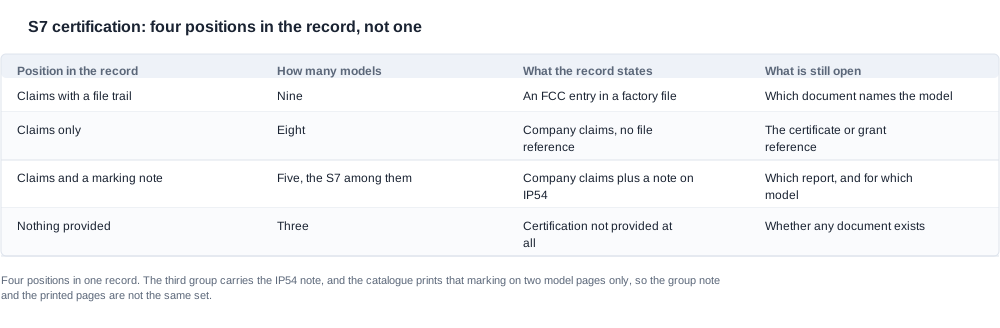
The first position covers nine models and carries a file trail: the compliance claims, plus a note that an FCC entry is held in a factory profile on the 1688 supplier platform. That is a trail worth having and still not a model-level report — a platform profile describes a supplier, not the S7. The second position covers eight models with the compliance claims and no file reference at all. The third position, the one this model belongs to, adds the note about the ingress marking having no third-party report number. The fourth position covers three children's models, for which the record states that certification information is not provided.
There is a trap inside that grouping, and it is worth naming because it is easy to inherit. The group note about the ingress marking is attached to five models in the record, but the catalogue itself prints that marking on two model pages only — and those two are this model and its sibling in the same family. The record's grouping and the printed pages are therefore not the same set. When you quote a group note, say which layer you are quoting from. A sentence that reads "five models carry an IP54 marking" would be wrong on the printed page, and a sentence that reads "no model carries an IP54 marking" would be wrong in the record. The honest version names the model and the page.
The three models with no certification information at all make the same point from the other end. Their position is not "certification pending" and it is not "certification absent" — it is that the record does not say, which is a different thing from saying there is nothing. A buyer cannot tell from a silence whether a supplier has not done the work or has simply not published it.
The second layer is where the numbering problem lives. For this model the record states the position itself: the IP level needs a detection report behind it before it can be claimed externally. That is a line the catalogue draws about its own page, and it settles the question that most gets argued over. The marking may be printed as a catalogue fact. It may not be printed as a tested result. The two digits carry two separate meanings, and both are easy to misread: a 5 in the first position is a solid-object figure, meaning limited dust ingress is permitted and the product is not dust-tight, while the 4 in the second position is a water figure for splashing from any direction, covering neither immersion, nor a shower, nor a water jet. The IP rating guidance page carries the standard in full, and the IP rating testing notes cover what to ask a laboratory for.

What the catalogue prints for this model, and what it leaves out
Read as a filing checklist rather than a product sheet, the model's published rows fall into two groups: the rows that describe the product, and the rows a conformity file needs. Most of the second group does not exist on this page, and the gaps are specific rather than general.
| Row | Printed on the page | What the record adds | What a file still needs |
|---|---|---|---|
| Compliance claims | CE, FCC and RoHS | Stated as company claims | A document naming this model, with references and expiry |
| IP54 marking | Printed on this model page | Catalogue marking, no report number | The standard, the laboratory and the sample batch |
| Camera resolution | 13 MP | — | Sensor, field of view, video mode and frame rate for the model description |
| Cell capacity | 260 mAh | The same number as the sibling model | The cell identifier and its transport test summary |
| Charging method | Magnetic | — | The pack content list, which decides how many cells ship |
| Bluetooth version | No row on this page | Camera models publish no Bluetooth version | The listing and declaration identifiers, which are the only handle |
| Product page and media | One product image per model page | No demonstration video, no independent product page | Production files and an instruction sheet for artwork |
The catalogue is enough to name the product and not enough to file it. That sentence is the practical summary of the table. Every row on the left is a true statement about the S7 that a buyer can repeat to a customer. Not one of them is the evidence a customs authority or a channel compliance reviewer asks for, because none of them is a document.
One trap sits in the record itself, and it is worth knowing about before a parameter reaches a listing. For this model the technical-key field also carries a fast-charge entry for a charging interface that the printed page does not show, and the differentiation field attributes that entry to two other models in the catalogue. The page itself shows magnetic charging and a charge ceiling of two hours or less, and nothing else. The rule that follows is simple and it is the rule this whole page is built on: the model page is the source, and any parameter that is not on it is a question rather than a specification. A fast-charge figure that circulates in a market, an agent sheet or a competitor comparison is exactly the kind of claim that needs to be traced back to the page it is supposed to come from before it goes anywhere near your own artwork.
Two rows deserve separate attention, because both look like gaps that a supplier might close with a sentence and neither can.
The camera specification is not a compliance row, but it appears in the file. A conformity file describes the product in enough detail that nobody can confuse it with a different product. For a camera model, that description includes the sensor and the video configuration, and this page publishes neither — it publishes the still-image resolution and stops. The number is useful for a marketing line and useless for a file, which is why it needs a separate answer rather than a footnote.
The absence of a Bluetooth version row is a different kind of gap. For the models in this catalogue that publish a Bluetooth version, the identifiers can be chased from the published figure. For camera models the version is not published at all, so the listing and declaration identifiers become the only handle a buyer has. That makes the identifiers worth asking for specifically rather than assuming they can be derived, and the Bluetooth SIG certification buyer checklist sets out what those identifiers are and why they are quick to verify once you have them.
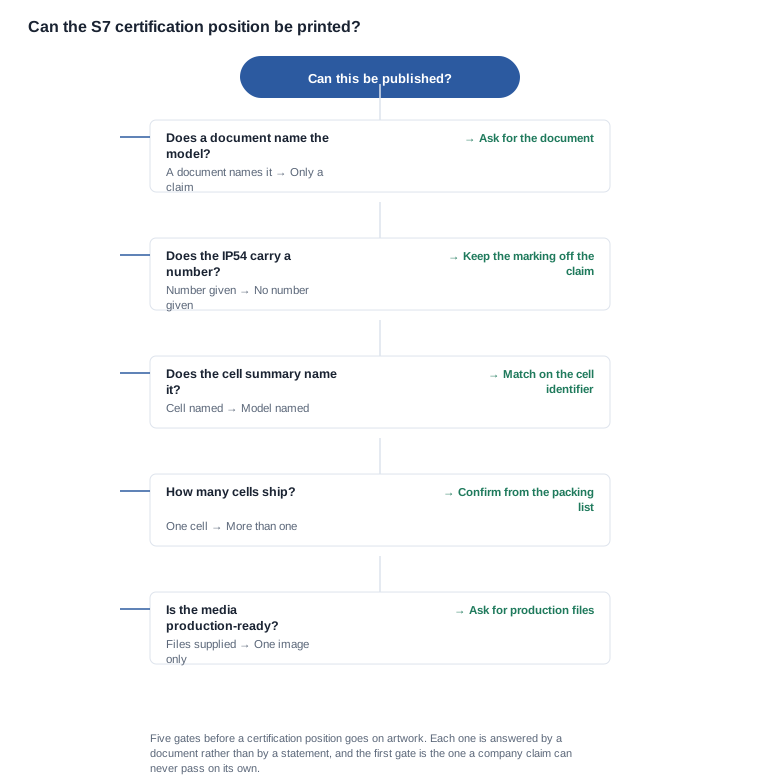
The decision figure above is the practical version of the table. Five gates, each answered by a document rather than by a statement, and the first gate is the one a company claim can never pass on its own: a document has to name the model.

The battery file, and why matching on capacity fails
The battery is where a capacity number quietly turns into an identity claim, and this model is a clean illustration of why.
The S7 publishes 260 mAh, and the sibling model in the same family publishes 260 mAh as well. The two models differ on the printed page in exactly one parameter row — the camera resolution — and their cell capacity figures are identical. The intuitive move is to treat a transport document that says 260 mAh as covering both. That inference does not hold, for a simple reason: a capacity is a value, and an identity is a model number. Two different cells from two different suppliers can carry the same capacity figure; identical capacity is what you expect of a family that shares a cell, and it is also what you expect of a family that only shares a number. The catalogue publishes no cell type, no cell model number and no batch for any model, so the printed capacity cannot be used to decide which document applies to which model.
The consequence for a buyer is concrete. A transport test summary arrives, it quotes a capacity, and a colleague reads the matching number as a match. It is a match on a value, not on the item. The only identifiers that can carry that weight are the ones printed on the cell itself, which is why the request below asks for the cell identifier fitted to this model rather than for a document that mentions 260 mAh.
The catalogue page for this model has no charging-case row at all. That is a specific fact with a specific consequence, and it is worth stating plainly because the opposite is often assumed: nothing on this page states that a charging case ships with the product, and nothing states that one does not. The row is absent, which means the number of cells in the carton is not derivable from the catalogue at all. A pack containing a case means two cells and a second transport summary; a pack without one means a single cell. Those are different transport files, and the catalogue cannot tell you which one you are buying.
The same absence decides a second question. If the pack includes a case, the accessory side of the file — what that accessory is, what it contains, and how it is described on the packaging — is a separate document from the frame's, and the charging case options analysis sets out what that accessory file has to cover.
A cell is also the item most likely to change silently. The published rows on this page are a capacity, a charge method and a charge ceiling, and none of the three would move if a cell of the same capacity were substituted in a later production run. A transport document you hold against "260 mAh" would then be matching a number that no longer identifies the goods, while the catalogue page would still read exactly the same. That is why the cell identifier belongs in the agreement and not only in the request, and why a change to the fitted cell should be a notification event rather than something the importer discovers.
The battery transport document chain itself — the test summary, the declared watt-hour rating and the packing instruction that follows from it — is set out in the battery transport compliance checklist.

The request list to put in writing
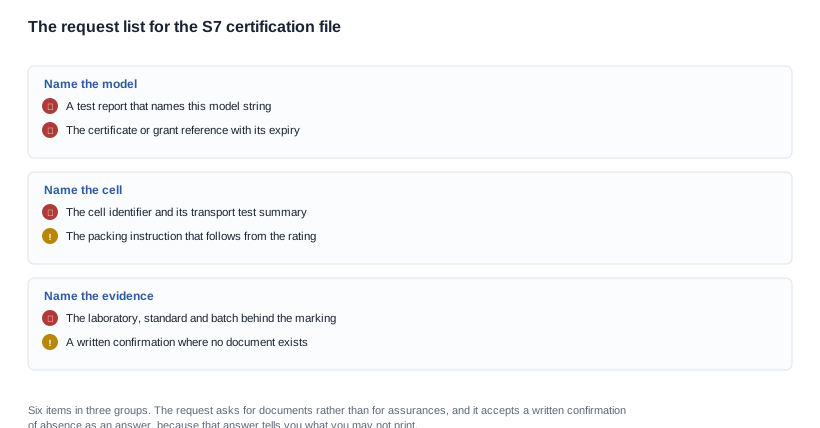
A request is only useful if the answer is a document. A request that asks whether the supplier is "certified" will receive a yes, and a yes cannot be filed, quoted in an agreement, or checked by anyone. The request below asks for named documents and accepts a written confirmation of absence as an answer, because that answer is the one that tells you what you may not print.
Name the model. A test report that names this model string; the certificate or grant reference with its issuing body and expiry; the index of the technical file; the Bluetooth listing and declaration identifiers; and the evidence behind the ingress marking — the standard, the laboratory and the sample batch.
Name the cell. The cell identifier fitted to this model and the transport test summary that covers it; the declared watt-hour rating; the packing instruction that follows from that rating; and the number of cells packed in the carton.
Name the evidence. The laboratory and batch behind any ingress claim; the production files and instruction sheet that the artwork has to match; and, for anything that does not exist, a written confirmation that it does not.
One more item belongs with the file rather than with the product, because it decides what the file has to describe. The record notes five customisation axes for this model without publishing what they are, and the optional-configuration field for it is empty because the catalogue page lists no configuration options at all. The practical instruction for a document request is narrow: ask for artwork, packaging and label files against the configuration you have confirmed, not against a generic model file, and ask which of those five axes your order actually uses — because a document written for one configuration is not the document for another, and the difference between the two is invisible on the page.
There are three things about the way this request is worded that matter more than the list itself.
Ask for documents, not for assurances. "Please confirm the S7 is CE, FCC and RoHS certified" is answered by the same sentence every time. "Please send the test reports that name the S7 model string, with the issuing body and expiry" is answered by a file or by silence. Silence is still an answer: a supplier who confirms in writing that no report exists behind the ingress marking has told you something you need before artwork is printed, and has done you the service of doing it in writing.
Watch for the substitutions. Four answers look like progress and are not. A document that names the family but not the model — it covers your order only if the supplier confirms the model is in scope. A capacity-only match on the battery document, for the reason set out above. A reference number with no issuing body attached, which cannot be checked by anyone outside the supplier. And a report with no sample batch, which tells you a type of product was tested without telling you this unit was.
Put the list in the agreement, not only in the inbox. The documents you receive for a first order describe the goods as they were when they were made. What keeps the file true afterwards is the clause: a change of the fitted cell, a change of the model string, a change of test laboratory or a change of the certificate reference requires notification and, where it matters, a re-issued document. Before you commit to a shipment, decide which of those four changes you want to hear about in advance, and put them in the contract rather than in a purchase order note. The export documentation checklist covers the paper that travels with the goods.
Where the S7 record stops, and what we will not claim
Every published row has to end up somewhere that someone else can read without you in the room, and the certification file is the strictest version of that requirement.
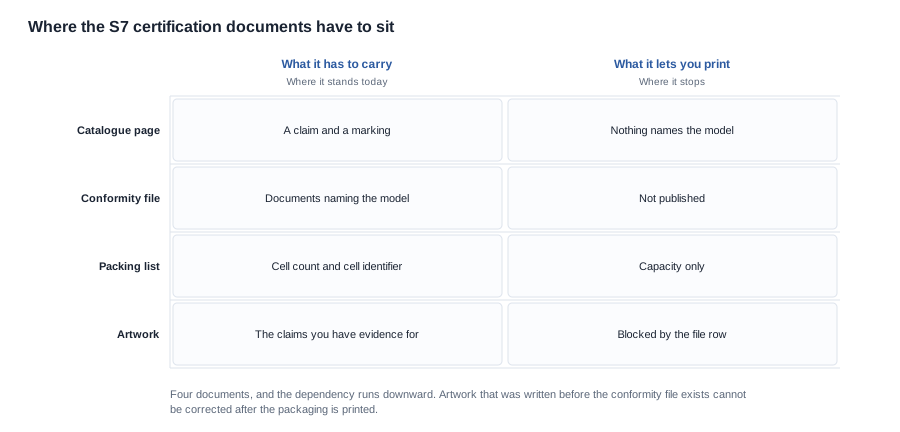
The catalogue page carries a claim and a marking, and neither names the model in the sense a file requires. The conformity file is the document that has to close that gap, and the record does not publish one for this model. The packing list has to carry the cell count and the cell identifier, and the published page gives a capacity instead. Artwork then inherits whatever the two rows above it can support — which means artwork written before the file exists cannot be corrected once the packaging is printed.
What the record supports. The published rows for this model, the four certification positions across the catalogue, the distinction between a group note and a printed page, the request list above, and the three-layer way of reading any certification status you are handed — including one that arrives complete.
What it does not support. We have no certificate number, no laboratory and no report behind the ingress marking for this model, and the record says so. We have no cell identifier, no transport test summary and no pack content list to publish. There is no independent product page for this model, the marketing material is one product image on the model page with no demonstration video, and no detection report, real photograph or video was supplied with the record. The record itself notes that the page numbering printed for this section does not line up with the printed index, so confirm which page your supplier is citing and put that page in the agreement rather than relying on the index.
Our position. We will print the CE, FCC and RoHS line as a company claim, because that is what it is. We will not present the IP54 marking as a tested rating, we will not quote a certificate number we have not been given, and we will not state a transport document for the cell fitted to this model that we have not seen. What we will do is tell you which layer any document you have actually reached, and what it still does not let you claim.
One thing we cannot answer is the destination. The record does not state a market-by-market position for this model, so the destination you sell into, the shipping mode and the model strings you intend to print are inputs we need from you rather than things we can quote back. That is the difference between a factory and a compliance adviser, and it is worth being explicit about it before a lane is chosen: for this model the destination determines the critical path, and the critical path is where the file work sits.
Send us the destination market, the shipping mode, and the brand and model strings you intend to print on the packaging, and we will tell you which of the request items is on the critical path for that lane and which ones we cannot answer from the record. The published rows for this model are in the S7 specification list, and the platform this model sits among is in sport smart glasses.
A short list of related reading
- The catalogue rows this model publishes — S7 specifications and features
- What the ingress digits mean — IP rating guidance
- What to ask a laboratory for the ingress evidence — how to test before ordering an IP rating
- The document chain for the battery — battery transport compliance buyer checklist
- The paper that travels with the goods — OEM ready platforms export documentation
Send the destination market and the model strings you plan to print, and we will tell you which of the request items we can answer from the record and which need a document from the supplier.


