
Buyers usually arrive at a charging question with a number already in mind: how long it takes, what is in the box, whether a dock is part of the package. The S7 record answers one of those questions in four words and leaves the rest of the chain outside the printed rows. On the model page the charging method reads magnetic charging, the charge time is printed as two hours or less, the cell reads 260 mAh, and the published use duration reads five to eight hours. That is the whole of it. What feeds the frame, what arrives in the carton, whether a case or a dock belongs to the proposition, and what happens while the frame is on charge have no row of their own.
That gap is not a reason to distrust the record, and it is not a reason to treat the model as unusable. It is a reason to know precisely which questions the four printed rows can answer, because the common failure in a charging conversation is to ask a printed row to carry more than it was written to carry. A buyer who treats magnetic charging as a charging specification will order against an interface category. A buyer who treats two hours or less as a measured charge time will publish a figure that nobody in the supply chain has agreed to. Both mistakes are made in good faith, and both can be closed before the first order instead of after the first shipment.
There are three levels of answer a charging question can have, and it helps to keep them apart. A figure can be printed on the page for this model string. It can live in another document — a packing list, a transport file, a product page. Or it has to be measured and written down. The S7 record is generous with the first level for four rows and silent at the other two for everything connected to charging, which is why most of what follows is about how to ask rather than about what to conclude.
What follows sets out the four rows read closely, a field name in this record that means two different things, the difference between a missing row and a negative answer, the wearing frame against the power pack, and six questions to put in writing before you commit to an order. Nothing in it is inferred from how this category usually works; every statement is either printed on the model page or marked as unpublished.
What the four published S7 charging rows settle
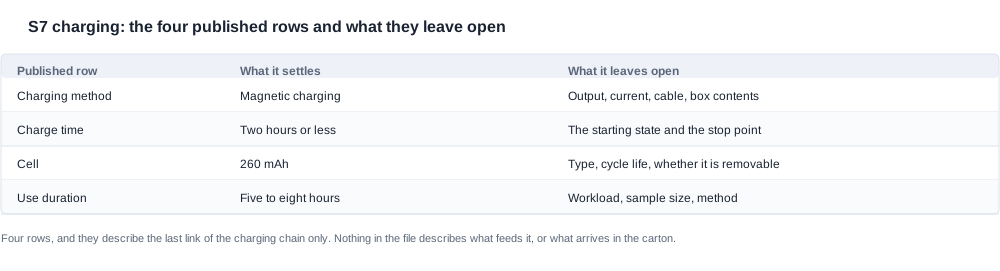
The model page carries four rows that touch charging: the charging method, the charge time, the cell capacity and the use duration. Read one at a time, each of them is exact about what it says and about nothing else.
The charging method reads magnetic charging. That is a class of contact arrangement, and a class is what the page publishes. Across the whole record of twenty-eight models, seventeen rows stop at that level or at magnetic charging combined with a charging case, and none of them prints a charger output, a charge current, a connector standard or a cable type for that arrangement. Seven rows in the same record do name a connector. V03 Pro prints a charging port line and repeats the same standard in its feature line, L2 Utral prints a charging interface line, and five further rows state the connector inside their own specification block. The distance between those two groups is the useful part: a magnetic contact and a named connector are different levels of detail, and a page that publishes the first one is not withholding the second.
The charge time reads two hours or less, with the less-than sign printed in front of the number. Two things follow from that sign. It is a ceiling rather than a measured duration, because the page does not say the clock starts at an empty cell and does not say the charger stops at any particular point in the charge. And the ceiling is written the same way across the record: twenty-six models print two hours or less, and two print about one hour instead. A field that reads identically on twenty-six rows and differs on two is describing a specification limit rather than a measured outcome, and on a model page it should be read as exactly that.
The cell reads 260 mAh. It is the only cell figure published for this model, and it is a nameplate capacity rather than a description of the cell inside. The record does not publish a cell identifier for this model, a chemistry, a cycle-life figure or a cell format, so a buyer cannot yet write a transport summary, a carton declaration or a comparison sheet from what is on this page.
The use duration reads five to eight hours. It is a bracket with an unlabelled load behind it, and no model in the record carries a laboratory, a workload, an ambient condition, a method or a unit count against that bracket. Reading a bracket correctly is a separate exercise, and it is set out in how the published endurance rows on this model hold up. For the charging rows themselves, this model and V06 print the same four values apart from the pixel count, and the side-by-side treatment of the two sits in the two-model charging comparison.
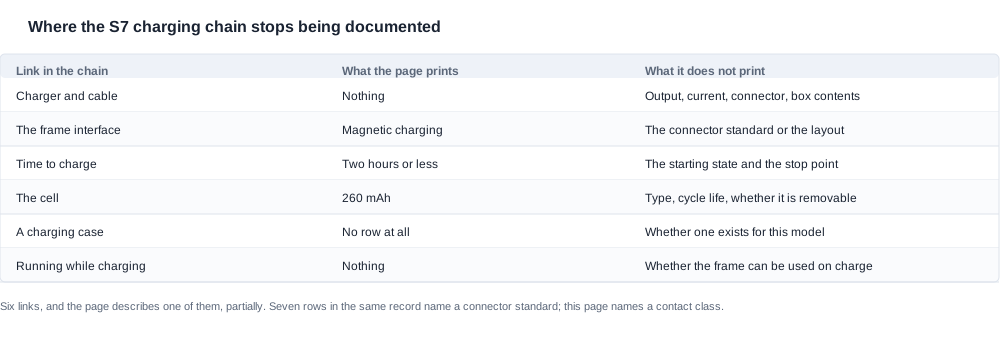
Read as a chain rather than as four separate rows, the shape of the record becomes plain. Six links sit between the wall and the camera: the charger and its cable, the contact arrangement on the frame, the time the charge takes, the cell itself, the case or dock, and whether the frame can be used while it is on charge. This page describes the middle two links and half of the third. Everything upstream of the frame — output, current, connector, cable, and what is physically in the carton — is described nowhere, and the page says nothing about whether a case exists for this configuration or whether the frame can be worked on while it is charging.
What you can print today is short and it is worth printing it precisely. The model charges magnetically. The charge time is two hours or less, stated as a ceiling. The cell is 260 mAh. The published use duration is five to eight hours. That is a defensible specification paragraph, and it is enough for a catalogue page, a quotation request and a technical file. It is not enough for a retail listing that promises a charge-and-go experience, a packaging claim about what is included, or a comparison table built across the range.
A procurement team copying these rows into an RFQ will usually copy them into a spreadsheet first, and the spreadsheet is where the labels start to disagree with the pages. That is worth catching before the request goes out, because a supplier asked to confirm four charging figures will answer the four figures you sent, and if the two-hour ceiling was filed under the wrong heading the confirmation repeats the error rather than correcting it. A short RFQ with page references attached takes longer to assemble and closes faster.

One field name in the S7 record means two different things
Before you compare a charging figure from this page with one from another page, there is a labelling problem inside the record that will silently invert two columns in any spreadsheet built from it.
The charge time appears under two labels. Twelve rows print a charge time field and sixteen print a charge duration field. On both, the value has the same shape — a ceiling rather than a measured duration — with twenty-six rows reading two hours or less and two reading about one hour. The use duration is where it gets worse, because it appears under three labels: eleven rows use a use duration field, fourteen use a run-time field, and three — MT5 and V03, and KY06 — use the charge duration field for the run-time value.
That last group is the trap. On V03 the charge duration field carries five to eight hours, and on KY06 and MT5 it carries six to eight hours; the second record for the same catalogue calls those three figures the run time, which confirms how they should be read. But on the five models that print a case capacity, and on eleven more besides, the charge duration field carries the two-hour ceiling instead. One printed label therefore means charge time on sixteen rows and run time on three, inside a single document, with no warning on either side.
The cost of that is not abstract. A specification sheet built by copying column headings rather than pages ends up with the two-hour figure sitting in a run-time column for sixteen models and the six-to-eight-hour figure sitting in a charge-time column for three. The sheet still looks complete, it still looks internally consistent, and it will survive an internal review, because nothing on any page is wrong. The error is only visible to whoever checks a figure against the page it came from.
The criteria for transcribing charging data out of this record are simple enough to apply to a whole range at once. Split every charging column into two fields, one for time to charge and one for time of use. Cite the printed page for each figure rather than the column name. If a figure cannot be traced to a page, it does not enter the sheet at all. When a supplier sends their own comparison table, the same three rules apply to it, and the fastest test of a supplier table is to ask which printed page each figure came from.
One practical point about how to ask. The printed labels on this catalogue are Chinese field names, and they are worth quoting exactly in your request, because the supplier will read the same page you are reading. If you ask for the charge duration, you may get either the two-hour ceiling or the six-to-eight-hour figure depending on which model you are looking at. If you name the page and the model string, you will get one answer that can be filed. That is the difference between a question that produces a document and a question that produces a summary.
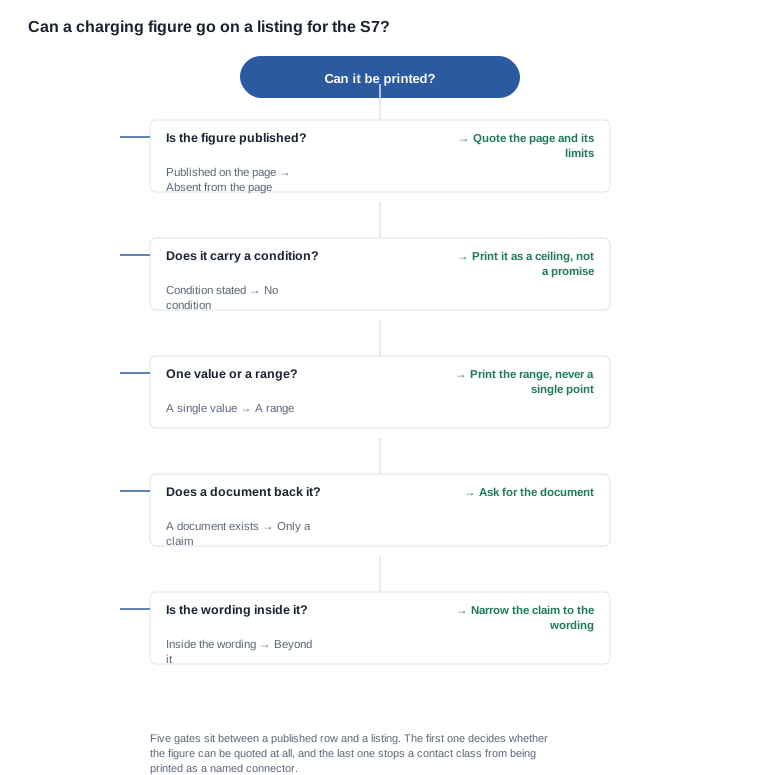
The same discipline applies to your own artwork and your own channel pages. A figure is publishable when it is printed on the page for this model string, when its own wording carries any condition that belongs to it, when a range is printed as a range rather than as a point, when a document stands behind it, and when the words on your listing do not reach past what the row says. Magnetic charging on a specification sheet is inside the wording. A named connector on the same sheet is beyond it, and that single distinction separates publishing this model honestly from publishing a detail the page never carried.
A missing charging row is not a negative answer
The S7 model page has no charging case row at all. It is worth looking at how the record treats cases across the range before drawing anything from that absence.
Case wording appears on seven of the twenty-eight model pages. Two of them put the case inside the charging method line, printing magnetic charging combined with a charging case. Five of them give the case a battery capacity of its own: 1400 mAh on three pages, 900 or 1400 mAh on one, and 1200 mAh on the last. The remaining twenty-one pages say nothing about a case at all.
What the record never does is state that a model has no case. No page in the range prints a line saying no case, so the absence of a row is an absence of information and nothing more. For this model the honest sentence is that the packing list for this configuration has not been published. It is not that the carton contains no dock, and it is not that the carton contains one. The same holds for the connector: seven rows name a standard and this page does not, so the page describes a contact method rather than a connector, and no connector can be read into it.
There is a third reading of the same absence that matters more than either. A row that is missing tells you nothing about the product, but it tells you a great deal about the file. The charging rows across the record divide into three groups: seventeen rows that publish a contact method without a case, seven that name a connector, and four that publish a case capacity and no charging method whatsoever. A model that prints a case capacity and nothing else cannot be charged from the page alone, because the method is simply not there. A model that prints a contact method and no case cannot be charged from the page alone either, because whether a dock is needed is not there. The absence of one row is never compensated by the presence of another, and a comparison sheet that fills the gap by inference will be wrong in a direction nobody can check.
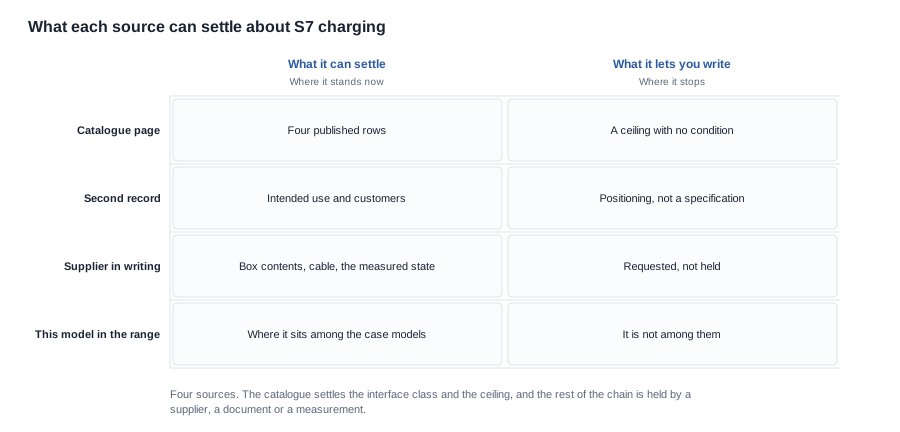
That is why the question to ask is not whether a case exists. It is whether the packing list for this model string names one, and the document to ask for is the packing list itself. The four sources that can settle a charging question are the model page, which gives you the interface class and the ceiling; the product record, which tells you who the model is aimed at rather than how it behaves; a written answer from the supplier, which is where carton contents, cable and measurement conditions live; and the pack content list, which is the only document that can answer the case question either way. Three of those four are documents you request rather than facts you read, and none of them is something you can settle with a single conversation and then rely on.
When you do receive a packing list, run it against a three-item checklist before you accept it. Does it name the model string that will be printed on the artwork. Does it enumerate every accessory separately rather than describing them together. And does every cell that appears in it have an identifier and a transport test summary that names that identifier, because a charging accessory that carries its own cell has to be declared as its own item rather than folded into the frame. If the answer to any of those is missing, you have a document to chase rather than a product to evaluate.
Files of this kind belong in the technical file rather than in a message, because the compliance file, the shipping documents and the quality assurance record all reference the pack content list by document number. If the list arrives without a number, ask for one. An unnumbered document cannot be cited in a conformity file, and a conformity file that cannot cite its inputs will not survive a supplier audit or a channel buyer's own due diligence.
The detachable S7 inner frame is a wearing part, not a power part
One feature on this model page invites a reading that the record does not support, and the reading is expensive because it changes what you order.
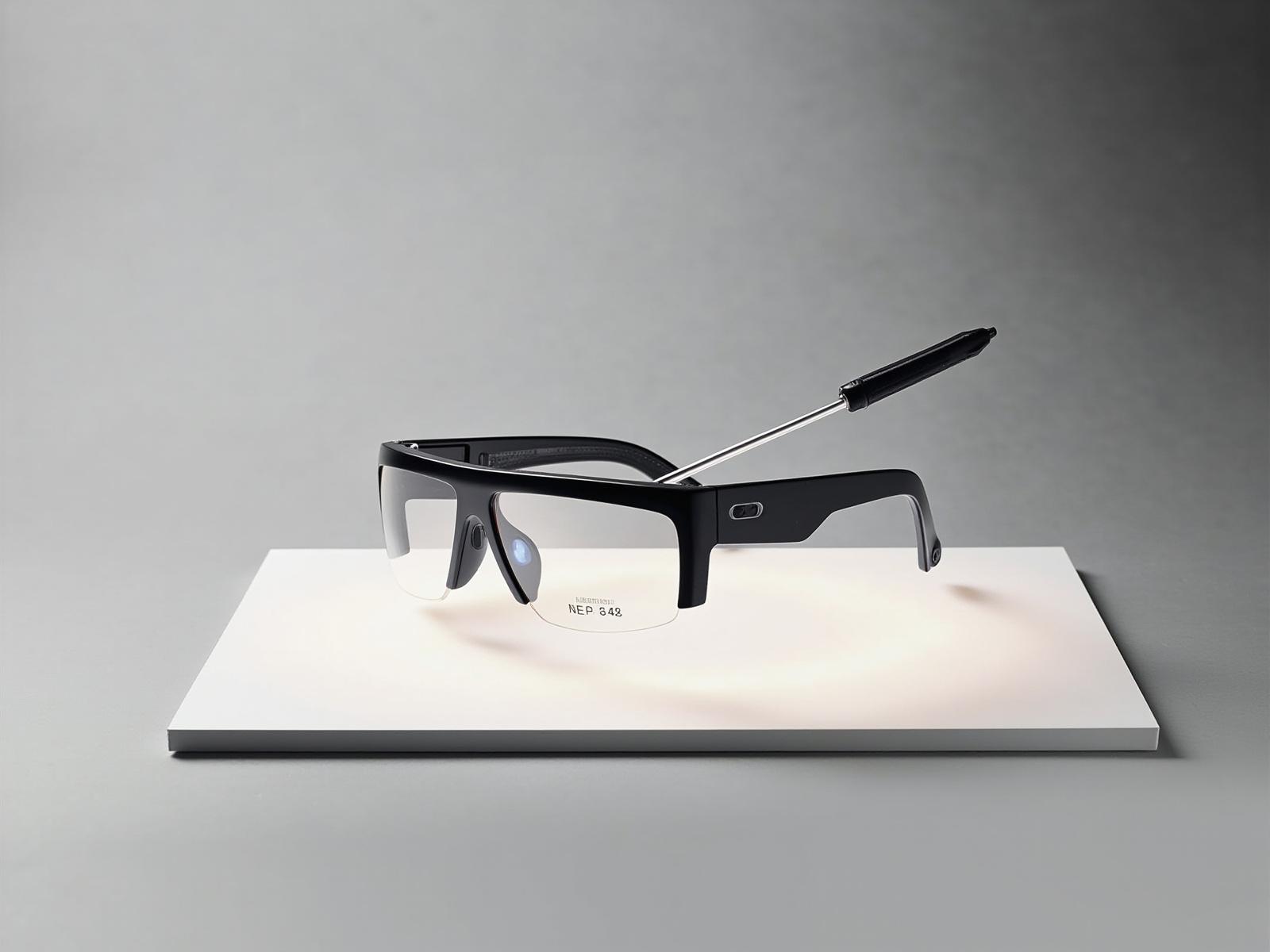
The feature line lists a detachable inner frame. The inner frame is the part that changes size for the person wearing the glasses, and that is all the record says about it. There is no row for a removable cell on this page, no cell identifier for this model, no row connecting the inner frame to the charging contact, and no row about charging with the inner frame taken off.
Three readings are therefore unavailable. A removable inner frame does not make the cell removable, because nothing on the page describes replacing the cell and no tool or procedure for it appears in the record. Whether the frame charges with the inner frame removed is not published, and that question matters commercially: if your sizing plan carries several inner frames for the same outer frame, it decides whether a spare inner frame can be charged on its own or has to travel with the outer body, which in turn decides how you stock, label and ship the spares. And which part actually carries the contact is not published either, so no supplier, distributor or listing should be told that the frame charges in a particular way with a particular part removed.
The same page carries an ingress marking, and this record prints that marking on two pages only. Read the two digits in order and the first covers solid ingress at a limited level while the second covers water arriving from all directions. Neither of them is an immersion rating. The record prints no condition for the product while it is charging, and no storage or handling instruction for the contact area, so the requirements for a contact surface during charging are a question for the supplier rather than something to be read off a marking. If your channel sells this model into outdoor, marine or industrial use, that question belongs in the written request, not in an assumption about what a marking permits.
The commercial trade-off of the whole subject is worth naming plainly, because it is the part buyers argue about internally. A frame that is charged by a cable is one line in your bill of materials and one item in your carton. A frame that is charged by a dock is a second line in your bill of materials, a second entry in the packing list, a second set of transport rows, and a second thing for the end customer to find in the box. Neither is better. What decides it is the proposition you are selling, the shelf and counter space you have, and what you can document, and how to choose between the two is not a question the catalogue page can answer. The record does not say which arrangement this model ships with, so the decision cannot be made from the catalogue page, and a channel partner who has been told otherwise is going to find out from their own customers.
Six S7 charging questions to put in writing before you commit
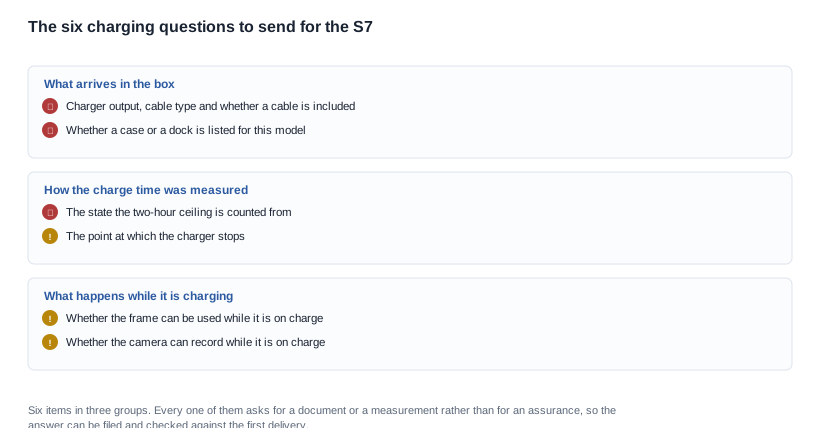
The six questions below are ordered along the charging chain rather than by importance, and each is written so that a usable answer is a document or a measurement rather than an assurance. They are the questions to ask when one charging description has to hold on a listing, in a carton and in a compliance file at the same time. Assurances cost nothing to give and are hard to file, hard to check and easy to forget.
- What arrives in the carton. Ask for the packing list for this configuration and this model string, and ask it to name every accessory it includes: the cable, the adapter, the dock, the case. A list that names the model string is usable. A description that says the contents are the same as another model is not, because the record shows seven rows of the range printing case wording and twenty-one printing nothing at all, and a summary cannot tell those two situations apart.
- What feeds the frame. Ask for the charger output, the form of the cable, and whether a cable is supplied at all. A cable described only by the word magnetic has told you nothing you can put on a packing list, and a charger described only as included has not told you whether it is the same unit as the one in the photograph. If a charger is supplied, ask whether it carries a mark of its own, because that mark travels with the accessory and not with the frame. Ask whether the supplied charger is covered by the same warranty as the frame, and whether it carries certification marks of its own that the channel buyer has to file.
- What the two-hour ceiling counts from. Ask which state the cell was in when the clock started, at what point the charger stops, and what a partial top-up delivers. Write the answers back as a method line rather than as a number, because the number is the part that changes between production batches and the method is the part that makes two numbers comparable.
- What happens while it is on charge. Ask whether the frame can be used while it is charging, and whether the camera can record while it is charging. Both are unstated for this model, and both change how you describe a working day. A frame that can record on charge and one that cannot are different products to a channel partner even when the battery figures are identical, and the difference is exactly the kind that generates a support contact in the first week of ownership.
- The cell and the inner frame. Ask whether the cell is fixed or replaceable, what a replacement would involve for a channel partner, and whether the frame charges with the inner frame removed. These three answers decide whether a spare inner frame is a stock item you can sell on its own or a bundled one, and they also decide what your quality assurance check on the first delivery has to cover.
- Anything that would make the charging design your own. The product record for this model lists five customisation axes, and whether the charging interface or the supplied cable is among them is not published. Ask it as a question. Do not assume it, do not plan a private-label cable around it, and do not let it into a quotation as a line item until it has been answered in writing.
What the charging decision costs you is structural before it is financial. A frame charged by a cable and a frame charged by a dock produce two different bills of materials, and a dock or case arrangement brings its own entries into the packing list, its own rows into the transport file and its own wording on the packaging that has to survive the packaging rules you already work to. The record does not say which arrangement this model ships with, so those entries cannot be costed or documented yet. What can be settled now is the arrangement itself, in writing, because the arrangement is what decides the entries. The quotation follows the arrangement, not the other way round.
For a brand owner running a private label programme the same question has an extra layer: the label, the packaging and the documentation all sit under your name rather than ours, and each of those is a separate approval. Whichever way the arrangement goes, the charging description on the carton has to match the packing list the compliance file carries, and the contract is where that match is written down. A sourcing team that wants to close this faster can fold the six questions into the supplier evaluation instead of a separate message, so the answers arrive with the documentation the file already holds rather than in a second thread.
The red flags in a charging answer are specific to the subject, and they are worth naming once. A cable described by the word magnetic instead of by its form. A charge time offered with no starting state attached. A case shown in a product photograph and named in no packing list. An assurance that the frame works while charging, given as a sentence rather than as a measurement. A charger that appears in the picture and in no document. None of these is unusual in a conversation, and all of them are cheap to correct before an order and expensive to correct after one.
On the first delivery, whatever the answers turned out to be, the check is short. Confirm that the carton contains what the packing list named and nothing it did not. Confirm that the charger in the box is the charger the list describes. Confirm that the frame reaches the state your published wording promises, and that the wording itself is the one you approved. The purpose of the check is not to test the cell, which the record never claimed anything about, but to confirm that the document and the goods agree. When they agree, the charging description you publish is a description of a product you have actually held. The check is short enough to run on every carton in the first shipment, and short enough to repeat on a second supplier if a channel buyer later asks for a factory audit.
What we will and will not put in writing. We will give you the four published rows and the limits that belong to each of them, the documented charging figures for the models whose pages publish them, and the exact wording of each request that closes a gap. We will not print a connector standard that this page does not name, we will not turn a ceiling into a measured charge time, we will not describe the contents of the carton for this model while its packing list is unpublished, and we will not carry a charging figure over from a different model string. When you ask what the charger output is or how a partial charge behaves, we will tell you whether it is documented or whether it has to be confirmed from the production side before anything goes on a listing.
Further reading on this model
- The endurance bracket and the conditions behind it — how the published endurance rows hold up
- Every row the model page prints — the full published row set for this model
- The category this model belongs to — the category page for this family of frames
Send us the target market, the channel and the quantity, and we will tell you which charging figures are documented for this model and which ones have to be confirmed before anything is printed.


