
Choosing between the S7 smart glasses and the YKC02 is a requirement question with a short answer, and the useful work is in making sure the requirement is written before either model is named. Neither page carries a price, a price tier, an order floor, a production timetable or a warranty term, so no cost ranking is available and none should be implied. What is published is enough to answer the question of which of the two products a given brief belongs to, and it is enough because the two pages describe products that do different work: one of them carries an ingress marking, a detachable inner frame and a camera class, and the other carries a two-cell battery arrangement, a surround sound line and a published radio version. This page is written for the buyer who has to make the call and defend it, and for the channel partner who has to answer the same question for a customer without a price ladder to point at.

The decision in one line
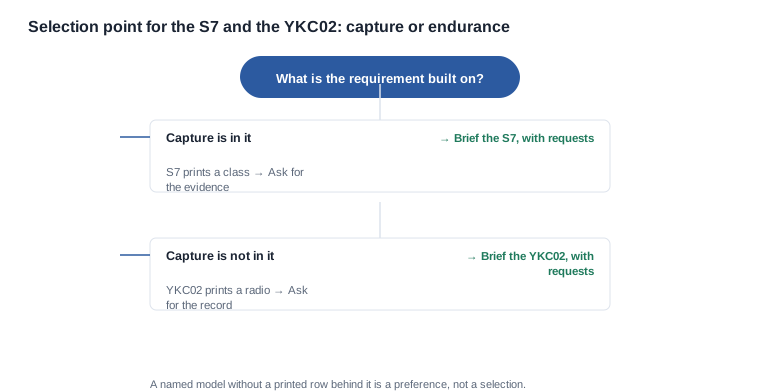
The one-line test is this. If the requirement involves capture, the S7 is the only one of these two that publishes a camera class, and the YKC02 publishes no imaging row at all. If the requirement does not involve capture, the YKC02 is the one that publishes a radio version and a single runtime figure, and the S7 publishes neither. Everything else about the two is either shared, absent from both, or expressed in a way that cannot be compared without more information.
That test is worth more than it first appears, because it is traceable to a printed row on each side. It is not a judgement about which product is the more capable, the more attractive or the more valuable, and it does not depend on any assumption about how the two perform. It simply says: one of these two products is a camera product and the other is not, and a camera product and a non-camera product do not answer the same brief.
What the one-line test does not settle matters as much as what it does. It does not settle the cost, because no price or price tier is published against either model. It does not settle the physical product, because neither page carries a weight or a dimension, so the two frames stay incomparable in published material even after the model has been chosen. And it does not settle the evidence, because both models publish descriptors that carry no measurement behind them. What it settles is the brief, and that is the only thing a one-line test should be asked to settle.
The selection sequence that follows from it runs in six steps, and the order is what keeps the decision honest:
- Write the requirement in one sentence, with no model named in it.
- Decide whether captured stills or video are part of it, and write the answer down.
- Read both catalogue pages and list the rows that speak to that requirement.
- List the rows that neither page answers, and convert them into request lines.
- Send one request annex covering the selected model, against one configuration version.
- Score the returned answers against the criteria, then specify the model and the configuration together.
Step six is the one that protects the decision from becoming a preference. A model selected on the published rows and then confirmed on the returned answers is a specification; a model selected on the published rows and never confirmed is a hope.

What the YKC02 is for
The YKC02's page is short, and every line on it is a feature rather than a caveat. It prints a battery capacity of 70 mAh multiplied by two cells, an endurance figure of about eight hours, a charge limit of two hours or less, magnetic charging, a Bluetooth version of V5.4, and two feature lines reading surround sound and long battery life. That is the whole published content, and it describes a product built around an audio circuit, a radio and a pair of cells.
Read as a brief, that page answers a requirement of the following shape: an operator needs audio on the move, the radio configuration has to be known because the device is bought to work with something else, and the endurance figure has to be long enough to cover a session without a recharge. The published rows support all three. The radio version is stated rather than inferred, which matters for a product whose whole purpose is to be paired, and the eight-hour figure is a single stated duration rather than a range, which makes it easier to plan against a shift.
What the page does not answer is as much a part of the brief as what it does. There is no imaging row, so nothing about capture can be claimed for this product. There is no ingress marking, so no weather-protection claim can be made. There is no detachable inner frame, so there is no size or spares programme to plan. There is no weight, no dimension and no temple length, so the physical product cannot be compared against anything in published material. And there is no charging-case line, so the accessory set in the carton is an open item rather than a published fact. The endurance figure also arrives without its test condition, so the eight hours is a number without the duty cycle that produced it, and the charge ceiling arrives without a starting state or a completion criterion.
That combination is coherent. It describes a product that is meant to be specified on what it does rather than on what it is claimed to survive. The risk in a selection is not that the YKC02 is a weaker product; it is that a buyer arrives with a requirement that includes capture, an ingress claim or a spare frame, and then has to be told that this page cannot carry any of them.
One figure on this page also needs care in a brief. The battery capacity is printed as 70 mAh multiplied by two, which is a cell size and a cell count rather than a single total, and a total should not be written into a specification as though the page had stated it. The same applies to the endurance figure, which is about eight hours for a condition the page does not describe. A brief that says the YKC02 runs for eight hours has already turned a point figure into a promise, and a brief that says it carries 140 mAh has invented a number the catalogue never printed. Both conversions are easy to make and awkward to defend once a customer starts asking where the figure came from.
What the S7 is for
The S7's page is built the other way round. It prints a camera class of thirteen megapixel, a 260 mAh cell, a five to eight hour endurance band, a two hour charge ceiling, magnetic charging, and three feature lines: an ergonomic design descriptor, the thirteen megapixel descriptor and a detachable inner frame descriptor. The fourth feature line is the ingress marking. There is no radio version on the page at all.
As a brief, that content answers a requirement of a different shape: an operator needs captured stills from a moving position, the product has to survive an outdoor environment to a stated level, and a removable inner frame has to be planned as a size programme with spares. The published rows support the first and the third, and the second rests on a marking that a buyer has to have evidenced before it can be used in a claim.
Two things make the S7's brief heavier than the YKC02's, and both of them are consequences of what the page publishes rather than of anything written on it. The first is the imaging evidence obligation. A camera class is a component figure, and behind it the catalogue stops: on the sensor model, on the lens, on the field of view, on the frame rate, on the file format, on the stabilisation and on the behaviour in low light, it prints nothing at all. The brief therefore has to carry an image acceptance criterion the buyer writes, since the catalogue will not supply one. The second is the ingress evidence obligation. The IP54 marking appears on two pages in the whole library, and this is one of them, which means the marking is a distinguishing feature rather than a shared one, and that the report behind it — naming the standard, the laboratory and the sample batch, and recording whether the inner frame was fitted at the time the unit was tested — has to be requested and filed.
There is also a documentation subtlety in the S7's favour that a buyer should not skip. Its endurance figure is a band rather than a point, which is the more honest way to publish a runtime when the conditions differ, and it comes with a charge ceiling that is expressed as a bound. A brief written around a band needs the test condition behind each end; a brief written around a point figure needs the same thing. Either way the request is identical, which is one reason the two products are easier to brief together than their different row structures suggest.
The camera class carries a naming risk that is worth handling in the brief rather than leaving to whoever writes the listing. The S7's page prints the thirteen megapixel figure twice, once in the specification block and once as a feature descriptor, and a buyer who lifts the descriptor into customer-facing copy without the specification context will end up claiming a camera specification where the catalogue publishes only a resolution class. The correct treatment is to write the class into the specification annex, to write the evidence request into the acceptance criteria, and to keep the two claims apart in anything that leaves the building.

Where the published evidence stops
Everything above describes what the two pages print. This section is about where they stop, and the stopping point is large enough that it shapes how a selection should be run.
The catalogue publishes one unit weight for the entire library, and it belongs to a third model: the MT6 eyewear body at 158 g, a number that measures the eyewear and leaves the folding case out. Nothing is published for either the S7 or the YKC02. No dimensions, no temple length, no indication of where the two cells sit in the YKC02, no lens or bridge measurements for the S7. In other words, the one category a buyer would instinctively reach for when choosing between two frames of similar shape is precisely the category the pages cannot support, and any statement of the form "this one is lighter" or "this one is smaller" would be an invention rather than a comparison.
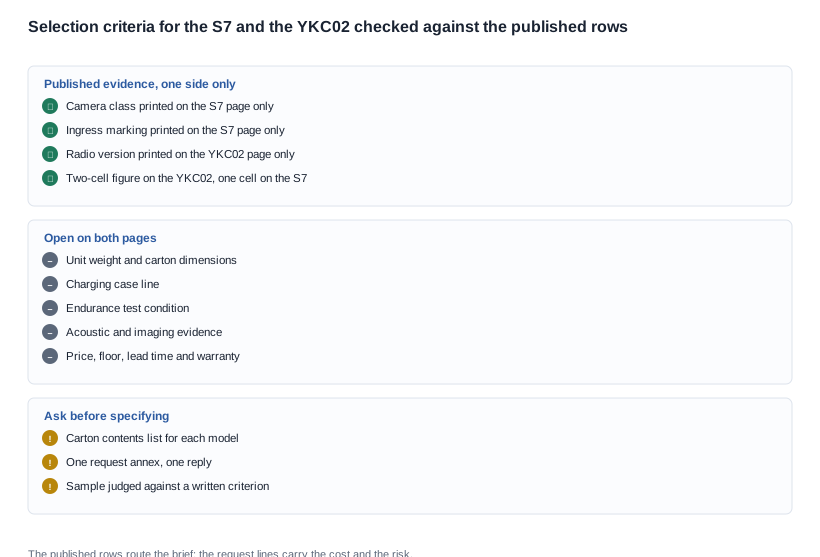
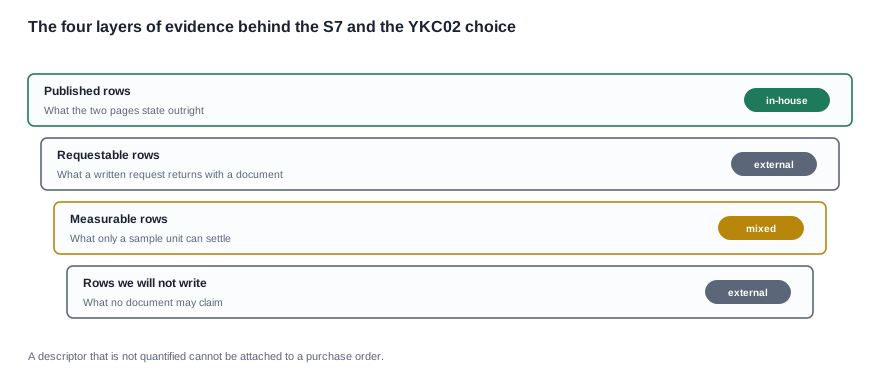
The same holds for the evidence behind the feature lines. The YKC02's surround sound descriptor comes with no driver, no response and no measured output, and the S7's camera class comes with no sensor and no imaging behaviour. The two gaps are different in kind, and the requests that close them are different in wording, but the discipline is the same: a descriptor that is not quantified is a phrase, and a phrase cannot be attached to a purchase order.
Three further lines are absent from both pages, and each of them is a standing request across the camera and sport groups rather than a peculiarity of these two products. The charging case is not addressed on either page, which places both models in the group where the case question is open rather than answered. The radio version is printed on the YKC02 but not on the S7, because no camera page in the library prints one. And the commercial terms — price, order floor, production timetable, warranty response — are published for no model at all.
The certification position deserves a sentence of its own, because it is where a procurement team most often finds that a catalogue has been read too generously. No model in the catalogue carries a certification row, the three familiar marks are nowhere in the text, and the export certification page is a set of images of patents — eight of them appearance-design and two of them utility-model — which is a statement about the company rather than about this model. What a finished unit needs is the conformity file under the EMC Directive 2014/32/EU and the Radio Equipment Directive (EU) 2014/53/EU, together with the certificate numbers and the list of models each certificate covers, and a supplier who cannot produce those is telling a buyer something important.
One distinction has to be made carefully in this section, because it is easy to get wrong and expensive to get wrong in public. Where a page prints nothing, it is not saying the product lacks the thing; it is not saying anything at all. The charging case is the clearest instance, because the S7's page carries no case line of any kind, so a brief that records the model as shipping without a case has turned a blank into a claim. The same logic applies to the radio version on that page, to the weight on both pages, and to every commercial term in the catalogue. A brief should record these as request lines with a named answer attached, and a quotation should carry the answers back as lines of its own. Anything else risks a customer discovering a difference between the description and the carton.
Which one to specify, and what to request first
With the requirement written and the published rows read, the specification is a short piece of work. What follows is the order in which the open lines should be closed, and the order is driven by which answers change the decision and which only change the paperwork.
The first request is the one that can still change the choice: the endurance test condition and duty cycle behind each published figure, and the trigger and output behaviour of the remote shutter where the brief needs one. If the duty cycle behind the S7's band is not what the deployment assumed, the S7 may no longer be the right product even though it is the only one of the two that publishes a camera class. The second request is the evidence that converts a descriptor into a criterion: the sensor, lens, frame rate and format behind the S7's class, and the acoustic record behind the YKC02's surround sound line. The third request is the physical and commercial set — weight as shipped, carton dimensions, carton contents, the case position, the unit price for the quantity being ordered, the smallest acceptable order, the production timetable, the warranty period and the conformity file.
The criteria for scoring the returned answers are worth having on paper, because they are what separates a selection from a preference. Four of them come straight from the pages: a camera class is published on the S7 and not on the YKC02, a radio version is published on the YKC02 and not on the S7, a two-cell figure is published on the YKC02 while a single cell figure is published on the S7, and an ingress marking and a detachable inner frame are published on the S7 and on no other page. The remaining criteria are the request lines themselves, and they are the ones that carry the cost and the risk of the order.
There is a set of red flags that should stop a selection before it is written up. A specification that names a model and cites no printed row for the reason is a specification written backwards. A response that supplies the eight-hour figure without a test condition has supplied a number, not a criterion. A weight returned as a frame figure cannot be used for freight. A conformity answer that names no certificate number and no model schedule cannot be filed. And a carton list that arrives in a different form from the one the packaging artwork was drawn against is a configuration change, and it should be treated as one.
Two further points belong in the same paragraph of the brief. First, the two models share a charging method and a charge ceiling, so a buyer who ends up carrying both in one range has one class of charging accessory to plan rather than two, and the accessory programme is simpler than the rest of the comparison suggests. Second, the S7's cell figure and the YKC02's multiplied cell figure are not comparable numbers, so any range sheet that puts them in the same column is a sheet that needs a footnote rather than a value.
Choosing between the S7 and the YKC02 has to be settled against a written requirement and published rows, and we will not present a preference between them where the catalogue gives none. The S7 is the only one of the two that prints a camera class, plus an ingress marking and a removable inner frame; the YKC02 is the only one of the two that prints a radio version, a two-cell arrangement and a surround sound descriptor. Those are facts, and they are enough to route a brief. They are not enough to price anything, and we do not publish prices. If you want the full published row set for the S7 before writing the requirement, the S7 specification breakdown is the reference, while the request annex it produces is written out in the S7 buyer review checklist; the physical comparison that the pages cannot support is dealt with in the S7 and YKC02 form factor note. The question worth asking a factory is not which of the two to take, but what each of them will confirm in writing.


