

The basic AI questions — on-device or cloud, subscription or not, offline or not — are settled at evaluation. The advanced questions appear after a product is chosen and a channel is designed, and they are the ones that determine whether the AI feature is an asset or a liability. None of them can be answered from a datasheet, because none of them is a hardware property. So smart glasses ai features smart glasses advanced considerations is a conversation about architecture, contract and marketing — three things outside the factory's control and, in two cases, outside the buyer's too.
The shift from evaluation to operation is the whole subject of this article. At evaluation you are comparing products against a table. After evaluation you are carrying obligations: a service dependency, a data policy, an update relationship, a recurring cost and a published claim. None of those appears in a comparison table, and all five of them land on the brand that put the feature on the packaging.
Smart glasses AI features: what changes after selection
Three questions the buyer owns before you commit: offline behaviour, update control, and listing wording
Smart glasses ai features smart glasses advanced considerations is decided by three questions the buyer has to own: what the product does when the network is unreachable, who controls the updates, and how the feature is worded in the listing. The first is a resilience question, the second is a contractual one, and the third is the one that carries legal exposure in the buyer's name rather than the supplier's.
The four things a buyer is now carrying
A buyer asking these questions has already chosen a product and designed a channel around an AI feature, and holds the samples, the target price, the market list and the marketing plan. What they will not hold is a contract, and three of the four issues below are contractual.
A service dependency. If the feature depends on a server, the product has a component that can be withdrawn, degraded or made unavailable. The dependency is invisible in the hardware and total in the failure case.
A data policy. What the device collects, where it goes, how long it is kept and who can reach it. That is a set of commitments, and commitments live in agreements, not on policy pages that can be changed.
An update relationship. Whoever controls the firmware controls the behaviour. If that is the supplier and not you, then a change to how the assistant behaves lands on your product and on your packaging without your involvement.
A claim. How the feature is marketed determines how it is treated. The same functionality, described differently, can attract a different level of scrutiny.
The questions that belong to nobody
There is a fourth category worth naming, because it is the one that produces the most expensive surprises: the questions that fall between two organisations without either of them accepting ownership.
The processing location is the classic example. The factory built the device and knows what the hardware can do. The software house wrote the assistant and knows where the inference runs. The entity operating the backend knows where the data lands. Three organisations, three partial answers, and no single party who can state the full path for your configuration.
The same pattern applies to update control, to the offline fallback, and to the cost model. Each of them crosses a boundary that was drawn for organisational reasons rather than for product reasons, and each of them is the kind of question that gets answered twice, differently, by two people who are each certain they are describing the same thing.
The practical instruction is to assume that any question spanning two organisations will be answered in pieces, and to ask for the pieces in a single document with a single owner. A supplier who replies "I will confirm with our partner and come back" has given you the most useful answer available, because they have identified the boundary. Follow up by asking who at their side owns the relationship, and get the answer in writing.
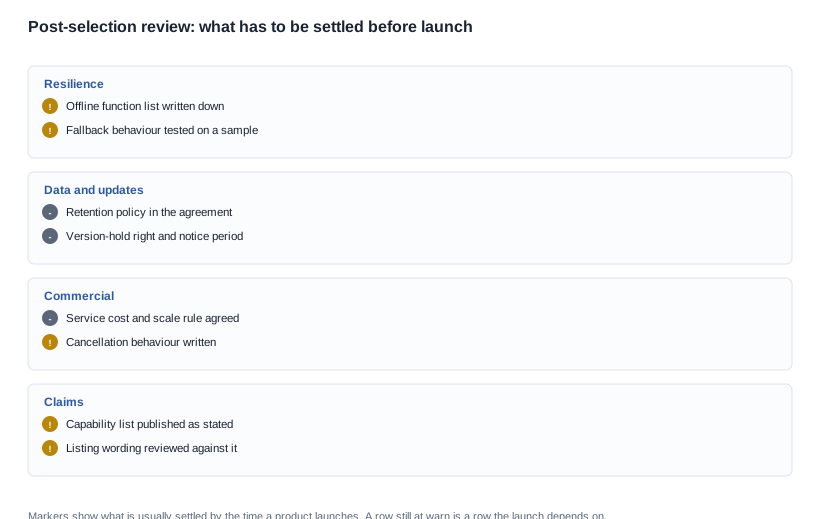
Four failures a buyer is specifically trying to avoid
A feature that disappears with connectivity. That is a feature that produces complaints in exactly the markets with the least reliable service, which are frequently the markets where the product was priced to sell.
A change in AI behaviour that lands without notice. If the supplier controls updates and you cannot, a change that alters a feature you are marketing on is a commercial event you did not plan for and cannot schedule around.
A recurring cost that appears after the product succeeds. A per-user or per-unit cost that arrives at scale is a problem you cannot unwind, and the unwind is always more expensive than the decision that caused it.
A marketing position you cannot evidence. How an AI feature is marketed determines its regulatory treatment, and the same functionality can fall differently depending on the wording.
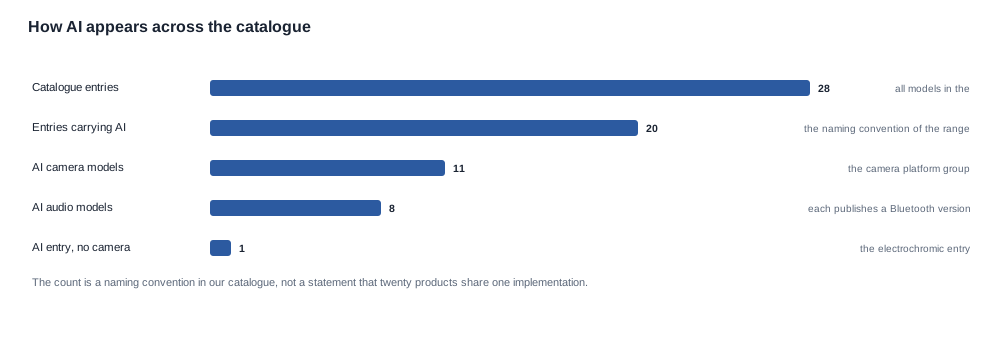
The bar chart is worth one note. Our catalogue contains 28 model entries, and 20 of them carry the AI designation in the name — 11 camera models, 8 audio models and one electrochromic entry with no camera. That is a naming convention of the range, not a statement that twenty products share one implementation. We publish no architecture, no model list and no processing location for any of them, which is exactly why every question in this article has to be asked of a supplier rather than read out of a catalogue.

Latency, accuracy and the fallback: the three that decide usability
Latency is determined by the network path, not by the chip
Latency is a function of where processing happens and how good the connection is, not of the hardware in the frame. On-device inference is fast and limited in capability. Server-side inference is capable and slower, and its latency depends entirely on the connection the user happens to have at that moment.
For a channel where the product is used in a call, in a live stream or in a warehouse workflow, latency is the difference between a feature that feels responsive and one that feels broken. A user does not evaluate an AI feature on accuracy when it takes nine seconds; they evaluate it on the wait, and they stop using it.
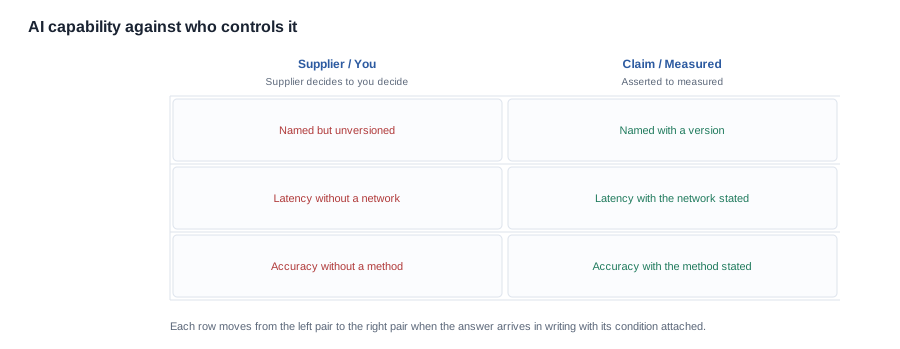
The threshold to hold is a figure measured against a fixed limit, with the network condition stated — not "fast", and not a number measured on a controlled network in the supplier's own building. There is no latency figure in our catalogue for any model, and we will not estimate one from the processor class.
Accuracy is a coverage question, not a percentage
There is no useful single accuracy figure for a language or recognition feature, and a supplier who offers one is usually averaging across conditions that do not match your channel. The question is not "how accurate is it" but "how was accuracy assessed for the languages and conditions my market actually produces, and what were the results."
Training coverage is uneven across languages, and it is uneven across domains within a language. A feature that handles general conversation well may fail on the specific nouns, units and abbreviations your channel uses every day, which is why a content set built from your own usage is worth more than any published benchmark. The measurement method is set out in how to measure smart glasses AI features.
The threshold to hold is a method and a result set: the test set described, the conditions, the failures listed, and the date the assessment was run.
The offline fallback is the resilience question
If every AI function depends on a network service, the product loses its primary differentiator whenever that service is unreachable or withdrawn. The question that closes this row is not "does it work offline" but "does it still take calls, still capture, still play audio, still show the time, with the network off."
That list is the product your customer actually has when the service is down, and it belongs in the instructions and in the listing. A feature that degrades is a materially different proposition from one that stops, and the difference is worth a paragraph of copy.

The three tests are a single afternoon: a written requirement set before the first prompt, a run on a sample in a real network condition, a repeat with the network disabled, a timing for each response, and a probe with input the system should refuse. What that probe reveals matters commercially — a system that returns fluent nonsense is more damaging than one that returns nothing, and it is invisible in a demonstration.
Data, updates and the cost that arrives at scale
Data retention is a commitment, and commitments belong in an agreement
Where the data goes after it leaves the device, how long it is kept there, who can access it and under what basis it is processed are all commitments. None of them can be satisfied by a policy page, because a policy page describes an intention rather than a promise, and it can change without notice to you.
Two questions settle the commercial position. Which jurisdiction — because that determines your own disclosure obligations in the markets you sell into, and it cannot be answered after the launch. How long is the retention — because an indefinite default is not an answer, it is an absence, and you cannot write a privacy statement around an absence.
Update control decides whether your packaging stays true
The version you shipped is not the version your customer will still be running in eighteen months. Whoever can push a firmware build can change what the assistant does, and therefore change what your listing says the product does.
Three terms decide whether that is manageable. The notice period before a behaviour change lands, so you can update the packaging, the training material and the support script. The version-hold right, so that a specific build can be pinned for a fleet or a channel if a change breaks something. And the change-notification scope, so that a change to the assistant's behaviour is notified even if the change is technically part of a general release.
None of these is a technical fact and none of them appears in a datasheet. All three are ordinary commercial terms, and they are far easier to obtain before the first order than after the first complaint.
The cost model has a scale rule, and the scale rule is the negotiation
A per-unit cost and a per-user cost are different products with different margins. A per-unit cost scales with the units you ship and is easy to model. A per-user cost scales with adoption, which is the thing you cannot predict — and it arrives at scale, after the product has succeeded, at exactly the moment you have the least room to change anything.
The threshold to hold is a figure plus a scale rule: what happens to the unit cost at ten times your first order, whether it is capped, whether it is a term or a rolling basis, and whether it changes if a third-party model is retired.
The cost structure in this category is covered in AI cost factors, and the supplier-side checks are in AI supplier verification.
Regulatory exposure follows the wording, not the manufacture
A feature described as a translation aid and a feature described as making decisions about a person are treated differently, and the difference is created by the copy rather than by the hardware. That is why the capability list and the listing wording have to be reviewed together, and why the review has to happen before the copy is written rather than after a marketplace reviewer asks for a substantiation.
Our own rule is that we will not describe a product as supporting a named model or a named language count unless the manufacturer states it and we can source it, and we decline briefs asking us to position AI capability in a way we cannot evidence. A vague claim is commercially weaker than a precise one and legally riskier.

Putting the advanced questions into writing
The post-selection request, and what counts as an answer
The questions below are for a supplier you have already selected. The distinction from an evaluation brief is that each one needs an answer that survives being read a year later by somebody who was not in the room.
| Request | The answer that holds | What a soft answer sounds like |
|---|---|---|
| Inference architecture | On-device, cloud, or a stated split, per function | "It's AI-powered" |
| Measured latency | A figure against a fixed limit, with the network condition stated | "Very fast" |
| Accuracy assessment | The method and the results for your languages | "Highly accurate" |
| Offline fallback | What the product still does without the service | "It needs a connection" |
| Data retention | How long, where, and who can access it | "We don't keep user data" |
| Update control | Who can hold a version, and how much notice a change carries | "We push updates" |
| Cost and scale rule | A figure and the rule that changes it | "There's a service fee" |
| Capability list | A named list the manufacturer states | "Supports 50 languages" |
| Certification scope | Certificate numbers naming the exact model | "CE and FCC available" |
| Firmware build | The build identifier and how a shipped unit is updated | "Updates over the app" |
The difference between the second column and the third is the whole point. Every answer in the third column can be true, and none of them can be relied on, because none of them tells you what happens when conditions change.
The clauses that carry these answers into the programme
The data path and the operator entity as fixed terms, not as descriptions. A clause stating the behaviour of every feature when the service is unreachable or the subscription ends. A clause requiring notice before any firmware or model change that alters the assistant behaviour, with a defined period. A clause fixing the retention policy and the mechanism for changing it. A clause on the service cost and the scale rule. A clause requiring the marketing wording to match the manufacturer's stated capability list. A clause stating who bears the cost when a sample does not meet the acceptance criteria.
On the commercial side, the lines worth negotiating are the structure of the service cost, the update notice period and the version-hold right, minimum order quantity, the packaging and insert design including the market labels and the language of the documentation pack, and the payment staging — a deposit at the contracting stage, a balance once the inspection is cleared, and a holdback on the paperwork. What is not a lever is the certification cost or the certification elapsed time, which are fixed per product family and set by the test laboratory's queue, nor the regulatory treatment, which follows from the functionality and the wording and which no commercial term can move.

A post-launch review, walked through
This is a hypothetical scenario, not a client project, and it is written to show the sequence rather than to report an outcome.
Assume a brand-side product manager who launched a camera platform with an AI voice assistant into two markets, one of which has patchy connectivity. Six months after launch, three things have happened: support tickets in the weaker market cluster around a single complaint, the packaging copy no longer matches what the assistant does, and the unit cost of the service is not what the original model assumed.
The first issue is the resilience one. The brand turns the network off on a sample and enumerates what still works. The answer is that capture, calls and playback survive, and the assistant does not. The brand now knows that the assistant is an enhancement rather than a dependency, which is a usable answer — but only because it was measured rather than assumed. The listing copy is corrected to describe the assistant as requiring a connection, and the support script is updated. The cost of this fix is an edit. The cost of not making it is the ticket cluster.
The second issue is the update one. The supplier shipped a firmware change that altered the assistant's phrasing and its willingness to answer in certain categories. The brand's notice period clause required fourteen days, and the brand got eleven. The packaging in the warehouse is now wrong for a proportion of units, which means the brand has to decide whether to reprint, to add an insert, or to accept the divergence and adjust the listing. Each of those three options has a cost, and the size of the cost was set by whether a notice clause existed.
The third issue is the cost one. The service is priced per user, and the brand's model assumed a modest attach rate. The actual attach rate is higher, because the feature is the reason some customers bought. The scale rule turns out to be absent from the original agreement. The brand now has to negotiate a retrospective position with a supplier it has already paid twice — which is a materially weaker position than negotiating one before the first order.
The three failures share a structure, and it is the structure of this entire article: each one was a question that had an answer, and each one became expensive because the answer was never requested in a form that bound anybody.
What our documentation states about AI, and what it does not
We will publish the AI features our catalogue states and mark the rest as open. We publish an AI voice assistant across the camera models, and our independent site references AI translation on the K01, which is an audio model — so we treat that as an observation from our own marketing material rather than as a specification.
We publish no architecture, no model list, no language count, no latency, no accuracy figure, no processing location, no subscription terms, no data policy and no per-model certificate number. Those are not oversights, and they are not places where a plausible value would help you. A buyer who needs them needs them for a specific configuration and a specific firmware build, and the only party that can produce them accurately is the party that implements the feature.
We would rather a buyer understand that AI capability in this category is a contractual and architectural question than discover it after the channel is built. And we will not write a number into a listing that we cannot source from the manufacturer.
If you tell us which AI function your channel depends on and in which market, we will say what we can confirm and what you must obtain separately. The background is under AI features, the measurement method is in how to measure AI features, the supplier checks are in AI supplier verification, and the cost side is in AI cost factors.
Where the advanced questions come from
Tell us which AI function your channel depends on, and we will tell you which of these five it exposes you to.


