

An AI feature is unusual among smart glasses options because it is the one that can change after you order it. Hardware is fixed when the tooling is cut; software can be updated, deprecated or made dependent on a third party. That means the checklist below has a different job from a hardware checklist: it is not confirming what the product is, it is establishing what you are buying a dependency on.
The nine rows below are written for a procurement team rather than for an engineer, because the AI rows are rarely closed by an engineering question. Seven of them are closed by a party the factory does not control, and two are closed by a measurement the procurement team has to commission. That distribution is the single most useful thing this checklist communicates, because it tells you what to send, to whom, and what to expect back.
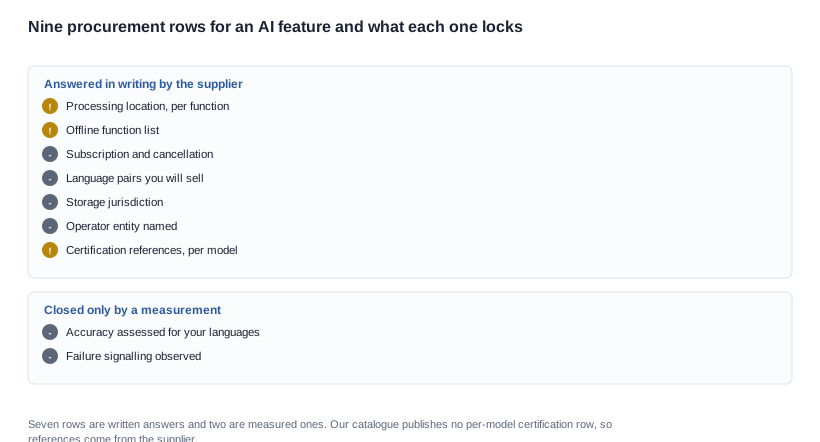
Smart glasses AI features: the nine procurement rows
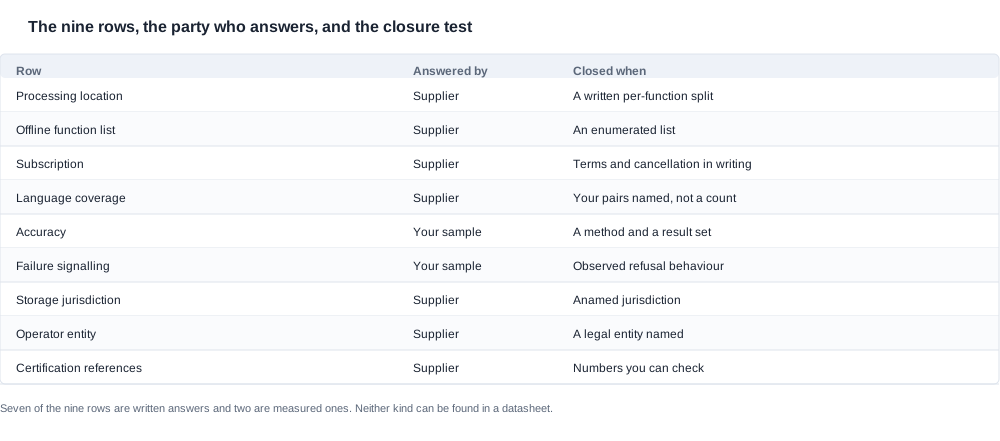
The rows and the closure test
| Row | Answered by | Closed when |
|---|---|---|
| Processing location | Supplier | A written per-function split |
| Offline function list | Supplier | An enumerated list |
| Subscription | Supplier | Terms and cancellation in writing |
| Language coverage | Supplier | Your pairs named, not a count |
| Accuracy | Your sample | A method and a result set |
| Failure signalling | Your sample | Observed refusal behaviour |
| Storage jurisdiction | Supplier | A named jurisdiction |
| Operator entity | Supplier | A legal entity named |
| Certification references | Supplier | Numbers you can check |
Seven of the nine rows are written answers and two are measured ones. Neither kind can be found in a datasheet.
The distinction that makes the checklist work
A row is closed when it binds, not when it is filled in. A supplier who answers "we process in the cloud" has filled the processing location row. A supplier who answers "for this configuration, the assistant's voice requests are sent to a server in region X; capture and playback are processed on device; the retention period is Y" has closed it.
That distinction is what separates a procurement checklist from a questionnaire. A filled row produces a document. A bound row produces a position you can hold somebody to, and it is the second one that lets you write a clause, set a warranty and refuse a lot.
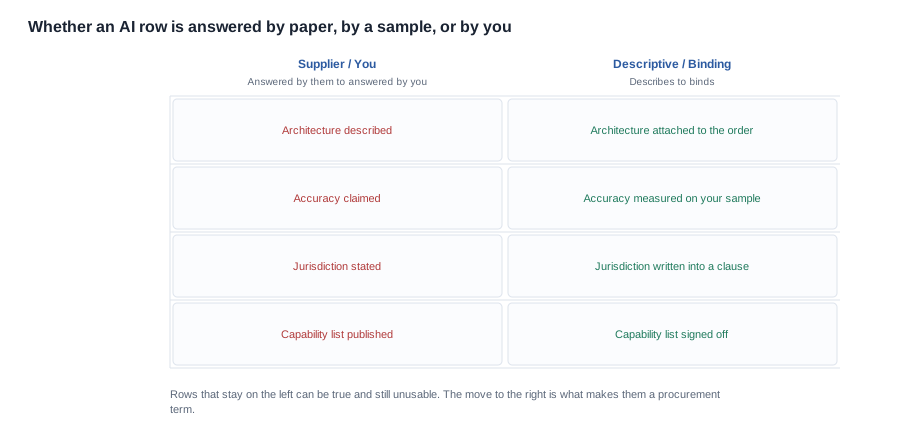
The matrix above is the checklist viewed as a two-axis grid. The horizontal axis is who holds the answer. The vertical axis is whether the answer binds. A row sitting in the top-left quadrant can be perfectly true and still be useless to you, because it describes rather than commits. The work of the checklist is to move rows right and down, and it is worth knowing which rows will not move at all.

The seven rows a supplier has to close in writing
Row one: processing location, per function
On the device, on a server, or split. This determines the data story, the privacy exposure and the offline story, so ask it first — the other answers depend on it.
The closure test is a per-function split, not a product-level statement. A product with three AI-assisted functions may run one locally, one on a server and one on the phone, and a single statement covering the product will hide exactly that split. A supplier who answers per function has understood the question; one who answers per product has given you a summary that will turn out to be wrong in one case.
Row two: the offline function list
Which functions survive with no network. A feature that stops working is a materially different product from one that degrades, and the distinction is invisible until a customer is on a train.
The closure test is an enumerated list — capture, calls, playback, assistant, settings, and whatever else the unit does. A sentence about "basic functionality" is not a list, and it is not usable in an instruction manual or a listing caveat.
Row three: the subscription, and its cancellation behaviour
Whether there is a recurring fee, on what basis, what happens to it at scale, and what happens to the feature if a customer stops paying.
The closure test is the terms and the cancellation behaviour in writing. The second half is the part most often missing, and it is the half that becomes a refund policy question, a contract question and a warranty question once you have launched. A per-unit cost and a per-user cost are also different products with different margins, and the scale rule belongs with the terms rather than in a later negotiation.
Row four: language coverage, in your pairs
Not "supports 168 languages". Which pairs, in which direction, and how many are actually usable.
The closure test is your pairs named. Define the set your market needs and ask whether those are covered. A count is not a coverage statement, because a count includes languages your channel will never use while telling you nothing about the ones it will use every day.
Row five: the storage jurisdiction
Where audio, images and text go after they leave the device, and for how long they stay there.
The closure test is a named jurisdiction and a stated retention period. "Secure servers" is not an answer, and an indefinite default is an absence rather than an answer — you cannot write a privacy statement around an absence. In most markets this row also creates a disclosure obligation that attaches to you rather than to the supplier.
Row six: the operator entity
Which legal entity operates the backend. If your customer has a problem, this determines who they complain to and who your own recourse is against.
The closure test is a legal entity named, ideally with the address that the customer-facing terms will reference. "Our partner operates it" is not a closure; it is an indication that the question crosses an organisational boundary, which is exactly the kind of boundary where answers come back in pieces.
Row seven: certification references
Radio qualification and market conformity, with numbers you can verify independently rather than documents you accept on delivery.
The closure test is numbers you can check — in the issuing body's register, against the exact model designation on the units you will receive, character by character. The reference numbers for a camera model and for an audio model are different products in that register, and a document covering a platform does not cover a branded configuration of it.
The two rows that only a measurement can close
Accuracy, and why a single figure is not an answer
Accuracy is a property of a deployed system in your conditions, and it cannot be established by a specification. It has to be measured.
There is no useful single accuracy figure for a language or recognition feature. A supplier who offers one is usually averaging across conditions that do not match your channel, and a percentage with no method is a marketing figure.
The closure test is a method and a result set. The content set described, the conditions, the failures listed, and the date the assessment was run. The method for building that set is in how to measure smart glasses AI features, and the sample route is under sample evaluation.
The practical method is straightforward: build a set of fifty sentences resembling what your customer will actually say, including proper nouns, numbers, units and deliberately ambiguous phrases; run them through a sample; record which fail and how; then feed the system input it should refuse and see whether it refuses. That produces a number specific to your product, which is worth more than any published benchmark and costs about a day.
Failure signalling, which is the risk nobody tests
What does the system do when it is unsure? A system that returns a fluent wrong answer is more damaging than one that returns nothing, and it is invisible in a demonstration because demonstrations are made of prompts that work.
This row is deliberately included in a procurement checklist because it is the one with a direct commercial consequence. A confident wrong answer reaches a customer, becomes a complaint, and cannot be distinguished from a defect by the person receiving it. A system that says "I did not catch that" is a support-script line, and the cost of one is a minute of a support agent's time.
The closure test is observed refusal behaviour. Deliberately ambiguous input — a name that could be two people, a number with no context, a phrase with two readings — and a record of whether the system signals uncertainty or produces confidence.
Why these two rows belong to the procurement team
Neither row can be delegated upward or downward comfortably, and that is worth saying plainly. An engineer will tell you accuracy is the software house's problem; the software house will tell you it depends on the deployment. Both are right, and neither produces a closure.
The procurement team's job on these two rows is to commission the measurement rather than argue about it: specify the content set, the thresholds and the conditions, and put them into the order as acceptance criteria. Once they are criteria, they are testable by anyone who holds the unit, including your own team.
Scoring a shortlist on binding answers rather than complete ones
The three grading levels
A completed row is not a full answer. Three levels are enough, and they map onto the matrix above.
Level one — answered with a condition. The answer states what it applies to, and you can rely on it. It names a configuration, a firmware build, a region, a language pair or a measurement method.
Level two — answered without a condition. The answer is true but unbounded, and it cannot be relied on when conditions change. "Fast", "secure" and "supports many languages" all sit here.
Level three — not published. The row is explicitly open, and you now know it needs a test or a clause.
A supplier with many level-one rows is not automatically the better supplier for your channel. A supplier with many level-three rows in the rows that matter to you is worse, because the gap will be closed by your own customer instead of by a conversation with the supplier.
What to do with a level-two answer
A level-two answer is the most common result and the one most often left to sit. It is neither true nor false; it is unbounded, and it can be converted into something usable in three ways, depending on which row it is.
Convert it into a requirement. If the row is a latency figure, a retention period or an accuracy statement, write the criterion you need and send it back as a specification item: the response must complete within a stated time on a stated connection, measured on a sample supplied by the manufacturer. A supplier who cannot produce the figure can usually accept the criterion, because a criterion is a thing they agree to rather than a thing they have to prove.
Convert it into a clause. If the row is the processing location, the operator entity or the cancellation behaviour, the answer does not need to be more precise — it needs to be fixed. Write the answer you were given into the agreement as a fixed term, with a notice obligation if it changes. An unbounded description becomes a binding commitment simply by being written down.
Convert it into a decision. Some rows cannot be converted at all, and the honest answer is to accept the risk and price it. An unknown service cost goes into your margin model as a worst case rather than as a forecast. An unowned account goes onto the launch checklist as an item you resolve before you ship. A missing latency figure becomes a listing caveat: the feature is described without a speed claim.
What you must not do is let a level-two answer quietly become level one in the specification. That is how a description ends up in a contract, and it is the most common way a procurement file fails a year later.
Running the same nine rows against every supplier

The comparison only works if the rows, the wording and the order are identical for every supplier on the shortlist. A checklist asked differently against two suppliers produces two anecdotes rather than a comparison, and the decision then gets made on something else — usually price.
Two practical rules for the procurement team. Send the nine rows as one attachment with one deadline, so the answers arrive together and in the same form. And run the two measurement rows on samples from every supplier, using the same content set and the same thresholds, because that is the only way the results are comparable.
Then compare in three steps rather than one: each result against your requirement set, each result against the same requirement set for the other suppliers, and the gap between them against what the gap would cost you. The third step is the one that turns a test result into a purchasing decision, and the one most often skipped.
What a supplier who answers everything is telling you
Be careful here, because it is not the good news it appears. A supplier who can answer all nine rows in detail usually depends on a third party for the AI stack — which is a normal and often better commercial arrangement, but it means you are buying a dependency rather than owning a capability.
The useful follow-up is: what happens to the product if that relationship ends? A supplier with a genuine answer has thought about the end of the arrangement, not just its beginning. And if the answer is that a different provider takes over, several of the nine rows may need to be re-closed, which is a cost that belongs in your evaluation of the answer rather than discovered later.

What changes in the programme once the rows are closed
The programme consequences, in order
The specification stops being a hardware document. Two of the nine rows cannot be closed by any document at all, so the specification has to contain measured criteria or it contains nothing about the AI feature.
The acceptance criteria change shape. Instead of a batch-inspection criterion — a physical check on the units — you get a functional one: a network-off run, a latency threshold, a refusal behaviour. That means the acceptance step needs a device, a script and a person, and it needs to be scheduled rather than assumed.
The warranty stops being a description. "The AI feature works as described" cannot be settled. "The assistant answers the defined class of input within the stated time on the stated connection, measured by the stated method" can.
The listing is written from the limitations rather than the features. The offline function list and the failure list become the source of the copy, which is why the checklist matters commercially rather than only technically.
The documentation pack gains a layer. A privacy statement, a subscription disclosure, a limitation paragraph and a set of contractual criteria sit alongside the conformity file, and the two need to be version-controlled against each other — because a change to one has to trigger a review of the other.
The commercial terms this checklist governs
The subscription structure is the most consequential term attached to an AI feature, and the parts worth negotiating are what happens on cancellation, whether the feature degrades or disappears, and whether a service tier is bundled with the hardware. Minimum order quantity is negotiable. Packaging and insert design, including the market labels, the subscription disclosure and the language of the documentation pack, is a low-cost negotiation. Delivery splitting against a documentation-review milestone is often granted more easily than a price concession, and that milestone should be the completion of this checklist rather than the shipment of samples.
Payment structure is worth attaching to this checklist rather than to the production schedule, because the checklist defines what the buyer is actually paying for. A deposit against the answered rows, a balance against the sample passing the two measured rows, and a retention held until the registration details for the domain, the developer account and the cloud credentials have been handed over. That last one is the node most often left out, and it is the node that protects the buyer against the failure that ends the relationship — a service the buyer does not control.
What is not a commercial lever is the certification cost or the certification elapsed time, which are fixed per product family and set by the test laboratory's queue; nor the regulatory treatment, which follows from the functionality and the wording and which no commercial term can move.
Where our own answers stand on these nine
We publish the capability and we do not publish the implementation. For the nine items above, the honest answer from our documentation today is that we would need to obtain that information for a specific configuration, and some of it would then become part of your documentation obligations rather than ours.
Our source material references an AI voice assistant capability across the camera platforms, and the independent site describes AI translation support. Twenty of our 28 catalogue entries carry the AI designation in the name — eleven camera models, eight audio models and one electrochromic entry with no camera — and that is a naming convention of the range rather than a claim that twenty products share one implementation.
We do not publish supported languages, accuracy, latency, offline behaviour, processing location, subscription terms, the app operator, the data storage jurisdiction, or any certificate number. Our catalogue carries an export certification statement at company level and no per-model certification row, so the references have to come from the supplier for the configuration being bought.
We mark those rows not published rather than leaving them blank or filling them with typical values, because this is the area where a plausible invention is most likely to be discovered by somebody else.
That does not make the camera platforms unsuited to a project with AI in it. It means the AI question has to be asked before the specification is frozen rather than after — and that the nine rows above are a better instrument for that conversation than any datasheet in this category.
The feature background is under AI features in smart glasses. The documentation an AI feature forces you to write is in the certification obligations an AI feature creates, and the comparison method is in the procedure for comparing two AI feature sets.
Related reading
- The paperwork an AI feature creates — AI features certification requirements
- Comparing two suppliers on this axis — how to compare AI features
- Testing claims you cannot get in writing — sample evaluation
Send us the nine answers you have from a supplier and we will tell you which of them we can corroborate.


