

Smart glasses ai features smart glasses cost vs performance is the hardest line in the business case of this category, and the reason is structural: almost none of the cost of an AI feature appears in the bill of materials, and almost none of the performance is under the hardware's control. A buyer comparing two platforms on unit price learns nothing about the AI feature, and a buyer comparing two AI features on a demonstration learns nothing about either.
The second half of that sentence is the part buyers get wrong most often, so this article is organised as a procedure rather than as a verdict. There is no honest answer to "which is better value" without knowing which four decisions the two options have made, and the article sets out those decisions, the six dimensions the comparison has to run on, and a way to score performance when no benchmark exists for either option.
Our published position is deliberately thin on this subject. We publish an AI voice assistant as a key technology across the camera tier and the audio tier, AI translation on the K01, and the smart noise reduction technique for the Bluetooth audio family. We publish no cost, no performance figure, no latency, no accuracy and no data-flow detail for any of them — and that absence is why the comparison has to be built as a method rather than as a ranking.
Smart glasses AI features: what unit price misses
A quotation for smart glasses prices a frame, a camera or an audio pair, an electronics design, a cell, an assembly process and a box. It does not price the account, the terms of service, the sign-up route, the application, the store release, the legal data review, the support process for a feature that fails, or the per-use cost of running the assistant.
None of those are on the invoice, and all of them are real. That is why two options at the same unit price can differ by several times in the total over a retail lifecycle, and why the unit price is not simply a weak signal — it is a signal about a part of the cost that has little to do with the feature being compared.
The performance side has the same shape, and a different cause. The capture, the playback and the wake-word detection are in the device. The recognition, the answer, the latency and the accuracy happen beyond the frame, on a phone or a server. So the performance of an AI feature is mostly an experience of the network and of the model, and it is not something a brand controls by choosing a better supplier of glasses.
That has a consequence that surprises people: the performance comparison is not a comparison of hardware at all, and a better frame does not improve it. Which means the two questions — what does it cost, and how well does it work — cannot be answered with the same evidence, and the mistakes in both come from treating them as if they could.
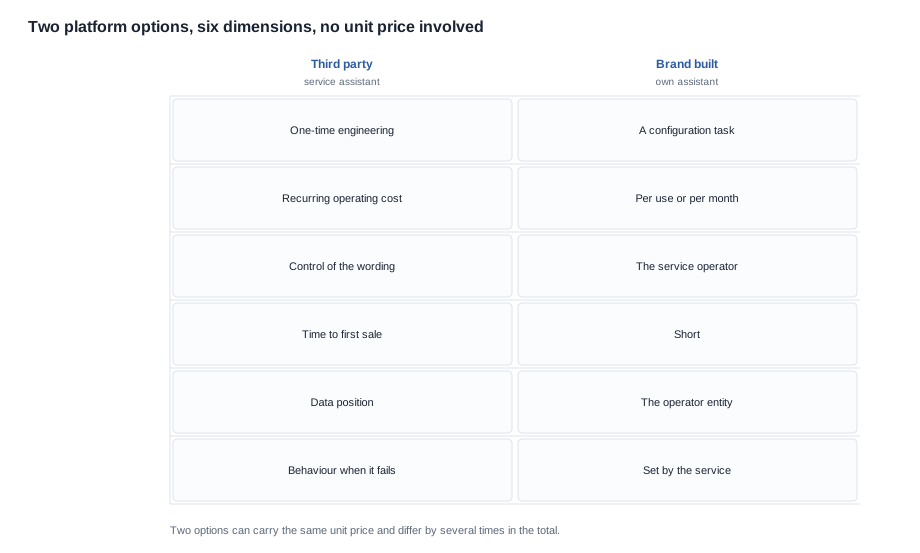
The buyer in this comparison is usually choosing between a platform that arrives with a third-party assistant and one the brand intends to own, and holds a target price, a launch date, a market list and a set of samples. What they will not hold is a cost structure for either option, and in this category the cost structure is the comparison.

The six dimensions the comparison has to run on
Six dimensions is enough to expose the differences that matter and few enough to complete. Each one gets a line per option, and each line is written before the two are placed side by side, because a side-by-side view with empty cells produces false confidence.
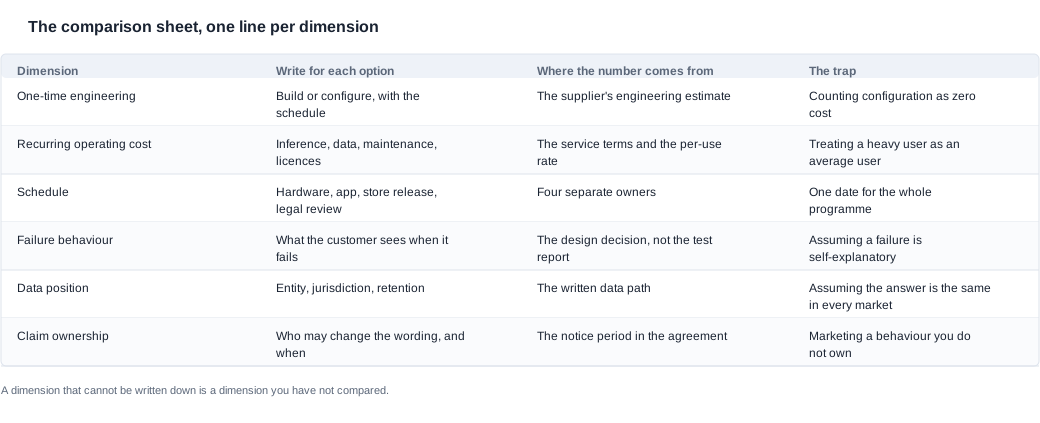
| Dimension | Write for each option | Where the number comes from | The trap |
|---|---|---|---|
| One-time engineering | Build or configure, with the schedule | The supplier's engineering estimate | Counting configuration as zero cost |
| Recurring operating cost | Inference, data, maintenance, licences | The service terms and the per-use rate | Treating a heavy user as an average user |
| Schedule | Hardware, application, store release, legal review | Four separate owners | One date for the whole programme |
| Failure behaviour | What the customer sees when it fails | A design decision, not a test report | Assuming a failure is self-explanatory |
| Data position | Entity, jurisdiction, retention | The written data path | Assuming the answer is the same in every market |
| Claim ownership | Who may change the wording, and when | The notice period in the agreement | Marketing a behaviour you do not own |
One-time engineering. The two options are not variants of the same product, and the difference is not a matter of degree. Configuring a third-party assistant is an account, credentials, a wake word, a command list and an application skin. Building the brand's own is a programme with its own design, testing and maintenance cycle. The trap is treating the second as if it were the first because a supplier said "we can do either".
Recurring operating cost. Four lines, and they are the ones that decide the margin. Inference if there is a service, data handling, maintenance of the platform and the application, and model licensing if a third-party model is used. The trap is averaging usage: a per-use cost quoted at an average of one use a day is a number that describes nobody, and the heavy user is the one who generates the invoice that ends the margin.
Schedule. Four owners and four different clocks: the hardware, the application, the store release and the legal review. The trap is a single launch date on the plan, which hides the fact that the feature is usually the last thing to land. The lead-time side of this is covered in AI lead time factors.
Failure behaviour. What the customer sees when the feature does not work. This is a design decision rather than a test result, and it is rarely written down. A feature that fails visibly is better than one that fails silently, and both are better than one a support agent cannot diagnose because the device publishes no state. The trap is assuming that failure is self-explanatory, which is true of a dropped connection and false of a mis-recognised command.
Data position. The operating entity, the jurisdiction and the retention period, and whether the answer is the same in every market you sell into. The trap is generalising a single-market answer, which is a privacy exposure rather than a cost error.
Claim ownership. Who may change the behaviour, and whether they have to tell you first. The trap is marketing a behaviour you do not own: a claim about a service's language coverage is a claim about somebody else's roadmap.
Scoring performance when no benchmark exists
Here is the difficulty with the performance half of the comparison: you cannot compare accuracy, because neither option publishes one, and a demonstration does not produce a comparable number. So the performance comparison has to be made structurally, on questions whose answers describe the behaviour rather than on figures nobody has.
Four questions, asked of each option separately, in this order.
Where does the processing run? On the device, in a vendor's service, or in the phone application. The answer determines the latency, the offline behaviour, the data position and the cost shape simultaneously, which is why it comes first and why everything else is a consequence of it.
What happens with no connection? An enumerated list of surviving functions, per option. An option that answers this with a paragraph is an option that has not tested it, and an option that answers with an empty list has told you the truth about a device that stops working in a basement.
What does the customer see when it fails? The failure state, the support route, and whether the device publishes any state a support agent can read. This is the cheapest of the four to establish and the one most often left unwritten.
What is the data path? Where the audio goes, who can retrieve it, and for how long. Two options with identical features and different data paths are not equivalent, and the one with the weaker answer is the one a compliance team will stop.
Scored this way, performance becomes a set of structural differences rather than a score out of ten, and a structural difference is something you can act on: you can write a narrower claim, schedule the legal review earlier, or price the service usage.
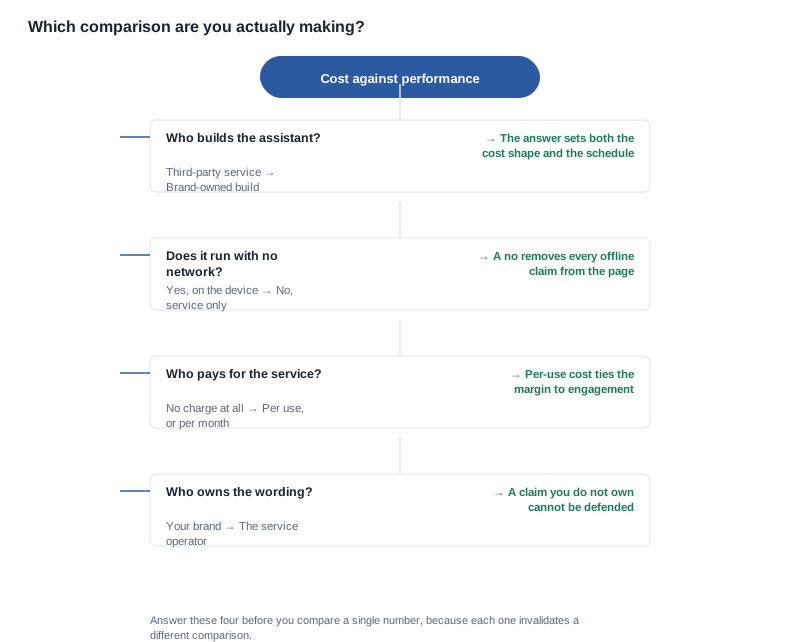
The fork at the top of that diagram is worth stating on its own. Before you compare a single number, you have to know which comparison you are making, because the four questions above invalidate different comparisons. If the assistant runs in a service, the cost question is about usage and the performance question is about the network. If it runs on the device, the cost question is about silicon and power, and the performance question is about the model. If the phone answers, then the capability belongs to another product and the honest claim is about hands-free operation rather than intelligence.

Running the comparison on two realistic options
The most useful way to see this method work is to apply it to two options that a real buyer would actually be choosing between. The options below are typical shapes rather than two named products, and the numbers attached to them are the ones the method produces, not figures from any supplier.
Option one: a platform with a third-party assistant already configured. The engineering is a configuration task measured in days. The recurring cost is a per-use fee on a published scale rule, with the rate to be confirmed and the scale rule agreed. The application is a third party's, with its own release cycle and its own device matrix. The data position belongs to that operator, in a jurisdiction to be established. The failure behaviour is the operator's design. The claim ownership is the operator's roadmap.
Option two: a platform with a brand-owned assistant. The engineering is a programme measured in months, including the design of the failure state and the support route. The recurring cost is a team the brand already pays, plus hosting and inference on a scale the brand controls. The application is the brand's, with its own store release and its own review queue. The data position can be the brand's own entity in a jurisdiction the brand chooses. The failure behaviour is a design decision the brand makes and owns. The claim ownership is the brand's.
Step one: the two options, on one sheet. Six dimensions, two columns, and every cell written before the columns are compared. The result at this stage is usually that the two options are not close on cost and are not close on schedule, and that the two options are broadly similar on nothing at all.
Step two: test the chain on each. On the same script, on the same network, on the same day, with the same units. This is the only part of the comparison where the two options are measured against each other rather than against a description, and it is worth doing even though the answer is usually that the third-party option is more capable today, because that is a fact about today.
Step three: test the network-off behaviour on each. Whichever option loses functions here has lost the offline claim, permanently and for good reason. In a market with uneven connectivity that is not a small difference, and it is the single most common finding in this comparison.
Step four: write the claim for each option separately. Then check each claim against the measurement sheet from step two. A claim that is longer than the sheet supports is a claim that will fail in a customer's hand, and the cost of a claim that fails is not the claim — it is the reprint, the listing correction and the support load.
The result is rarely a winner on price. It is usually a clearer statement of what each option actually is, which is what lets a buyer choose deliberately: the third-party option buys capability and a dependency, the brand-owned option buys control and a programme, and the price difference between them is usually the smaller of the two differences.

Where the comparison breaks, and what to negotiate instead
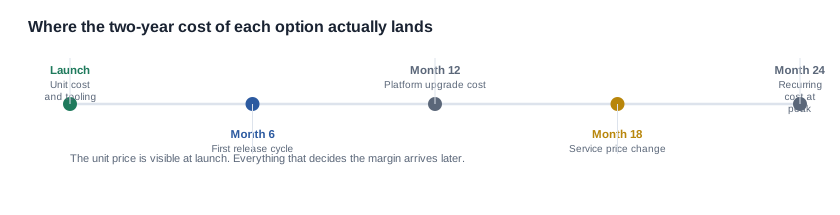
The comparison breaks in four specific places, and each one has a commercial answer that is worth more than the comparison itself.
It breaks when a service changes between the test and the launch. The test result is a dated observation of somebody else's system. The commercial answer is a notice period, and a copy review trigger, in the agreement. Not a notice of any change — a notice of any change that alters the behaviour of a claim you are marketing on, with a defined period in which you can amend the listing.
It breaks when usage is heavy in one market and light in others. The per-use cost was modelled on an average. The commercial answer is a scale rule and a cap, negotiated before launch rather than discovered in a quarter where the invoice arrives.
It breaks when the failure behaviour was never specified. Then every failure becomes a support ticket, and a support ticket becomes a defect report, and a defect report becomes a margin problem. The commercial answer is to write the failure state into the purchase order as a design commitment, including what the device shows and what the support script says.
It breaks when the subscription position is discovered late. A product priced as a device turns out to be a service, and the retention model, the support model and the pricing all have to change at once. The commercial answer is the question in the brief, with the lapse behaviour attached, before the first order.
Two things about this section are worth stating plainly, because they are where buyers try to negotiate hardest and get least. Certification cost and certification time are not a commercial lever: the fee is per product family and the elapsed time is set by the test laboratory and the review queue. Tooling is a one-off, and the useful question is over what volume it is amortised and what happens to it if the programme is discontinued. The performance of the chain beyond the frame is not the brand's to control, and a contract that pretends otherwise is a contract that cannot be fulfilled.
The questions to ask, then, are about the things that genuinely move: the scale rule, the notice period, the acceptance criteria, the accessory list, the minimum order quantity, the payment node structure and the packaging and insert design, including the market labels and the language of the documentation pack. A deposit, a balance on inspection before shipment and a retention held against the documentation package is the standard structure, and the retention is the one that protects you on the failure that costs most.
The criteria that decide between the two options
Once the sheet is complete, the decision is usually not a calculation. It is a question about which risk the brand can carry, and there are three criteria that decide it in practice.
How long the feature has to be sold. A programme that launches in two months cannot absorb a months-long assistant build, whatever the total cost works out to. If the schedule is fixed and the feature is not, the configuration option is not the cheaper option — it is the only one available, and the comparison should be made against the next feasible alternative rather than against an ideal.
Who has to be defended when it fails. The brand-owned option puts a support agent in the path of every failure. That is a cost, and it is also an asset, because a design with a defined failure state can be supported. The third-party option is cheaper to operate precisely because somebody else absorbs the failures, and that somebody else's terms are the dependency. The criterion to apply is whether the brand is willing to carry the support load in exchange for the control.
How many markets have to work on day one. A brand-owned assistant can be pointed at one jurisdiction and one data position. A third-party service arrives with a data position already fixed, and if that position does not suit the launch markets, the answer is not to negotiate the unit price but to change the option.
The pitfall in all three criteria is the same one, and it is worth naming because it is common: the comparison gets made as if the two options were interchangeable products at different prices, when they are different products with different consequences. A buyer who has answered the four questions on the fork above already knows they are not interchangeable, and the sheet exists to price the difference rather than to resolve it.
What we can and cannot tell you to compare
Here, "AI features" is not a comparison axis, it is a set of four decisions, and a buyer who has those four answers can compare two platforms properly while a buyer who does not is comparing marketing language.
We will not publish a language count, an offline capability, a subscription term or a data location, because we do not hold them, and we will not convert our own website copy into a specification. We will not present an AI feature as a clinical, health or safety benefit, and we make no medical or health claim for any product in this range. Where the feature is published, we will say which model it is published on, and where it is not, we will say that it is not.
What we can do is tell you which of the six dimensions our documentation speaks to and which have to come from the manufacturer, and help you build the one-page cost structure for each option so that the two are compared on the same sheet. The mechanism behind the performance half is set out in how AI features work, the over-claims to stop repeating are in AI myths, and the background is under AI features.
Where the comparison method comes from
Send us the two options and we will help you build the one-page cost structure for each.


