

Smart glasses ai features smart glasses how it works is a six-step chain, and understanding where the weak link sits is what lets a buyer price the feature, schedule it and write the copy honestly. The chain is: the microphone captures the voice, the wake word is detected, the audio is transmitted, the assistant processes it somewhere else, the answer comes back, and the temple speaker plays it. Almost every question a buyer has about an AI feature — where it runs, how fast it is, whether it works offline, what happens to the data — is answered by one of those six steps, and almost none of it is answered by the hardware.
Our catalogue publishes an AI voice assistant as a key technology across the camera tier and the audio tier, and AI translation on the K01, which is an audio model. It publishes no detail about any of the six steps below, and that is not an omission to be filled with a typical figure — the steps have different owners, and the owner of each step is the thing a buyer actually needs to know.

Smart glasses AI features: six steps from microphone to temple speaker
1. Capture. The microphone picks up the voice, along with everything else in the environment. This step is governed by the microphone array, the processing and the fit of the frame, and our catalogue publishes none of it. What a buyer should notice here is the physical consequence: a microphone at ear level is in a different acoustic position from a microphone in a phone, and it collects the wearer's own voice differently from a room. That is the reason a pair of glasses can outperform a phone for voice pickup, and it is also the reason a hands-free call sounds the way it does.
2. Detection. The wake word is recognised. In most designs this happens on the device, because the device has to stay listening for a specific phrase while ignoring everything else — and that is a power draw, because the device cannot sleep while it waits. This is one of the reasons an AI feature has a battery cost, and it is a cost that a rated runtime figure does not separate out.
3. Transmit. The audio leaves the device. Almost always, because a device with a 220 to 290 mAh cell is not going to run a large language model locally. This is the step where latency enters, and where the connection to the phone or the network starts to matter.
4. Process. The assistant runs. Here — on the phone, on a server, or a combination — is the answer to the question every buyer asks, and it is the question our documentation leaves open. We publish no architecture, no provider and no model list for any model in the range.
5. Return. The answer comes back as audio, and it has to be compressed, sent and decoded. The network is involved twice in a single exchange, once each way, and the second direction is the one that carries the text the user is waiting for.
6. Playback. The temple speaker plays it, and the open-ear acoustic design means the customer hears it while still hearing the world. This is the step a buyer is most likely to underestimate, because it is the only step with an obvious physical spec, and the published rows for it are the least developed.
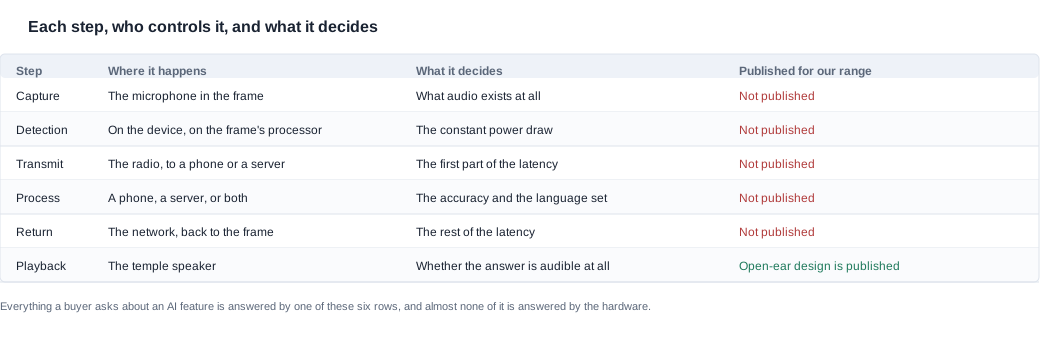
The table above puts each step next to the party that controls it, and that column is the one that matters commercially. Steps one, two and six are inside the product. Steps three, four and five are outside it, and they are where the performance, the latency, the data path and the recurring cost actually live. A buyer who reads the table once will never again ask a hardware supplier to explain an AI feature's accuracy, because the answer is not in the hardware.
Where the power goes, and why the published runtime is not the assistant's runtime
The most common technical misunderstanding in this category is the treatment of a published runtime figure as though it described an AI feature. It does not, and the reason is visible in steps one and two.
The always-listening draw is a different number from the active-processing draw. A device that waits for a wake word is not in deep sleep. The current that decides the overnight loss is not the current that applies while the assistant is answering a question, and neither of them is the number in a runtime figure, which is typically measured on a mixed-use profile. A buyer comparing two platforms on published runtime is comparing a mixed-use profile, and a feature that is always listening changes the profile rather than the number.
The power budget of a camera product is already committed. The camera tier carries a cell between 220 mAh and 290 mAh — 220 mAh on the MT5 and the V03 Pro, and the V03, 260 mAh on the KY06 and the S7, and the V06, 290 mAh on the L1 Pro and the CY05, and the L2 Utral and the CY03, with the MT6 at 265 mAh — and a published runtime band of five to eight hours. The camera and the audio are the load that the runtime figure already describes. An on-device model has to fit into what is left, and the question to ask a supplier is specific: what does the feature consume, and what is the measured runtime with it running continuously against the runtime without it.
Charging cases change the practical answer without changing the cell. Several camera models are published with a charging case, and the case capacity is a real number in the catalogue: 1400 mAh on the L1 Pro and the CY05, and the CY03, a 900 or 1400 mAh case on the L2 Utral, and a 1200 mAh folding case on the MT6. The KY06 and the MT5 are published with a magnetic charging case whose capacity is not published. A case extends the working day for a wearer who can charge on the move, and it does nothing for a wearer who cannot. That is a channel and use-case question, not a specification question, and it is worth answering before the specification is fixed.
Weight is a power-adjacent fact. The MT6 is the only model in the catalogue with a published weight, at 158 g, and it is an AI camera model with a folding charging case rather than a children's frame. Its weight must not be quoted as a children's frame weight, and it should not be quoted as a typical figure for anything else either — it is a published fact about one model.
Where the latency comes from
Latency is the number buyers find hardest to compare, because it is a property of a chain rather than of a product, and because the same product produces different numbers in different rooms.
Steps three and five are the network, and they happen twice. The audio goes out and the answer comes back, and each direction carries a queue, a transfer and a decode. A feature that responds in half a second on an office network can take several seconds on a congested venue network, and no amount of engineering in the frame changes that.
Step four is the model, and it is the largest single term. The time a model takes to produce an answer depends on the size of the model, on the queue in front of it, and on how much text it is generating. This is why a latency figure without a network state and without a measure of what was being asked is not a measurement.
Step two is on the device, and it is the term buyers forget. If a device is scanning a wake word continuously, the time between the phrase and the transmission includes that scanning. It is small, but it is the part of the latency the hardware controls, and it is the only part that a different supplier could improve.
The measurement rule follows from all of this: a latency figure has to name the network state, the phrase or task, and the number of attempts, and it has to state whether it is measured from the end of speech to the start of the answer or to the end of the answer. Those are different numbers, and a supplier who will only give one of them has not measured it properly. The over-claims to stop repeating are collected in ai features myths.

Where the data goes, step by step
The data question is a chain question, and reading it as a chain is what turns a policy document into an answer a buyer can use.
Step one creates the data. The audio captured is the personal data, and the frames that create it are a camera and a microphone worn on a face in public. A product with a camera and a microphone creates personal data by default, which means the disclosure question is not an optional extra that a good product avoids — it is inherent to the design.
Step three moves it. The transmission is where the data leaves the device's control, and the question of whether it leaves the device at all is decided by step four, not by step three. A device that transmits to a phone has not sent data to a cloud service, and a device that transmits to a server has. The distinction matters because the obligations differ by an order of magnitude.
Step four is where the processing happens, and where the operator becomes the accountable party. The entity that operates the service, the jurisdiction it operates in, and the retention period for the audio are all properties of that party rather than of the glasses. Our catalogue publishes no data path for any model in this range, which is a gap a buyer should close in writing before the first order rather than discover during a privacy review.
Step five is where the data comes back, and the retention question lives. A response is derived from what went out, and the retention rules for a recording and for a transcript are not the same. The question to ask is whether the audio is retained, whether a transcript is retained, and whether either can be deleted by the user — and a buyer who cannot get a different answer per market has a compliance problem rather than a documentation gap.
This is the substance of the privacy and security risk assessment required under EN 18031, a cybersecurity standard that has been a mandatory component of the CE mark since 1 August 2025, and it is the part of the AI feature story that is entirely about the chain rather than about the frame.
The chain questions to settle before you commit
The chain is useful as a checklist because each step has one question, and the answers between them determine each other. The list below is the order that works, because each answer narrows the next one.
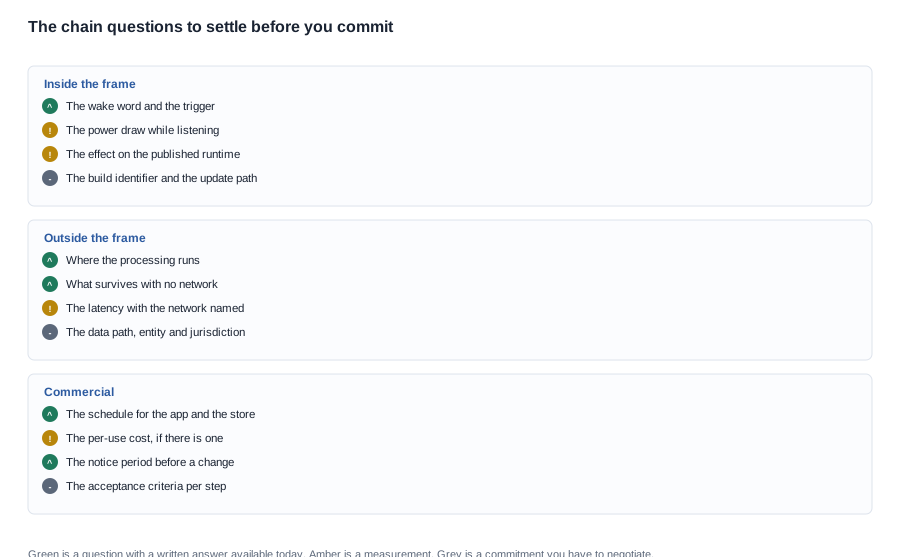
Inside the frame, four questions. What the wake word is and what triggers it. What the device draws while listening, as a figure rather than an adjective. The effect on the published runtime, measured on the model you will ship. And the build identifier with the update path, so that a later change is recognisable as a change.
Outside the frame, four questions. Where the processing runs. What survives with no network, enumerated function by function. The latency, with the network named. And the data path — the entity, the jurisdiction and the retention period.
Commercially, four questions. The schedule for the application and the store release, which is not the hardware schedule. The per-use cost, if there is one, and the scale rule if there is. The notice period before a change that alters a behaviour. And the acceptance criteria, one per step, so that a sample can be passed or failed rather than admired.
The three failure modes the chain produces, and what to do about them. A feature that works in the office and not in a basement: the offline behaviour was never established, and the prevention is the network-off test with the enumeration written into the listing. A demo that outperforms the field: the test ran on a good network in a quiet room, and the prevention is a test on the network the customer will have, in the environment they will be in. And a feature that changes with no notice: there is no copy review trigger, and the prevention is a notice period plus a review trigger, both in the agreement.
What the chain means for your schedule and your copy
Two consequences follow, and they are the reason this article exists rather than a technical reference.
First, the AI feature has to be scheduled separately from the hardware, because almost none of it is physical. The lead time of a voice assistant is the lead time of an application, an account, a data flow, a privacy review and a store release — none of which moves when the product moves.
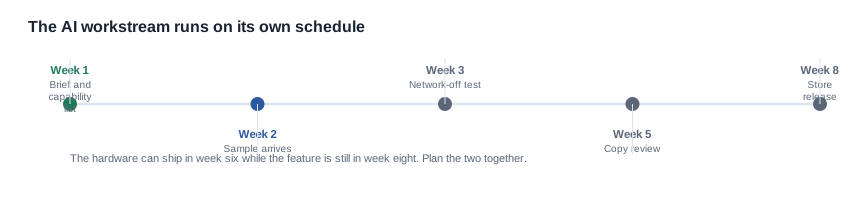
The calendar above is the realistic shape. The hardware can ship in week six while the feature is still in week eight, and the copy cannot be finalised until the capability list and the data path have both landed. The scheduling side is covered in more detail in ai features lead time factors, and the procurement version of the same checklist is in ai features procurement checklist.
Second, the copy has to match the chain. A feature that depends on a network cannot be described as something that works anywhere, and a feature that streams audio cannot be described as one that keeps everything on the device. The two claims that recur most in this category — the language count and the offline capability — are both statements about step four, and both are unanswerable from the hardware.
That last point is the practical test for any sentence you intend to publish. Ask which of the six steps the sentence is about, and ask which step you can evidence. A sentence that is about step one or step six can be evidenced from the catalogue and from a sample. A sentence that is about step four has to come from the service operator, and until it does, the sentence has to be narrower than the feature.
The same test works on the questions you ask a supplier, and it is the most efficient way to run the meeting. Instead of asking what the assistant does, ask what happens at each step: what is captured, what is detected on the device, what is transmitted, where it is processed, what comes back, and what is played. A supplier who answers step by step has described an architecture, and you can price it, schedule it and write it. A supplier who answers with a feature name has given you a sentence, and you will not know whether it is true until the sample arrives.
The commercial answer that follows. The notice period, the acceptance criteria, the scale rule and the offline enumeration are the four items worth negotiating before the order, because each one converts a dependency into a stated position. The minimum order quantity, the packaging and insert design including the market labels, and the payment schedule in practice — a deposit covering the artwork round count, a balance that falls due at the inspection, and a holdback on the file — are the standard areas. Certification cost and certification time are not a commercial lever, because the fee is per product family and the elapsed time belongs to the test laboratory. Tooling is a one-off cost, and the useful questions are over what volume it is amortised and what happens to the tooling if the programme is discontinued.
What we will and will not answer
The short answer: we publish the AI capability as our catalogue states it, and we publish the empty rows next to it rather than filling them with typical values from the industry. We will not quote a language count, we will not state a subscription position we have not confirmed, and we will not write a data-residency claim for a product whose chain we cannot describe. We will not present an AI feature as a clinical, health or safety benefit either, and we make no medical or health claim for any product in this range.
There is a reason for that discipline beyond caution, and it is the thing this article is actually about. Every gap in our published rows corresponds to a step in the chain that belongs to somebody else, and a typical figure in a published row would imply that the gap does not exist. A buyer who found a plausible number there would build a schedule around it, a product page around it, and a cost model around it, and the first time the real service behaved differently all three would be wrong at once. An empty row costs a question. A wrong row costs a quarter.
What we can do is take a proposed feature and tell you which of the six steps it touches, what it implies for the power budget, and which questions have to be answered by the company rather than by the catalogue. The feature background is under AI features in smart glasses, and the comparison method is in how to compare ai features.
Related reading
- The claims to stop repeating — ai features myths
- The scheduling consequence — ai features lead time factors
- The procurement version — ai features procurement checklist
Tell us the feature you are planning and we will tell you which of the six steps it touches and what it means for the power budget.


