

Each of the six claims this article corrects has the same shape, and naming the shape first is worth more than correcting them one at a time. It takes a piece of true information, drops the condition that makes it true, and arrives at a claim nobody can support. The true information in this category is thin, and most of it is a use case rather than a specification. Our catalogue lists an AI voice assistant as a key technology and AI real-time translation among the use cases, and that is very nearly the whole of it; the K01 is the only model with an explicit AI translation claim, and even that comes from our own site rather than from the product catalogue. Smart glasses ai features smart glasses myths is therefore a list of six specific sentences to stop using, where each one came from, and what to write instead.
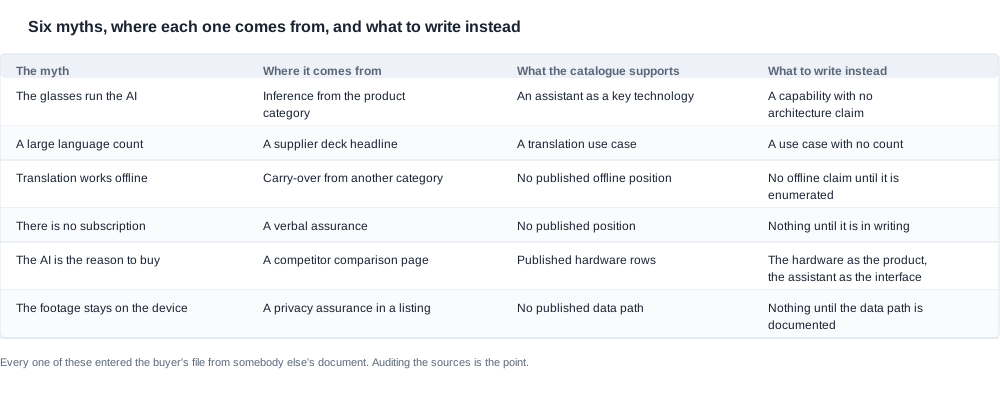
Smart glasses AI features: where each of the six claims comes from
Provenance is the useful part
Knowing that a claim is wrong is less useful than knowing how it got into your document, because the source determines who owns the fix and how fast it can happen. Every one of the six entered a buyer's file from somebody else's document, and in every case the claim was true when it was written about something else.
The six sources, in order of how often they produce them. A supplier deck states a capability, and it becomes a row in a specification. A competitor's listing states a figure, and it becomes a benchmark. A marketplace page states an assurance, and it becomes copy. An engineer's inference about a product category becomes an architecture claim. A verbal assurance becomes a commercial term. And a carry-over from an adjacent product category becomes a capability claim.
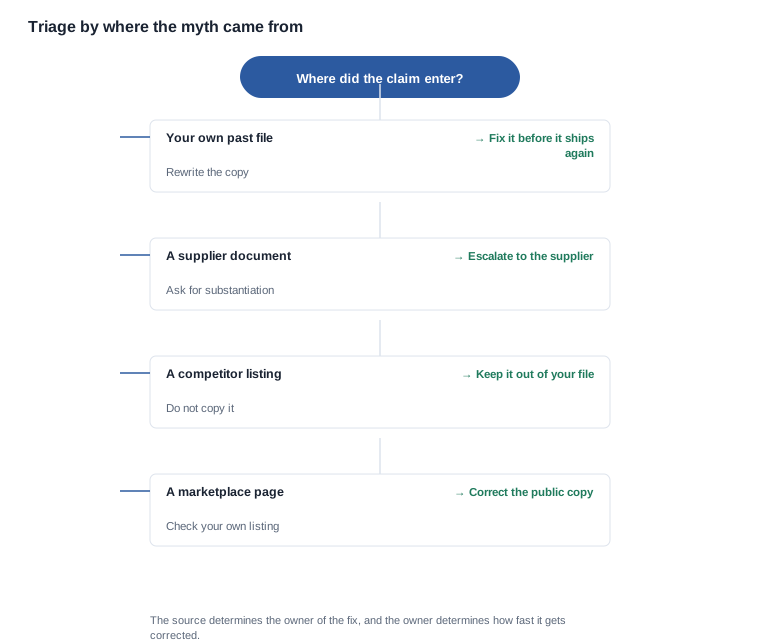
This is why the myth list is a list of documents rather than a list of sentences. When a buyer asks where a claim came from, the answer decides the action. A claim from your own file is a rewrite, and it can be done today. A claim from a supplier is an escalation, and it needs a written request. A claim from a competitor's page is a thing to keep out of your file, and the cheapest correction is prevention. A claim from a marketplace page means your own public copy is probably carrying it too.
The habit that stops all six
There is one practice that prevents every one of these claims from entering your documents, and it is a document practice rather than a technical one. Mark, in every specification sheet you receive, which sentences are claims and which are descriptions, and refuse to copy a claim without the condition attached to it.
The reason this works is that the conditions are the valuable part and they are the part that gets dropped. A supplier who says the assistant performs well in quiet conditions has given you a usable statement. A supplier who says "always accurate" has given you a sentence with nothing attached to it. Copying the second one into a specification sheet is how the condition gets lost — not because anybody lied, but because a condition is a clause and a headline is a line, and the line is the thing that travels.
The device that runs the AI, and the language count that is not one
Myth one: the glasses run the AI
This is the most common and the most consequential of the six. An assistant on a wearable is usually a thin layer that captures audio, sends it somewhere, and plays the answer back — and the somewhere is the point. It may be the phone in the wearer's pocket, a server, or a combination of the two. A device with a cell in the 220 to 290 mAh range is not doing the computation locally for a large language model, and the camera models in our range run at those capacities.
What the catalogue says is that an AI voice assistant is listed as a key technology. What it does not say is where the processing happens. Ask, and the answer determines the latency the customer experiences, whether the feature works without a connection, what happens to the data, and what the compliance position is. One unanswered question, four downstream consequences.
The version of this myth that survives into production is the diagram. A product page that shows a phone talking to a cloud service implies the architecture correctly, and a deck that shows a lightning bolt between the glasses and a cloud icon implies it incorrectly. If your own documentation contains the second diagram, that is a rewrite, not a clarification.
Myth two: it translates a large number of languages
Three separate claims are compressed into one number, and they are independent. The number of languages is a count of what is nominally supported. The accuracy is a quality figure, and it varies enormously between a formal sentence and fast overlapping speech. The offline position is a capability that either exists or does not.
Our catalogue lists AI real-time translation as a use case for the camera range. It publishes no language count, no accuracy figure and no offline capability. If a supplier quotes a language count, the useful follow-up is what happens to that count when the network is slow, and then what happens to it in the specific pair the customer will actually need, in the direction they will actually need it.

The offline claim borrowed from another category, and the subscription nobody disclosed
Myth three: translation works offline
This one is usually an accidental carry-over from a different product category, and it arrives with a plausible-sounding mechanism attached. Offline translation requires either a model on the device or a specific local engine, and a wearable with a 40 to 290 mAh cell is not the place for it.
Our catalogue publishes no offline capability for any model, and we would not infer one from the radio version, the cell capacity or the presence of an AI feature. Ask specifically, and treat a vague answer as a no. The useful form of the question is not "does it work offline" but "which functions still work when the network is physically removed", because a vague yes covers everything from "the device still shows the time" to "capture, transcription and playback all continue".
The commercial reason this myth matters more than it looks is that offline capability is a product-positioning claim. A brand that promises an assistant that works on a plane, in a basement and in a market with no coverage has made a promise that the return rate will measure.
Myth four: there is no subscription
This is the claim that has the least evidence behind it and the largest commercial consequence. Nobody in this category publishes the subscription position in either direction, and "there is no subscription" is itself a claim rather than an absence of a claim. It is often inherited from a verbal assurance made during a demonstration, and it is the kind of assurance that evaporates precisely when the product succeeds.
It is entirely possible that a feature works without a plan, and it is entirely possible that a particular assistant requires one. The answer affects your business model rather than your product, because a subscription on the end customer's account is a support obligation and a churn factor that has nothing to do with the hardware.
Ask for it in writing, and ask the three parts: whether a plan is required, what the feature does when a plan lapses, and who the plan is billed to. The third part is the one nobody asks and the one that determines whether the feature is your problem after sale.

The idea that the AI is the reason to buy the glasses
Myth five: the AI is the reason to buy one
This is the myth that costs a buyer the most, because it sends the sourcing decision to the wrong question. What is published about these products is hardware: the camera resolution tier, the charge time, the cell capacity, the runtime and the charging method. The AI is the interface. A customer who buys a camera glasses product is buying a camera, a microphone, a speaker and a battery, and the assistant is how those are operated.
The published hardware in this range is genuinely comparable: the eleven camera models run from 8MP to 13MP, the cell capacities run from 220 mAh to 290 mAh, the charge ceilings are at or under two hours and the runtime bands run from about five to eight hours, with charging cases at 1400 mAh on three models, a 900 or 1400 mAh option on L2 Utral, a 1200 mAh folding case on MT6, and cases of unpublished capacity on KY06 and MT5. IP54 is marked on V06 and S7 only, and the 158 g figure on MT6 is the only published weight in the catalogue.
That is a real product with real, checkable, comparable specifications. The AI layer is a use case written next to it.
If a customer says they want the AI, the useful follow-up is what they want to do with it. Usually it is translation, or a hands-free note, or a phone call, and each of those has a different requirement and a different failure mode. A brand that resolves that question properly ends up with a narrower feature and a stronger product, and a brand that does not ends up with a product page whose headline it cannot substantiate.
What replaces it in the copy
The replacement is not to remove the AI from the listing. It is to move it from the headline into the specification, and to describe it in the terms the catalogue supports. "An AI voice assistant is included" is accurate. "A voice assistant that always understands you" is not, and the second sentence costs more to retract than the first sentence earns.
The promise that the footage never leaves the device
Myth six: the footage stays on the device
This is the most consequential myth for a brand, because it is the one that creates a compliance exposure rather than a customer complaint. A camera product that pairs with a phone may transfer data automatically, and where it goes, which jurisdiction it lands in, who can retrieve it and how long it is retained are all questions that have to be answered before the product is sold into the European Union.
The instrument that makes this a formal question rather than a commercial one is EN 18031, the cybersecurity standard cited into the Radio Equipment Directive for radio equipment in scope, which requires a security and privacy risk assessment, testing and documentation, and a vulnerability handling process. A camera and microphone product sits at the higher-risk end of that scope.
We publish no data-flow detail for any model, and we will not write "your data stays on your device" into a listing for a product whose data flow we have not documented. The phrase appears in listings written by people who were not told that it is a technical claim, and it appears often enough that it has become one of the six.
The difference between the sixth myth and the fifth
The fifth myth — that the AI is the reason to buy — is a positioning problem, and the cost is a product page that is weaker than it could be. The sixth is a documentation problem, and the cost is an exposure the brand cannot discharge after the fact.
That difference is worth carrying into a meeting. A positioning myth is a decision to revisit at the next listing update. A documentation myth is a decision that has to be made before the file is assembled, because a data path that is discovered to be wrong after launch cannot be corrected by a support script. In our catalogue, the export certification on the cover is a company-level capability and the catalogue carries no per-model certification rows, which is the same discipline applied: a company-level capability does not become a per-model claim by being printed next to one.
The one habit that stops all six
The audit, and what to do with the findings
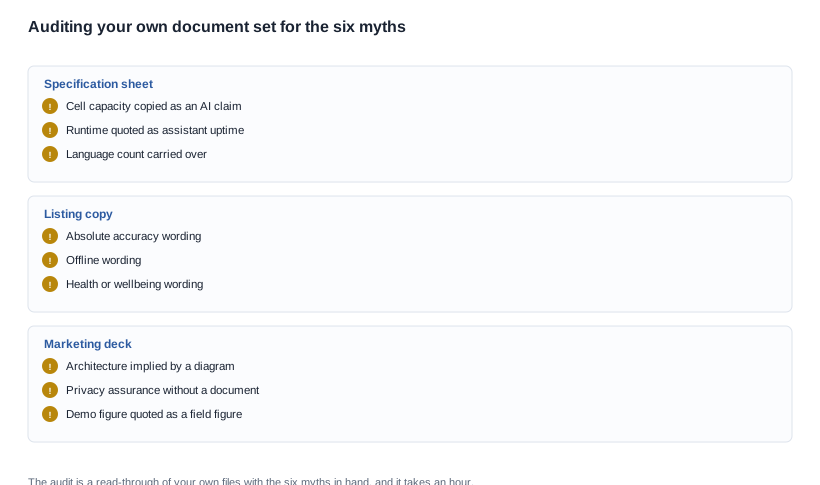
The audit is a read-through of your own documents with the six claims in hand, and it takes about an hour. It is worth doing once per programme rather than once per launch, because the same six claims reappear in every artefact a programme produces.
The read-through is not a hunt for sentences that are wrong. It is a hunt for sentences that assert something about the AI layer without a condition attached. In practice that means checking three places. The specification sheet, where a hardware number has been copied next to an AI feature and has quietly become an AI number. The listing copy, where an assurance has been written to fill a gap the buyer was not told about. And the deck, where a diagram has made an architectural claim that no document supports.
The three outcomes of the audit are different and each has a different owner. A sentence in your own specification sheet is a rewrite, and it is yours to fix today. A sentence in a supplier's document is an escalation, and it needs a written request with a deadline. A sentence in a competitor's or a marketplace's document is a warning, and the action is to make sure it does not get into yours.
What each myth costs when it reaches a customer
The six do not damage a programme equally, and the ranking decides where the effort goes.
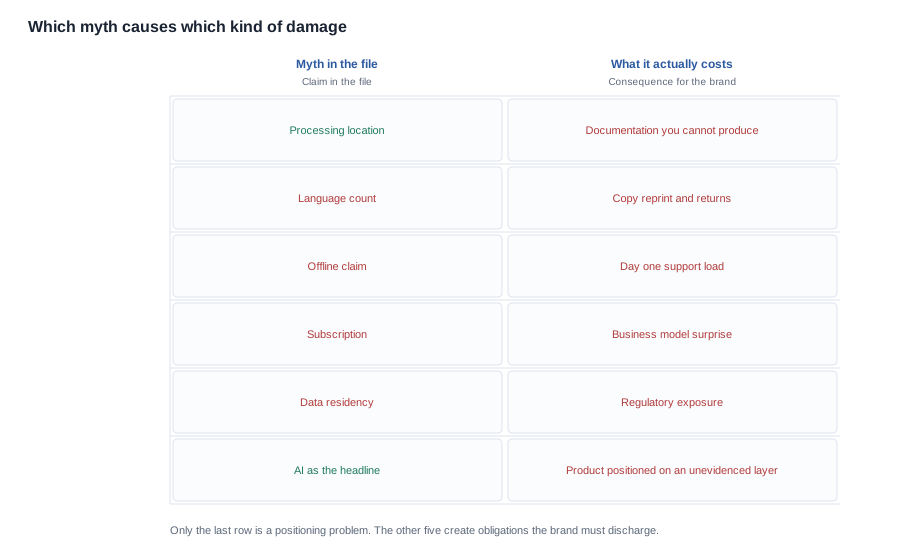
The device-runs-the-AI myth is the most expensive in the long run, because it produces a latency expectation, a connectivity expectation and a data expectation that all have to be corrected at once. The language-count myth is expensive in proportion to how prominently the count appeared, because every appearance has to be corrected and every correction is a reprint. The offline myth is expensive at the point of sale, since it determines how many customers are disappointed in week one rather than in month one. The subscription myth is expensive later and in a different department, because it arrives as a support load and a churn figure rather than as a return. The AI-is-the-reason myth is the cheapest of the six, because it costs a positioning decision rather than a correction. And the data myth is the one that cannot be corrected at all after the fact.
That ranking has a direct consequence for how a buyer negotiates. The first myth and the last one have to be closed before the order, because neither can be closed later. The middle four can be closed before the listing goes live, which is late enough to be comfortable and early enough to be useful.
The clauses that keep the myths out
Two commercial terms do most of the work of preventing a myth from becoming a liability. The first requires that the marketing and label wording match the manufacturer's stated capability list, which prevents the drift between a specification sheet and a listing page. The second requires notice before a firmware or model change that alters the assistant's behaviour, with a defined period, so that the copy can be corrected before the change reaches customers rather than after.
Neither of them is difficult to agree, and both are ordinary to ask for in a hardware programme. The rest of the commercial structure is standard as well: a deposit, a balance on inspection before shipment, and a retention held against the documentation package rather than against units. The retention belongs on the documentation because the documentation is where this category's schedule problems live, and a myth that survives into launch is almost always a myth that was never written down anywhere.
Where we sit on the same six
We publish the AI capability as the catalogue states it — an assistant, and a translation use case on the camera range — and we publish the empty rows next to them rather than filling them with values borrowed from another product. We will not quote a language count, we will not state a subscription position we have not confirmed, we will not write a data-residency claim for a product whose data flow we cannot describe, and we will not repeat a marketing phrase as though it were a specification.
That is a slightly uncomfortable position to hold commercially, and it is the reason we are comfortable holding it. A number on an unevidenced capability is not a competitive advantage; it is a liability that gets discovered by a customer, a marketplace reviewer or a regulator, and the discovery is public.
The AI claims in your specification sheet
Send us the AI claims in your specification sheet and we will tell you which of the six they are, what each one actually asserts, and what has to be established before it goes into a listing. The feature background is under AI features in smart glasses, the documentation obligations are in ai features certification requirements, the comparison method is in how to compare ai features, the procurement version of the same list is in ai features procurement checklist, and the evidence structure is in ai features case study template.
Related reading
- Comparing two suppliers on this axis — how to compare ai features
- The procurement version of the same list — ai features procurement checklist
- The evidence structure — ai features case study template
- How to read a datasheet
Send us the AI claims in a specification sheet and we will tell you which of the six they are and what has to be established first.


