

An AI feature is the longest-lead-time feature in a smart glasses programme, and almost none of the delay is physical. The work happens in an account, a server, an app store and a legal review rather than on a production line, which means a buyer who schedules the feature inside the hardware schedule will be surprised by it, and a buyer who schedules it separately will not. So smart glasses ai features smart glasses lead time factors is best understood as a question about structure rather than duration: which items in the schedule can be compressed, which cannot, and where the two tracks of a programme have to be joined. We publish no lead time for any model and no capacity figure, so the useful output here is a method for reading a supplier's stated schedule and for finding the item that actually controls the launch date.
Smart glasses ai features: what controls launch
The buyer, and the deadline that is real
The reader is usually a sourcing manager or a brand product manager working to a launch date set by somebody else: a retailer, a marketplace, a seasonal window, or a marketing commitment made before the engineering had a chance to speak. The buyer believes they have one problem — getting the product made on time — and in fact has two, and the second one is invisible until the first one is nearly done.
That is the pattern worth naming. A hardware programme that runs late is a production problem, and it is visible: the factory is late, the goods are late, the container moves. An AI feature that runs late is an absence. The hardware arrives exactly as promised and the feature that the listing was positioned around is not there, and the launch either proceeds without the feature or slips anyway. In both cases the hardware supplier's performance was perfect.
The cost of that outcome is disproportionate to the delay. A launch without its headline capability is a reprint of artwork, a change to the product page, a customer support script that no longer matches the listing, and possibly a refund wave from the customers who bought on the strength of the promise. None of that is visible in a schedule that only tracks goods.
Why the delay is not physical
There is a structural reason the AI feature sits outside the production schedule. A production line consumes materials, machine time and labour, and all three compress with money or with priority. An account setup, a legal review of a data flow, a claim review in two markets and an app store submission do not compress with money at all. They compress only with sequencing, which means starting earlier and deciding sooner.
That is why the lead time of an AI feature is usually longer than the lead time of the hardware it ships on, in a category where the hardware is the part everybody plans for. Our camera models publish charge times at or under two hours and runtime bands of about five to eight hours, and the hardware side of this range is ordinary: tooling, certification, production and freight. The feature side is a different kind of work entirely, and the failure is to plan it on the wrong clock.

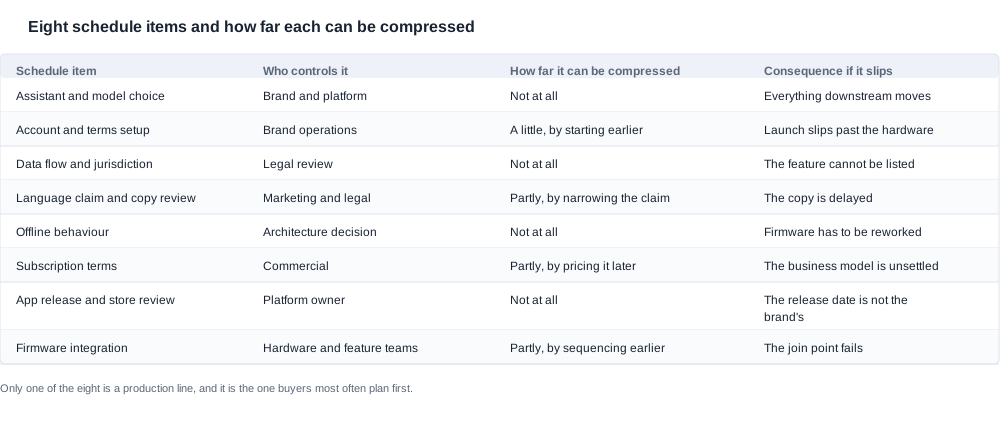
Eight schedule items, ranked by how little they can be compressed
The items and their compressibility
The assistant itself. Which assistant the product uses — a third-party service, a brand's own build, or a hybrid. A third-party service can be integrated quickly; a brand's own assistant is a development programme with its own architecture, evaluation and safety work. We publish nothing about this for any model in our range, and it is the first question, because the answer determines how long everything else takes.
The data flow. Where captured audio and captured images go, in which jurisdiction, who can retrieve them and for how long, and the privacy and security risk assessment that documents it. In practice this is the longest item on the list, because it needs a legal review and a legal review cannot be compressed by asking more urgently.
The account and the sign-up. A brand account, terms of service, a support process, and a way to handle a customer who has forgotten their credentials. This is a business process rather than an engineering one, and it is the item most often left until the hardware is finished, at which point it becomes the item with no time left in it.
The language set and the accuracy behind it. The languages claimed, the testing that supports the claim, and the review of the copy that states it. A language count without an accuracy position is a marketing claim, and in a market with a consumer-protection regime a marketing claim is a compliance item with a clock on it.
The offline behaviour. Whether any part of the feature works without a connection, and what the product does when it does not. This is an architecture question and it has to be answered before the firmware is written, because it decides whether the assistant runs on the device at all. Answering it late means rewriting firmware, which is the one thing on this list that pushes back on the hardware schedule.
The subscription. Whether a plan is required, what it covers, and the support load of a customer whose plan has lapsed. Nobody in this category publishes this in either direction, and it affects the business model rather than the product, which is exactly why it tends to get deferred until someone asks about the revenue model rather than about the schedule.
The app and the operating system versions. The application itself, the store review, and the matrix of device and operating system versions it supports. A store review is a queue, and a queue does not compress, which makes submission date more important than completion date.
The firmware and the radio. The wake word, the pairing behaviour, the radio interaction and the regression testing. This is the only item on the list that is partly physical, and it is the part most likely to be in the hardware schedule already — which is why it is also the item most likely to be underestimated when the feature track has been compressed.
Reading the compressibility column correctly
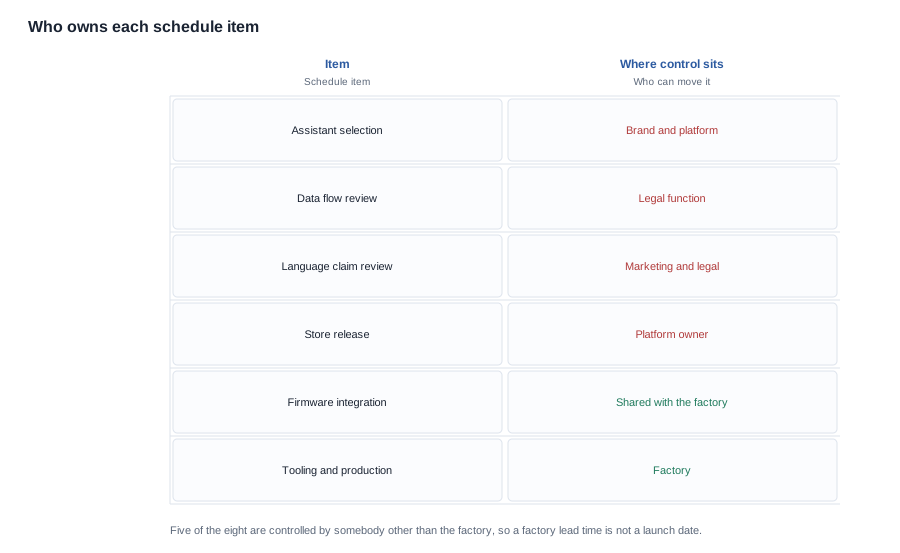
Compressibility is not a property of the task alone; it is a property of the task and the owner. The same data flow review takes three weeks in an organisation with a compliance function and a standing review slot, and it takes three months in one where the review happens when a lawyer finds time. The same app store submission takes days if the build is already correct and a month if the first submission is rejected for a metadata error.
So when a buyer reads a schedule, the question to ask is not "how long does this take" but "who owns this, and what is their current queue". A supplier's schedule is a snapshot of the supplier's organisation, and an organisation can change.
Two schedules and one join point
The method
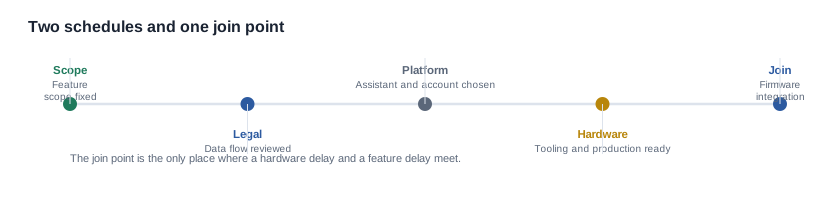
Build two schedules and name one join point. The hardware schedule covers the product, the tooling, the certification, the production run and the freight. The feature schedule covers the assistant, the account, the data flow, the application, the claims and the store release. The join point is the firmware integration, and it is the moment at which both schedules have to be true at the same time.
The value of the two-schedule method is that it makes the failure visible early. On a single combined schedule, a slipping legal review looks like a general delay and gets absorbed. On two schedules, the legal review is visibly late relative to the hardware, and the join point is visibly at risk, and that is a decision that can be made while there is still time to change something — narrow the claim, drop the offline requirement, descope a market, or move the launch date.

Scheduling the long pole first
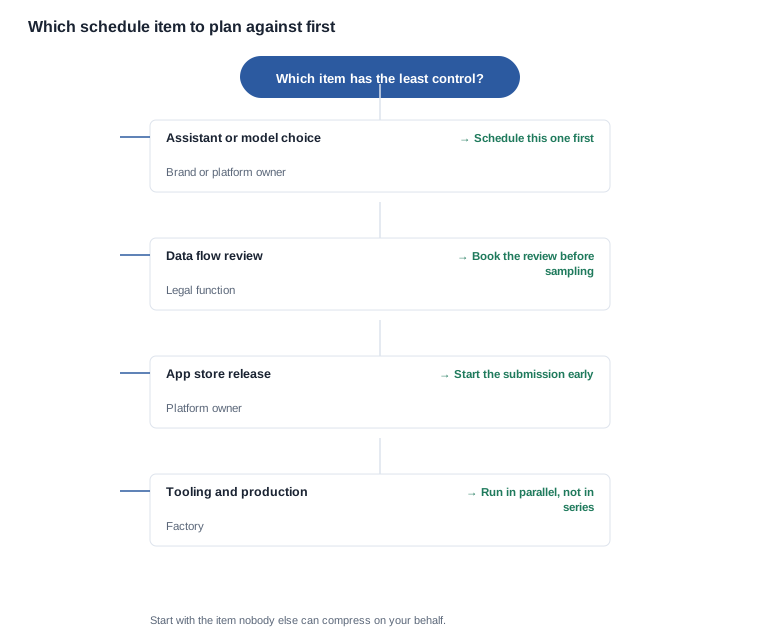
The rule that follows from this is simple to state and hard to apply: schedule the item with the least compressibility first, because it is the one whose delay propagates. On most AI glasses programmes that item is the data flow review or the assistant selection, and in both cases the answer is not a request for a faster supplier but a decision made earlier by the brand.
There is a second reason to start with the long pole. Several of the eight items are decisions rather than tasks, and a decision that is taken late cannot be recovered by adding effort. Narrowing a claim takes a week. Narrowing a claim after the artwork is approved takes a month and a reprint.
The join point needs a named owner
The join point is where a hardware delay and a feature delay meet, and in most programmes nobody owns it because it belongs to neither track. It needs a named person, a date, and a written definition of what "integrated" means — which build, on which firmware, against which application version, with which account configuration, passing which script.
Without that definition the join point is a meeting. With it, it is a test, and a failed test has an owner and a date and a consequence. This is the single cheapest schedule control available in this category, because it costs a paragraph in the programme plan.

The four items that have to be settled before the platform is chosen
Decisions that close options
Four items are not schedule tasks at all. They are decisions, and they are best taken before the platform is selected, because each one narrows the platforms that are acceptable.
The processing architecture is first, because it decides whether the assistant can run on the device at all, and a wearable with a cell in the 220 to 290 mAh range is not running a large language model locally. If the brand has decided that the assistant must work with no connection, the platform list is very short and that decision has to be made before a platform is shortlisted rather than after.
The data flow and the account model are second, because they are decisions about the brand's own business rather than about the product. Which legal entity operates the service, in which jurisdiction the data lands, who owns the customer relationship after the brand changes supplier. A platform that cannot accommodate the brand's data position is a platform that has to be re-selected, and re-selection is the most expensive item in this list.
The claim scope is third. Which markets, which languages, and how wide the copy can be before the data and the accuracy are known. A brand that fixes the claim scope early has a bounded specification; a brand that leaves it open has an unbounded schedule.
The subscription position is fourth. Whether the business model carries a recurring per-user cost changes the commercial structure of the whole programme, and changing it after the first order is a different conversation with the customer than changing it before.
The order these four are settled in
They are not independent, and there is an order. The architecture constrains the platform; the platform constrains the account model; the account model constrains the data position; the data position constrains the claim scope; the claim scope determines whether a subscription is a product decision or a commercial afterthought.
Working that chain forwards is what stops the programme from starting with the most visible decision — the assistant — and discovering the others later.

How to read a supplier lead-time statement
Six things a schedule statement usually omits
A quoted lead time in this category is usually a production statement, and it is usually accurate for what it covers. The problem is what it does not cover, and there are six omissions that recur.
First, the start point. A lead time quoted from "deposit received" is not the same as one quoted from "order confirmed", and the difference includes account setup, artwork approval and the data flow review, which is where most of the programme's time actually is.
Second, the end point. "Shipped" is not "delivered", and for a launch with a fixed date the difference between the two is a customs clearance and a booking, neither of which the factory controls.
Third, the certification line. Whether the certificate is included, whether it is assumed, and how long the test laboratory's queue is. This is the item that most often turns a quoted lead time into an impossible one.
Fourth, the sample round. Whether the sample is built before or in parallel with the tooling release, and how many rounds are included. A programme with two sample rounds and a tooling release that starts after the first sample has a structure that a single lead time figure cannot express.
Fifth, the feature dependency. Whether the quoted lead time assumes a working assistant, or whether it assumes hardware only with the integration left open.
Sixth, the contingency. What happens if the long pole moves. A schedule with no stated contingency is a schedule that has not yet met one.
The questions to ask, in the order to ask them
When you ask a supplier for a lead time, the first question is what the clock starts at. The second is what it stops at. The third is which items sit inside the quoted span and which sit outside it — and the answer is normally a list, which is more useful than a number because it tells the buyer where to look. The fourth is what the supplier's assumption is about the items the buyer owns, because that assumption is usually optimistic.
Then there are the two commercial questions that determine whether the number is actionable. What happens when the long pole moves, and who notifies whom, in what time frame. And what the order looks like commercially, because a supplier that has to wait for artwork approval and a signed data-processing position cannot start, and a supplier paid on a deposit can start on anything.
The commercial terms a schedule can and cannot change
What a buyer can move
Several commercial terms directly change the calendar, and they are worth negotiating before the first order rather than as a correction afterwards.
The split between a pilot tier and a run tier matters more here than in a purely hardware programme, because the pilot tier is where the feature behaviour gets established, and the run tier should not start until the pilot has produced the answers. Splitting the order gives the buyer a scheduled review point at which the feature position is known, and it gives the supplier a clear milestone rather than an open-ended phase.
Minimum order quantity across the number of configurations is the second lever. A brand that has committed to one assistant configuration, one language set and one claim scope has a much shorter feature track than a brand that has committed to six of each. The number of distinct configurations is the main driver of the feature schedule length, and it is worth negotiating explicitly, because it is usually set by habit rather than by requirement.
Payment structure is the third. A deposit, a balance on inspection before shipment, and a retention held against the documentation package rather than against units — the documentation package being the artefact most likely to be incomplete, as this category's schedule problems tend to be documentation problems rather than manufacturing problems.
What the schedule cannot change
Certification cost and certification lead time are not levers. The fee is per product family and the elapsed time is set by the test laboratory and its queue, so a buyer who negotiates hard on that line gains nothing and signals that they have not understood the structure. Tooling is a one-off cost normally amortised across the first order, and the useful questions there are over what volume it is amortised and what happens to the tooling if the programme is discontinued.
Above all, the schedule cannot compress the items with an external owner. A legal review, a store queue and a platform owner's release cycle are all outside the factory's gift, and a supplier who quotes a lead time as though they were inside is quoting a number that will move. The honest statement of a lead time in this category is not a date. It is a list of assumptions.
Where our own position stops
We publish the AI capability as our catalogue states it — an assistant across the camera range, a translation use case, and the K01 as the only model with an explicit AI translation claim — and we publish the empty rows next to it. We will not quote a language count, a subscription position or a data-residency claim that we cannot stand behind, and we will not quote a lead time for any model in this range.
What we can do is take a planned feature and tell you which of these eight factors it touches, which of them have to be settled before the hardware is chosen rather than after, and where the join point is. The feature background is under AI features in smart glasses, the chain is in ai features how it works, the procurement list is in ai features procurement checklist, and the claims to correct before a launch are in ai features myths.
The feature, the markets and the date
Tell us the feature you are planning, the markets, and the date you are working back from. We will tell you which of the eight factors it touches, which one has to be scheduled first, and where the hardware schedule and the feature schedule have to meet.
Related reading
- The chain behind the feature — ai features how it works
- The procurement list — ai features procurement checklist
- The claims to correct — ai features myths
- How to test before ordering
Tell us the feature you are planning and we will tell you which of these eight factors it touches and which one to schedule first.


