

Most of the time the answer to this question is yes, and the interesting part is what "yes" is actually paying for. A buyer who asks whether they need long runtime is usually asking a narrower question than they think, and the four most common narrow questions have four different answers, only one of which is about hours. The purpose of this article is to make the exclusion logic explicit: the conditions under which a larger battery is the wrong specification, what to specify instead, and how a wrong choice in either direction gets priced. It is not a model recommendation, and it does not cover how to select a model once you know you need one — the selection criteria for this range are in the buying guidance, and the recurring comparison errors are in the separate notes on common mistakes.
Smart glasses battery life: the question behind "do I need it"
Ask a buyer why they want a long runtime and the answer is usually a symptom rather than a cause. "Our operators need them to last the whole shift" may mean the shift is genuinely longer than the published rating, and it may mean that the units spend four hours a day on a dock and the buyer has not yet worked out what happens in the other four. Both of those are real needs, but they are met by completely different specifications, and the second one is met by a smaller battery.
There are four constraints that a battery specification is regularly asked to solve, and only one of them is the runtime itself.
- The runtime itself. The unit has to complete a stated period of work on one charge. This is the constraint a long-runtime specification genuinely addresses.
- The turnaround. The unit has to become usable again inside the break between two periods of work. This is a charge-time constraint, and more capacity makes it worse.
- The distance from a dock. The unit has to work for a period away from any charging point. This is a case or spare-pool constraint, and it is solved without touching the cell inside the unit.
- The mass. The unit has to be carried for a long period without becoming a fatigue problem. More capacity works directly against this constraint.
A buyer who writes "we need eight hours" when the real constraint is the third one will pay twice: once for the capacity they bought and once for the case they still need. A buyer who writes "we need eight hours" when the real constraint is the second one will pay for capacity that does not help and will still have a turnaround problem.
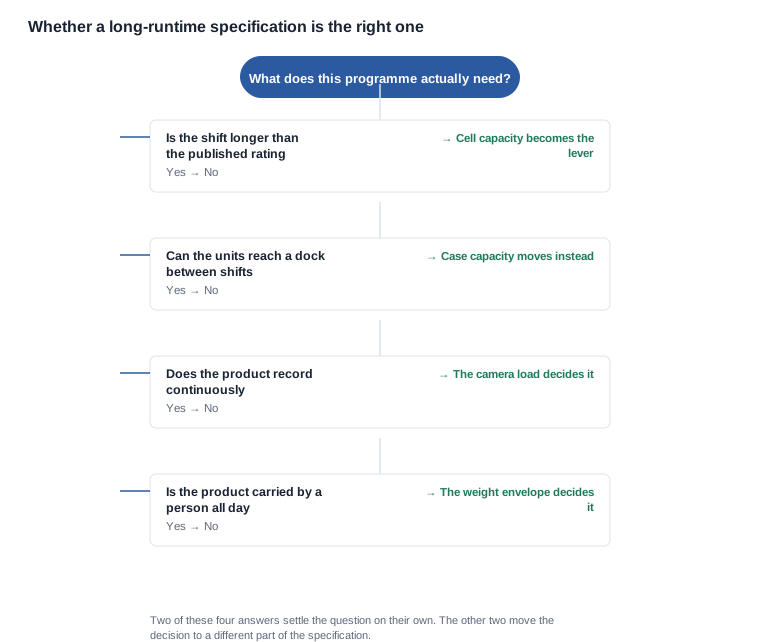
The decision tree above is the four-way split. Two of the branches move the decision to a different part of the specification entirely, which is the outcome most of these questions should produce. Only one branch keeps the question where it started.
The second half of the answer is about what "long" means. On our range, long runtime is not a continuous variable that a buyer dials up. It is a set of distinct platforms, and the published figures run from about six hours on the entry audio models, through seven and eight hours across the mid and upper audio groups and the camera models, to around twenty hours on the three children's rows. There is no platform that delivers nine hours and no platform that delivers twelve. So the question "do we need more runtime" is really the question "which of these platforms does our duty cycle land in", and the answer is either that you need a different platform or that you need a different operating procedure.

Five conditions under which a larger battery is the wrong specification
These five conditions are exclusions. When one of them holds, the correct action is to stop, because a bigger cell will not solve the problem and will make the product worse in a measurable way. They are written as conditions on the programme rather than on the product, because that is where they can actually be checked.
The product sits at a bench for most of the shift
If the unit is at a fixed station for most of the working period, then the hours it spends powered are a minority of the hours it spends existing. Capacity spent on idle time is capacity the operator carries and nobody uses. The specification that fits this programme is a smaller cell with a dock at the station, and the mass saved by the smaller cell is felt every hour of the shift rather than once.
The symptom that shows this later is not a runtime complaint. It is a fatigue complaint, and it usually arrives attributed to the product generally rather than to the battery, which means it is expensive to diagnose.
The shift is short and the units recharge daily
A shift that is clearly shorter than the published rating does not need a larger cell. It needs the unit to be back in service quickly, and adding capacity moves the charge time in the wrong direction. The right specification is a faster charge, which inside a given envelope usually means accepting a smaller cell rather than a larger one.
The symptom here is the one that most often reaches a factory as a product complaint: units that are returned from the dock at a partial charge because the charge did not complete inside the break. A larger cell makes that complaint more frequent, not less.
The product records continuously with no pause
Where the dominant load is a camera running continuously, the relationship between cell capacity and runtime is weak. The camera draws a current that does not scale down with a larger cell in any useful way, and the extra mass is added to a product that is already the heaviest in the range. A duty-cycle limit, a spare unit policy, or a capture schedule that allows the unit to idle are all more effective than a larger cell.
The symptom that shows this later is a shortfall that grows with the length of the recording session rather than with the age of the unit, which is a signature that points at the load rather than at the cell.
The programme already runs a spare pool
Where the operation already keeps spare units for failures, a second cell inside every carton duplicates the fleet. The inventory grows, the spare count becomes hard to audit, and the charging logistics double for no gain in runtime. The specification that fits is one cell per unit with the charging case moved to an accessory line, so the case is bought against accessory demand rather than against unit demand.
The channel has no service path
A capacity claim in a market with no repair, no returns processing and no technical support creates an expectation the channel cannot meet. The unit is sold on a promise about hours, the customer experiences a shortfall against a promise rather than against a specification, and the returns land with a distributor who has no way to diagnose them. The specification that fits is a clearly published rating with a stated condition, and a charging cycle the customer can actually manage.
What the programme becomes when the battery is downsized
Dropping a capacity requirement is not a matter of cost-cutting. It is a reallocation, and the budget it frees has somewhere better to go. Four substitutions cover most programmes.
The first is charge speed, which converts capacity into turnaround. The second is dock density, which converts capacity into availability by putting more charging points in more places. The third is the charging case, which converts capacity into hours away from a dock. The fourth is the spare pool, which converts capacity into resilience by keeping ready units rather than ready hours in every unit.
Which of the four is right depends on which of the original four constraints was actually binding,
Each of the four substitutions has a running cost of its own, and a buyer who makes the substitution without pricing that cost simply moves the expense rather than removing it. Charge speed costs additional components and a thermal design that has to be validated. Dock density costs floor space, installation, and a capital line that the product budget does not normally carry. The charging case costs a second product, its own packaging and its own transport documentation. The spare pool costs inventory, a charging rota and a stock discipline that somebody has to own.
The rule that follows from this is simple and it is the reason the exclusion test belongs before the brief. Substitute only against a named constraint, and price the substitution in the same calculation as the specification. A programme that has excluded the large cell and added a spare pool without counting the spare units has not saved anything; it has moved the money from the unit price into the inventory and into the rota, which is where it reappears as a shortage in month three. and that is why the exclusion test has to run before the specification is written rather than after the quotation arrives. A programme that has excluded a large cell for the wrong reason will simply re-buy the same problem in a different form.
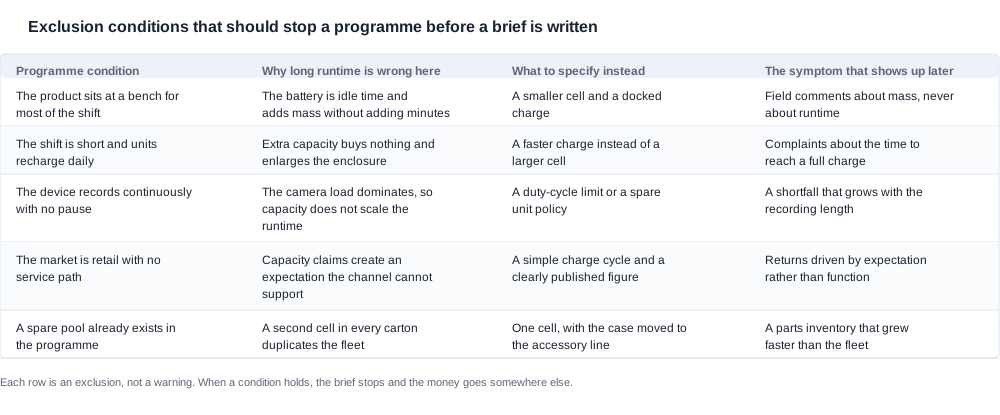
The table sets out the five exclusions with the reason, the substitution, and the symptom that surfaces later if the exclusion is ignored. The third column matters most in practice, because the symptom is what a programme will actually experience, and recognising it early is what saves the cost of a re-engineering cycle.
There is a version of this decision that a buyer can make almost entirely from published information, and it is worth describing because it is fast. If the duty cycle fits inside the published rating of the platform you are considering, the runtime constraint is not binding and the question is settled without any supplier conversation. If it does not match, the question becomes one of degree, and the answer depends on whether the gap is large enough to justify a different platform or small enough to be covered by the operating procedure. The published rating is the entry point to that reasoning, and the measurement method behind it is in how to test smart glasses battery life.

The flow above is the order to run it in. The last step is the one most briefs never reach, and it is the cheapest decision in the whole cycle: the answer is sometimes that runtime is not the constraint at all, and the programme should stop buying runtime and start buying something else.

How the cost of choosing the wrong battery specification is priced
Choosing too large and choosing too small both cost money, and neither cost appears in the unit price of the battery. It is worth being explicit about where each of them lands.
Choosing too large is paid in four places. The unit price, because capacity is a purchased component and a larger one costs more. The mass, because the extra mass is carried by the operator through the shift, and the effect is a fatigue problem that is reported as a general complaint rather than a battery one. The unit economics, because a heavier and more expensive unit has to carry the same margin. And the charging logistics, because a larger cell takes longer to reach a usable state, which means more docks or more spare units to cover the same number of operators.
Choosing too small is paid in two places, and they are quieter. The first is the return: units that run short in the field come back with the freight, the inspection and the replacement, and the return rate lands in the after-sales cost rather than in the product cost. The second is the reputational cost in the channel, which is not on any invoice and which is the reason a shortfall claim is more expensive than a component saving.
There is a third cost that applies to both directions and is the one most often left out of the calculation.
There is a practical reason to make this calculation explicit rather than leaving it in a buyer's head. The decision to size a battery is made once, by one person, and it is reviewed by people who are reviewing the product rather than at the duty cycle. When a shortfall appears eighteen months later, the review tends to assume that the requirement was clear at the outset and that the implementation failed, and that assumption is much harder to dislodge when there is no document recording the reasoning. A one-page note, stating the duty cycle, the constraint that was binding and the alternatives that were priced, converts a later argument about intent into a discussion about evidence. It is the cheapest risk control in this category and very few programmes keep one.
The second reason is that the calculation has to be repeated. The duty cycle changes over the life of a programme — the shift pattern gets compressed, the recording schedule gets longer, the site moves indoors — and a requirement that was correct at launch can become wrong without anybody deciding to change it. The exclusion test is therefore a recurring discipline rather than a one-time gate, and the moment to run it is when the operating data changes rather than when the complaint arrives. It is the cost of changing the decision later. A platform built around one cell configuration and one interface has a change cost when the runtime requirement turns out to have been misjudged, and that change cost is a design review, a test programme, a compliance re-issue and a schedule. A buyer who is going to get the requirement wrong is better off choosing a platform with more than one viable answer, and that is a question about the supplier's engineering maturity rather than about the battery.
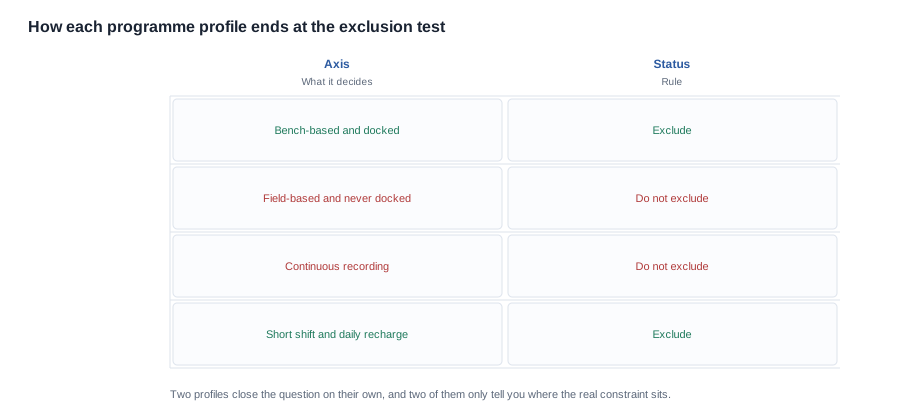
The matrix shows how the four common programme profiles end at the test. Two of them close the question on their own and can be excluded before a quotation is requested. The other two do not close it; they relocate it, to the charging case or to the duty cycle, which is a better outcome even though it is not a smaller programme.

Deciding a runtime requirement with the rows the catalogue actually holds
The rows that can settle this question without a supplier conversation are the published ones, and it is worth being precise about what they are. For every model in the range we publish the cell capacity and the rated runtime, we publish the charging interface for the twenty-four models that carry one, and we publish the capacity of the charging case on the models where the catalogue states one. Those four rows are enough to run the exclusion test and to identify which tier a programme lands in.
They are not enough to answer the second-order questions, and the gaps are specific rather than general. The charge time is published per model — ≤ 2h on most rows and ~1h on the two Type-C sports models — but it is published without the starting state or the end point, so the turnaround constraint can be judged only roughly from published data and has to be measured properly before it is relied on. We do not publish a cycle life figure, so the long-run behaviour of the cell cannot be evaluated from published data. We do not publish the frame weight for any model in the range; the one published weight in the range is the 158 g of the MT6 glasses body, which includes its 265 mAh cell and its camera and excludes the folding charging case, whose own weight has not been published. And we do not publish a unit price, a price tier or a minimum order quantity, because those are quoted per order and a typical figure is one you cannot verify.
Knowing which rows are missing is what makes the supplier conversation efficient.
There is one more published row worth noting, because it changes the arithmetic of the whole decision. The one weight published anywhere in the range is the 158 g of the MT6 glasses body, which includes the 265 mAh cell and the camera and excludes the folding charging case. The case capacity is published at 1200 mAh and the case weight is not published at all. So the one model in the range where the mass question can be quantified is also the one where the case has to be treated as an unquantified addition to what the operator carries, and that is exactly the combination that decides whether a case-based architecture is viable for a programme with a mass constraint. For every other model in the range, the weight has not been published and has to be requested as part of the quotation, which is one of the questions worth asking before you commit to a platform with a mass envelope. The questions worth asking are the four that the published rows leave open: the starting state and the end point behind the published charge time, the cycle life to a stated threshold, the gauge configuration and the end point of the runtime measurement, and the top-up count the case actually delivers. A factory that answers those four produces a specification a buyer can defend. A factory that does not has a product that has to be managed with an operating instruction instead.
The runtime question we will answer, and the one we will not
It is worth being precise: a runtime requirement should be written as a duty cycle and a condition rather than as a number of hours, and the number of hours in a catalogue is a rating produced under conditions the catalogue does not publish. Where a programme asks us for "the model with the longest runtime", the honest answer is usually that several models in the range share a rating and that the choice between them is decided by the interface, the case, the mass and the price tier rather than by the hours.
We will also say the uncomfortable part. Some of the models in this range have a rated runtime that a demanding duty cycle will exceed, and we would rather tell you that before the order than demonstrate it afterwards. The three children's rows publish around twenty hours on 40 to 70 mAh cells, which is a high ratio of runtime to capacity and a correspondingly sensitive platform in storage. The audio models cluster between six and eight hours. The camera models publish five to eight hours on larger cells, and where a case is present the case extends the working day rather than the single-shift runtime.
What we will not do is quote a cycle life figure, a test condition or a weight for a model where the weight has not been published, because those are the numbers a buyer will build a programme on and we would rather be missing from a specification than wrong in one. What we will do is run the exclusion test with you against the models you are considering, tell you which of the four constraints is actually binding for your operation, and tell you which of the four levers moves it.
Send us the duty cycle, the shift length, the docking opportunity and the mass envelope, and we will tell you whether runtime is the constraint, and if it is not, what to spend the money on instead. The published electrical rows are collected under smart glasses battery life and power, the recurring comparison errors are in battery life common mistakes, and the selection criteria for the range are in the battery buying checklist. The decisive question in every one of those documents is the same one this article ends on: which of the four constraints is actually binding for your operation.


