

If you have been handed a smart glasses catalogue and asked to come back with a battery recommendation, the hardest part is not the arithmetic. It is that the numbers on the page are not the same kind of number as each other, and a buyer who treats them as interchangeable will produce a shortlist that cannot survive contact with a supplier. This guide is written for the buyer who has no background in the category. It does not choose a model for you, because choosing is a decision that depends on an operation you understand better than the factory does. What it does is give you the vocabulary, the order to work in, and — most importantly — the first correct question to ask, which is not the question most buyers ask first.
Smart glasses battery life: the two numbers on every battery row
Every row in a smart glasses catalogue carries at least two figures that appear to belong to the same kind of thing. One of them is a property of the product. The other is the result of a test, and it belongs to the test as much as to the product.
The first is capacity, written in milliampere-hours or in watt-hours. Capacity is a property of the cell. It says how much charge the cell holds. A 290 mAh cell holds a quantity of charge, and that quantity does not change because the room is cold or because the radio is busy or because the unit is one year old. Capacity is a number in the way that a tank's volume is a number.
The second is runtime, written in hours, and it is not a property of anything. Runtime is the answer to a question: how long did this unit run, on this load, at this temperature, from this starting state, until it stopped doing its job? Change any one of those five inputs and the answer changes. Two units with identical cells can have different runtimes, and a single unit can have different runtimes on different days. That is not a defect. It is what the word "rated" in "rated runtime" is there to warn you about.
The consequence for a first-time buyer is a rule worth memorising.
There is a third figure you will meet less often and should still recognise: the charging case capacity. Where a model ships with a case, the case carries its own cell and the capacity appears in the same milliampere-hour unit as the cell inside the unit. It is tempting to add the two together and treat the sum as the total charge available to the customer. Do not. The two numbers are not the same kind of thing, because one of them describes a cell inside the product and the other describes a cell in a separate enclosure that the product has to be physically placed into. The sum tells you roughly how much charge travels with the box; it does not tell you how long the unit runs, because the case has to be charged, transferred and charged again, and the transfer is never complete. The figure that matters for a working day is the top-up count, which is not published for any model in our range and which you have to measure. Never compare a runtime figure from one source against a runtime figure from another unless you know the condition behind both, and assume the conditions differ until you have checked. And never convert one into the other. The tempting calculation — a 290 mAh cell and an eight-hour figure — produces a number that reads like a power draw and means nothing at all, because the answer depends on how much of the capacity the unit can use, how much current the average load draws, and how the firmware behaves at the end of the discharge.
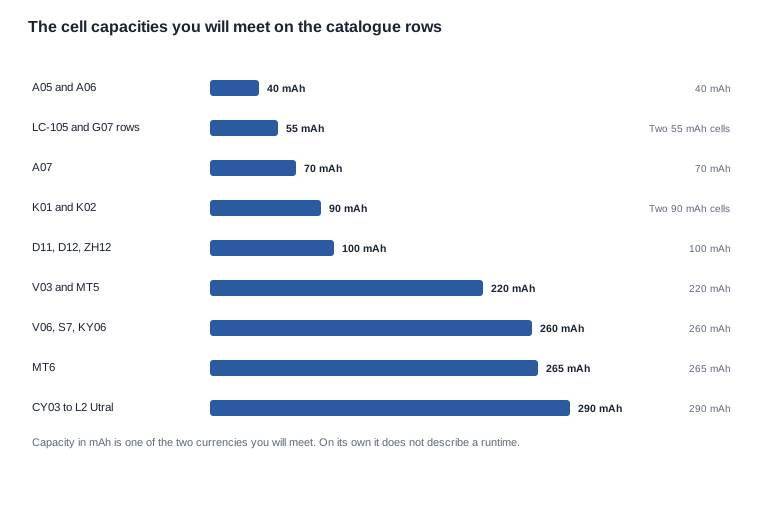
The capacities above are the real published figures from our range, and their spread is itself a lesson. They run from 40 mAh on the smallest children's rows to 290 mAh on the camera models, and the audio models cluster between 55 mAh and 115 mAh. That spread is not a menu of interchangeable options; each figure belongs to a platform that was designed around a particular load, and the platforms differ in more than the cell.

A first read of a battery row: five columns and what each one can settle
Our catalogue rows carry a small set of fields, and a first-time buyer will find it far more efficient to treat them as five separate questions rather than as one specification.
The columns that are published for every model
Cell capacity, rated runtime and the charge time are published for every model in the range, and the charging interface for the twenty-four rows that carry one. Where the interface is published, it is either a magnetic contact or a wired Type-C connector, and it is worth knowing which one you are reading before you assume anything about the charging arrangements: a magnetic interface implies a dock is involved somewhere, and the dock is either in the box or it is not.
These three columns are enough to make one decision and only one: which platform a model belongs to. They are enough to say "this is a camera platform" or "this is an entry audio platform", and they are enough to exclude a model whose cell capacity is nowhere near what your operation needs. They are not enough to compare two models within the same tier, because two models with the same capacity and the same interface can still differ in every way that produces the runtime figure.
The columns that are published for some rows only
The charging case capacity is published where a case exists. Across the range, the CY05 and the CY03, and the L1 Pro carry a 1400 mAh case, the L2 Utral is published with either a 900 mAh or a 1400 mAh case depending on the option, and the MT6 carries a folding case at 1200 mAh. Two further models carry a case whose capacity is not published, and four camera models — the S7 and the V03, and the V06 and the V03 Pro — publish no charging-case row at all. Where the capacity is published, the figure answers a real question: how much charge travels with the product.
One more published figure deserves its own mention because it is quoted incorrectly more often than any other in the category. The MT6 has a published weight of 158 g, and that is the weight of the glasses body including the 265 mAh cell and the camera, excluding the folding charging case. The weight of the case itself has not been published, and no other model in the range has a published weight at all. If you need a weight for a specification, this is the only one you can quote, and you have to quote it with the same qualification.
The columns that are not published at all
The charge time is published, as ≤ 2h on most rows and ~1h on the two Type-C sports models, but without the starting state or the end point that give it meaning. Cycle life is not published for any model. The test condition behind a rated runtime is not published. The gauge accuracy, the reserve, the end point of the discharge and the runtime policy are not published. The unit weight is not published except in the single case above.
This is not an oversight and it is not a secret; it is the normal condition of the category, because these are per-configuration and per-order figures that a factory quotes rather than publishes. What it means for you is that the published rows will take you as far as the platform decision, and no further. Everything beyond that has to come from a supplier conversation, and the quality of that conversation depends on how well you have prepared it.
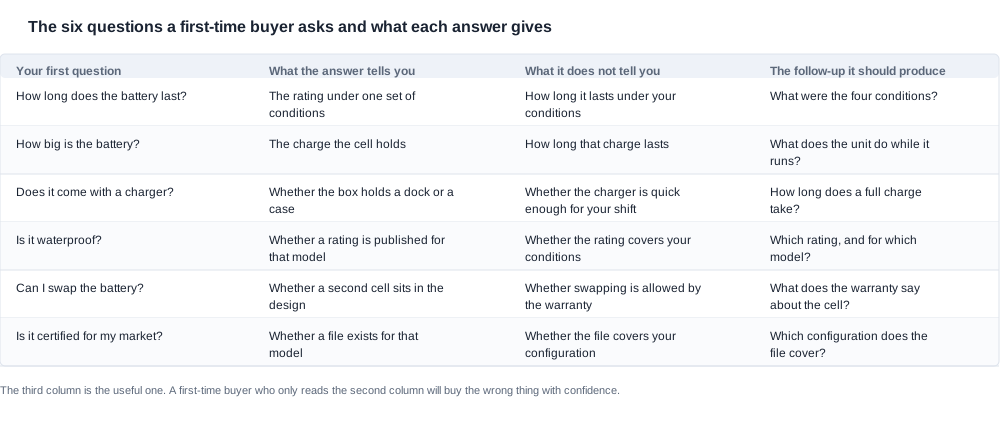
The table above is the most useful thing on this page for a buyer who has never done this before. The second column says what an answer actually gives you; the third says what it does not. The third column is where the first-time mistakes happen, because a confident answer to the first question reads like a complete answer and is not.
One question settles more of this than a battery model recommendation will
Ask a supplier for their recommendation and you will get a model, and the model will be whichever one they have most of or whichever one they are most confident talking about. It is a reasonable question and it is close to useless, because it asks the supplier to make a decision that depends on facts only you hold: your shift length, your duty cycle, your docking opportunities, your mass constraints and your market.
Ask instead: what condition does this runtime figure come from? That single question opens the conversation in a way that a recommendation cannot, and it is the question that separates a supplier who can support their product from one who is quoting a catalogue number.
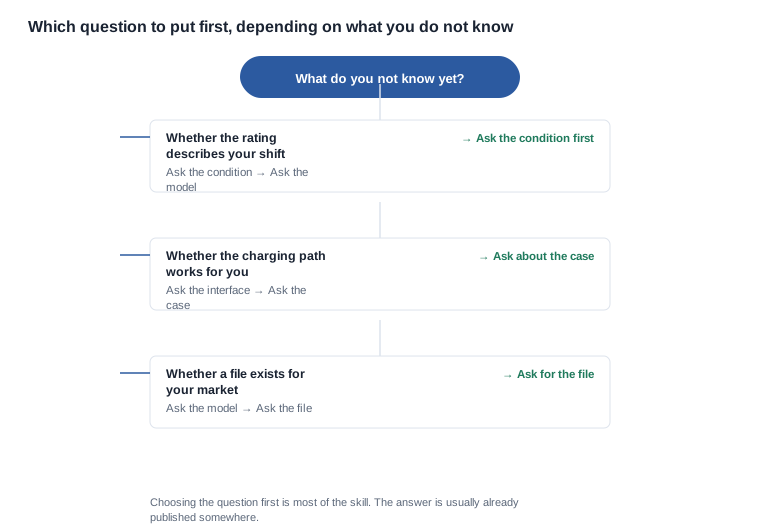
The tree above shows how to choose the question based on what you are actually uncertain about. If you do not know whether the published rating describes your operation, ask for the condition. If you are worried about the charging arrangements, ask about the case. If you are checking whether a product can be sold into a particular market, ask for the file rather than for a summary of it.
Once you have the condition, three more questions follow naturally and are worth having in the same conversation. What is the end point — when does the unit stop doing its job? What does the unit do while it is running, since that is what determines the load? And what happens as the charge falls, since the behaviour near the end of the discharge is what determines whether an operator experiences a full shift or a shortened one? None of these is a difficult question and none of them requires a factory to disclose anything commercially sensitive. They simply require the supplier to have run the product rather than only to have configured it.
There is a practical advantage to asking these four questions in writing, and to asking every candidate the same four questions in the same words. A supplier who answers a condition question verbally will usually give you a fair answer, because the condition is a technical fact that their engineering team already knows. What varies between suppliers is not the truth of the condition; it is how readily it is surfaced when nobody has asked. Put the four questions in the body of the first email, keep them identical across suppliers, and the answers arrive in a form you can put side by side. A supplier who takes three weeks to answer the condition question has told you something important about the programme, and you would rather learn it before the deposit than during the pilot.

Building your own battery comparison sheet in an afternoon
A first-time buyer can get most of the way to a shortlist without a single supplier conversation, and the work is mechanical once the order is understood. The order matters, because doing the comparison before writing down the duty cycle produces a comparison of nothing.
- Write your duty cycle as a sequence: what runs, for how long, in what order, with the radio in what state.
- Write your shift length in hours, and your docking opportunity in words — where the units charge and how often.
- Take the catalogue rows and fill in four columns for each candidate: cell capacity, charging interface, rated runtime, and case capacity where a case exists.
- Mark the rows where your duty cycle falls outside the published rating, and mark the rows where the runtime is clearly inside it.
- Note the weight where a weight is published and flag the rows where you will have to request one.
- Take the surviving rows and write the four questions above for each one, so that you send the same questions to every supplier in the same form.
- Send the same four questions, with the same duty cycle, to two or three suppliers, and compare the answers as a set.
The output of that session is not a chosen model. It is a shortlist with the gaps marked, and a supplier questionnaire that will produce comparable answers rather than comparable adjectives. It normally takes an afternoon, and it is the step that most first-time buyers skip and most later regret.

The flow above is the same sequence, and notice where it stops. It does not end with a purchase order. It ends with a shortlist and a questionnaire, because the decision between the surviving candidates needs the answers to those questions and, in most cases, a sample to run.
The measurement method behind every published runtime figure is set out in
One step sits between the comparison sheet and the purchase order, and it is the step most first-time buyers try to skip: the sample. A sample runs the duty cycle that you wrote in step one, on the hardware you shortlisted, under the condition you obtained in the questions above. It produces the only number in this whole process that describes your operation rather than a laboratory, and it costs a sample order and a week rather than a factory audit. The protocol is set out in how to test smart glasses battery life, and it is worth running the sample through the same cycle twice, because the first cycle and the second cycle on the same unit are not the same number and the difference between them is one of the things a sample tells you that a catalogue never will. how to test smart glasses battery life, and the criteria that decide which of the surviving candidates actually fits an operation are in how to choose on battery life. Both are worth reading before the first supplier call rather than after it.

The battery vocabulary you will need on day two
The terms below are the ones that come up in the first two supplier conversations, and each of them is defined properly in the glossary for this range. A short guide to why each one matters:
- Duty cycle. The pattern of load the unit sees across a shift. This is the phrase that converts a vague requirement into something a factory can quote against.
- Reserve. The charge the firmware holds back before the unit stops. This is why a unit with a given cell capacity delivers less than the arithmetic suggests.
- End point. The moment at which the unit is counted as having stopped. Two tests with different end points produce two different runtime figures from the same unit.
- Gauge accuracy. How closely the reported charge matches the real charge. This is what determines whether the operator's reading of the indicator is trustworthy.
- Cycle life. How many full charge cycles the cell survives, and to what end-of-life threshold. This is the figure that decides the warranty economics on a long programme.
- Top-up count. How many times a charging case can bring a unit back up from the case. This is the number that decides whether a case-based product actually works over a working day.
- State of charge. The charge the cell holds at a given moment. It appears in a transport declaration and it appears on a receiving record, and it is measured rather than assumed in both cases.
Knowing these seven is enough to follow a technical conversation
One warning about the vocabulary, and it is the one that catches experienced buyers rather than beginners. A supplier can use every one of these terms correctly and still fail to answer your question, because the terms are precise while the answers are not. "Cycle life" without a threshold is not an answer. "Fast charging" without a starting state is not an answer. "Eight hours" without a condition is not an answer. The discipline is to attach the qualifier to the term every time you use it, and to treat a supplier who cannot attach one as a supplier whose answer on the next question will be equally loose. A glossary is only useful if it is used as a set of demands rather than as a list of words. and to notice when an answer is being given in a way that does not settle the question. The full set, with the question each term should raise, is in the smart glasses battery life glossary.
The boundary of what a first contact on battery life can settle
It is worth being clear about what a first conversation with us can and cannot establish, because a buyer who expects too much from one email will go away with the wrong impression.
What a first contact can settle: which models in our range exist in which configuration, which of them carry a charging case and what its capacity is, which of them publish a Bluetooth version and which of those rows do not publish one, what the cell capacity and rated runtime are for each row, and where the published data stops. We will also tell you, from your duty cycle, which tier your operation lands in and whether the runtime constraint is likely to be binding at all.
What a first contact cannot settle: the starting state and the end point behind the published charge time, the cycle life, the gauge configuration, the end point of the runtime measurement, the weight of any model other than the MT6, and any price, price tier, minimum order quantity or lead time. Those are quoted against a specific order, a specific configuration and a specific destination market, and we will not quote a typical figure for any of them.
We will also tell you when we do not have an answer. That is more useful than it sounds, because the first-time buyer is usually working from a false assumption that the data exists somewhere and only has to be found. In this category a substantial part of what a buyer needs is not published by anyone, and the honest response to a supplier who says it is not published is to ask what they would need in order to provide it. The published rows are collected under smart glasses battery life and power, and the criteria for deciding which configuration to pursue are in how to choose on battery life.
If you take one thing from this page, take the question. Before you ask a supplier for a recommendation, ask what condition the published runtime figure was measured under, and write the answer down. That single step is what turns a catalogue into a shortlist.


