

A runtime figure is a rating for a condition, and the condition is never "a working day". It is a particular load at a particular temperature from a particular starting state, and a site that runs two different patterns across a week will find that the same units behave differently in each. That is not a defect in the product. It is the reason the acceptance criterion has to be written per operating profile, because a single pass criterion applied across five profiles is the reason battery disputes arrive at a supplier with no usable information in them. This article takes five operating profiles, states the runtime constraint each one creates, and gives the acceptance test that profile actually needs. It is not a model recommendation and it does not cover how a model is chosen once the profile is settled; the selection criteria are in the separate buying guidance, and the trade-offs between the ways of buying runtime are covered in the cost against performance notes.
Smart glasses battery life: five operating profiles and what decides each
The profiles below are not a taxonomy of industries.
Before turning to the five profiles, it is worth being clear about what a profile is for. It is not a way of describing a customer or a market. It is a way of describing a pattern of load and access, and the pattern is what determines whether the published runtime is the operative number or is irrelevant. Two sites in the same industry, with the same product, can sit in different profiles because one of them has a dock at the post and the other does not, and the consequence for the battery is larger than any difference between two catalogues.
That is also why the profile has to be established before the model is chosen rather than after. A profile is cheap to establish and expensive to discover late: it can be established from an operational description in an afternoon, and it can only be discovered late through a return rate, a complaint or a lost programme. It is worth noting that our catalogue is organised by hardware family rather than by profile, which means the published rows can tell you which hardware could serve a profile but cannot tell you which profile your operation is. That assessment belongs to the buyer. They are five distinct patterns of load and access, and a programme belongs to one of them or to a combination. The distinction that matters for the battery is access to a charging point, because that single fact decides whether the constraint is the cell, the case, the dock or the spare pool.
The continuous on-site post
A post occupied for a whole shift with the unit in hand and no dock within reach is the profile where the published rating is most likely to be the whole story. The requirement is that one charge has to cover the shift, and the acceptance criterion is not hours at all — it is the number of top-ups a case delivers from a stated starting level. A site running this profile needs the top-up count measured on the actual units, because the arithmetic on the case capacity overstates what is delivered in practice: the transfer is never complete and the unit does not accept a full charge every time.
This profile is also where the gap between a unit and a case becomes commercially decisive, since the case is doing the work rather than the unit. A camera platform in this profile should be read from the AI camera range rather than from an audio row, because the camera load and the case availability have to be sized together.
The outdoor survey team
The outdoor profile adds a variable that no catalogue figure addresses: temperature. The published rating is produced under one stated condition, and a team working outside for a full day at the cold end of its operating range will not see that rating, because the cell's available capacity falls as the temperature falls and the charge acceptance behaviour changes with it. The acceptance criterion for this profile is a runtime measured at the cold end of the working range, not a runtime measured in a warm room.
There is a second feature of this profile that is easy to miss. An outdoor team that also works from a vehicle has a charging opportunity that is not a dock: it is a vehicle power socket and a case that has to be charged overnight. The criterion that follows is that the case must be able to complete a full charge in the window between shifts, which makes the charge time and its starting state a gating item for this profile rather than a detail. The catalogue publishes a charge time for every model — ≤ 2h on most rows and ~1h on the two Type-C sports models — but the figure that matters here is the one measured from the state the case actually arrives in, and that is not published for any model.
The warehouse shift work profile
In a warehouse the shortfall is carried by a spare pool rather than by capacity. The units are issued at the start of a shift, returned at the end, and charged in the window between. When a shift is marginally longer than the published rating, the answer is a pool of ready units rather than a heavier unit in everyone's hand, and the acceptance criterion becomes the pool size against the measured shortfall per shift.
The thing that breaks this profile is a pool that is counted but not charged. A pool of spare units that sits at a low charge is not a pool, and the shortfall will appear as a daily operational problem rather than as a battery complaint. The records layer of the acceptance has to include the charge state of the pool, not merely the count of the pool.
The mixed indoor and outdoor day
The mixed profile is where a single averaged figure does the most damage. A team that is indoors for the first half of the day and outdoors for the second has a duty cycle that describes neither half. The load profile is bimodal, the temperature is bimodal, and the acceptance criterion has to reflect that: two acceptance tests, run under two conditions, with two signed results. Averaging them produces a number that is true of no actual day and therefore useful for nothing.
A mixed day also changes the charging architecture. The indoor half offers a dock, the outdoor half does not, and the case has to bridge the gap. That is the profile where a case becomes the system rather than the accessory, and it is the profile where the top-up count is the single most valuable measurement in the whole programme.
The short indoor shift
The short indoor shift is the profile where the constraint is turnaround rather than runtime. The shift fits inside the published rating with room to spare, and the only question is whether the unit can be back in service inside the break. The acceptance criterion is a charge completed within the break between two shifts, measured on the dock that will actually be installed, starting from the state the units actually arrive in.
This is also the profile where a larger cell actively makes things worse, because charge time scales with capacity. Where the requirement is turnaround, the correct specification is a faster charge inside the existing envelope rather than a bigger cell, and that trade is set out in the cost against performance guidance.
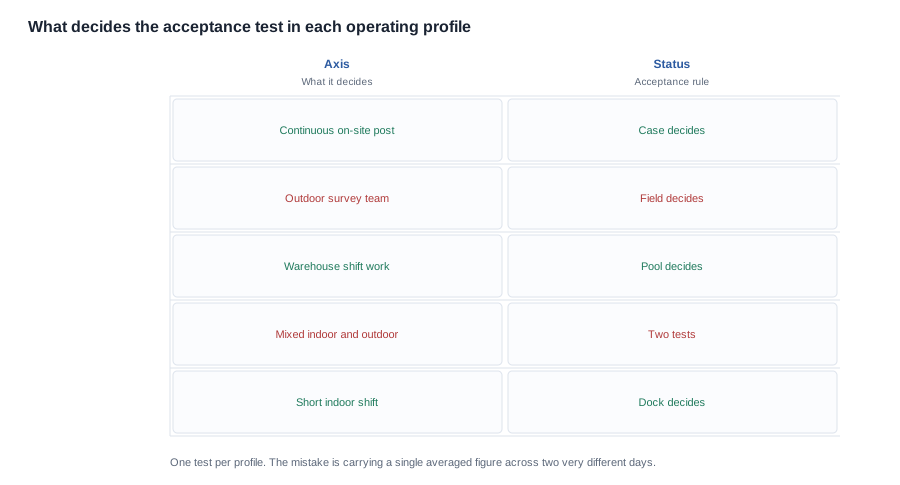
The matrix above shows how the five profiles end. Notice that three of them settle on something other than hours: the continuous post settles on top-ups, the warehouse settles on the pool, and the short shift settles on the charge window. Only the outdoor profile and the mixed profile require a runtime measurement as the acceptance criterion, and the mixed profile requires two of them.

Where the charge actually goes across a working shift
The most useful picture a buyer can build is not a bar chart of published figures but a timeline of a single shift, because the load is not spread evenly and the peaks are what decide the size of the case.
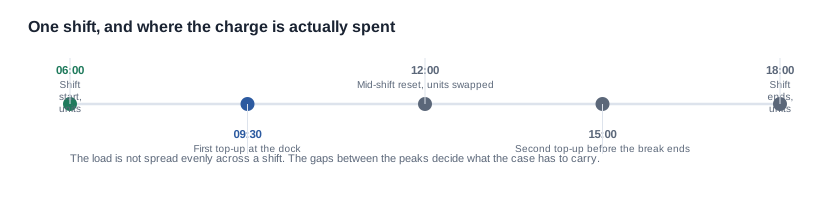
The timeline above describes a plausible shift. Two things in it drive the specification. The first is the mid-shift reset, which tells you whether the operation already has a swap discipline; if it does, the platform question changes from capacity to the cost of the swap. The second is the gap between the first and second top-ups, which is the window the case has to cover and which is normally shorter than the shift itself.
For a buyer working from published figures, the practical use of this timeline is that it converts a vague statement about the shift into a sequence that a factory can price. "Operators are on site for eight hours" cannot be quoted against. "Radio connected throughout, recording for the first two hours, two top-ups needed between the first and second breaks, units returned to a dock for the night" can be, and the answer to it is the specification.
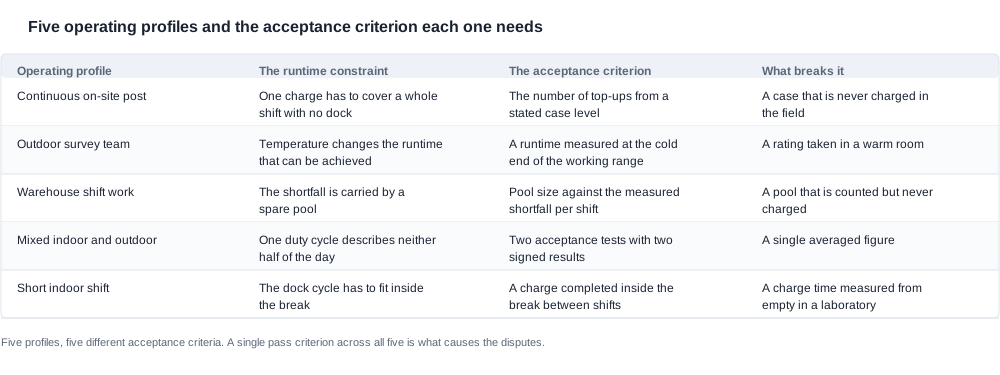
The table gives each profile the constraint, the acceptance criterion and the thing that breaks it. In a procurement conversation the third column is the one that saves time, because it converts a complaint about short runtime into a specific hypothesis that can be tested on the next delivery.

The acceptance test each profile needs, and the one it does not
There is a test that most programmes run regardless of profile, and it is the wrong one for four of the five cases in this article. It is the laboratory runtime test: charge the unit to full, run it under a stated condition, record the hours. That test is the right criterion for a range comparison and for a qualification statement, and it is the wrong criterion for an incoming acceptance decision in any profile where the unit is charged and used in a pattern that differs from the test.
The tests each profile actually needs are as follows.
- Continuous on-site post: a top-up count from a stated case level, measured on the production units, repeated after the units have been in service for a period rather than on day one.
- Outdoor survey team: a runtime measurement at the cold end of the working range, with the temperature logged rather than assumed, on a unit that has completed at least one full cycle in service.
- Warehouse shift work: a pool size calculation against the measured shortfall per shift, with the charge state of the pool recorded at each issue point.
- Mixed indoor and outdoor day: two runtime measurements under the two conditions of the day, with two separate signatures and no averaged figure.
- Short indoor shift: a charge time measured on the installed dock from the state the units arrive in, completing inside the break.
Each of those is a test that can be run at the site or in a receiving area, and each of them produces a result that can be acted on. What none of them is, is a charge-to-full-and-run test performed once on a sample.
The two errors that follow from using the wrong test are worth naming, because both are common and both are expensive. The first is accepting a lot against a test that the operation does not resemble, which produces a lot that passes on paper and fails in the field. The second is averaging. A programme with two operating profiles that runs one test and averages the two results has produced a number that will be wrong in both directions, and when the field reports a shortfall the supplier will correctly point at the test.
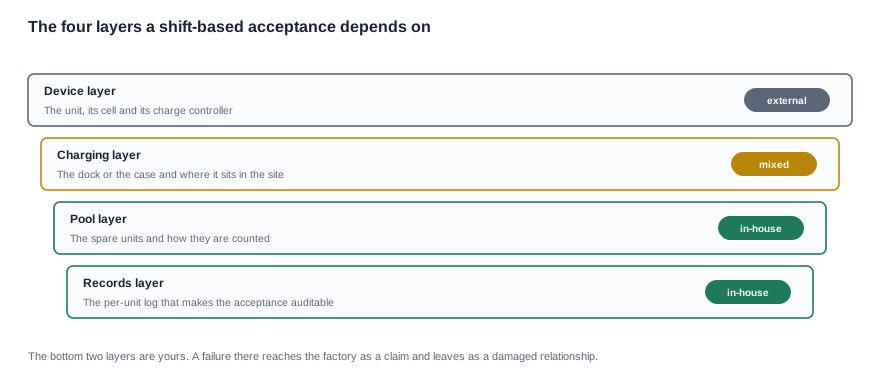
The layers above separate what the factory controls from what the buyer controls.
There is a fourth layer that is not visible on that diagram and that determines whether any of it is worth doing, which is the acceptance record itself. If the acceptance results are held in a spreadsheet on one person's machine, then the pool layer and the records layer exist in name only, and the first dispute will turn into an argument about what was measured. If they are held as dated records against a lot reference, then the comparison between the second shipment and the first becomes possible, and a claim becomes a comparison rather than a contest of memory. That is the difference between a battery programme that scales and one that argues.
It is worth adding one practical note on how the acceptance pack is put together, because the order of the documents matters at the point where somebody has to use it at three in the morning on a receiving dock. The profile comes first, because it determines the criterion. The criterion comes second, because it determines the test. The test method comes third, because it determines what a result means. And the consequence of a failure comes last, because it is the only part that requires a signature from someone outside the receiving team, and it should be agreed while the team is still thinking about the problem rather than written afterwards in the language of a dispute. The device layer and the charging layer are shared with the supplier; the pool layer and the records layer are yours. A failure in the bottom two layers arrives at the factory as a claim and leaves as a damaged relationship, which is why the acceptance pack has to include the pool and the records before the first shipment rather than after the first complaint.
The commercial shape that follows from the profile
The profile determines more than the technical acceptance, and the commercial consequences are worth writing into the order while the profile is still fresh.
Where the profile is the continuous post or the mixed day, the case is the system. That means the case quantity follows the unit quantity, the case carries its own tooling and its own minimum order quantity, and the case has its own compliance file because a second lithium cell travelling in the carton changes the transport declaration. Where the case is sold as an accessory instead, the case quantity follows accessory demand, the same tooling is spread over fewer units, and the accessory price per unit is higher than a buyer expects. Deciding the box contents per profile, before the quotation, is what keeps that decision from becoming a surprise in the second order.
Where the profile is the warehouse or the short indoor shift, the dock is the system, and the dock brings its own obligations: a minimum order quantity, a unit price as a separate line, an installation cost that belongs in the site budget rather than in the product budget, and a spare units count that has to be set and re-checked as the volume grows.
The other commercial item that follows from the profile is the warranty.
There is a red flag worth naming before the quotation rather than after it: a supplier who accepts a profile without asking what the acceptance criterion is. Any factory can say yes to a requirement written as a number of hours, because a number of hours can be made to match a product. A factory that asks what the criterion will be on the receiving dock, what the consequence of a failure is, and who signs the result is a factory that has run this before, and that is the difference between a supplier and a quotation. The questions to ask are short, and the ones that matter before you order are: what criteria do you apply to this configuration, what red flags would you see in a lot that had been stored badly, and what would you need from us to run the acceptance test ourselves. A profile with a spare pool generates returns in a different pattern from a profile without one, and a profile with an outdoor exposure generates a return rate that is sensitive to the temperature band rather than to the product. Where the profile produces returns, the defect definition in the agreement has to name the acceptance criterion, because otherwise the factory is being asked to warrant a product against a criterion nobody wrote down. The clause language is set out under contract terms, and the structure of a first order is under pricing.
What to send us for a battery decision in this category
Send four things and the profile question answers itself. The shift length in hours. The duty cycle as a sequence. The docking opportunity, described as where the units charge and how often. And the temperature band the units work in.
With those four we will tell you which profile you are actually in, which constraint is binding, which acceptance criterion belongs in the order, and which of the published rows is even in scope. We will also tell you when the profile is one we do not have a published answer for, and what we would need to measure to get one.
On what we publish, narrow and consistent across this range. We publish the rated runtime, the cell capacity, the charging interface, and the charging case capacity for the models that carry a case. We publish the charge time as a single figure per model, and we publish no cycle life, no test condition behind a rated runtime, and no weight for any model except the one model where a weight has been published — the MT6 glasses body at 158 g, including its 265 mAh cell and camera and excluding the folding case, whose own weight is not published. Where a figure is not published, we will say so and tell you what to ask for, rather than quoting a typical number you cannot verify.
The measurement protocol behind every published runtime figure is in how to test smart glasses battery life, the published electrical rows are collected under smart glasses battery life and power, the charging architecture decisions are under charging solutions, and the trade-offs between buying runtime in the cell and buying it in the case are in battery life cost against performance. The product range that the camera platforms come from is on the AI camera glasses page.
The single sentence to take from this article:
One practical check is worth running before the first order, and it takes an hour. Take the profile you have identified, write the acceptance criterion in one sentence, and ask two different people in your organisation to read it and say what they would measure. If the two answers describe different tests, the criterion is not yet specific enough to write into an agreement, and it will not settle a dispute when it is needed. The test is crude but it catches the majority of criteria that turn out to be unusable, and it catches them before the first shipment rather than after the first complaint. the profile decides the acceptance criterion, and the acceptance criterion is what makes a claim settleable. Write it down before the first shipment, not after the first complaint.


