
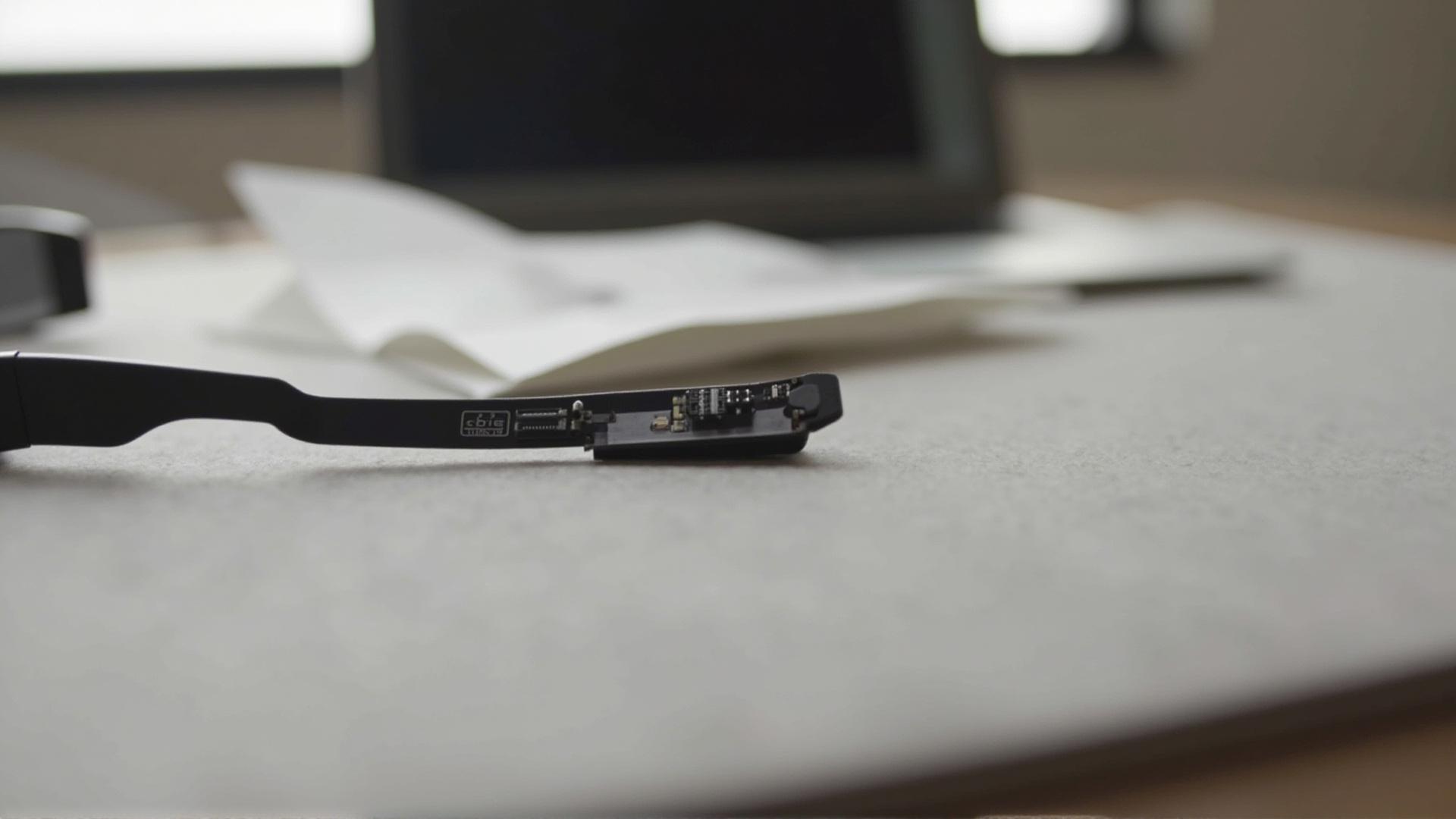
A limit in this category is best written as a conditional. Not "the battery lasts six hours", but "when the ambient temperature falls below a stated level, the available runtime falls below the figure the product page states". The first is a number. The second is a boundary, and a boundary is something a buyer can put into a specification, a test protocol, a warranty term and a product page.
There are two kinds, and mixing them is the most expensive error in this category. Some limits are choices: an operating temperature range, a radio coverage assumption, a charger output, a duty cycle. A buyer can write those down, test against them, and they become a specification. The rest are properties of a lithium cell in a small, warm enclosure on a head: the energy in a given volume, the thickness of a temple, the rate at which a cell ages. No commercial term changes those, and the only honest response is to accept them, price them, and stop negotiating against them.
Our published data makes the first group visible. The camera tier carries cells from 220 mAh to 290 mAh and, where it publishes a figure, publishes a range of five to eight hours. The audio tier publishes roughly six to eight hours on dual cells of 55, 70 or 90 mAh per side and on single 100 mAh and 115 mAh cells. The children's tier publishes roughly twenty hours on 40 mAh and 70 mAh cells. The bone-conduction entry publishes roughly seven hours on a 200 mAh cell. Every one of those arrives without a test condition, which is why so much of the list below is about the condition rather than the number.
Smart glasses battery life: two limits, one fixable and one physical
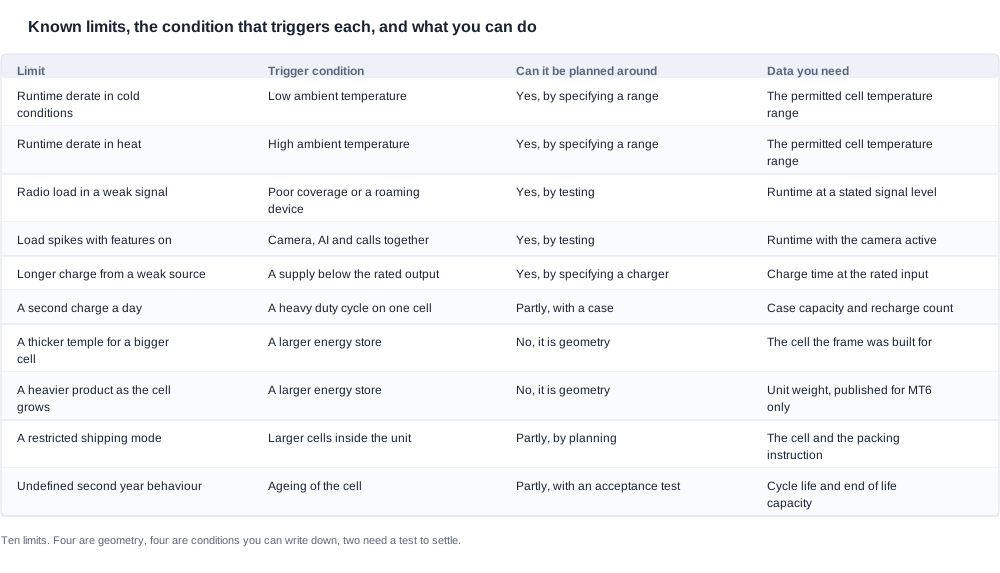
The ten limits below are the ones a buyer actually meets when the product is in the field. They are written with their trigger condition, because a limit without a trigger cannot be tested and a limit without a test cannot be written into an acceptance criterion.
The runtime derate in cold conditions. A cell behaves differently at low temperature, and the difference is large enough to change which end of a published range a unit reaches. The permitted cell temperature range is not published for any model in this range, so a buyer shipping into a winter market has a limit with no number attached to it. The remedy is a request: the permitted range, and a runtime measured at the bottom of it.
The runtime derate in heat. The same mechanism operating in the other direction, and a different problem, because heat is generated by the product itself. A unit in a hot car is a unit with a hot cell, and the heat case is the one that applies to a product left in a vehicle.
The radio load in a weak signal. A unit maintaining a link in poor coverage transmits harder than one with a clean connection, and the difference is why a figure measured on a bench next to a router is optimistic in a way that is hard to reason about from a specification. The limit here is a coverage assumption, and a coverage assumption can be written down.
The load spike with features on. A camera, a connected app, a voice assistant and an active call all draw from the same cell, and the published figure reflects only the combination the manufacturer measured. The remedy is a second runtime, measured with the camera active, on the shipped configuration with every feature enabled.
The longer charge from a weak source. A source below the rated output produces a longer charge with the same product and the same cell, and in some markets a cable is not included in the box at all. This limit is entirely a specification matter, because the buyer chooses the charger and the packaging.
A second charge a day. A heavy duty cycle on a single cell produces a product that needs a midday charge or a case. This is a design decision with a commercial answer: the case.
The thicker temple that a larger cell requires. This is geometry, and it is the limit that couples the battery decision to the industrial design decision, which is why the cell has to be settled before the frame is frozen.
The heavier product that a larger cell produces. Also geometry, and also fixed once the frame is tooled.
The restricted shipping mode that a larger cell produces. Partly a planning matter and partly a physical one, because the charge state and the cell size together determine which routes and modes are open.
The undefined second-year behaviour. The cell ages, and no cycle life rating is published for any model in this range, which means the behaviour of the product in its second year is undefined in the published documentation.
The last one is the only limit here that is a documentation gap rather than a physical fact, and it is also the one that decides the shape of the warranty conversation.
Temperature, signal and concurrency: the three conditions that move the number
The three conditions in this section account for most of the distance between a published figure and an experienced one, and they behave differently enough that a buyer should treat them as three separate questions rather than one.
Temperature is the condition with the sharpest edges. A lithium cell has a permitted operating range, and outside it the chemistry behaves in ways that reduce available energy and increase internal resistance. The consequence for a buyer is that a runtime figure is a figure at a temperature, and the temperature is the part a customer will not think about. A winter market and a summer market are different products unless the specification says otherwise. The published rows in this range state no temperature for any model, so the first question to a supplier is what the cell's permitted operating range is, and the second is what the runtime is at each end of it.
Signal is the condition that varies most within a single product's day. A unit that stays in range spends little on the radio; a unit that moves between a strong network and a weak one spends substantially more, and a unit in a lift or a basement spends more still. The result is that a runtime figure measured on a factory bench is close to a best case, and the distance between the best case and a real day is the reason a product can meet its rating and still generate returns. A buyer can close this by specifying the runtime at a stated signal level, which is a protocol question rather than a physics question.
Concurrency is the condition buyers most often forget, because each feature looks cheap on its own. A camera, a call, a voice assistant and a connected app are each a small draw, and the sum of small draws under a duty cycle is what actually runs the cell down. The published figure in the camera tier already contains some combination of these, and the buyer does not know which one. This is why the two-number request matters: a camera-active runtime and a camera-idle runtime are different products to a buyer, and a supplier who can only give one of them has measured only one of them.
The general rule that connects the three is worth stating, because it is what turns a list of complaints into a specification. A published runtime describes a device under a load, and the load has four components: what is running, how often, in what environment, and with what radio state. A buyer who writes those four into the test protocol has converted an unbounded figure into a comparable one, and the protocol is the document that makes the number defensible in a warranty argument.
The physical ceiling: cell size, temple profile and the weight nobody publishes
The energy that fits in a pair of glasses is bounded by the space the temples allow and by the heat the enclosure has to move, and this is the group of limits that no commercial term can change. It is also the group that determines whether the battery decision and the design decision can be made independently, and the answer is that they cannot.
Every increment of capacity has a cost in geometry. A larger cell is a thicker temple, a thicker temple is a different profile, and a different profile is a different mould and a different product. The cost of discovering this after the frame is frozen is measured in tooling, not in unit price.
The weight situation is where a buyer has to be particularly careful, and this is where the published data is thinner than anywhere else in the range. Our catalogue publishes a weight for exactly one model: the MT6, at 158 g for the glasses unit, which includes the 265 mAh battery and the camera and excludes the foldable 1200 mAh charging case. The weight of that case is not published. No other model in the range publishes a weight at all, and no frame weight is published for any model.
Two things follow, and both of them matter to a procurement decision. First, the 158 g figure belongs to the glasses unit, not to the frame, and there is no published figure anywhere in this catalogue for a bare frame. A buyer who needs a frame weight for a packaging or a logistics calculation has to request it, and we will not estimate it from other models. Second, the single published data point is not a useful baseline for extrapolation. The MT6 is the model that carries a foldable case, it holds one of the larger cells in the range, and it carries a camera. A buyer cannot use it to infer the weight of a 40 mAh children's model or a 55 mAh audio model, because the difference between those products is not only the cell.
The honest position is therefore that a buyer who has a weight requirement, a fit requirement or a shipping-weight requirement is buying data that nobody in this category publishes, and the way to get it is to request it per model and to specify it in the order. The logistics and packaging implications of a battery product are set out under shipping and logistics and sample evaluation.

The second-year limit, and why no cycle life figure exists in this range
A cell that is new on the shelf is not the cell that will be in the product in year two. Capacity fades as the cell cycles and internal resistance rises as it does, and both effects land on the tail of the runtime rather than on its middle. A unit that has lost part of its capacity delivers the same current for a shorter time, and a unit with higher internal resistance sees a lower terminal voltage earlier, which means the electronics reach their shutdown threshold before the timing on the box suggests.
None of that is published for any model in this range. There is no cycle life rating, no end-of-life capacity figure and no ageing curve, for any of the 28 models. The rated figures describe new cells, which is not the same as describing the product the customer will still be using in the second year of its life.
That absence has three commercial consequences, and the middle one is the most expensive.
The first is on the warranty. A warranty period written in years against a figure that describes a new cell is a warranty that is likely to be claimed. A warranty criterion written against a specified cycle count, with an agreed capacity at the end of it, is a warranty the buyer can defend, and it is the form we would ask for.
The second is on the returns. A product whose published figure was met at purchase and is not met in the second year produces a return that arrives as a defect, and a defect the supplier has not agreed a criterion for is a defect the buyer absorbs. This is the single largest hidden cost in the category, and it is the reason a baseline measurement on the production batch is worth asking for: it is the document that separates a manufacturing defect from a cell that has simply aged.
The third is on the second-hand and refurbishment market, where a product with a published cycle life can be graded and one without cannot. That is a longer-term consideration and it is worth noting for brands with a distribution lifetime longer than one cycle.

Where the charging case changes the limit, and where it does not
A case is the most common answer to a runtime limit and the most frequently over-credited one. The published case rows in this range are specific: 1400 mAh on the CY05 and the L1 Pro, and the CY03, 900 or 1400 mAh as a configuration choice on the L2 Utral, and 1200 mAh on the foldable case of the MT6. The KY06 and the MT5 arrive with a charging case whose capacity is not published. The V03 and the V03 Pro publish no case at all.
Where a case genuinely changes the limit, it does so by changing the routine rather than the figure. It converts a product that needs a midday charge into one that does not, provided it is charged on the same rhythm as the glasses. That conditional is the whole story, and it is a support-script and product-page matter before it is a hardware matter.
Where a case does not change the limit, the reasons are worth separating. It does not help with a charge that is slow because the source is weak, because the case has its own input and its own time, and neither is published for most models. It does not help with a runtime limit caused by a cold cell, because the case is at the same temperature as the glasses. It does not help with a product whose fundamental limit is the temple geometry, because the energy store has not changed. And it does not help the V03 or the V03 Pro, which publish no case in any configuration.
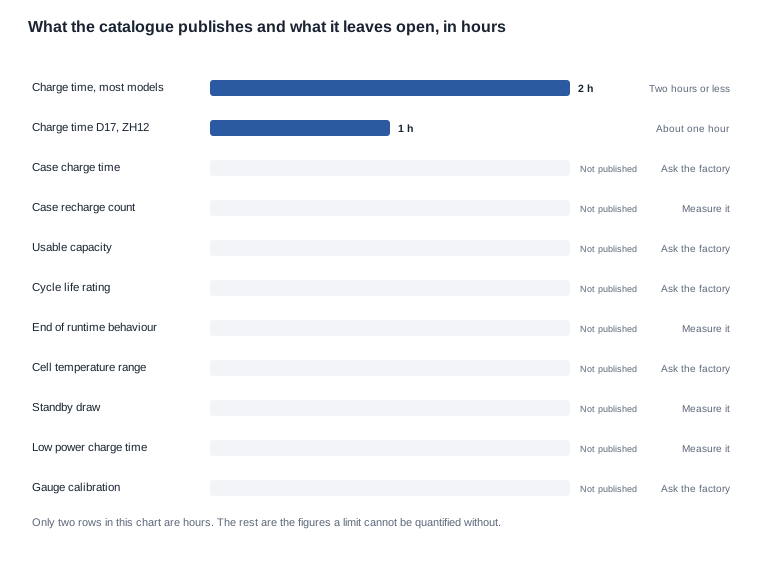
The chart above is the honest picture of the category. Of the eleven rows in it, two are published hours and nine are figures nobody publishes: the case charge time, the number of additional sessions a case adds, the usable capacity, the cycle life, the behaviour at the end of the runtime, the cell temperature range, the standby draw, the charge time from a weak source, and the fuel gauge calibration. A buyer who understands that list will not ask for a case as though it were a runtime figure, and will not write a product page that treats one as the other.
Turning each known limit into a specification line or an accepted risk
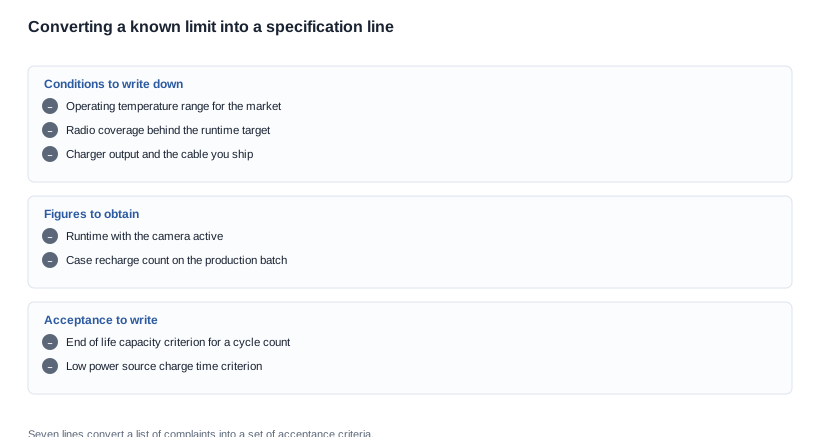
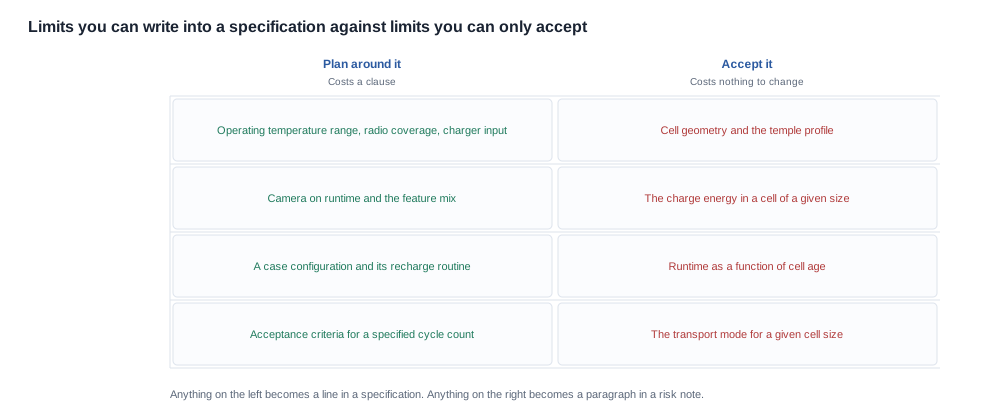
The purpose of listing the limits is to convert them, and the conversion is mechanical. A limit with a trigger condition and a remedy becomes a specification line. A limit without a remedy becomes an accepted risk, and an accepted risk belongs in a paragraph with a name on it rather than in a hope.
The lines to write into the specification. The operating temperature range for the destination market. The radio coverage assumption behind the runtime target. The charger output, and whether a cable ships in the box. The runtime with the camera active. The case configuration and its recharge count. The end-of-life capacity criterion for a specified cycle count. The charge time from a low power source. Each of these is one line, each is testable, and each converts a future argument with a supplier into a present question.
The risks to accept in writing. The energy available in a given temple volume. The thickness of a temple that carries a larger cell. The weight of a product that grows with its cell, where the catalogue publishes a weight for one model only. The runtime that declines as the cell ages, where no cycle life figure is published. The transport mode available for a given cell size and configuration. These cannot be negotiated, and the correct action is to name them, put a number against the ones that have one, and decide whether the product still works commercially with them in place.
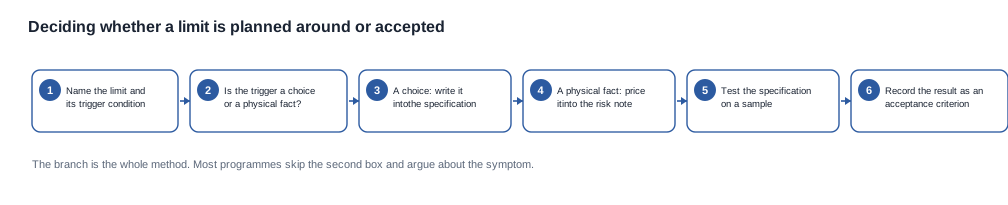
The decision chart below is the mechanism for doing that. The branch is the whole method, and most programmes skip the second box and then argue about the symptom for a year.
Two red flags are worth naming for the buyer who is still at the request stage. The first is a supplier who answers a limit question with a marketing phrase, which means the limit has been described but not bounded. The second is a limit that appears in the product page and nowhere else, which means somebody in the marketing team has made a decision that the engineering and compliance teams have not seen.
The questions to ask, and what a bounded answer looks like
The conversion above only works if the answers are specific enough to be tested. A bound is a number, a range or a named condition, and the four questions below are the ones that separate a bound from a description.
- What is the permitted cell temperature range, and what is the runtime at each end of it? A supplier who answers with a range and two runtimes has bounded the limit. A supplier who answers with "the battery performs normally in all conditions" has not.
- What is the runtime at a stated signal level, and is the reference a strong or a weak one? The reference point is what makes the number comparable, and it is the part that is normally omitted.
- What is the runtime with the camera active, with every other feature enabled, on the shipped configuration? Three conditions or none.
- What capacity do you expect at a stated cycle count, and what is the end-of-runtime behaviour? This is the pair that decides the warranty and the support script.
When to accept a limit without a number is a judgment rather than a rule, and the practical test is the total cost of being wrong. A limit that nobody has bounded is a limit that will be discovered through a return, and a return carries a replacement cost, a handling cost and a customer relationship cost that are all larger than the cost of a measurement. A limit that is bounded, priced into the product and written into the product page costs nothing further.
Concretely, we publish the electrical rows accurately and we will not present a mixed-use figure as a continuous-use figure, because that substitution is what makes a published runtime untrustworthy. We will also be honest about the group we cannot fix. The temperature range, the shared power budget, the fixed physical envelope and the distance between a test figure and a customer's day are properties of the technology, and no supplier can remove them. What a supplier can do is publish the conditions, and what a buyer can do is test the product under its own.
Tell us the load profile and the temperature range for your market, and we will tell you which of these ten limits are decisive for you, which ones are already answered in our documentation, and which ones need a written confirmation from the company. The published rows are at battery life and power, the mechanism behind the runtime figure is at how the runtime figure is made, the recurring errors this category produces are at battery common mistakes to avoid, and the factory-side counterpart is at battery quality control in practice.
Related reading
- Battery life and power
- How the runtime figure is made
- Battery common mistakes to avoid
- Battery quality control in practice
Tell us the load profile and the temperature range and we will tell you which limitations are decisive for you.


