

Battery quality control on smart glasses fails in a specific and predictable way: the unit passes every test on the bench and the customer still complains. The reason is that the published runtime figure describes a condition, and the condition under which the customer uses the product is not the condition under which it was measured. A test plan that inherits an undefined specification produces a passing result and an unresolved complaint, and the factory's quality file is on record as saying the unit was fine.
That is why battery quality control is a specification-definition question before it is a test question, and why the order of the two matters more than the sophistication of either. Define the conditions first, and the test plan can be written. Skip that step, and the test plan measures whatever is convenient, and the customer finds the gap.
Our published runtime figures in this range span roughly six to eight hours in the audio tier, roughly five to eight hours on the camera models that publish a figure, roughly seven hours on the bone-conduction entry and roughly twenty hours in the children's models, and every one of them is stated without a test condition. So the quality control question has to be answered as a protocol question rather than as a pass-or-fail question, and the buyer's role in it is to write the conditions the factory is going to measure against.
Smart glasses battery life: where control sits, and what each stage catches
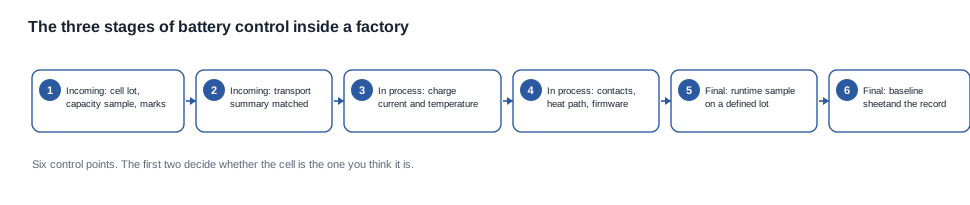
Quality control for a battery in this category runs across three stages, and each stage catches a different class of defect. The most common planning error is to put everything in the last stage, where the unit is finished and every fault is expensive.
Incoming inspection happens before the cell enters the product, and it is the only stage that can catch a wrong cell. A cell from an unintended lot, a cell with a lower rating than specified, a cell whose marking does not match the drawing, and a cell with no transport documentation behind it are all detectable here and invisible after assembly. Nothing downstream of incoming inspection can detect a substitution, because by the time the unit is built, a substituted cell looks exactly like the specified one.
In-process control happens on the line, and it is the stage that catches the assembly faults. A charge circuit that draws too much, a contact that is not aligned, a thermal path that is not making contact, a calibration that was applied to the wrong firmware version, a joint that did not take. These are the defects that pass a visual inspection and fail in the field.
Final inspection happens on finished units, and it is the stage that produces the evidence the buyer and the after-sales team will actually use. A timed runtime on a defined lot, a timed charge from a stated start, a case recharge count, an indicator check, a packaging check against the bill of materials. This is where the baseline sheet is created, and it is the only document that makes a year-old complaint answerable.
The fourth stage is not inside the factory at all, and programmes that skip it are usually the ones whose complaint data is anecdotal. Field information, gathered through a structured question at the point of a support contact, is the only source of information about real use. Without it, the published range stays untested against reality and the factory's quality file is an internal document that nobody outside ever reads.
The sequencing rule that follows is worth stating because it is counter-intuitive in a buying negotiation. A buyer who asks a factory for more inspection is asking for more sampling, which is a cost. A buyer who asks a factory for a defined set of conditions to measure against is asking for a specification, which is a document. The second request is cheaper, it is more useful, and it is the one that actually changes the defect rate.

Incoming inspection: the cell lot, the protection circuit and the traceability chain
The cell is the only component in the product where a substitution by a sub-supplier is invisible in the finished unit and shows up only in the runtime. That makes incoming inspection the stage that carries the whole battery risk, and it is also the stage that is easiest to under-specify, because the checks sound procedural and the consequences are not.
Four checks carry that risk, and each of them has to name an object.
The lot identity. The cell lot number has to be recorded against every unit that uses it, because a lot is the unit of risk. A lot here means a specific cell batch from a specific maker, and a product built in July with a cell lot from March is not a homogeneous population. This is the single most useful piece of traceability in the category and it is the one most often missing.
The capacity sample. A charged and measured sample from the incoming lot, against the specified rating. The check is variable inspection rather than attribute inspection, because capacity is a measured quantity with a tolerance rather than a pass or fail. What matters commercially is the acceptance rule, and an acceptance rule that only says "within specification" without a number is not an acceptance rule.
The marking and the drawing. A visual check that the cell's marking, its polarity and its dimensions match the drawing, recorded per lot. This is the check that catches the wrong cell in the most common way it goes wrong, which is a substitution that is electrically similar but not the same part.
The transport documentation. A document check confirming that the transport test summary on file covers the lot being received, matched by part number. This is the check that ties the incoming inspection to the compliance file, and it is the one that makes a cell substitution visible at the bench rather than at the port.
The protection circuit is the fifth item, and it is the one most often left undocumented. The arrangement, the current limits and the cut-off behaviour all determine the failure mode of a cell that is pushed outside its working range, and none of them are published for any model in our range. A buyer that wants to write a sensible failure-mode clause in the agreement needs that description, and a supplier who cannot provide it is telling the buyer something about the depth of its own engineering.
In-process control: the points where a battery fault becomes invisible downstream
In-process control is where a good cell is turned into a bad product, and its defining property is that the faults it creates are invisible to a final inspection that does not know to look for them.
The charge path. Charge current, charge time from a stated start, and the temperature rise during the charge. A charge circuit that works but runs hot is a fault that appears in the field as a unit that is warm in the hand, and it is not caught by a runtime test at all. The published charge times in this range give the reference: two hours or less across most models and roughly one hour for the D17 and the ZH12, with no start point and no source output stated for any of them. A control plan that checks charge time without fixing the start point and the source is checking an undefined quantity.
The contact alignment. On a magnetic dock, the contact geometry is a tolerance stack, and the check is a first-article check followed by patrol checks. This is where a case-related fault usually originates, because a case adds a second contact set with its own alignment and its own tolerance stack.
The thermal path. Whether the heat from the charge circuit is actually being conducted away. A thermal interface that is mispositioned produces a unit that charges correctly on the bench and behaves differently in a warm environment, which is a condition-dependent fault and therefore invisible to a factory test at room temperature.
The firmware and the calibration version. The version that governs the fuel gauge and the charge termination has to be the specified version, read on the unit rather than assumed from the batch. A firmware mix is a recurring and expensive failure mode because it produces two populations of units with two behaviours and no visible difference between them.
The connection to the cell. The joint between the cell and the board, and the cell's own protection arrangement. This is the check that catches a soldering or a connection fault, and it is the point at which a cell defect becomes a product defect permanently rather than a component that can still be swapped.
The pattern in all five is the same. Each fault is invisible to a final runtime test, because a runtime test measures the outcome of the fault rather than the fault itself. The only defence is to have an in-process check aimed at each one, and to write the acceptance criteria for those checks into the control plan rather than leaving them to the factory's own discretion.

Final inspection and the sampling logic behind a runtime test
The final stage is where the buyer gets its evidence, and it is also where the sampling logic has to be right, because a runtime test on a sample is the most expensive check in the plan and the one most often misunderstood.
A lot has to be defined before a sample means anything. A lot in this context is a cell lot plus a production window, not a production window on its own and not a cell lot on its own. The reason is straightforward: the two variables that drive the result, which cell and when it was built, are the two variables that a sample is supposed to represent. A sample drawn from three different cell lots across two weeks of production is not a sample of the population, it is a sample of the variation, and the result cannot be attributed to anything.
A sampled runtime test bounds the risk; it does not guarantee the lot. This is the distinction that buyers most often get wrong when a supplier offers an acceptance level. An acceptance level is a threshold for a lot, not a statement that every unit in the lot meets it, and a lot that passes has a residual probability of containing units that do not. The correct way to use it is to set the threshold, state the sample size and the method, and accept that a unit which fails in the field is a rare outcome of a passing lot rather than a contradiction of the quality system.
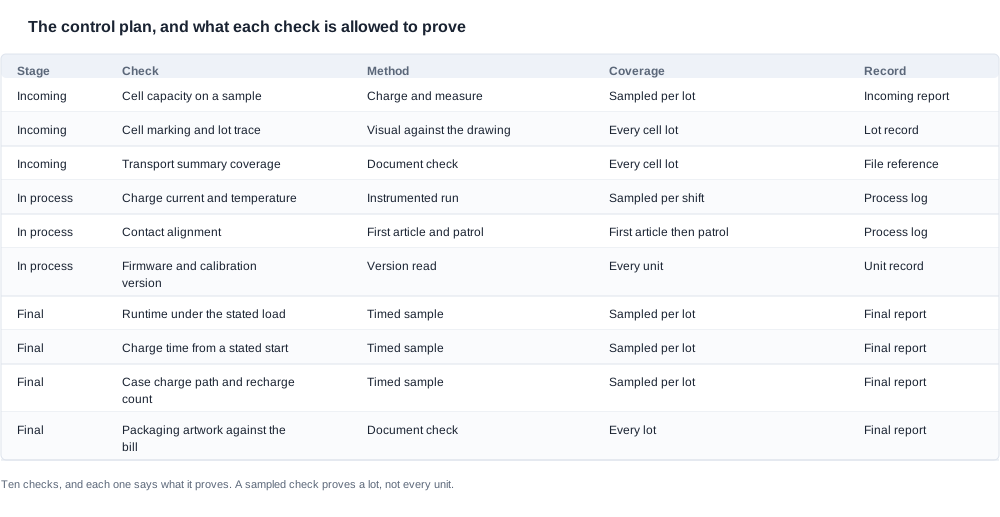
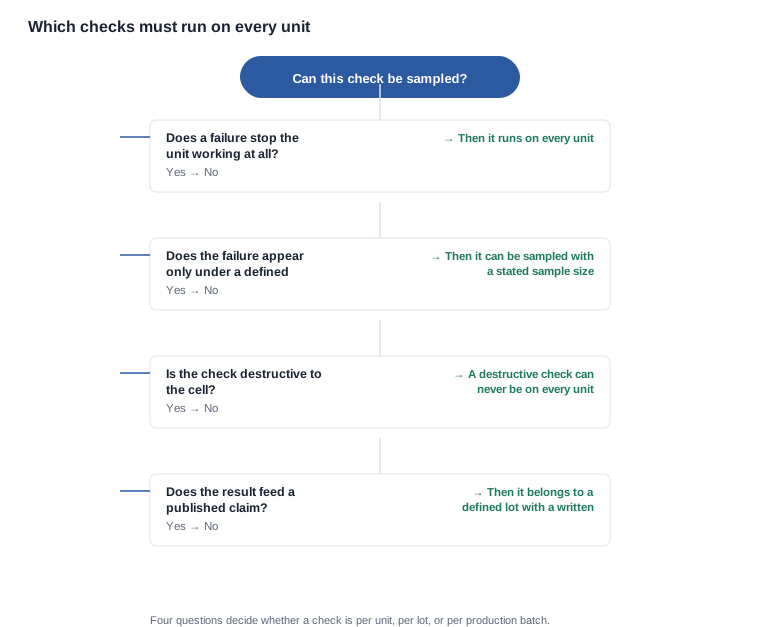
Some checks cannot be sampled at all. A check whose failure prevents the unit working has to run on every unit, because there is no second chance to find it. A check that is destructive to the cell can never be on every unit, and it has to be a sample check on a representative cell rather than on a production unit. And a check whose result feeds a published claim has to belong to a defined lot with a written method, because the claim is made about the population.
The decision chart below is the compact version of that rule set, and it is the thing to ask a factory to confirm: for each check in the control plan, whether it runs per unit, per lot or per production batch.
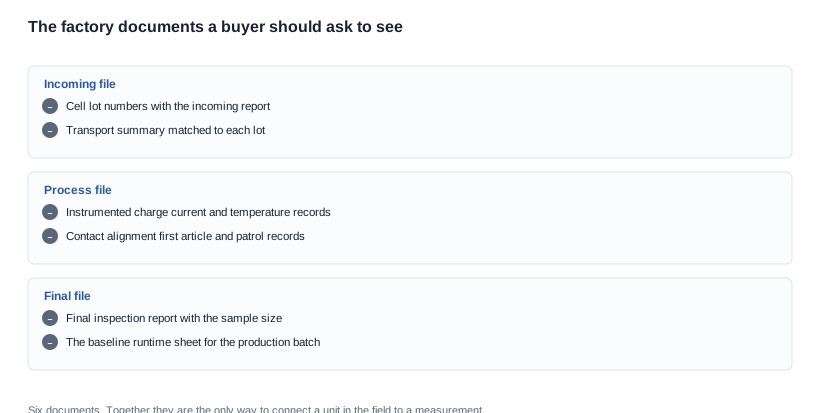
The records are where the value is. Six documents connect a unit in the field to a measurement: the incoming report with its lot numbers, the transport summary matched to each lot, the instrumented charge current and temperature records, the contact alignment first-article and patrol records, the final inspection report with its sample size, and the baseline runtime sheet for the production batch. A factory that holds all six can answer a question about a unit nine months after it shipped. A factory that holds one or two can only answer a question about a unit on the line.

The control plan a buyer can ask to see, and the records it should produce
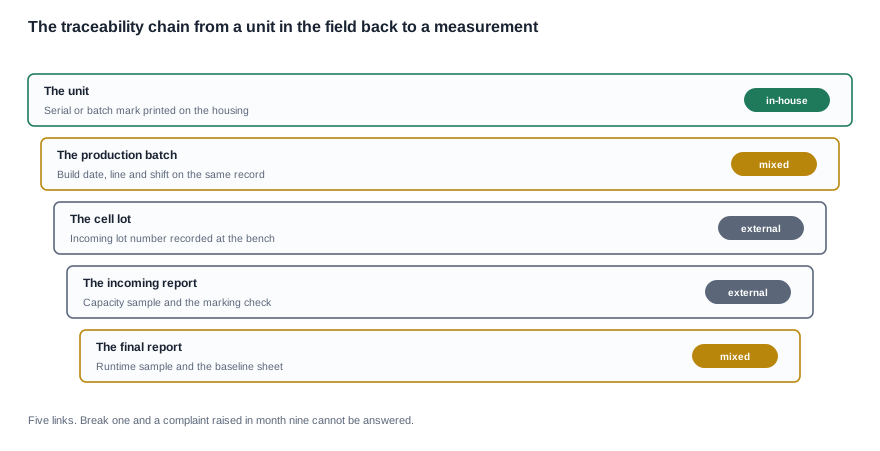
The traceability chain above is the spine of the system, and the buyer is usually the only party who can insist that it exists, because the factory sees a request for records as an administrative request and a buyer sees it as the difference between a defendable warranty position and an open-ended one.
The chain has five links. The unit carries a serial or batch mark. The production record ties that unit to a build date, a line and a shift. The cell lot ties the build to the incoming lot. The incoming report ties the lot to a capacity sample and a marking check. The final report ties the production batch to a runtime sample and a baseline sheet. Break any one of them and a complaint raised in month nine cannot be traced back to a measurement, and the only remaining response is a goodwill replacement.
Three things in that chain are worth naming because they are the ones a buyer should test for specifically. The lot segregation rule, because mixed lots are the common cause of a batch complaint. The shift and line record, because it is what makes a cluster of complaints attributable rather than anecdotal. And the baseline sheet, because without it the comparison has no reference point.
There is a specification gap in this chain that buyers should be aware of, and it is a gap in our own catalogue as much as anywhere else. Our catalogue publishes the Bluetooth version for fourteen of the 28 models, the cell configurations, the charge times, the runtime ranges and the charging methods, and it states that the test condition behind any runtime is not published. It publishes a weight for exactly one model, the MT6 glasses unit at 158 g, which includes the 265 mAh battery and the camera and excludes the foldable charging case, and the case weight is not published either. No other model in the range publishes a weight, and no frame weight is published for any model.
The consequence for a control plan is specific. A check can only compare against a specification, so any check on weight, on capacity or on runtime has nothing to compare against unless the buyer supplies the specification. The factory cannot be asked to verify a tolerance on a value nobody has published, and the buyer should not expect a pass on one.
Acceptance criteria, out-of-tolerance disposition and the buyer's audit rights
An acceptance criterion without a disposition is half a specification, and this is where most control plans stop. When a lot fails, something has to happen to it, and the something has to be named before it happens rather than negotiated after it. The dispositions available are rework, downgrade to a different grade or configuration, use as production with a recorded concession, quarantine, and return. Each of them has a different commercial consequence, and the decision is a commercial one rather than a quality one, which is exactly why it belongs in the agreement rather than in the factory's internal procedure.
The clauses a buyer should require are therefore specific rather than general. A definition of what a lot is, so that the sample and the acceptance threshold mean the same thing to both parties. The acceptance criteria for each check that touches the battery, with the measurement method and the sample size written down. A clause requiring notice before any change of cell, protection arrangement, charge circuit or calibration, since each of those invalidates the configuration the criteria were written against. A record retention period long enough to cover the warranty, which is a period rather than a promise. And a right to audit, which is the only mechanism by which the rest of the clauses can be checked at all.
None of this is a demand for a supplier's confidential information. It is a demand for the six documents listed above, for a definition of a lot, and for notice on changes. A supplier who declines all of it is telling the buyer that the connection between a unit in the field and a measurement does not exist in their process, and that is information the buyer needs before a purchase order rather than after a warranty claim.
The short answer: we will not publish a runtime figure for a condition we have not measured, and we will not present a mixed-use figure as if it were a continuous-use figure, because that specific substitution is what makes a published number untrustworthy. We publish what the catalogue states and we say plainly that the test condition behind each runtime is not published. We do not publish our incoming inspection results, our process records, our final inspection data, our defect rates, our yields or our production capacity, because the company has not confirmed them to us and we will not estimate them from typical values. If a supplier quotes a runtime without a condition, that is the question to ask back.
What we will do is take a defined workload, a defined environment and a defined sample size, and tell you which published rows apply to that protocol, what a factory's control plan would have to check to produce a comparable number, and where the open rows in our documentation would need a written confirmation from the company. A buyer-run test on a fixed protocol across a sample from the actual production batch is worth more than the catalogue figure, because it is a measurement of your units under your conditions, and it is worth more than a catalogue figure even when it is less flattering. Record the protocol, or the result is not comparable to anything.
The published rows are at battery life and power, the rows the spec sheet leaves out are at what the spec sheet omits about runtime, the charging decisions behind the in-process checks are at charging solutions, and the range the control plan applies to is at AI camera glasses.
Related reading
- Battery life and power
- What the spec sheet omits about runtime
- Charging solutions and interfaces
- AI camera glasses range
Tell us the load profile your users create and we will say which conditions have to be fixed before any runtime figure is comparable.


