

Battery myths are the most expensive myths in this category, because the published runtime is the one figure a customer tests and the one figure a buyer is tempted to decide on. A figure that has been read wrongly becomes a product that appears to be faulty, and a product that appears to be faulty generates a return, a warranty claim and a listing that has to be rewritten.
This page is written for two people at once. The buyer who is about to publish a runtime claim, and the support team that will field the complaints when the claim was read differently from the way it was written. The second person is usually the one who finds out that the claim was wrong, and they find out it in a ticket queue rather than in a design review.
The published data in our range makes the risk concrete. The camera tier carries cells from 220 mAh to 290 mAh and, where it publishes a figure, publishes a range of five to eight hours. The audio tier publishes roughly six to eight hours on dual cells of 55, 70 or 90 mAh per side alongside single 100 mAh and 115 mAh cells. The children's tier publishes roughly twenty hours on 40 mAh and 70 mAh cells. The bone-conduction entry publishes roughly seven hours on a 200 mAh cell. Charge times are two hours or less across most of the range and roughly one hour for the D17 and the ZH12. Every one of those runtime figures arrives without a stated condition.
The sixteen beliefs below are not exotic. They are the ones that show up in specification packs, in product pages and in the conversations where a shortlist gets built.
Smart glasses battery life: sixteen beliefs that survive a specification
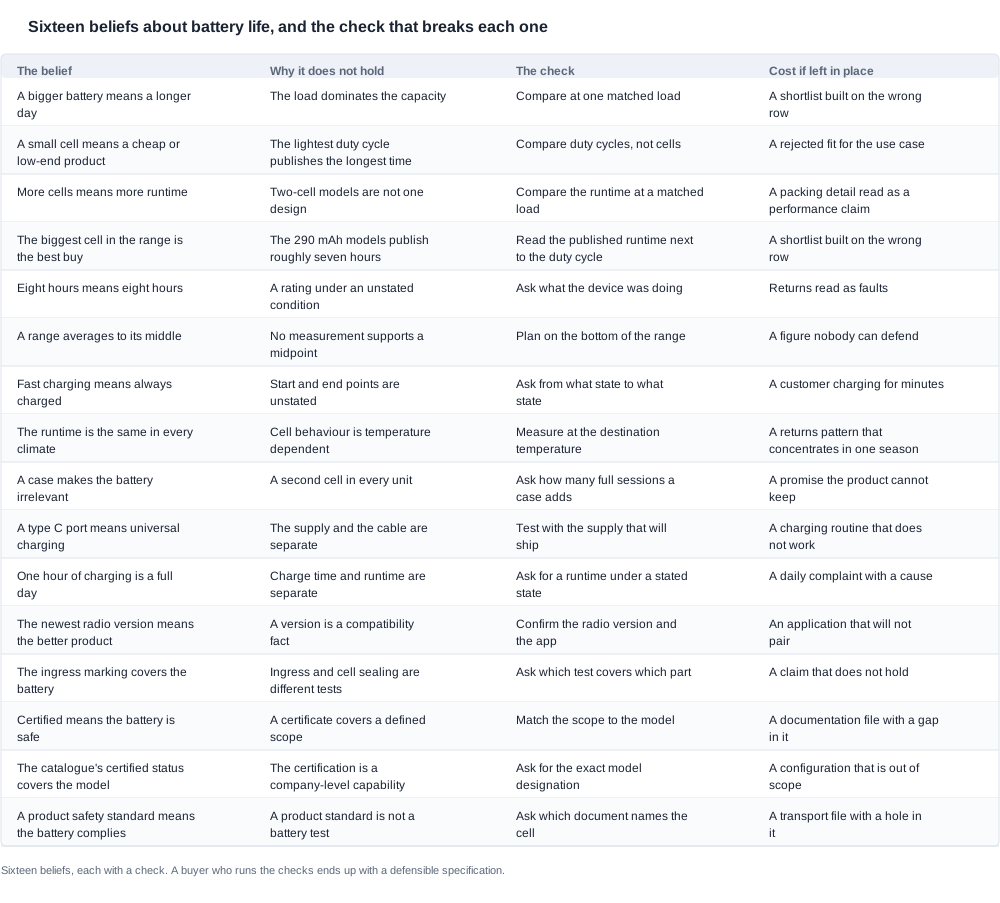
Each row of the table has the same four parts, and the order matters. The belief is what somebody actually says or writes. The second column is why it does not hold, stated in terms of this catalogue rather than in general theory. The third column is the check, and a check has to be something a buyer can perform rather than something they can believe. The fourth column is the cost of leaving the belief in place, which is what makes the refutation worth a paragraph rather than a footnote.
The list is grouped into four, and the grouping tells you where the belief came from. The first group comes from reading a capacity number as a duration. The second comes from reading a rating as a measurement. The third comes from assuming the accessory carries the product. The fourth comes from assuming the paperwork carries the product. A buyer who can name which group a belief falls into can usually work out who needs to be asked about it.
Two framing notes before the list. The first is that a myth is not the same as a false statement, and most of these sixteen are true statements used in the wrong place. A 40 mAh cell does deliver a long time against a light duty cycle. A fast charge does exist. A case does add sessions. The belief goes wrong when the condition travels with the number and the reader never sees it.
The second is that the price of a myth is not usually the myth itself. It is the shortlist it produces, the claim it supports, and the return it eventually generates. A buyer who builds a shortlist on a belief does not make a wrong choice; they make a choice they cannot explain to their own product team, and that conversation has to happen at some point.
Four beliefs that come from reading a capacity number as a duration
A bigger battery means a longer day. The load dominates, and the catalogue proves it in its own rows. The A05 and the A06 publish 40 mAh and roughly twenty hours. The camera models publish 220 mAh to 290 mAh and, where they publish a figure, five to eight hours. The smallest cells in the range publish the longest figures and the largest cells publish the shortest. The check is to compare at one matched load rather than across loads, and the cost of not doing so is a shortlist built on the wrong row, which is a product that cannot survive the afternoon it was sold for.
A small cell means a cheap or low-end product. This is the same fact read in the other direction, and it is the one that rejects a good fit. The smallest cell in the range, 40 mAh on the A05 and the A06, publishes roughly twenty hours, which is the longest figure in the catalogue. If the intended use is a light duty cycle with long idle periods, the smallest cell is the correct one and the largest cell is the wrong one, because the larger cell is buying capacity the workload will never draw on. The check is to compare duty cycles rather than cells.
More cells means more runtime. Seven models in this range publish two cells: the LC-105-1, the LC-105-2, the G07 and the YK12 at 55 mAh on each, the YKC02 at 70 mAh on each, and the K01 and the K02 at 90 mAh on each. They publish roughly eight, roughly eight, roughly six, roughly six, roughly eight, roughly eight and roughly eight hours respectively. The cell count does not predict the runtime, because the two-cell models are not the same design and the arrangement of the pair is not published for any of them. The check is the runtime at a matched load, and the cost of the belief is that a buyer treats a packing detail as a performance claim.
The biggest cell in the range is the best buy for endurance. The 290 mAh models are the largest cells in the range, the L1 Pro and the CY03, and the L2 Utral and the CY05, and they publish roughly seven hours. The 260 mAh KY06 publishes six to eight, the 220 mAh V03 and the V03 Pro publish five to eight, and the 40 mAh children's models publish roughly twenty, so the largest cell in the range sits in the middle of the published runtimes and the smallest cells publish the longest figures. Capacity does not produce the runtime; the load does. The check is to read the published runtime next to the duty cycle rather than the capacity next to a price, and the cost is a shortlist built on the wrong row, which is a product that cannot survive the afternoon it was sold for.
Four beliefs that come from reading a rating as a measurement
Eight hours means eight hours. The audio tier publishes roughly eight hours on the K01, the K02 and the LC-105 pair, roughly six on the G07 and the YK12, and roughly seven on the D11 and the D12. The sport models publish roughly eight hours on the YKC02 and the ZH12 and roughly seven on the D17. These are ratings produced under conditions the catalogue does not state. The check is to ask what the device was doing during the measurement, in the same words for every model, and the cost of leaving the belief alone is a customer whose day includes a camera and a weak signal, who will report a fault and will not connect the two.
A range averages to its middle. The V03 and the V03 Pro publish five to eight hours and the KY06 publishes six to eight. A midpoint of six and a half is a number no measurement supports, and a product page built on a midpoint is a claim the brand cannot evidence and cannot explain. The check is to plan on the bottom of the range for a camera product and to publish the range rather than a summary of it, and the cost is a published figure that fails the first time a customer is anywhere near it.
Fast charging means always charged. The D17 and the ZH12 publish roughly one hour of charge, and the rest of the range publishes a charge time of two hours or less. A charge time is meaningless without a start point and an end point, and the difference between a charge from empty to full and a charge from a quarter to full is larger than the difference between one hour and two. The check is to ask from what state to what state, and the cost is a customer who charges for twenty minutes before a meeting and expects a full day.
The runtime is the same in every climate. Cell behaviour is temperature dependent in both directions, and a figure measured at room temperature does not describe a cold morning or a hot car. The check is a measurement at the temperature of the destination market, and the cost is a returns pattern that concentrates in one season and is diagnosed as a defect rather than as a condition.
Four beliefs that come from assuming the accessory carries the product
A case makes the battery irrelevant. A case changes the routine rather than the figure, and it is also a second lithium cell in every unit that carries one, a second thing to charge, a second thing to lose and a second set of transport documentation. The published case rows are specific: 1400 mAh on the L1 Pro and the CY03, and the CY05, 900 or 1400 mAh on the L2 Utral, 1200 mAh on the foldable case of the MT6, and unpublished capacity on the cases that ship with the KY06 and the MT5. The check is to ask how many full sessions a case adds, measured, and the cost of the belief is a promise the product cannot keep in a customer's bag.
A type C port means universal charging. A port is not a source. The charge time depends on what the supply delivers, and the V03 Pro and the D17, the ZH12, the D11 and the D12 and the bone-conduction entry all charge over type C. In markets where a cable is not included in the box, this is a routine the customer may not be able to complete at all. The check is to test with the supply that will actually be shipped or recommended, and the cost is a charging routine that does not work because the accessory was never in the plan.
One hour of charging is a full day. Charge time and runtime are separate quantities, and the market is full of products that have been made to sound as though a short charge produces a long day. The check is to ask for a runtime under a stated workload and to publish the routine you measured rather than the charge time, and the cost is a daily complaint with a perfectly identifiable cause.
The newest radio version means the better product. A radio version is a compatibility fact, not a performance figure. Our catalogue publishes version 5.3 on the K01 and the K02 and version 5.4 on twelve other models, and the eleven camera models, the two children's protection models and the bone-conduction entry publish no version at all. The check is to confirm the radio version and the app support for the specific model, because for the models that do not publish it, the question has to be asked. The cost is an application that will not pair with the product, discovered by the customer.
Four beliefs that come from assuming the paperwork carries the product
The ingress marking covers the battery. IP54 appears on the V06 and the S7 in our catalogue and on no other model. Ingress protection and cell sealing are different tests with different methods, and a marking on the housing says nothing about the cell inside it. The check is to ask which test covers which part, and the cost is a claim that does not hold on the one product in the range where the marking is an asset.
Certified means the battery is safe. A certificate covers a defined scope, and the scope of a document is the part nobody reads. A test report binds the samples tested on one date, a certificate binds a defined product scope, a declaration of conformity binds the models the manufacturer lists, a technical file binds nothing external, and a marking on the product is a claim rather than a document. The check is to match the scope to the model being ordered, and the cost is a documentation file with a gap in it that only appears when somebody asks.
The catalogue's certified status covers the model being ordered. Our catalogue describes export certification as a company capability on its front page, and it carries no per-model certification row for any of the 28 models. A company-level statement cannot be converted into a model-level claim. The check is to ask for the exact model designation on the document, and the cost is a configuration that turns out to be outside the covered scope.
A safety standard on the product means the battery is compliant. The same confusion in a different form. A device safety standard covers the assembled product, a cell safety standard covers the cell, and a transport test summary covers moving the cell. Each is necessary and none substitutes for the others. The check is to ask which document names the cell part number, and the cost is a transport file with a hole in it at the moment a consignment is refused.
What survives the refutation, and how to write it into the order
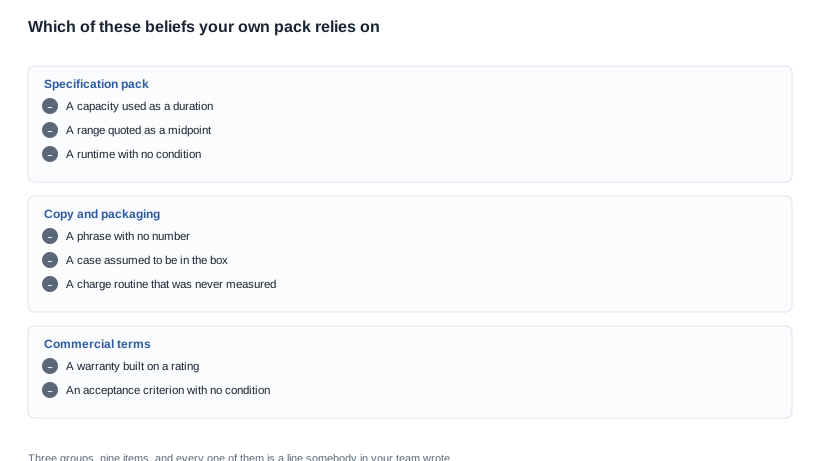
Refuting sixteen beliefs is only useful if something replaces them. Three things survive, and they are what a buyer should be left holding.
The published runtime is a rating, and a rating is a ceiling for a stated condition. Not a promise and not a midpoint. This is not a rejection of the figure; it is the correct way to hold a figure that arrives without its condition.
The load, not the capacity, decides the day. Which is why the two measurements worth funding are a continuous load and a mixed load, both at a stated temperature, both on a sample from the actual production batch.
The case changes the routine and the case recharge count has to be measured. It is the cheapest available answer to a runtime problem and it is still a measurement rather than a capacity.
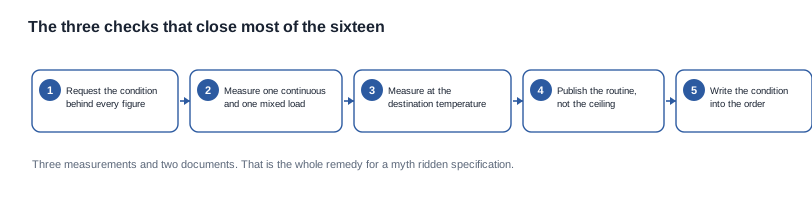
The checklist above is the version to run against your own pack, because the beliefs in it are usually written by people who did not know they were beliefs. A specification that says "the battery lasts 8 hours" has embedded myth two. A specification that says "rated runtime 8 h, test condition not stated" has removed it. A product page that says "20 hours of use" for a model with a 40 mAh cell has embedded the duty-cycle conversion, and a product page that says "about 20 h of light use" has not.
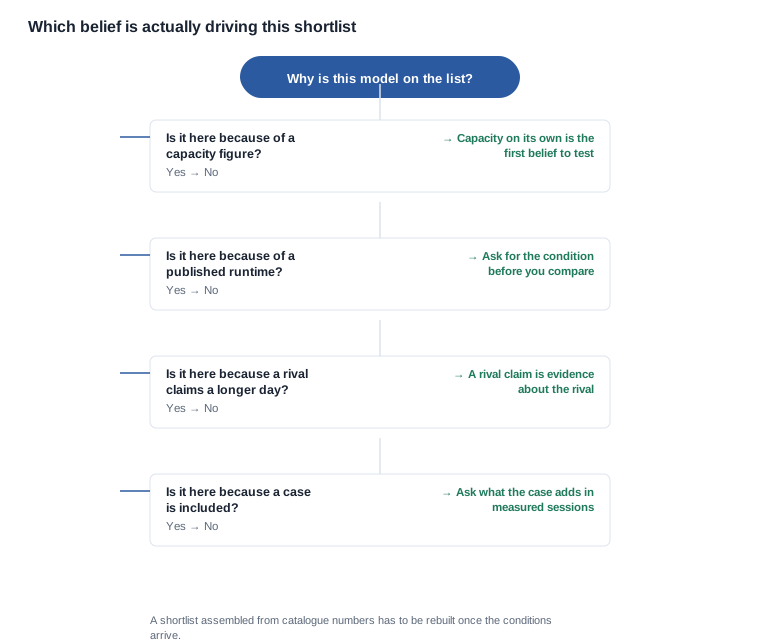
The decision chart is for the buyer who wants to know where to start. If a model is on the shortlist because of a capacity figure, start with myth one. If it is on the shortlist because of a rival's claim, start with myth eleven, because a rival's marketing line is evidence about the rival rather than about the product in front of you. If it is on the shortlist because a case is included, start with myth five.
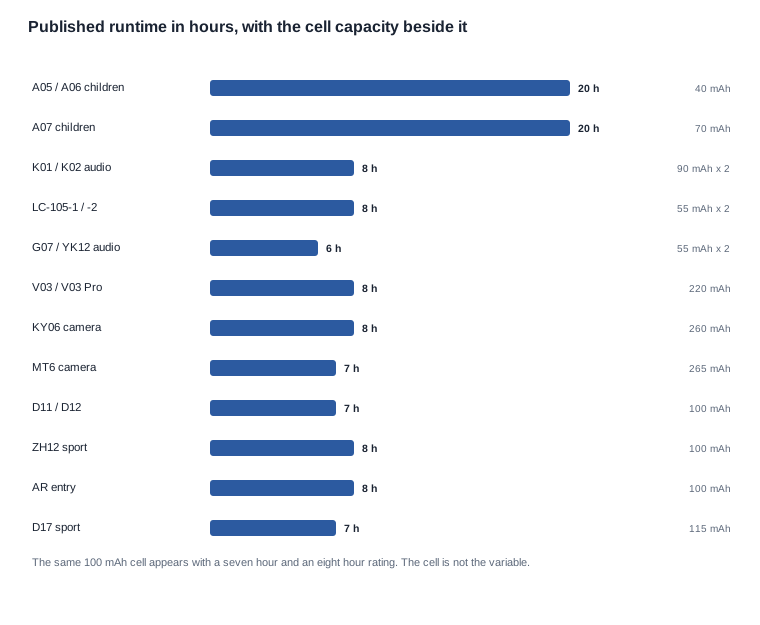
The chart is the one-line version of the whole article. The same 100 mAh cell appears with a seven hour rating on the D11 and the D12 and an eight hour rating on the ZH12 and the AR entry, and the cell is not the variable that explains the difference. Any shortlist that was built on the cell was built on the wrong row.
Turning a belief into a purchase-order clause
The refutation is worth nothing unless it changes a document. Each belief maps to a clause, and the clauses are short.
- A runtime in the purchase order is stated with its condition, or it is stated as a rating and explicitly as a ceiling.
- The cell part number appears on the order, with a change-control obligation attached to any substitution.
- A case configuration, when ordered, has its measured recharge count attached, and the case's own charge time and input are stated.
- The charge time is stated from a stated start point at a stated source output.
- The end-of-runtime behaviour is specified, including whether the product warns.
- A cycle count with an end-of-life capacity criterion is written as an acceptance criterion rather than as a warranty assumption.
Before you order, the cost of a belief is a claim you cannot defend and a shortlist you cannot explain. After you order, the cost is a return, a warranty claim and a page that has to be reprinted. The trade-off is obvious, and the clause language is at contract terms.
One further practical point belongs with these clauses, and it is about who signs them. A clause of this kind is usually negotiated by a buyer, and the buyer is usually the person who has least patience for a discussion about test conditions on day one of a commercial negotiation. The clause is worth far more than its negotiating cost, because a dispute about a runtime figure in month nine is settled by a document rather than by a memory, and a document only exists if it was written in month zero.
The method behind these clauses is covered at battery life and power, the recurring errors this category produces are set out in battery common mistakes to avoid, and the protocol for producing a number you can defend is at how to test battery life.
Related reading
- The method — Battery life and power
- The errors in full — Battery common mistakes to avoid
- The protocol — How to test battery life
Tell us the workload, the climate and the models you are shortlisting, and we will tell you which published figures carry a condition and which do not.


