

Battery verification is easy to do badly and easy to do well. The difference is entirely in whether you insist on the test condition. A supplier who has measured properly can tell you exactly how the figure was obtained in two sentences. A supplier who has copied a figure from a platform datasheet cannot.
This checklist is built so that the first four steps are answerable over email and eliminate most of the risk before anyone buys a sample. It is also built in a deliberate order: it verifies the supplier before it verifies the claim, because a claim from an entity that cannot be identified is a claim that cannot be enforced.
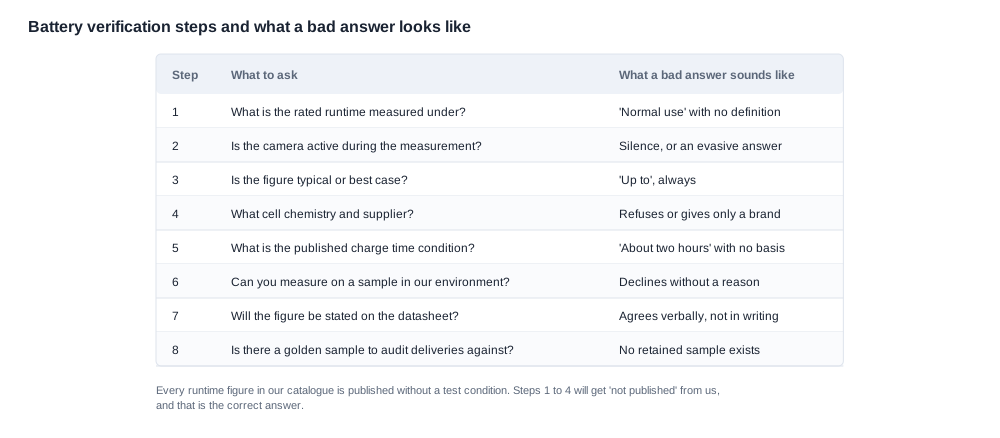
Smart glasses battery life: the company check comes before the claim
The first question is not about the battery. It is about who you would be able to sue if the battery claim turned out to be wrong, and the answer is a company name, an address and a registration record — all of which are checkable in an afternoon without spending anything.
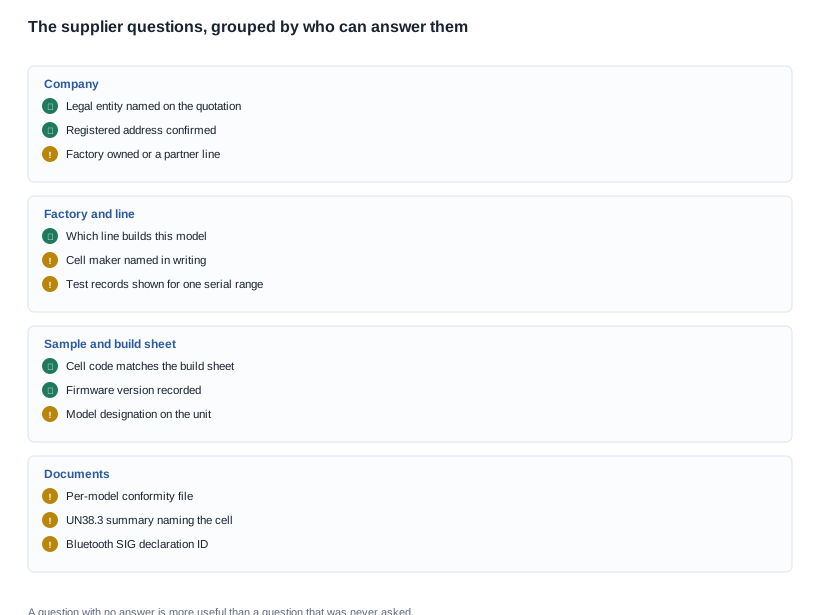
The legal entity behind the quotation. A quotation that carries a brand name, a trading name or a contact email but no registered entity is not a document you can enforce. Ask for the company name, the registered address and the registration details, and check them against the public register. In international trade the difference between a manufacturer and a trading company is not a formality: it determines whether a quality claim, a warranty claim or a documentation correction reaches the party that can actually answer it.
Whether the factory is owned or a partner line. A partner line is a normal arrangement and often a good one, but it changes what you can ask for and what you can rely on. On a partner line the production capacity belongs to somebody else, the schedule priority is negotiated rather than granted, and a component change is a conversation between two companies rather than one. The question to ask is specific: is this model built on a dedicated line or on a shared line, and what is the lead time when the shared line is committed to another programme.
Whether the certification capability is company-level or model-level. This is a distinction that our own catalogue forces us to make, because the export certification statement on the first page is a company-level capability while the catalogue itself contains no per-model certification row. A company-level capability tells you that the company can obtain documents. It does not tell you that a document covering your model exists, and it is not possible to infer one from the other. A buyer who reads a company capability as a model certificate will find out at the shipment.
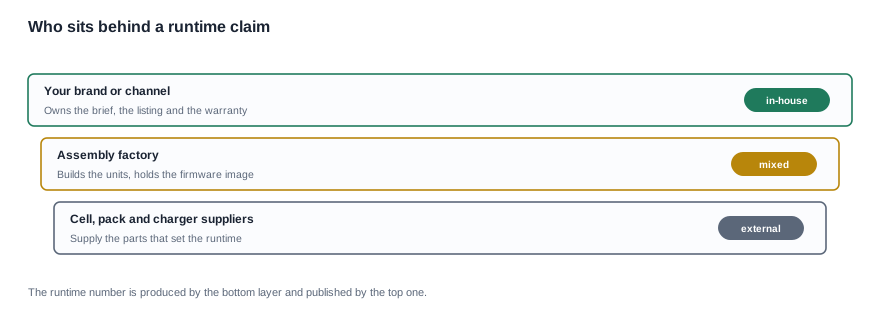
The practical output of this first stage is short and specific: a named entity, a known address, a stated relationship to the factory, and a document list. A supplier who answers all four has told you something about how they will handle the rest of the file.
The commercial side of this stage deserves a paragraph of its own, because it is where due diligence usually stops too early. Three questions belong with the entity questions: what the payment structure is, what the recourse is when a lot fails acceptance, and what happens to the tooling and the documentation if the programme ends. The payment structure decides how much of your money sits with the supplier before a single unit is accepted — a deposit that is large relative to the order value transfers risk to the buyer, and a staged payment tied to document delivery and first-article acceptance transfers it back. The recourse question is the one that is most often left implicit and most often needed: a warranty on the product is not the same thing as a remedy for a lot that fails a workload you specified. And the end-of-programme question decides whether a cell change in year two becomes a supplier problem or your problem.
The factory audit, and the five questions that make it informative
Most factory audits in this category are wasted, because they confirm what was already known and skip what would change a decision. The five questions below are chosen because a supplier can answer all of them from records rather than from a presentation, and because each one is a place where a substitution can hide.
Which line builds this model, and how many units per day does that line run? The answer tells you whether the model has a dedicated slot or shares a line with other products. A shared line is not a problem in itself; it is a scheduling dependency, and it should appear in the lead time you negotiate.
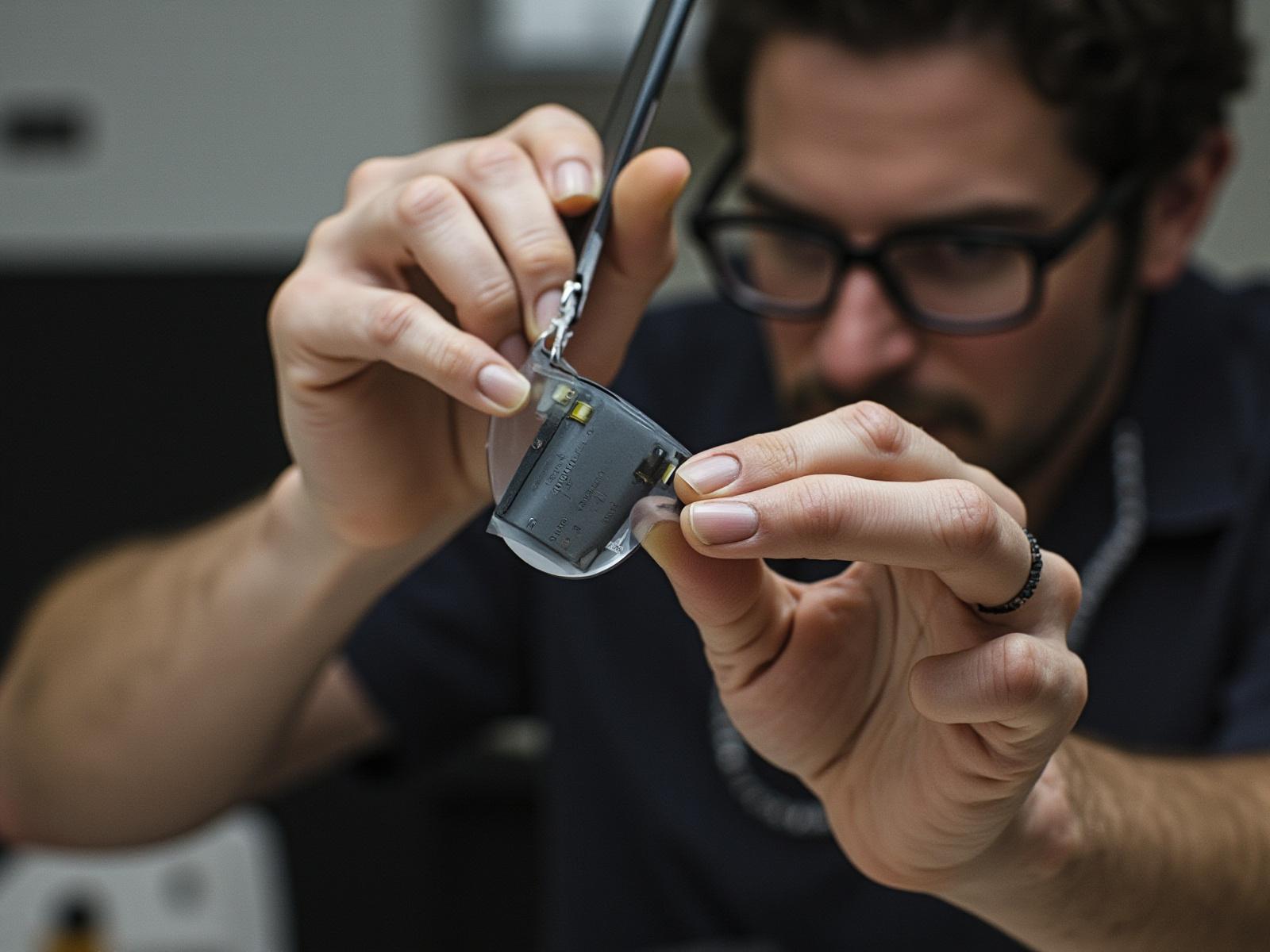
Who buys the cell, and what does the purchase record show? A cell specified in a bill of materials and a cell actually fitted are two different facts. This question is uncomfortable for suppliers that buy cells through a trader, and it is exactly the question that a substituted cell would fail. A trader will forward the question, which is itself an answer: the buyer then knows to ask the factory directly and to check the cell code on the build sheet against the transport summary.
How is a firmware image versioned and released? Ask to see the release note for the image on the sample. A supplier with a versioned release process can name the image, the date and the change list; a supplier without one will describe a procedure in general terms. This matters for a battery programme specifically, because power management behaviour is frequently tuned in firmware, and a change to it can move the runtime without any change to the cell.
What test records exist for one serial range? Ask to see the records for the batch the sample came from, not a summary. What you are looking for is evidence that a test exists at all, that it produced a number, and that the number is attached to a serial range rather than to a model.
What happens if the cell supplier changes? A good answer names the change-control step, the re-test that follows it, and the notice period. A vague answer means the cell can change without your programme being told, and a cell change invalidates three documents at once.
Two practical notes on running an audit in this category. First, audit the line that will build the order, not the showroom line — in a product with a shared platform, they are frequently the same and occasionally are not. Second, treat the answers as evidence to be recorded rather than as conversation to be remembered, because the value of an audit is that it produces a document you can attach to a purchase order.
Sample-to-line consistency, and the checks that catch a substitution
The sample is the point where the paperwork and the physical product have to agree. This is the stage where the checks are cheap and the findings are expensive, which is why the sample order should never be treated as a formality.
Compare the cell code on the unit against the build sheet. The build sheet should name the cell, and the cell should be identifiable on the unit itself — by marking, by the part number on the pack, or by a production record that ties the serial number to the cell. Where the cell is not marked and no record exists, the cell cannot be checked, and the runtime claim cannot be tied to a specific part. That is an open item in the file, not a closed one.
Compare the model designation on the unit against the designation on the order. This sounds trivial and it is the single most consequential check in the category, because a family-level document does not cover a specific model. Three entries in our own catalogue carry no model designation at all, which means that for those platforms the designation check has to be done against a different anchor — the order, the packaging artwork and the customs description.
Record the firmware version on the sample and hold it as the reference. Keep one unit from the approved lot with its firmware version written on the box. Every later delivery is then measured against that reference, and a drift between lots becomes visible instead of anecdotal. Cell behaviour and power management both drift between production lots, and this is the only way a buyer notices.
Compare the case in the box against the case in the quotation. Several camera platforms in our catalogue are published with a case, and the published case capacities differ by a factor of more than two across the range, with two models publishing a case and no capacity. If the sample's case differs from what was quoted, the freight weight, the packaging dimensions and the transport documentation all move with it.
Check the serial number range the sample came from. A sample from a development lot tells you less than a sample from the first production lot, and the difference is not always obvious from the outside. Ask directly which lot the sample belongs to, and require that the first production order is from a lot the same process produced.
The sequencing rule that makes this stage effective: do all five checks before the sample is approved, because a sample approved with an open item becomes a sample that has been accepted with an open item. Approval is the moment the open item stops being visible.
The failure branch matters as much as the pass branch, and it should be agreed before the sample arrives rather than improvised when it fails. If the cell on the unit is not the cell on the build sheet, the useful question is whether the cell is a deliberate change with a new transport summary and a new measurement, or an undocumented substitution. The first is a document request and a schedule conversation; the second is a supplier that has already demonstrated it will not tell you what it is shipping. The same distinction applies to a firmware version that differs from the one quoted, and to a case that differs from the one described. What to ask in every case is the same: which document now covers this unit, and when was it issued.

Sub-supplier transparency on the cell and the pack
The runtime of the product is largely decided by parts that the quoting supplier may not have designed and may not own. A cell, a protection circuit, a charger and a charging case are all bought in, and a supplier who will not name them is asking you to accept a claim about parts they cannot identify.
The cell. The cell maker, the cell model and the cell's own safety documentation. The transport test summary produced under the United Nations Manual 38.3 test standard records the battery maker, the testing laboratory, the report number and the cell model, which makes it possible to check that the summary on file belongs to the cell in the goods. If the supplier declines to name the cell maker, the summary cannot be checked against anything, and that gap has to be recorded rather than glossed.
The pack. Who assembles the pack with the protection circuit, and whether the pack is assembled in-house or bought in. This matters for the same reason the cell does: the pack is what the transport documents describe, and it is what a carrier will examine if a shipment is held.
The charger and the case. Both are cells or mains-powered accessories with their own compliance position. A case with a 1200 mAh cell inside it is a second cell in the carton, and it has to appear in the transport documentation set. In our range, the CY05 and the CY03, and the L1 Pro publish a 1400 mAh case, the L2 Utral publishes 900 or 1400 mAh as a configuration, and the MT6 publishes a foldable 1200 mAh case; the KY06 and the MT5 are published with a case and no capacity.
The radio module. The module and its chipset determine the draw from the radio path, and they are the parts most often changed without a version note. Ask for the module part number on the build sheet, not the Bluetooth version: a version is a generation, and a generation is not a part number.
There is a legitimate commercial reason for a supplier to be reluctant here, which is confidentiality in a competitive market. The resolution is not to force the disclosure but to require the evidence that the disclosure would have produced: a document that names the cell model, matched to the part on the unit and matched to the transport summary. A buyer who cannot have the supplier's bill of materials can still have the cell's identity.
The request itself is easier to make than buyers expect. Instead of asking who supplies the cell, ask which document the cell's identity can be read from — the transport summary, the cell safety file, the build sheet or the marking on the pack. That phrasing asks for evidence rather than for a commercial relationship, and it is much harder to decline. When it is declined anyway, the correct entry in the file is that the cell identity is not independently verifiable, because that fact changes what a buyer can claim if a lot fails.

What a completed supplier file should contain
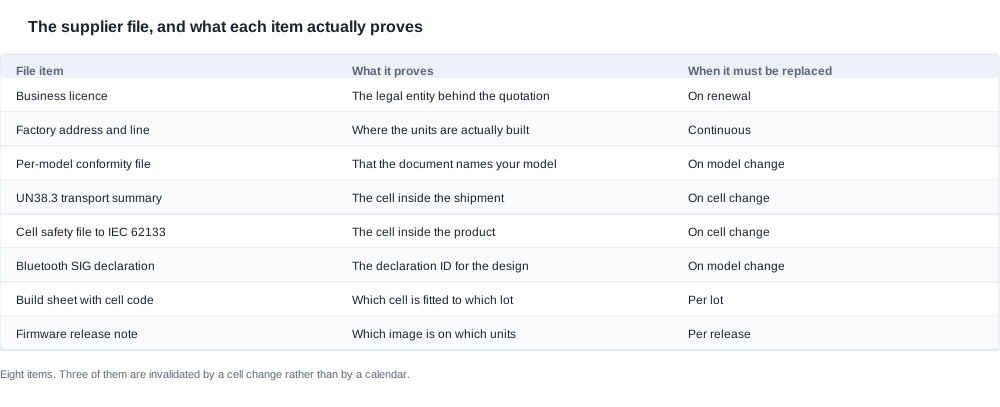
When the due diligence is finished, the file should be a list of documents rather than a set of impressions. Eight items cover the battery and the platform, and each of them has a known expiry condition.
The business licence and the registered address. The factory address and the line that builds the model. The per-model conformity file, with the exact model designations named on it. The UN38.3 transport summary, naming the cell model that is fitted. The cell safety file to the portable lithium cell safety standard, IEC 62133. The Bluetooth SIG declaration, with the declaration ID and the design number for the model — a trademark qualification, which is a separate instrument from the radio authorisation every product in this category needs. The build sheet with the cell code, per lot. And the firmware release note for the image that is on the units.

Two properties of this list are worth stating. First, three of the eight are invalidated by a cell change rather than by a calendar, which means the file has to carry a change-control clause rather than a review date. Second, the list is deliberately short enough to be complete, and a supplier who cannot produce it is telling you something important about the programme's maturity.
The last item on the list is not a document at all, and it is the one that decides whether any of the rest are enforceable: the agreement. The claims, the workload, the acceptance threshold, the notice obligation on component change, the warranty and the sample reference all belong in the purchase order rather than in a quotation or an email. A figure that lives in an email will be quoted on your listing by somebody else eventually, without the conditions attached.
The difference between due diligence and a factory visit
Not every programme justifies a visit, and a buyer who insists on one anyway will be told no, or will be granted a showroom tour that answers none of the questions above. The trade-off is worth stating so that the decision can be made deliberately.
A remote verification is sufficient when the order is small enough that the downside of a substitution is a single rejected lot, the product is an existing platform with no customisation, and the supplier has answered the five audit questions from records rather than from description. At that scale, a video walkthrough of the test bench, a sample of the release notes and a build sheet are worth more than a flight.
A visit is worth its cost when the programme involves customisation, tooling or firmware, when the order is large enough that a single lot failure exceeds the cost of the visit, when the product is new to the supplier's line, or when a previous programme failed on a documentation issue rather than on a quality issue. The visit should then be an audit against the five questions above, not a tour.
The honest middle position is that a visit is a procedure rather than an event, and most of its value comes from the records rather than from the building. A buyer who walks a line without asking for the release note has bought a day of travel and no evidence.
What we can offer from this side of the table is narrower than a factory audit and more useful in a specific way. We publish the electrical rows for our models — the cell capacity, the rated runtime where the catalogue states one, the case capacity where it states one, the charging interface, the Bluetooth version for the fourteen models that carry one — and we will say plainly where those rows are absent rather than filling them in. We do not publish a test condition behind any runtime, a usable capacity, a cycle life rating or a thermal figure for any model, and we will not estimate them. What we will do is take a model and a duty cycle and run the measurement with you, so the figure in your purchase order is one you produced, and we will name the model designation and the cell on the build sheet for the units you receive. The battery and power pillar covers the technical side, and charging solutions covers the interface and the case question separately.
Related reading
Three things to put in front of a supplier before you accept a runtime number:
- Measuring battery life on a sample — the protocol to run yourself once the datasheet is exhausted.
- Battery life certification requirements — what the cell documentation has to cover before the figure travels.
- Battery life supplier verification — the same checks at procurement-team level.
Send your duty cycle and environment and we will say whether the published figures reach it.


