

A battery lot arrives at the receiving area with a claim attached to it: the units run for less time than the purchase order says they should. The person standing at the dock is rarely the person who chose the model, and the conversation they are about to have with the factory is not a sourcing conversation. It is an acceptance conversation, and it is governed by evidence rather than by opinion. This checklist covers the arrival, the sample, the release, the hold and the record that has to survive the shipment. It does not cover how a model was selected, which runtime to specify, or what questions to ask before an order is placed — those belong to the selection stage and to a separate buying checklist. What follows is what the execution team has to be able to show when the lot is questioned six months later.
Smart glasses battery life: who owns acceptance on the execution team
The buyer's job ends when the purchase order is signed and the deposit is paid. At that point the buyer is managing a commercial relationship and a delivery date. The execution team inherits something quite different: a physical lot, a tolerance that may never have been written down, and a claim that can only be settled with evidence. Procurement can decide that a supplier is preferred. Only the execution team can decide that a lot is cleared to release into the channel, and only the execution team can produce the record that makes that decision defensible later.
There is a specific reason battery lots need this more than other product lines do. A cosmetic or assembly problem is visible the moment the carton is opened, and the unit can be quarantined on the spot. A runtime problem is invisible until someone runs the unit to the end of its charge, which on a catalogue model means somewhere between six and eight hours of continuous operation. By the time the shortfall appears, the lot has usually been received, distributed, and partly sold. The evidence that would settle the claim has to be captured in the first days after arrival, by people who know that this is their job.
Our catalogue publishes the electrical rows that a receiving desk needs: cell capacity per model, the rated runtime per model, the charging interface on the twenty-four models that carry one, the charge time per model, and the capacity of the charging case on the models that carry one. It does not publish cycle life, it does not publish the starting state or the end point behind a charge time, and it does not publish the tolerance band around a rated runtime. That means the acceptance criteria cannot be recovered from a product page. They have to exist in the purchase order, and the receiving team has to be able to point at them.
What follows is therefore a working procedure rather than a philosophy. Each section gives the check, the evidence it produces, the pass condition, and the action when it fails. Where a figure is published, it is given. Where it is not, the row says so and tells the reader what to ask the supplier for in writing instead.

Four documentary battery checks and the one measurement that carries the lot
Four of the acceptance checks are documentary, in the sense that they are settled by reading something rather than by measuring anything. The fifth is the measurement that the whole lot turns on. Running them in this order is not a preference; the documentary checks are cheap, they happen first, and they determine whether the measurement is even meaningful.
The order line, and the designation it names
Everything downstream depends on the model designation written on the purchase order matching the model that is physically in the carton. This category is unusually prone to that failure, because the range contains families with very similar names and materially different cells. A pair of AI camera models from the same family can differ by a charging interface while sharing a name pattern, and a sports model and an audio model can differ by a few tens of milliamp-hours and a completely different enclosure. A carton that arrives with the wrong designation inside is not a packing error that can be corrected on the dock; it is evidence about the factory's configuration control, and it has to be recorded as such.
The cell marking on the units opened from each sample position
Read the cell marking on the units you open. Do not read it on the carton, and do not read it on a photograph of a carton. The marking is the only point at which the ordered configuration and the delivered configuration touch each other, and it is the check that most often finds a mismatch because the paperwork for a shipment is usually written against a model that was produced several weeks earlier.
If the marking on the unit cannot be read, that is a finding in its own right. Record it as unreadable rather than as acceptable, and ask the factory to confirm the part number against the production record for the lot. A supplier who can produce that record in hours has told you something valuable about their configuration control; a supplier who cannot has told you something more valuable.
Charge state at arrival, against a level agreed in the order
The state of charge a unit arrives with is not published for any model, because it is not a property of the model. It is a property of the shipment, and it is set by how long the unit sat after the last charge before it was boxed. A unit held at a high state of charge in a warm store for a week is different from a unit charged on the morning it was packed, and the difference shows up as capacity loss across the lot rather than as an obvious fault.
So the order needs a line for it. The transport documentation normally declares a state of charge for the consignment, and the declared level should be the level you accept. The charging interface question is set out in more detail in why charging matters for smart glasses, the interface decisions themselves sit under charging solutions, and the deeper questions about the interface sit in charging advanced considerations.
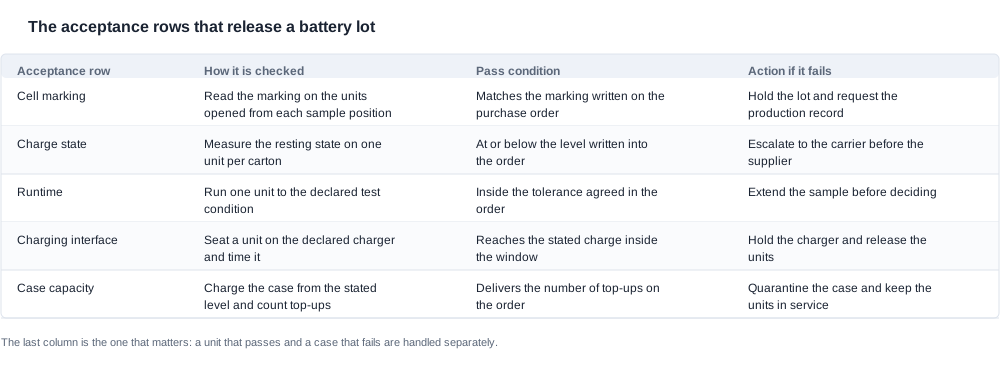
The table above gives the five acceptance rows in the order they should be run. The last column matters more than it appears to: a unit that passes and a case that fails are two different problems with two different commercial answers, and a receiving procedure that treats them as one problem will either release defective cases or hold good units for no reason.
The charging case, treated as a separate lot
Where a model ships with a charging case, the case is a second product. It has its own cell, its own capacity, its own transport documentation, and its own failure modes. A case that fails to deliver its declared number of top-ups does not stop the unit from working. It changes the working day of the person who carries it, which is why it belongs in the acceptance scope but not in the same lot record as the units.
Our catalogue publishes case capacity where a case exists: 1400 mAh on the L1 Pro and the CY05, and the CY03, 900 mAh or 1400 mAh on the L2 Utral depending on the case selected, and 1200 mAh on the folding case of the MT6. Two further models carry a case whose capacity is not published, and one camera model has no case at all. Where the capacity is not published, the receiving team cannot verify the case against anything, so the case either enters the order with a capacity written into it or it enters as an unchecked accessory. The transport side of a case is covered in does the charging case need its own report.
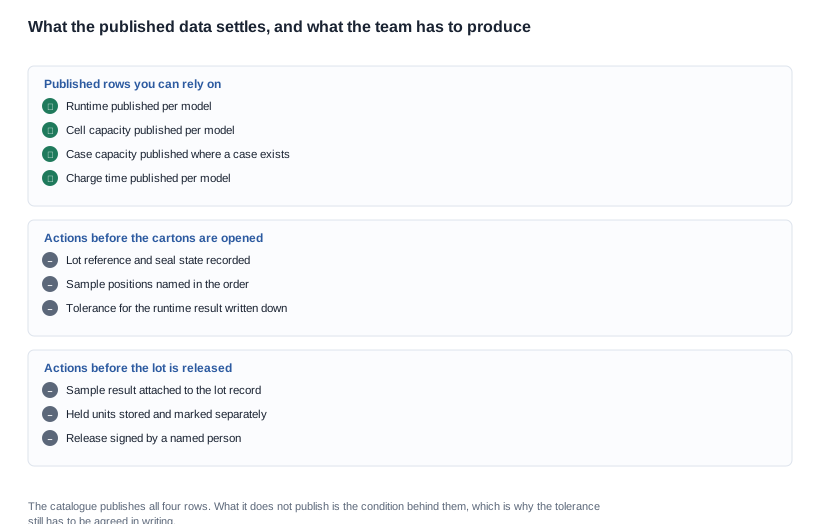
The checklist above separates the three published rows from the three that only the execution team can produce. The published rows are free: any receiving desk can read them off the catalogue. The other three are where the effort goes, and they are all things a receiving desk is normally expected to do without being told.
Drawing the battery sample: positions, quantities and what the sample can prove
The sample is the instrument that converts a claim into a measurement. It also has a scope that is easy to overestimate. A sample proves something about a lot only when the lot was produced under one configuration, in one production window, with one set of upstream materials. The moment a consignment mixes production windows or configurations, the sample no longer describes the consignment; it describes the part of the consignment it was drawn from.
That is why the sample positions have to be agreed in the purchase order rather than chosen on the dock by whoever is nearest the loading bay. A reasonable starting point is:
- Draw units from more than one carton, and record which carton each unit came from.
- Draw from the first and the last carton of the shipment, because they were handled differently.
- Draw from at least one carton filled in a different production window, where the packing list allows it.
- Draw the case, where the model has one, as a separate sample against a separate record.
- Seal and number a second sample, and write the seal number onto the lot document.
The reason for the third point is simple: the riskiest units in any battery consignment are not the ones from the middle, they are the ones that sat longest before being boxed.
Quantities have to be written down as well, and the number has to be justified rather than assumed. The decisive consideration is not statistical elegance. It is what happens to the argument. A small sample that is drawn from documented positions and recorded by name can defend a decision to hold a lot. A larger sample drawn from undocumented positions cannot defend anything, and the difference in cost between the two approaches is negligible next to the cost of a released lot that turns out to be short.

The flow above is the sequence. Notice where the evidence is produced: every step writes something down, and a step with no written result has not happened. The final step is a signature rather than a decision, because the decision itself was made by the tolerance in the order and the result in front of the desk.
Two practical points belong to this stage rather than to the laboratory. First, the sample should be drawn by someone who did not place the order and did not negotiate it. The person receiving a shipment has no commercial stake in it, and that independence is what makes the record credible if the lot is later disputed. Second, a second sample should be sealed and retained, with the seal numbered and the number recorded on the lot document. A sealed second sample is what allows a dispute to be settled months later without re-running the whole argument.

The tolerance that has to exist before the runtime re-test runs
A tolerance written after the result has arrived is not a tolerance; it is a justification. The whole point of agreeing it in advance is that it removes the argument about what was acceptable from the argument about whether the result was acceptable. The receiving team should never be in a position where it has to decide, in the moment, how much shortfall a supplier is allowed to get away with.
What the catalogue publishes and what it does not
For each model our catalogue publishes the cell capacity, the case capacity where a case exists and the rated runtime, and it publishes the charging interface on the twenty-four that carry one. One figure needs a specific warning because it is frequently repeated incorrectly: the MT6 has a published weight of 158 g, and that figure is the weight of the glasses body including the 265 mAh cell and the camera, excluding the folding charging case. The weight of the case is not published, and the weight of the frame alone has never been published for any model in the range. A receiving desk that is asked to weigh a unit should record 158 g for an MT6 body and nothing at all for any other model.
The range does publish a charge time — ≤ 2h on most rows and ~1h on the two Type-C sports models — but it publishes no cycle life figure, no gauge accuracy, and no test condition behind the rated runtime. Those gaps are the reason the order has to carry the acceptance criteria, and they apply just as much to the charge time row as to the runtime row. A runtime figure without a condition is a rating, and a rating cannot be compared with a measurement taken under different conditions.
Writing the tolerance so that both sides can sign it
A workable tolerance line has three parts: the condition, the tolerance and the signatory. The condition names the load, the radio state, the temperature and the starting state. The tolerance names the number and the band around it — the published rating plus or minus a stated percentage. The signatory names the person on each side who accepts the result, and by naming them you make it harder for either side to reopen the tolerance later.
The size of the band is a commercial decision, not a technical one, and it should be made with the supplier before the order rather than discovered after the first rejected lot. A band that is too tight will reject good lots and cost the buyer the relationship. A band that is too loose will accept a lot that the end customer experiences as short. The number most often found acceptable in this category sits close to a fifth of the published rating, and the reason is that the measurement itself introduces variation: a unit that is genuinely at the published figure will still read a little under or a little over it depending on the room, the starting state and the charge controller.
Running the re-test and reading the result honestly
Run the re-test on one unit from the sample first, and run it the way the condition describes. The mistake that damages the relationship most is a laboratory re-test carried out with the radio idle while the published figure was produced with the radio active. That result will appear correct and will be worthless, because it answers a different question from the one the order asked. If the condition cannot be reproduced on the dock, the honest outcome is to record the result as indicative rather than as an acceptance result, and to schedule the full test at a location that can reproduce the condition.
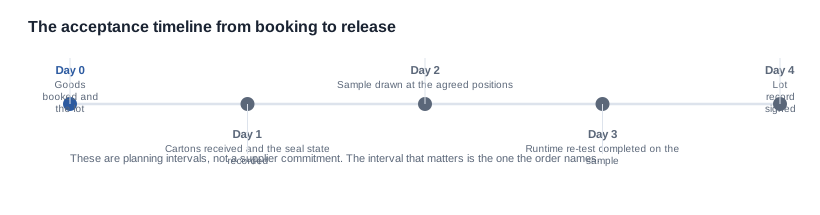
The intervals on the timeline are planning intervals, not a supplier commitment, and they are deliberately modest. A battery acceptance that takes a fortnight to close is a battery acceptance that the channel will not wait for, so the plan has to hold a decision and a release even where the supplier's answer is slow. The mechanism for that is the sealed second sample: the lot can be released on a partial basis while the supplier's evidence is gathered, provided the decision is written down with its conditions.

Three signals that hold a battery lot, and who they escalate to
A hold is a defined state, not a rejection and not a delay. It has a trigger, a deadline, an evidence requirement and a named owner, and anything that does not have all four of those is a grievance rather than a procedure. Three triggers cover almost everything that happens in practice.
The first is a documentary mismatch: the designation, the cell marking or the interface on the unit does not match the purchase order. This trigger is cheap to detect and expensive to ignore. It usually resolves within hours, because a factory that has configuration control can produce the production record quickly, and a factory that does not has already told you what its quality system is worth.
The second is a runtime result outside the agreed tolerance. This is the trigger most likely to be disputed, and it is the one where the sealed second sample earns its keep. When the result is challenged, the second sample is opened in the presence of both parties and run under the same written condition. If the second result falls inside the band, the original measurement was the anomaly, and the lot is released with the deviation recorded. If it falls outside, the supplier is dealing with a lot issue rather than a measurement issue, and the conversation moves to the production window.
The third trigger is a condition of arrival outside the agreed band, principally a charge state or a storage temperature that the order did not permit. This one is usually the carrier's or the warehouse's responsibility rather than the factory's, and it is the trigger where the escalation path most often gets confused. Record it as a condition-of-arrival observation, notify the party responsible for the leg of the journey that caused it, and do not present it to the factory as a product fault. Confusing these three causes is how a battery claim that should have taken two days turns into a three-month argument.
The owner of the hold should be a named person on each side, and the release condition should be written in the same sentence as the hold. The purpose of that discipline is not control for its own sake. It is that at the end of a campaign, when a distributor asks why a particular production window behaved differently from the rest, the answer has to exist somewhere other than in somebody's memory.
The signature that releases the battery lot, and the archive that survives it
The lot record is a short document and it is the last artefact of the acceptance process. It carries the lot reference, the sample positions and the units drawn, the result of every check with the method behind it, the deviations, the decision, the signature and the date. It should be possible to read it six months later without any explanation from the person who wrote it, because six months later the person who wrote it may have changed roles.
The archive is the part that is usually skipped. The record has to be retained somewhere other than one person's machine, in a form that does not depend on a particular application, for a period that covers the destination market's record-keeping expectation and the warranty period on the cell. It also has to be retrievable by a person who did not create it. A file that exists only on a laptop is not an archive, and a claim raised in month nine against a shipment from month one is the normal case, not the exceptional one.
The reason the archive matters commercially is comparative. The second shipment of a programme is the first time the two lots can be compared, and the comparison is only meaningful if both were accepted against the same written criteria and recorded in the same form. Where the first lot was accepted on a verbal assurance and the second on a written one, the two cannot be compared at all, and the supplier will be able to show that the difference is in the test rather than in the product.
The short answer: deliberately narrow, and it is worth stating plainly. We publish the electrical rows for every model in the range, including the model weight for the one model where a weight has been published, and we would rather tell you that the other weights are not published than quote a typical figure you cannot verify. We publish a charge time for every model and we publish no cycle life, no acceptance tolerance and no test condition for any model, because publishing a tolerance without publishing the condition behind it would be worse than publishing nothing. Where those figures matter to a decision, send us the models, the quantities and the target market, and we will tell you which configurations exist, which of them carry a charging case, and which of the acceptance criteria you will have to write into the purchase order yourself.
If your team is about to receive a first battery consignment, the most useful thing you can do before the goods ship is to put the four acceptance rows and the tolerance line into the purchase order. That single document is what turns an arrival into an acceptance. The measurement method behind every published runtime figure is set out under smart glasses battery life and power, and the interface decisions that sit underneath it are covered in charging solutions for smart glasses.


