

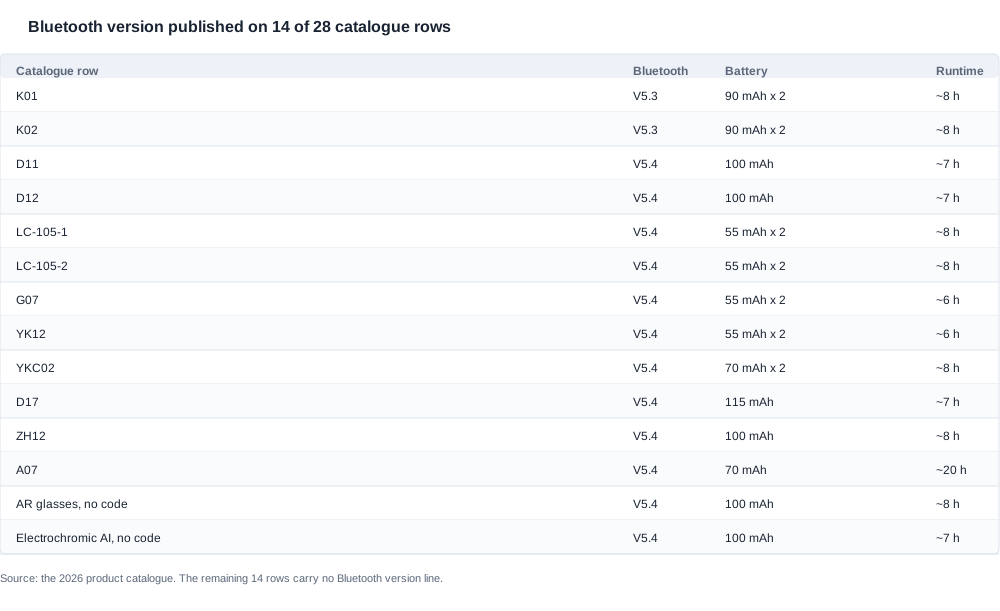
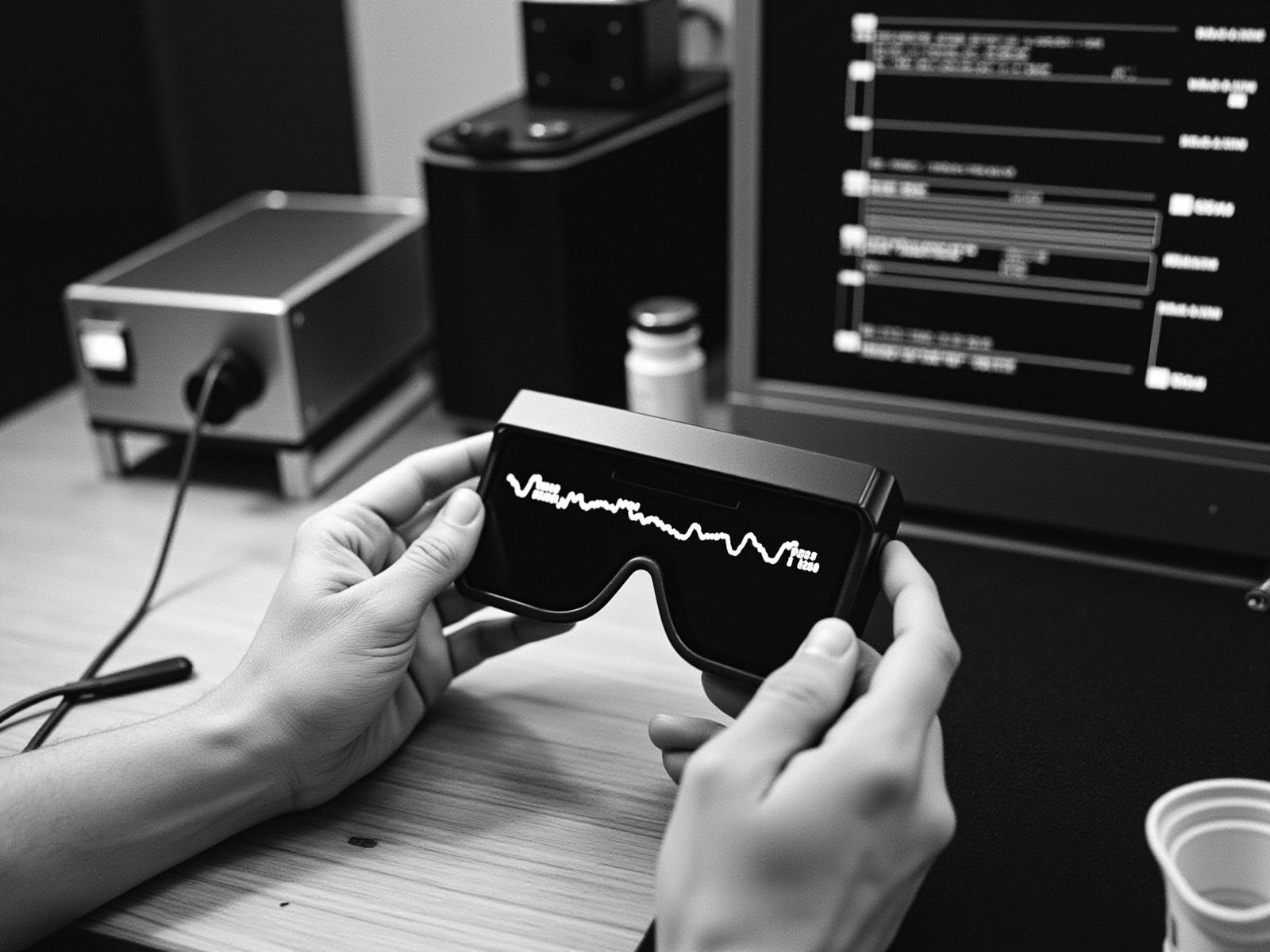
Across the 28 rows of our product catalogue, 14 print a Bluetooth version and 14 print nothing. Two rows state V5.3, twelve state V5.4, and fourteen carry no radio line at all. Every one of those fourteen silent rows is either a camera model or a lens-format product, which means the half of the range carrying the heaviest radio workload is the half you cannot compare from the sheet. That changes the job rather than adding a footnote to it. You cannot shortlist on radio generation, because the generation is not published where the workload is. You shortlist on what a supplier will put in writing, and you write the answers into the acceptance terms before the first production order, not after the first field complaint.
Smart glasses bluetooth version: published and withheld rows
Here is the published set in full. The two rows on V5.3 are the K01 and the K02, both on a 90 mAh × 2 configuration with a rated runtime of about eight hours and magnetic charging. The twelve rows on V5.4 are the D11 and D12 on 100 mAh and about seven hours with a Type-C interface, the LC-105-1 and the LC-105-2 on 55 mAh × 2 and about eight hours, the G07 and the YK12 on 55 mAh × 2 and about six hours, the YKC02 on 70 mAh × 2 and about eight hours, the D17 on 115 mAh and about seven hours, the ZH12 on 100 mAh and about eight hours, the A07 on 70 mAh and about twenty hours, the AR glasses entry on 100 mAh and about eight hours, and the AI electrochromic entry on 100 mAh and about seven hours.
What that table establishes is a fact and a boundary. The fact is that we publish the version for these fourteen rows because the source document states it for these fourteen rows. The boundary is that the version is the only radio information attached to them. There is no profile list, no codec list, no transmit power, no antenna configuration, no multi-device limit and no measured behaviour anywhere in the published material.
A version number in that position is worth one line in a technical file, and it is worth rather more than one line in a market-access file. The radio inside the product is what brings the product into scope for the radio rules of the destination market: in the European Union the Radio Equipment Directive (EU) 2014/53/EU, in the United Kingdom the UK equivalent regime, in the United States FCC Part 15 equipment authorisation, and separately a Bluetooth SIG qualification if the Bluetooth trademark and protocol are used. The qualification and the regulatory approval are answered by different organisations and cost different money, and neither of them is settled by a version string on a catalogue page.
What the version does not do is rank the products. Read the published rows again with that question in mind and the correlation simply is not there. V5.4 appears on a 55 mAh × 2 cell with a six-hour runtime, on a 70 mAh single cell with a twenty-hour runtime, on a 100 mAh cell with a seven-hour runtime and on a 115 mAh cell with a seven-hour runtime, across magnetic and Type-C charging, across audio and sport platforms. If a buyer assumes that a higher generation means more headroom, more stability or a better product, that assumption has no support in the published data, and it is exactly the assumption that causes a price comparison to go wrong.
Why one version appears against four different power budgets
Read the published rows once more with the question of headroom in mind. V5.4 is printed against a 55 mAh × 2 cell with a six-hour rated runtime, against a 70 mAh single cell with a twenty-hour runtime, against a 100 mAh cell with a seven-hour runtime and against a 115 mAh cell with a seven-hour runtime. Four configurations, one version, and no relationship between the radio generation and the power available behind it. The generation identifies the radio controller family. The headroom sits in the cell, in the duty cycle and in the antenna, and the catalogue publishes a duty cycle for no row at all.
That gap has a direct consequence for a shortlist. If your selection criteria include how the product behaves through a full shift, the version row contributes nothing, and the rows that do contribute — cell capacity, charging interface, rated runtime — are the ones a buyer is already inclined to trust without cross-checking them. The discipline worth building is the opposite one: trust the electrical rows because they are printed, and treat the radio row as a compliance input rather than a selection input.
The fourteen rows where no Bluetooth version is printed
The second half of the catalogue is silent, and the pattern of that silence is the most useful thing on this page.
The eleven camera models — the KY06 and the MT5, the V06 and the S7, the V03 and the L2 Utral, the CY05 and the MT6, the V03 Pro and the L1 Pro, and the CY03 — print no radio line. The two lens-format entries, the A05 and the A06, print no radio line. The bone conduction entry, with its 200 mAh cell, a seven-hour runtime and a Type-C interface, prints no radio line either. Together they are fourteen rows, exactly half of the catalogue.
The first thing to get right here is what the silence does not mean. It does not mean those products have no radio. It means the catalogue carries no radio line on those rows. They are wireless products with an audio path that has to reach a phone, and the omission is a documentation gap rather than a statement about the hardware. A buyer who reads "no version" as "no Bluetooth" will draw a conclusion the catalogue never made, and a buyer who reads it as "Bluetooth, version unknown" has read it correctly.
The second thing is why the gap lands where it lands. A camera model streams. Streaming changes the radio load from idle listening to sustained traffic, and sustained traffic is where reconnection behaviour, coexistence with a phone's own radios and the effect of an antenna inside a temple all become visible. The row that would tell you how the radio behaves under that load is exactly the row that is absent, and the absence is not a small detail on a specification sheet — it is the whole of the radio specification for the class of product where the radio matters most.
That is what makes the gap a procurement problem rather than a documentation complaint. For a camera-row buyer, a radio comparison is not available from any published source. It has to be manufactured: you have to ask for the module, for the sharing arrangement between the audio and capture paths, for the ceiling on concurrent connections, and for the answer on whether the radio can change during your production window. And then you have to convert those answers into a written acceptance condition, because a spoken answer from a sales contact is not a specification.
Five items belong in the request for a camera row, and each one needs a form that can be filed:
- The radio module or chipset part number. Not the version, and not a marketing phrase. A part number is checkable against the module vendor's own documentation, which means it can be verified by a third party who is not the supplier.
- Whether capture and audio share one radio link. If they do, the radio version influences far more than the link-up speed, and the coexistence question moves to the top of the technical file.
- The sustained-streaming ceiling. The resolution and frame rate at which the link holds, stated as a number. This is the row that converts a runtime claim into a usable production plan.
- The simultaneous-connection limit. One device, two devices and five devices are different products. The limit is not published for any row in the range.
- The update duty and the freeze question. Who owns firmware updates for the project, whether the radio can be revised mid-production, and how you would be told if it changed.
Why the silent half is the expensive half
There is a second-order effect worth putting in front of a buying team, because it changes the order of operations rather than the content of the request. On a camera-led product the radio file is the long pole. The module part number, the profile list, the coexistence behaviour and the firmware update duty all have to be resolved before a conformity assessment can be scoped, and a conformity assessment cannot be scoped from a specification sheet with blank cells in it. The practical instruction is therefore to raise the radio request before the sample order rather than after it, and to treat the answer as a condition of the shortlist rather than as one more item to check off at the end.
A buyer who sequences it the other way discovers that the sample it took six weeks to produce cannot be signed off, because the technical file has no radio section to file. That is a schedule failure rather than a technical one, and schedule failures on a camera programme are the expensive kind, because the marketing date has usually been committed long before the technical file is complete.
The same reasoning applies with less force to the two lens-format rows and the bone conduction entry, for a simpler reason. Those rows carry audio only, so the blank is easier to close and the radio load is closer to idle listening than to streaming. But the row is still blank, and the answer still has to come from the supplier rather than from the catalogue.
There is one specific way to go wrong that is worth naming because it is easy and it is quiet. A buyer comparing a camera model against an audio model sees a version on the audio side and a blank on the camera side, and fills the blank from the neighbouring row in the catalogue. That produces a specification sheet with a version number on it that no document supports. It is worse than the blank, because the blank is honest and the filled cell is not, and it will be relied on later when the conformity assessment is scoped.
Five questions that settle the Bluetooth position before a quotation
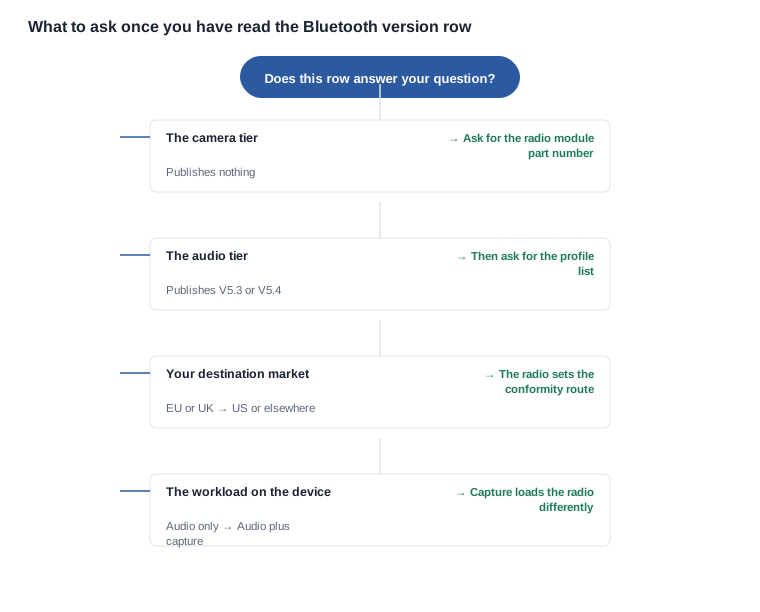
The five questions below are ordered so that each one becomes unnecessary if the previous one is answered properly. That is deliberate: a buyer who gets a named module part number in writing has already removed most of the ambiguity that the later questions are designed to expose.
- Which radio does this exact model, in this configuration, use? Ask for the module part number rather than the version, because a part number can be checked independently. Completion criterion: a part number in writing that you could verify without asking the supplier anything.
- Does the capture path share the radio with the audio path on a camera model? The answer is a yes or a no, and if it is a yes, ask for the stated streaming ceiling. Completion criterion: a yes or no, plus a number if the answer is yes.
- How many devices will hold a connection at once? Completion criterion: a stated number, not a description of an experience.
- Which profiles and codecs are supported, and which one is negotiated by default? A version number does not carry the profile list, and the default decides the microphone path in a call. Completion criterion: a named list with the default marked.
- Is the radio fixed for the life of the project, and how would you be told if it changed? Completion criterion: written confirmation that the radio is fixed, or a named notification route if it is not.
Score the answers rather than simply collecting them. A written, named, dated answer can go into the technical file and be re-checked at the next order. A verbal answer, even an accurate one, cannot be re-checked, and the person who gave it will have moved on by the time the question matters. The test is simple: could a colleague who was not in the conversation act on this answer without calling the person who gave it? If not, the answer is a starting point and not yet a specification.
Partial answers are normal and should be handled rather than treated as a failure. A supplier who can give the module and the profile list but not the multi-device limit has given you the two rows that decide the radio. Write the third one into the request as an open line with a response deadline attached, and record it as outstanding in the quotation rather than accepting a blank in the specification.
Writing an open line into the request
Where a row genuinely cannot be closed before the quotation, the way to carry it is as an open line with a named owner and a date rather than as a footnote. In practice that means the request names the question, the response deadline sits alongside the commercial deadline, and the specification issued with the order records the answer or records the gap. A quotation that carries three open lines is a normal document. A quotation that carries three blank cells inside a specification sheet is a document that will later be read as a complete specification by somebody who was not in the conversation when the decision was taken. That is the failure this category produces most often, and it is entirely administrative, which is precisely why it goes unremarked until it costs money.
It also helps to record what was asked and what was not answered, because the second conversation will be shorter than the first. A supplier who answered three of five questions in writing on the first request and two of the remaining three on the second is behaving in a way worth noting. A supplier who answered none of them has told you something more useful than the questions themselves, and the most useful version of that answer arrives in the form of a written explanation of why the information is not available, which tells you whether the gap is an internal disclosure choice or a technical limitation that will not close.
Where our published position stops and a supplier file begins
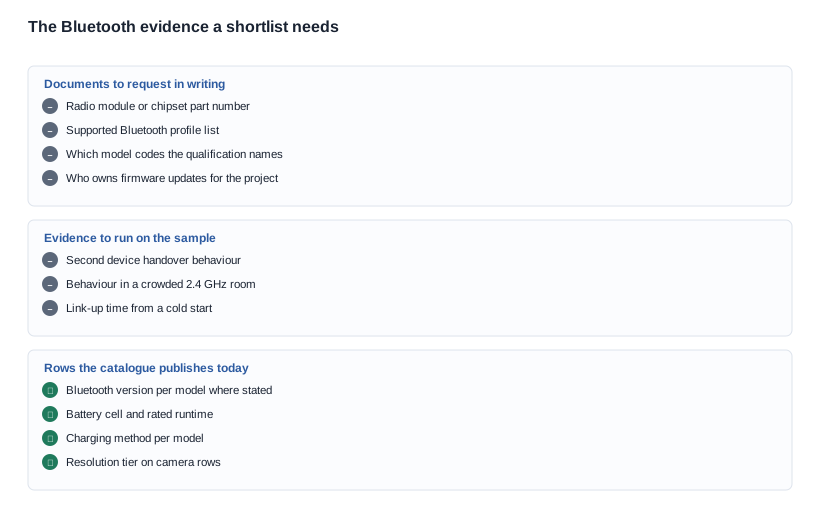
The working rule we apply: the catalogue publishes a Bluetooth version on fourteen rows and says nothing on the other fourteen, and we would rather leave the empty cells empty than fill them with a figure borrowed from a neighbouring model. There is a commercial cost to that choice. A catalogue with a number in every cell is easier to compare, and a buyer who finds the gap during their own evaluation is a buyer we did not convert. We have decided that a buyer who discovers the gap later costs more than one we lose at the specification stage, particularly on the camera rows, because those will be tested harder than the audio rows once they reach the field.
What we will not do is estimate a version for a camera row, publish a module part number we do not hold, describe a link-up behaviour we have not measured, or convert the V5.3 and V5.4 split into a quality argument. None of those is published to us, and an estimate that turns out to be wrong is a defect in the product rather than in the document.
What we will do is read your file. Send us the module part number, the profile list, the transmit power, the antenna note and the model coverage on the conformity documents, and we will tell you which of them are consistent with the published catalogue rows for that model and which of them point at something the product description should be saying. We will also tell you which rows of the catalogue a given answer can apply to, because the answer for an LC-105-1 does not travel to an S7.
There is one boundary worth stating plainly. The catalogue's export certification statement is a company-level capability, and the catalogue carries no per-model certification row. That means we cannot tell you that a specific model holds a specific certificate number from the catalogue alone, and we will not infer one from the company statement. If a document is needed for a market-access decision, it has to be requested and read.
What this changes in the quotation and the supply agreement
Two clauses do most of the work here, and neither of them is unusual. The first is a version freeze: the agreed radio module part number and the agreed version are written into the supply agreement as the configuration that applies to that production window, and any change requires notice and, usually, a re-run of the conformity assessment. The second is an update duty: the supplier states who owns firmware updates for the product, the channel those updates travel through, and what notice the buyer receives before a radio-affecting change reaches the field. A change to the radio inside a product already shipped is not a firmware update. It is a new product carrying the same model code, and without a clause that says so, the buyer inherits the cost of discovering it.
Both clauses are cheap to ask for at the quotation stage and expensive to introduce after the first production run, because the second attempt is a variation to a signed agreement rather than a line in a request. That asymmetry is the reason we treat the radio row as a commercial term rather than a technical detail, and it is the reason we would rather publish the gap than fill it in.
Send us the models you are narrowing down, the destination market, the annual volume and the use case, and we will tell you which radio rows are published for those models, which ones are not, and exactly what has to be requested to close them.
Related reading
- How radio version interacts with camera streaming — smart glasses camera technology
- What to test the moment a sample arrives — sample evaluation
- Battery figures and the test conditions behind them — battery life specification
The published rows for the audio platforms are on the bluetooth audio glasses range page, and the wider treatment of radio behaviour sits under bluetooth connectivity.
Tell us the models you are narrowing to and we will tell you which radio details we can confirm for each.


