

Smart glasses Bluetooth version certification requirements have two answers, and they live in two different systems administered by two different kinds of organisation. The first is a radio approval that grants market access in a named destination, taken against a model list printed on the document. The second is a trademark qualification for one Bluetooth implementation, which grants nothing and opens no market — it permits the mark to be used on the product and its packaging.
Neither of them is decided by the version number on a datasheet, and this is the single most useful thing to understand about the category before a document request goes out. A row that reads "Bluetooth 5.4" tells you the radio specification release the part implements. It tells you nothing about whether a document exists that covers your model, and it tells you nothing about whether the trademark is properly qualified for the implementation you are shipping.
The decisive question here is narrow, checkable and usually skipped: does the document in your hand name the model you are about to build? A document that names a family does not cover a specific variant, and no version number repairs that gap. Put the version in the traceability annex of the technical file, where it belongs, and spend your negotiating effort on the model list. The three red flags to watch for before you order are a document whose scope you cannot read off the page, a model designation that differs in spelling from the one on the unit, and an assurance given verbally that no one is willing to put in writing.
Smart glasses Bluetooth version: the certification questions it does not settle
A protocol generation is a fact about a radio controller. Market access is a function of four other things: which radio module is fitted, what the antenna does, what the product does with the data it handles, and which route the destination market requires. Change any one of those and the conformity position moves, while the version string stays exactly where it was.
The published data in our own range makes the point without needing an argument. We publish a Bluetooth version for fourteen of the twenty-eight models in the catalogue: 5.3 on the K01 and the K02, and 5.4 on the A07, the D11, the D12, the LC-105-1, the LC-105-2, the G07, the YK12, the YKC02, the D17, the ZH12, and on the AR and the light-responsive entries. The remaining fourteen publish no version at all — the eleven camera platforms, the A05 and the A06, and the bone conduction entry.
That distribution is itself a certification lesson. The models where radio documentation matters most, because they carry a camera and an application, are exactly the models whose radio rows are blank. A buyer who has written a rule of the form "we only buy 5.4" has, on our published data, excluded every camera model in the range — not because any of them fails, but because nobody recorded the number.
| What the buyer wants to know | The version row | The document set |
|---|---|---|
| Which radio specification release the part implements | Answers it | Silent |
| Whether the product may be placed on the market in the destination | Silent | Answers it |
| Whether the Bluetooth mark may be used on the product | Silent | Answers it |
| Whether the document covers the specific model | Silent | Answers it |
| Which models the document names | Silent | Answers it |
| Whether a radio module change is permitted | Silent | Answers it |
Two further points belong in the same place. First, the version number is a durable, quotable, low-controversy row, which is exactly why it survives into specifications and marketing copy — it is easy to carry, and it is easy to carry the wrong thing. Second, the version row is not even complete across a range, so a specification that requires a version for every model is a requirement that some of the range cannot satisfy on paper today.
The two approval layers a radio product clears separately

The radio approval is a market access matter and it is taken per destination market against a named model list. In the European Union the Radio Equipment Directive (EU) 2014/53/EU applies, with the EN 18031 harmonised standards cited into it for the cybersecurity requirements, covering three categories: internet-connected radio equipment, radio equipment processing personal data, and radio equipment enabling the transfer of money or virtual currency. A wearable with a microphone and an application is radio equipment that processes personal data, so of the three it is the personal-data category that applies. The General Product Safety Regulation (EU) 2023/988 applies from 13 December 2024 and layers general safety obligations on top of the sector rules.
The United Kingdom operates a UKCA framework that has diverged from the European Union's rather than tracking it automatically, and the divergence has to be tracked deliberately by whoever owns market access. The United States operates an FCC equipment authorisation regime for the radio that is a separate framework from the European one, not a derivative of it. Each of these produces its own document, its own model list, and its own renewal and change obligations.
The Bluetooth qualification is a different thing entirely, and the confusion between the two is the most common technical error we see in an RFQ. The qualification is tied to a specific implementation, not to a product and not to a version string. A radio module change is a new implementation and therefore a new qualification. Four elements sit inside this layer, and each of them is worth asking about separately.
The implementation itself. The qualification covers a defined implementation, and a buyer should establish what that implementation is, because the implementation — not the model number, and not the version — is what the document names. Our published position is that the qualification position itself is not published here, so this is a question for the factory rather than a row to look up.
The listing. The member's listing status is a commercial matter rather than a regulatory one, but a product that ships without it is a product whose trademark use is not covered. This is the point at which a procurement file and a legal file meet.
The membership terms. These govern how the mark may be used on the product, on the packaging and in the marketing material. For a private-label programme, the packaging artwork is where this becomes visible: the mark has to appear in a way the membership terms allow, and the mark owner has to be named somewhere the buyer can point to.
The trademark use on the buyer's brand. A private-label product with the buyer's name on the box and the buyer's application presenting the product raises a straightforward question about who is making the Bluetooth claim. The answer is that the implementation is qualified, not the brand, and settling it before the artwork is finalised costs a phone call; settling it after artwork is printed costs a reprint across every carton.
Here are the four questions that keep the two layers apart, and they are the questions a technical buyer should put in a written request rather than a meeting.
- Is this an approval that grants market access, or a qualification that permits trademark use? A buyer who treats the qualification as regulatory approval will assume a level of protection it does not give; a buyer who treats the radio approval as covering the trademark will make a claim that is not true on the packaging.
- Which model is named on the radio approval document? The model list is what coverage means, and it is the only part of the document that answers the question.
- Which implementation is named on the qualification, and does a configuration change affect it?
- What happens to both layers when the radio module changes? A module change is a new approval and a new qualification, and it is the change least likely to be anticipated by a buyer who assumed the radio was a settled component.
Four market routes, and what each one asks of the model
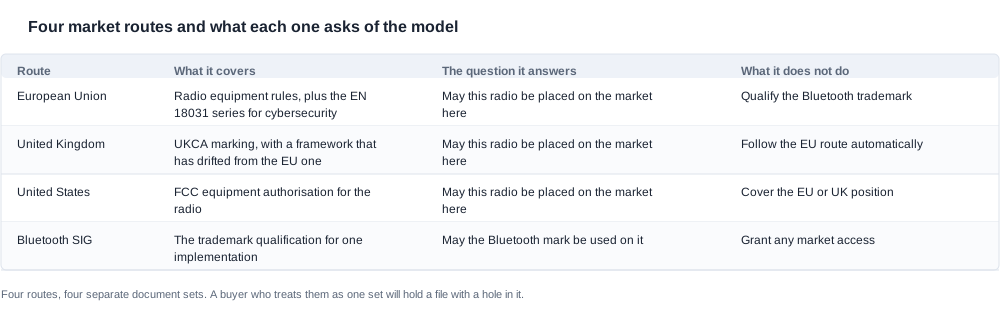
Each destination market asks the same product a different set of questions, and the answers are not interchangeable. The European route asks for a radio conformity assessment and, because the product handles personal data, asks which EN 18031 category applies and what evidence supports that classification. The evidence is usually a technical file rather than a certificate, which is why the technical file is the document a buyer should be reviewing rather than the box of paperwork the supplier forwards.
The EN 18031 category in particular follows from what the product does, not from what radio it carries. A wearable with a microphone and an application processes personal data, and that classification is a property of the product's function. Two products with identical radios can fall into different categories because one of them ships an application that talks to a server and the other does not. This is the point at which the version number and the regulatory file separate completely: the version tells you the radio generation, the category tells you what the manufacturer has to demonstrate about the software.
The United Kingdom route asks the same class of question under a framework that no longer follows the European one automatically. In practice this creates a two-market programme where one set of documentation has to be re-examined rather than reused, and where a buyer who assumed symmetry will discover the gap at the point of shipment rather than at the point of quotation. The prudent approach is to establish, per market, whether the same technical file can be presented or whether a new assessment is required — and to have that written down rather than assumed.
The United States route is a separate framework again. FCC equipment authorisation covers the radio, and it is not derived from the European position. A buyer running a multi-market programme should plan for parallel technical work rather than a single file with several market stamps on it, and should ask the supplier which parts of the file are shared and which are market-specific.
The fourth column of the table is the one that catches people. None of these routes qualifies the Bluetooth trademark, and none of them can be satisfied by a version number. A radio approval says a product may be placed on a market; a qualification says a mark may be used on a product. A product with a valid radio approval and no qualification is sellable and unbranded. A product with a qualification and no radio approval is branded and not sellable. Very few of the problems we are asked about are in that first category, and the ones that are in the second are usually discovered at the artwork stage.
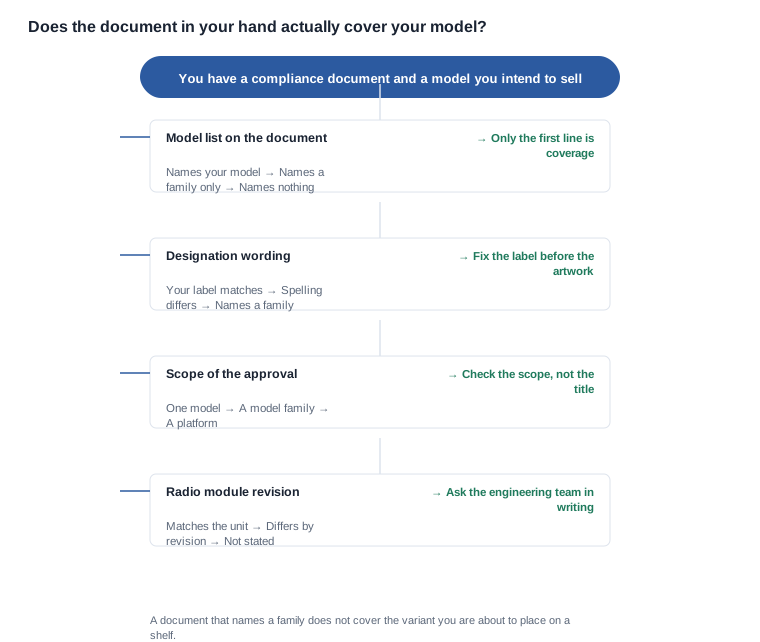

The model list on the document is the coverage
A radio approval is a statement about a set of models. Reading that statement properly takes four checks, and each of them can be completed in a few minutes by somebody who has never seen the document before.
Check the model list. Open the document and find the annex or appendix that enumerates the covered models. Write the list down. Do not work from the title of the document, from the product family name on the cover, or from the supplier's summary, because none of those is the list. The list is a specific set of designations printed in a specific place.
Check the designation wording against the unit. This is where our own catalogue creates a live problem, and it is worth naming it. We publish one entry as "L2 Utral", with a note that "Utral" appears to be a typographical rendering of "Ultra", and a further designation of "Utral Pro Max" whose meaning is not published to us. The light-responsive entry and the bone conduction entry have no model designation at all. A document that names a model in a slightly different spelling does not cover a unit whose label reads differently, and a mismatch here is found at goods-in or at a customs check, which is the worst possible moment to find it.
Check the scope. Is the document issued for one model, for a family with a stated boundary, or for a platform? A family-level document with a stated boundary may or may not include the variant you are buying, and the answer is on the page, not in the description. A platform-level document is rarer and needs more care, because it is usually written to describe a construction rather than to enumerate the models built from it.
Check the module revision. A radio module can be revised while the model designation stays the same. If the document names a revision, and the factory has since moved to a later revision, the coverage question comes back. This is the point at which a change-control clause earns its cost.
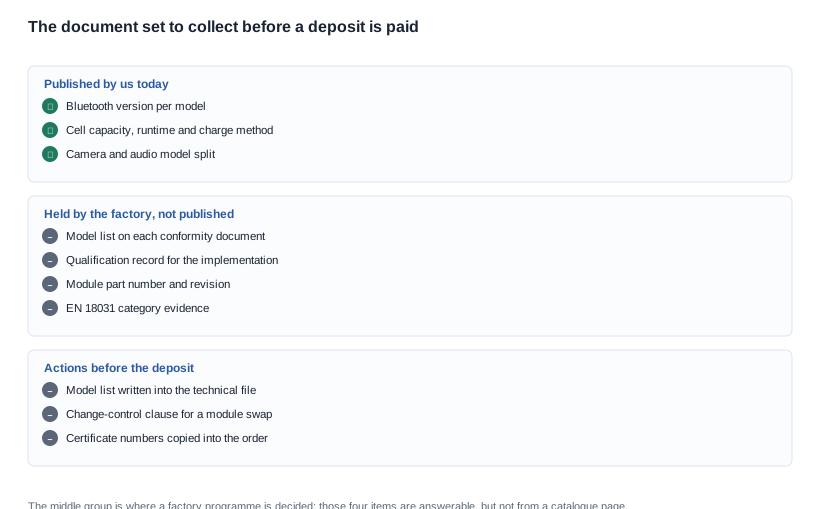
Working a multi-market, two-model range through the four checks
The checks are easy on one model and one market, and most programmes that go wrong are running three markets across a two-model range. Here is how that file actually comes together, because the order of the work is what keeps it manageable.
Start with the models, not the markets. Write the two model designations exactly as they appear on the unit and on the carton, including any wording irregularities, because those are the strings that have to be found on a document. Then list the three destination markets in the order of commercial priority rather than in the order of ease, so that the first document request is the one for the market that matters most.
For each market, ask for the radio approval document and for the model list, and read the list against the two designations you wrote. A document that covers the first model but not the second is a normal outcome on a two-model range, and it is the most useful finding a buyer can get in week one, because it converts from a market-entry risk into a scope decision. The second model then needs either its own document, a document that names both, or a documented decision to launch the second model into a different market.
Only after that does the qualification question get asked, and it is asked per implementation rather than per model, because that is how the qualification works. The result is a short matrix — three markets by two models — with each cell holding either a document reference or a stated gap. A matrix with a gap in it is a plan. A prose assurance is not.
The children's models deserve a separate line in that matrix rather than a footnote. Our published position is that the certification position for the A05, the A06 and the A07 is not published to us, and the difference between those three and the rest of the range is not a radio question at all — it is a question about what the product may be represented as doing, and that question is settled by the product's function and its market rather than by any technical file. A buyer in that category should resolve the claim before the technical file, because a claim that cannot be defended will not be rescued by a valid radio approval.
The four questions below are the written version of those checks, and they are the questions to attach to a request for quotation rather than to ask verbally on a call.
- Which model designations are named on the radio approval documents, for each destination market?
- What is the qualification position, and which implementation does it cover?
- What is the EN 18031 category for the product, and what is the evidence behind that classification?
- What is the change control position for a radio module substitution?
On our own position, we will be exact about what we hold. The specific model and certificate numbers await confirmation, the certification position for the children's models is not published to us, and the qualification position is not published here. That is not a gap we can close by estimating, and a buyer planning a European launch needs documents rather than an assurance.

What a radio module substitution does to the whole file
A radio module substitution is the change with the widest consequences in this category, and it is worth pricing before it is requested rather than after it is offered. A different module can mean a different radio generation, a different regulatory approval, a different qualification, a different antenna requirement and a different firmware baseline. Each of those is a work package, and the total is not visible in a unit price difference.
Four things follow for a buyer, and all four belong in the agreement rather than in a meeting.
The approval question comes first. A new module is a new radio, and the new radio needs its own market access. If the substitution is proposed after the technical file is closed, the buyer is choosing between a delay and an uncovered product. A clause that requires the approval position to be confirmed in writing before a substitution is accepted turns that into a scheduled activity rather than a crisis.
The qualification is not automatically carried across. Because the qualification is tied to an implementation, a new module means a new qualification record, with its own fee and its own review queue. Neither the fee nor the elapsed time is negotiable in any commercial sense, and a buyer who has budgeted for one document and then receives two should not treat that as a supplier failure.
The antenna question has to be re-opened. A different module can have a different antenna requirement, and the antenna in this product form competes for space in a temple that is already carrying a cell, a board and, in the camera platforms, an imaging module. This is the change most likely to have a second-order effect on the product, and the second-order effect is the one that shows up in a return rate rather than in a test report.
The change-control route has to be named. Who may authorise a substitution, what written notice the buyer receives, how much notice, and who pays for the re-test. Our published position is that the radio module is fixed on a platform, which means a substitution is a new product rather than a configuration — and the honest commercial response to a request to change it is a new quotation, a new approval route and a new lead time, not a line-item adjustment on an existing order.
What we publish, what we hold, and what we will not claim
Stated plainly: we publish the Bluetooth version accurately for each model, and we will not present a version as though it were a certification, because it is neither a market approval nor a trademark qualification. We publish 5.3 on the K01 and the K02, 5.4 across the A07, the D11, the D12, the LC-105-1, the LC-105-2, the G07, the YK12, the YKC02, the D17, the ZH12, the AR entry and the light-responsive entry, and we publish nothing at all for the eleven camera platforms, the A05, the A06 or the bone conduction entry.
We do not publish module part numbers, transmit power, antenna configurations, supported profile lists, supported codec lists, qualification references or certificate numbers for any model in this range. We will not produce a document that names a model we have not seen named on the source document, and we will not tell a buyer that a certificate covers a product when the model list on that certificate says something narrower.
What we will do is take the models and the destination markets and tell you which route applies to each, which document set that route requires, which of those documents we can hand over now, and which have to come from the certification body. Send the model list, the markets and the deadline, and we will say plainly which parts of the file are closed and which are still open.
Related reading
- Bluetooth connectivity and versions
- Bluetooth SIG compliance
- EN 18031 cybersecurity compliance
- Certification checklist and model coverage
Send the models and the markets and we will say which documents apply.


