

Bluetooth compatibility in this category is usually a question about the radio version, and the answer to that question is less useful than buyers expect. The version describes what the radio controller is capable of in principle. The compatibility question is about which profile the stack negotiates in practice, which codecs are carried, which firmware build is on the unit and what the host device does with the result — and none of those appears on a datasheet.
The published data makes the shape of the problem visible. Two generations coexist in the range, and a buyer running pairing tests needs to know which one a candidate belongs to before the test bench is booked. The K01 and the K02 are the only two entries on 5.3; everything else that publishes a version — the LC-105-2 and the ZH12, the LC-105-1 and the YKC02, the D11 and the D17, the G07 and the D12, and the A07 and the YK12, the AR entry and the light-responsive entry — sits on 5.4. The remaining fourteen, which are the eleven camera platforms, the A05, the A06 and the bone conduction entry, publish no version at all, and a compatibility clause that assumes a stated generation on every model will exclude them before a single pairing test is run.
So smart glasses bluetooth version smart glasses compatibility is a question with four answers, and the one buyers test is the one that decides the least. The section below sets out which of the four is worth a buyer's afternoon, and how to turn it into evidence.
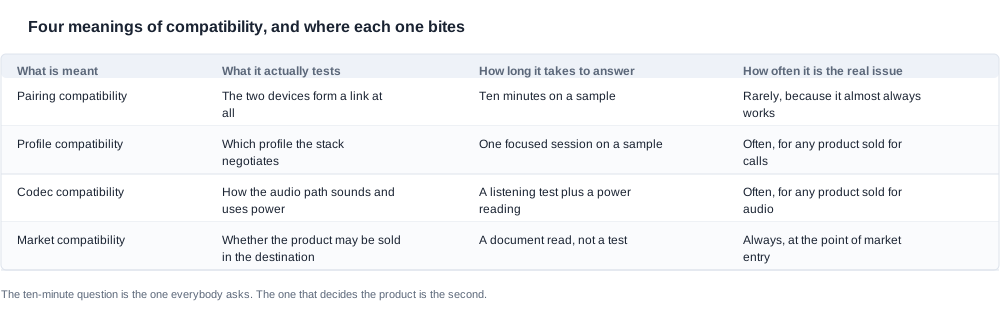
Smart glasses Bluetooth version: the four questions behind the word compatibility
When a buyer writes "is it compatible", they are usually asking one of four questions, and the four have very different costs to get wrong. Sorting them out at the start of a programme is worth more than any amount of additional radio data.
Can the two devices form a link at all? This is the ten-minute question, and it is almost always answered yes. A newer generation is backward compatible with older hosts, so a product on 5.4 will connect to an older phone. The answer tells you almost nothing, and it is the answer most programmes treat as the compatibility test. The exception is a genuinely old device in the fleet, and that is worth checking — but as a device question rather than a radio question.
Which profile does the product take? This is the question that decides whether a product works for calls, and it is the one that is never asked as a profile question. A product that supports more than one profile will often take the simpler one by default, and the microphone path changes with it. A hands-free profile is designed for a call; a stereo profile is designed for playback. A product that takes the wrong one by default will have a poor call experience that no amount of radio quality explains, and the buyer will usually conclude that the microphone is faulty.
Which codecs are supported, and do the host and the application negotiate one of them? This is the audio quality question and the power question at the same time. A product with no codec support has a poor path in a lossy environment, and it presents as a quality complaint rather than as a connection failure, which makes it much harder to diagnose from a return.
May the product be sold and used in the destination market? This is not a radio question at all. It is a function of the route and the documentation, and in the European Union the Radio Equipment Directive (EU) 2014/53/EU applies with the EN 18031 harmonised standards cited into it, where a product with a microphone and an application falls into the personal-data category. In the United Kingdom UKCA applies with a framework that has diverged from the European one, and in the United States FCC equipment authorisation covers the radio.
The practical order is the reverse of the usual one. Start with the market question because it is a document read and it has the longest lead time. Then establish the profile, because it decides the call experience. Then the codecs, because they decide the audio quality and the power draw. Leave the link question until last, because it is the one you will get for free.

The profile is what the radio actually negotiates
A profile is a role the product takes on the link. The audio role used for playback and the audio role used for a call are different roles, and a product that supports both will choose between them. That choice is made by the firmware, and it is not visible in the version number.
This is worth dwelling on because it is the single most common cause of a call complaint in this product form, and the most common cause of a call complaint being misdiagnosed. The buyer sees a product that connects reliably, sees a published radio generation, concludes that the radio is right, and then spends weeks investigating the microphone. The microphone is fine. The product is taking the role that carries the call, and the role that carries the call does not carry the microphone the way the buyer assumed.
The question to ask is therefore narrow and specific: which roles does the product support, and which one does it take by default? The answer is a list plus a name, and a supplier who cannot give both of those in writing has not characterised the product.
Three practical consequences follow for a procurement file.
The default matters more than the list. A product that supports both roles and takes the wrong one by default is a worse buy than a product that supports one role and takes it, because the second is predictable. Ask for the default explicitly, and ask whether the default can be changed by the application. Where it can, that becomes a configuration and therefore a specification line.
Forcing the other role is the cheapest available test. A buyer who can switch the product to the other role on a sample learns in ten minutes what would otherwise take a return cycle to establish. Record what changes in the call path when the role changes, because the difference in microphone behaviour is the number that will decide the product.
The role also constrains the host. What the customer gets is the intersection of the device, the phone and the application. If a phone takes a different role than the product expects, the product may fall back to a third. This is another reason to test on the actual devices carrying most of the volume rather than on the newest phone in the office.
Multi-device behaviour is a separate question from the role
Holding two connections at once, and switching between them, is often bundled into the word "compatibility" and is frequently assumed to follow from a newer generation. It does not. The number of simultaneous connections is a firmware and application setting, and the behaviour when a second device arrives — whether the product drops the first connection, whether the application arbitrates, whether the audio follows the phone or stays on the glasses — is a design decision that no version number records.
For a buyer this matters in a specific and common channel: a customer who carries a phone and a watch, or a phone and a laptop. The published position in our range is that no model publishes a multi-device figure, so this is a question to put to engineering and a behaviour to test. The test is short: connect one device, connect a second, and record what happens to the first. The useful output is not a count but a description, because a count of two with an arbitrary takeover is worse for a customer than a count of one with a predictable behaviour.
The related question is the one that gets asked less often: how the product behaves when the host is not the device it was last connected to. A product that reconnects to whichever device it finds first is a support problem in a mixed fleet, and it is a firmware behaviour that a compatibility table will never show.
Codecs decide how a call sounds, and they are not a radio property
A codec is the compression format that carries the audio. It matters commercially for three reasons, and the first is the one buyers forget.
Quality. A codec and the role it sits in together determine how a call sounds. A narrowband call on a good microphone still sounds narrowband, and a customer will describe it as a poor microphone. The fix is not a better microphone; it is a different call path, and a different call path is a firmware and configuration question.
Power. The compression format changes how much radio time the audio occupies, and radio time is power. In a product with a published runtime of roughly six to eight hours across the audio tier, a codec that carries more efficiently changes how that figure is reached. This is a genuine engineering trade-off rather than a free improvement, which is why a codec list is a useful thing to hold a supplier to.
Interoperability. The phone and the application negotiate the codec between them. A product that supports a codec the host does not will negotiate something else, and the fallback is often the one that sounds worst. A codec list without a statement of what happens when the host does not support it is half an answer.
The published position in our range is that no codec list, no profile list and no supported-feature list is published for any model. We will not manufacture one, and a buyer should be sceptical of a supplier who offers a generic list of features without tying it to a model. What can be obtained is the configuration as it is actually built: the roles the firmware implements, the codecs it carries, and the behaviour when the host offers something else. That is a request to engineering, and it is answerable in a document, a firmware build identifier and a test.

Which compatibility question dominates depends on the channel
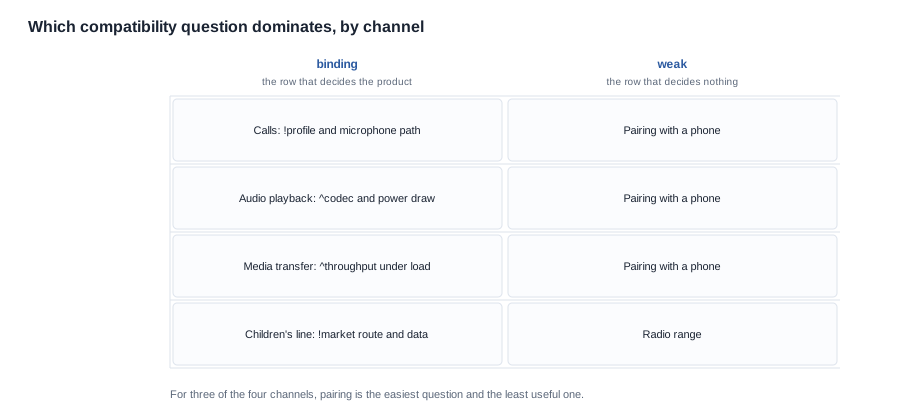
A programme that does not know which of the four questions it is actually asking will test the wrong one. The channel usually answers the question, and the four channels in this category resolve as follows.
A call-focused audio line. The binding requirement is the role the product takes and the microphone behaviour that follows from it. The radio generation is a poor selection criterion here, and the published data shows why: the audio platforms that publish a version all carry either 5.3 or 5.4, and both generations handle calls. The rows that matter are the role, the microphone path, and the noise behaviour, none of which is published for our models.
A playback audio line. The binding requirement is the codec and the power draw that follows from it. The published cell configurations across the audio tier run from 55 mAh × 2 on the YK12 and the LC-105-2, and the LC-105-1 and the G07, through 90 mAh × 2 on the K01 and the K02, to 100 mAh on the D11 and the D12, with rated runtimes from roughly six to roughly eight hours. The sport models sit on their own configurations — 70 mAh × 2 on the YKC02, 115 mAh on the D17 and 100 mAh on the ZH12 — and on the same runtime band. Playback endurance is bounded by those published rows, not by the radio generation.
A camera and media line. The binding requirement is behaviour under sustained load — how a clip or a still reaches the phone, and how quickly the product re-establishes the link after a phone change or a restart. This is a software behaviour, and it varies more between firmware implementations than between radio generations.
A children's line. The binding requirement is the market route and the data handling, because that is what the product can honestly be represented as doing. The radio is the least of the constraints, and the EN 18031 category follows from the product's function rather than from its generation.
The pattern across the four is that the generation is decisive in none of them and relevant in one, which is not the same as saying it is worthless. It is worth exactly one line in the technical file and nothing at all in the product comparison.
A sample protocol that produces evidence, and the record it leaves

Compatibility questions are answered on a sample, and the difference between a good sample test and a bad one is entirely in whether it produces a record. The protocol below has six steps, and each of them writes a line into a single table that travels with the purchase order.
Step one: write the device list before the sample arrives. The two or three phone models that carry most of your volume, with the operating system version on each, because a device family and a device version are different things and the failure is usually in the older version of a common family. Write the list down before the test, because a list written afterwards tends to include only the devices that worked.
Step two: connect each device and record the role that is taken. Not the fact that the link formed, but which role the product settled on. Record the role, the host device, the operating system version and the firmware build on the unit.
Step three: force the other role and record what changes. If the product supports both, switching and listening is the fastest way to establish what the buyer is actually buying. If it supports one, the fact that it supports one is a finding worth writing down, because it is a decision the customer will meet on day one.
Step four: play a fixed clip and record the codec that is carried. A fixed clip, on a fixed device, in a fixed order. The output is a small table, and it is the only way to make a codec claim that survives a second buyer asking the same question six months later.
Step five: walk the range in the place the product will actually be used. An office, a warehouse, a street, a plant room. The bench measurement is not the measurement that predicts the complaint, and the environments where a customer will use the product are the ones the specification should be written against.
Step six: write the results into the acceptance criteria of the order. A result in a test report is evidence of a sample. The same result written into the order is an acceptance standard, and a lot that fails it is a lot that can be refused.
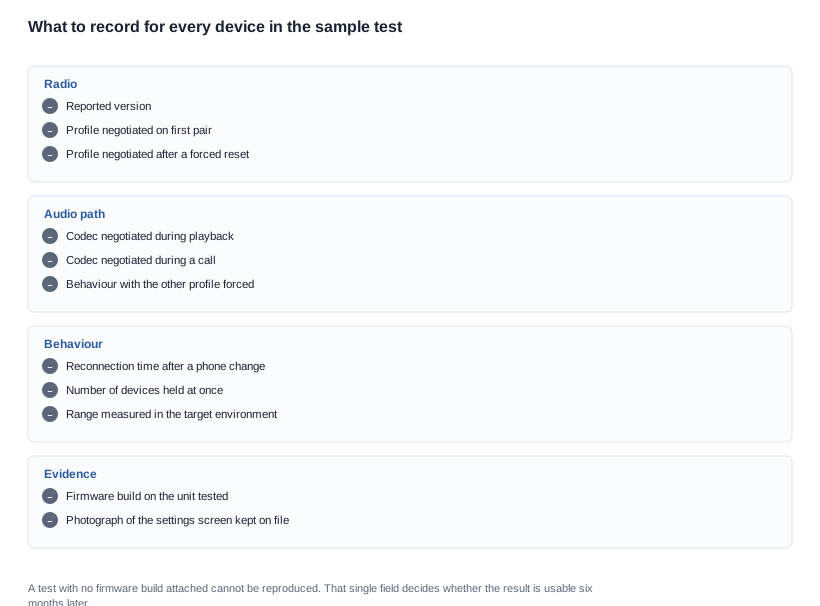
The record itself is short, and it is worth keeping deliberately short so that somebody actually completes it. Four fields per device — the role, the codec, the firmware build and the measured range in the named environment — plus one line per device for anything that failed. The firmware build is the field most often left blank, and it is the one that decides whether the test can be reproduced later; a compatibility result with no build identifier attached is an anecdote.
Dating a compatibility claim so it stays true
A compatibility statement in a product listing or a channel document has a shelf life, and the shelf life is shorter than buyers assume. It is not a matter of the product changing; it is a matter of the world the product meets changing. A phone operating system release can change which role is offered first. A new application version can change which codec is preferred. A competitor entering the same channel can change the fleet a customer is carrying by asking them to switch.
The discipline that follows is simple and is worth writing into the release process rather than into a launch checklist. Every compatibility statement carries three things: the date it was tested, the firmware build it was tested on, and the list of host devices it covers. Without the date it will be quoted as current. Without the build it cannot be reproduced. Without the device list it is not a statement about anything, because the whole question is whether a particular device in a particular fleet will work.
This also settles the question of who owns the statement. In a programme where the brand owns the listing, the brand owns the update cycle and needs a trigger to review the statement. In a programme where the factory owns the listing, the question belongs in the agreement as a notification commitment, and the notification should carry the build identifier and the affected device list rather than a general notice that something has changed.
What we publish, and which rows you have to test yourself
Here is the compatibility position, stated once. Our catalogue carries a Bluetooth version per model and nothing else about the radio, and we give you that number because it is the number we hold. What we will not do is dress it up. It is not a quality grade, it is not a proxy for range, latency or stability, and in the published data it separates no product from any other — the K01 and the K02 share a version and share nothing else either. Nor is it a compliance shortcut: a radio generation tells a buyer nothing about whether a document covering the model exists, and because the version is fixed at platform level it cannot be specified per order the way a colour can.
What we can do is give you the published configuration accurately and tell you which of the four compatibility questions your channel is actually exposed to. If the channel is calls, the role list is the row that matters. If it is content creation, the radio is rarely decisive and the reconnection behaviour is the row to test. If it is a children's line, the data and the regulatory questions dominate and the radio is a footnote.
We will also not publish a verified device list for any model. A compatibility list is only useful while it is accurate, and a list produced retrospectively from memory stops being accurate the moment it is written, so we would rather a buyer test the devices carrying their own volume than rely on ours.
Send the channel, the phone models your customers use and the operating system versions on them, and we will tell you which of the four compatibility questions to chase first and which of them have to be answered by a test on your own units. The background is under bluetooth connectivity, the terminology is in the bluetooth version glossary, and the platforms we can describe electrically are on the bluetooth audio glasses range.
Related reading
- Bluetooth version what buyers ask most
- Bluetooth version for beginners
- Bluetooth connectivity and versions
- Bluetooth SIG compliance
Tell us the channel and the phone models your customers use, and we will tell you which compatibility question to chase first.


