

Smart glasses Bluetooth version: two independent rows
The limitations of a Bluetooth version on a smart glasses product are not defects in the product; they are gaps in the specification, and the cost of leaving them open falls on the buyer. In our catalogue 12 entries publish Bluetooth V5.4 and 2 publish V5.3, and not one of them publishes the codec, the antenna, the usable range, the multipoint behaviour or the update path. The version says which radio standard the module was built to. It says nothing about how the device behaves in a pocket, under a hard hat, or in a room full of 2.4 GHz traffic. The sharpest way to see this is to put two rows of the same catalogue side by side: the version row and the runtime row are independent, so a buyer who ranks a shortlist by version and then reads the runtime figures will draw a conclusion the data does not support. An audio platform published as V5.4 with a 55 mAh cell has less headroom than a platform published as V5.3 with two 90 mAh cells. Four behaviours cannot be described by the version at all, and the correct response to each is a written request followed by a test on a sample — not a re-reading of the same number.
The buyer who has to work around the gap
The person reading this is a product manager or a sourcing lead who has just built a comparison table, ranked it, and found that the ranking does not survive the next row. He has a launch to make and a supplier who is quoting the version as though it were the decisive specification. His problem is not that the product is bad. His problem is that the published data does not contain the rows that decide whether the product works in the environment he is selling into, and that nobody has told him which rows those are or how to get them.
Three situations bring him here. The first is a brand whose product returns are rising and whose engineering team has no hypothesis beyond "the radio". The second is a channel buyer who has been asked by a customer whether the product will work with their own equipment, and who needs an answer that is defensible rather than optimistic. The third is a sourcing lead comparing two suppliers whose sheets both state V5.4, who needs a reason to choose between them other than the one they both quoted.
What he wants is not a warning. It is the list of rows that are missing, the method for closing each one, and the commercial consequence of leaving them open. That is what follows.
The four behaviours no version number describes
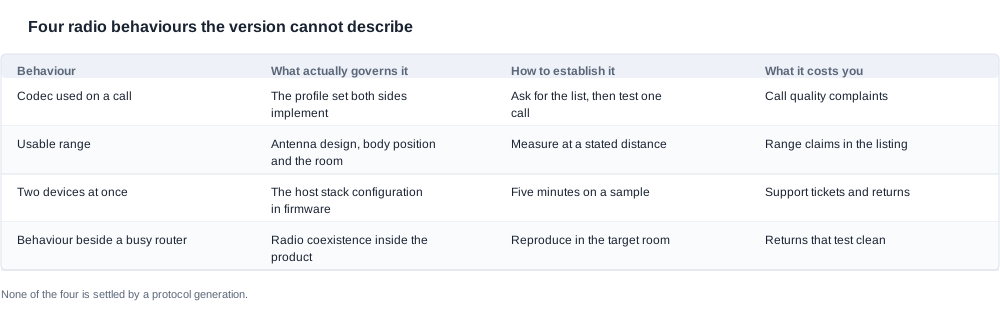
The codec. Bluetooth version and audio codec are separate decisions. A device can run a current radio and still negotiate only the baseline codec, which caps call quality well below what a wideband codec delivers. How a hands-free call sounds to the person at the other end is decided by the codec in use and the microphone chain, not by the protocol generation. Our catalogue publishes no codec for any model, and inferring one from the version would be a guess dressed as a specification.
The antenna. Usable range is an outcome of antenna design, body position, transmit power and the environment, not of the standard version. Two devices both published as V5.4 in the same catalogue — one on a 55 mAh cell in a slim temple, one on a 290 mAh cell with a charging case — can behave very differently in range because the power budget behind them is not the same and because the frame is physically part of the radio environment. A well-tuned V5.3 product can out-range a badly tuned V5.4 one, which is why a range figure without a stated method is not comparable with anything.
Multipoint and dual-device. Whether a product holds two devices at once, and whether it reconnects on its own after a missed connection, is a firmware behaviour rather than a consequence of the version. The instruction that tells a customer how to enter the linking state says nothing about what happens next, and the gap between those two things is where the tickets come from.
Coexistence. Bluetooth shares the 2.4 GHz band with Wi-Fi. How a device behaves in a room with a router, a laptop and a phone all transmitting is a real engineering outcome, and it is invisible in a spec sheet. It is also invisible in a laboratory, because a laboratory bench is the quietest 2.4 GHz environment a device will ever meet.
Why the version row is not where the cost sits either
There is a second limitation worth naming, which is commercial rather than technical. The version is also a poor place to negotiate, because it is a fixed property of the platform the supplier built. Two products on different radio generations can differ by a fraction of a percent in component cost, while differing by twice as much in landed cost once tooling amortisation, per-configuration minimums, artwork rounds, market count and the documentation work are counted. The unit price is the row both suppliers have the most incentive to make read similar. A buyer who negotiates on the radio row is negotiating on the one line with the least room and the least consequence.
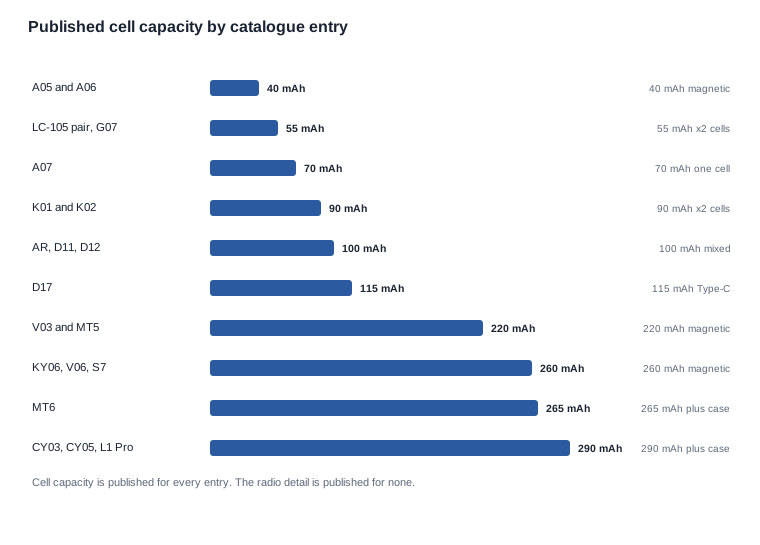
The cell capacity chart above is worth reading carefully as a counter-example to the version. Cell capacity is published for every entry in our range, from 40 mAh in the A05 and the A06 through 55, 70, 90, 100 and 115 mAh in the audio and children's families, to 220 mAh in the MT5 and the V03, and the V03 Pro, 260 mAh in the V06 and the S7, and the KY06, 265 mAh in the MT6, and 290 mAh in the CY03 and the CY05, and the L2 Utral and the L1 Pro. Published runtime runs from roughly six hours on some audio platforms to roughly twenty on the children's entries. Runtime is capacity divided by average power draw, and the radio is one of several loads — the camera module, the main controller and the speaker chain carry the rest. The version number and the runtime number are therefore independent, and a shortlist ranked by version and then read for runtime is internally inconsistent.
The thresholds to hold on the four behaviours
Each of the four behaviours needs a measurement method, a pass line, and a description of what an inflated claim amounts to. Without a threshold the answer is an opinion, and opinions are what a procurement negotiation turns into.
For the codec. Method: ask which codecs are available and which one is negotiated by default, then make a call on a sample against each host model in the customer's installed base and record what the link settled on. Pass line: if the listing makes any claim about call quality, the default on the dominant host models has to be a wideband codec. Inflated claim: a codec list with no default stated, because a supplier listing every codec the stack can negotiate is describing a capability rather than an outcome.
For the antenna and the range. Method: measure at a stated distance, with and without an obstruction, in a room you describe — and then repeat in the actual environment the product is sold into. Pass line: a figure you can repeat, with the environment recorded, and a second figure for the customer's environment that you can disclose. Inflated claim: a single distance with no environment, which is the most misleading figure in this category because twenty metres through open air, twenty metres down a corridor and twenty metres with the device on a body and the phone in a pocket are three different claims.
For multipoint. Method: connect two devices, take a call on each in turn, and observe whether the audio moves without manual intervention; then check whether the product remembers more than two. Pass line: a stated number of simultaneous connections, a defined switching behaviour, and a stated limit on remembered devices. Inflated claim: the word "multipoint" on a spec sheet with no count, which is usually true and usually incomplete.
For reconnection. Method: power cycle the unit and attempt a reconnection without re-linking; then leave the unit idle and repeat; then swap the phone and repeat again. Pass line: a stated number of attempts before a manual reconnection is needed, and a decision about what happens after that — because a device that re-links rather than reconnects is a support load that scales with the customer base. Inflated claim: a firmware version string offered as evidence of stability.
For coexistence. Method: reproduce the case in the customer's environment — audio playing while the phone is on a call, in a room with a router and other radios nearby — and record the result. Pass line: the behaviour is acceptable in the target environment, or it is disclosed in the listing. Inflated claim: nothing at all, because coexistence is the behaviour least likely to have been tested and most likely to be reported.
The five criteria a buyer can apply to a shortlist, each with the threshold that goes with it:
- The negotiated codec, per host model — the default must be a wideband codec if the listing claims call quality.
- Range at a stated distance, in a stated room — a figure you can repeat, not a figure you were given.
- The number of simultaneous connections and the switching behaviour — a stated count, not the word "multipoint".
- Attempts before a manual reconnection is needed — after a power cycle, after idle, and after a phone change.
- Coexistence in the customer's own environment — acceptable, or disclosed in the listing.
These are the criteria that replace the version row on a comparison table, and each one of them is a test rather than a quotation.
The warning that applies to every one of these thresholds
None of these figures is directly comparable across suppliers, and the reason is almost always the measurement rather than the product. A range measured in an open corridor is not comparable with a range measured in a warehouse aisle. A codec named in a datasheet is not comparable with a codec observed on a call in a city. A standby current measured on the bench is not comparable with one measured overnight on a connected unit. Until the method is stated, two numbers in the same row are two different measurements, and the comparison is between test methods rather than between products. A buyer who puts two suppliers' range figures in the same column without their methods has not made a comparison.

How to establish the four behaviours on a sample
Step one: write the protocol before the first reading. A protocol designed afterwards is a description rather than a measurement. The protocol needs the host models, the distances, the rooms, the durations and the pass lines, and it needs to be a document that both you and the supplier can hold.
Step two: start with the cheapest check that eliminates a whole layer. Power cycle and re-link before anything involving a second device. Most of the tickets in this category resolve at that step, and a supplier who will not run it will not run the harder tests either.
Step three: test the coexistence case specifically. A call on the phone while audio is playing, in the room type the product is sold into. Record whether the behaviour is acceptable. If it is not, the decision is not a technical one; it is a decision about whether the listing discloses it.
Step four: measure the range at a stated distance, twice. Once in a controlled space and once in the customer's environment, and write both conditions down. The second figure is the one that belongs in a listing, if any figure does.
Step five: record the codec actually negotiated. Not the codec list. The one the link settled on, per host model, written down. This is the row that closes the argument about call quality.
Step six: put the results and the method into the purchase order. The criteria and the method together are the acceptance standard, and a lot that fails them is a lot you can refuse. A protocol that lives only in your own spreadsheet protects you from nothing.

Where these limitations show up as returns, and what can still be moved
A unit that will not re-link is shipped as a support ticket. The symptom is a support load that scales with the customer base. The root cause is that reconnection was never in the acceptance criteria, only in the marketing. The prevention is to put the re-link test and its pass line into the incoming inspection criteria.
A coexistence behaviour is discovered by a customer. The symptom is a review that describes a fault that the product does not have. The root cause is that the behaviour was neither tested nor disclosed. The prevention is to test it in the target environment and, if it occurs, to disclose it in the listing — a sentence in the listing is much cheaper than a review.
The range claim in the listing was copied from the supplier sheet. The symptom is returns concentrated in one environment. The root cause is that an unmeasured figure was turned into a customer expectation. The prevention is to publish only a figure you measured yourself, with its conditions, or to publish no range claim at all.
The shortlist was ranked by version and re-ranked by runtime. The symptom is a purchase order that was approved on one basis and defended on another. The root cause is that the comparison table mixed two independent rows. The prevention is to decide the decisive rows first and to score only on those.
The codec row was never closed. The symptom is call quality complaints that the listing says were impossible. The root cause is that a capability was inferred from a protocol generation. The prevention is to record the negotiated codec per host model and to write the copy from what was observed.
The commercial items worth negotiating, and the ones that are not
The radio version itself has no room: it is fixed by the platform. Neither has the certification cost, the qualification cost or the laboratory time, which are fixed per family and per market and behave like queues rather than prices. What does move is the number of configurations in the first order, the number of markets, the artwork round count, whether the supplier will run the behaviour tests against your customer's phone mix rather than its own test set, and whether the supplier funds a second sample round for the coexistence and range work. That last one is the negotiation with the most leverage in this category, because the test work is a real cost and a supplier who absorbs it is absorbing a measurable amount.
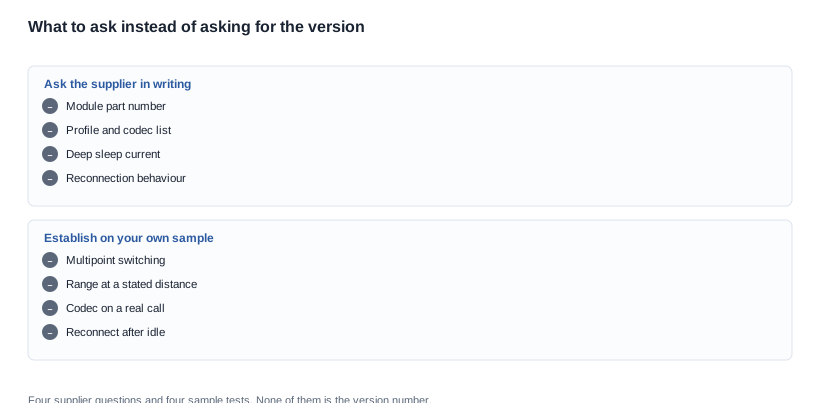
The documents to request before a deposit are specific: the module part number, the profile and codec lists, the standby current draw, the reconnection behaviour, the qualified host list, and the results of the coexistence and range tests with their conditions. The clauses to write into the order are the host list, the inspection criteria with their pass lines, the notice obligation on any radio or firmware substitution, and the disclosure text for any coexistence behaviour you have accepted.
A shortlist that refuses to be ranked on version, and the limits of our own data
A note on what follows: the case is constructed, it is not a client project, and it is written to show the sequence of choices rather than an outcome.
Assume a distributor supplying a warehouse scanning programme, where the device is on a headband for a full shift in a metal-framed building. Two suppliers' sheets both state Bluetooth 5.4. One quotes a runtime of eight hours. The distributor's buyer has provisionally ranked the two on the version and is about to use the runtime as a tie-break.
Step one: the independence check. The buyer notices that the two published rows come from different systems and that neither is derived from the other. The version is a protocol generation on a platform; the runtime is capacity divided by average load. A shortlist that scores on one and reads the other is inconsistent, and the buyer drops the version from the scoring.
Step two: the four behaviours as the criteria. The buyer writes the criteria for this programme specifically: reconnection after a power cycle, coexistence in a metal-framed building with a router and several devices, range at a stated aisle distance with the unit on a headband, and the negotiated codec per host model.
Step three: the sample round. The two suppliers are asked for the same six questions. Both name a module; only one supplies the profile list and the codec list. Both agree to run the coexistence test in a building like the customer's; one agrees to fund the second sample round for it.
Step four: the results. The supplier with the quieter sample programme fails the coexistence test in a metal-framed building and passes it in an open space, which is precisely the result the buyer needed to know. The second supplier passes the stated-distance test in the aisle. Neither result was visible on either sheet.
Step five: the disclosure decision. The buyer accepts the coexistence behaviour on the second product and writes a sentence about it into the listing and the support script, and rejects the first product for this environment. The order goes out with the inspection criteria attached, including the re-link test and the aisle range test at the stated distance.
The decisive step was step two. Four behaviour criteria replaced a version ranking, and they were chosen for the environment rather than taken from the category.
What our catalogue publishes, and what it refuses to fill in
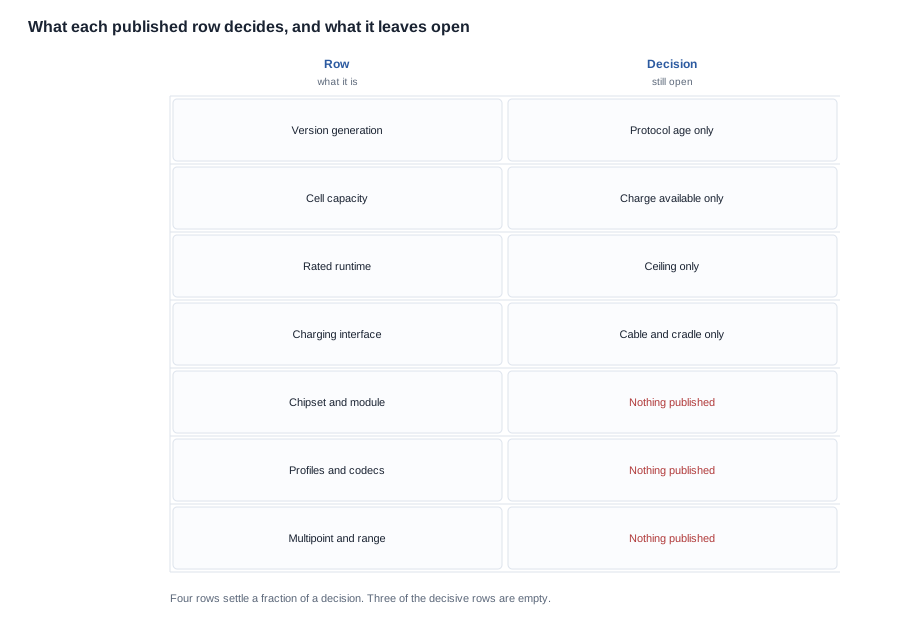
We publish the Bluetooth version because the catalogue states it, and we publish the gaps in the same table. We publish Bluetooth V5.3 on the K01 and the K02, and V5.4 on the D11, the D12, the LC-105-1, the LC-105-2, the G07, the YK12, the YKC02, the D17, the ZH12, the A07, the electrochromic entry and the AR entry. The AI camera glasses family, the bone conduction entry, the A05 and the A06 publish no version.
We do not infer a codec from a version number, we do not estimate a range we have not measured, and we do not present a version gap between two of our own models as an advantage when the runtime row shows the opposite. We publish no chipset, no module part number, no profile list, no codec list, no multipoint figure, no measured range, no deep-sleep current, no update method and no qualification reference for any model, and we will not estimate them.
A last illustration of the same pattern: our catalogue publishes a weight for one entry only — the MT6 glasses unit at 158 g, excluding its foldable charging case, with a case capacity of 1200 mAh — and publishes none for the other twenty-seven. That is not a gap in the product; it is a gap in the specification, and a buyer who reads an absent row as a zero or as an average ends up with a figure that describes no product at all. Nothing here asserts an efficacy claim on vision, health or eye protection at all.
The request that would close the gaps fastest
Send us the specific configuration and the environment, and we will tell you which of these answers we hold in our own records and which have to be established on your own units. The testing procedure is covered in how to test a bluetooth version claim, the buying side of the same question is in the bluetooth version buying checklist, and the commercial background is in bluetooth version cost factors.
Send us the configuration you are evaluating and we will tell you which of these answers we hold.


