

Smart glasses Bluetooth version: five myths, five chains
Smart glasses Bluetooth version myths all share a single assumption: that a higher version number means a better product. It does not. The version string describes a radio generation, and it reaches call quality, usable range, supported codecs, certification status and linking stability through five separate causal chains — and in four of those five, the version number is not in the chain at all. Our range carries Bluetooth V5.3 on two audio models, the K01 and the K02, and V5.4 on twelve further entries, and choosing between them on the version alone is the error this article is about. The cost of the error is not abstract: it is a shortlist that ranks itself on a row that decides nothing, a product page that promises a capability nobody tested, and a return rate that arrives a month after launch. The corrective is not a better comparison table. It is a compatibility check — a small protocol run against the phone models that dominate your market, producing evidence about your product in your market rather than a number copied between two suppliers.
Who carries the myth, and why it is so persistent
The person who carries it is usually a product manager or a sourcing lead who has been handed a category in which every competitor quotes the same row and where the row reads like the only comparable thing available. The persistence of the belief is not stupidity. It is a rational response to poor data.
Think about what a buyer actually has when the version row is the only figure published. Our own catalogue states Bluetooth V5.3 on the K01 and the K02 and V5.4 across the D11, the D12, the LC-105-1, the LC-105-2, the G07, the YK12, the YKC02, the D17, the ZH12, the A07, the electrochromic entry and the AR entry, and it publishes no version at all for the camera family, the bone conduction entry, the A05 or the A06. For the audio models it publishes no codec matrix, no range measurement, no reconnection stability figure, no microphone count, no capsule type and no pickup distance. When the only technical figure available is the version string, it gets over-read — and it is the buyer's supplier that leaves them no alternative.
That is the real reason a myth about a version number is so hard to kill in this category. The version is a proxy for quality that is sometimes accidentally true — a newer generation usually does sit on a better-documented chipset — and a proxy that is sometimes accidentally true is more dangerous than one that is always false, because it survives the first case where it happens to work.
What the corrected position amounts to
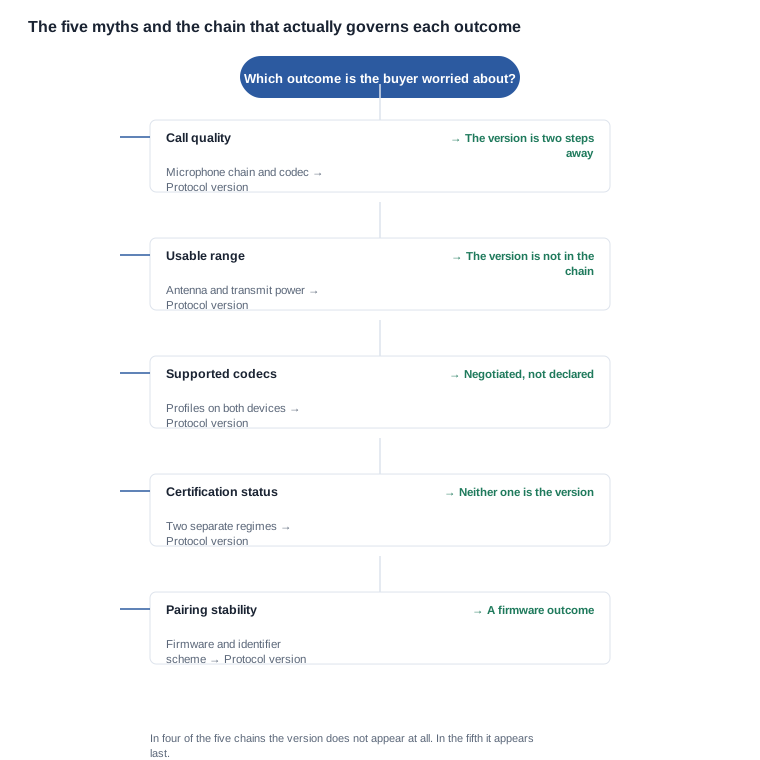
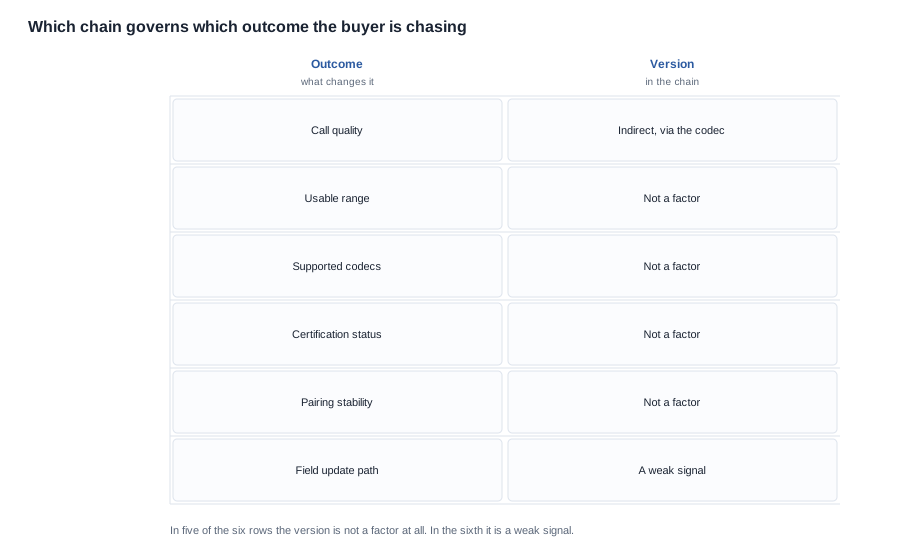
Five outcomes get argued about in Bluetooth smart glasses procurement, and each has a chain. Four of the chains do not include the version at all, and in the fifth it appears at the far end.
Call quality runs through the microphone chain, the audio processing, the negotiated codec and the phone. The radio version affects it only indirectly, through power budget and through which codecs are available to negotiate.
Usable range is dominated by antenna design, transmit power, the body of the device and the environment. A well-tuned V5.3 product can out-range a badly tuned V5.4 one.
Supported codecs are negotiated between two devices at connection time and depend on the profiles both sides implement, not on the version label. A product can advertise a recent version and still land on a narrowband codec with a given phone, because that is what the phone chose.
Certification status is two separate systems — radio equipment rules and the Bluetooth trademark and qualification programme — and a product can comply with one without the other. Neither should be taken from a catalogue line.
Linking stability is a firmware quality question, depending on the memory limits of the identifier store, the reconnection behaviour, the identifier scheme, and whether firmware survives a phone change or an app reinstall.
The one thing worth checking about the version
The myth is that the version predicts behaviour. The accurate, narrower statement is that the version predicts the maturity of the ecosystem around the radio — the firmware baseline, the app support, the availability of documentation, the existence of second sources for the module. That is worth knowing when you are choosing a platform to build a range on, because a better-supported chipset is a cheaper platform to support over three years.
What it does not predict is how the product behaves in a customer's hand. And the version row on the specification sheet is not even a statement about maturity — it is a statement about which generation of protocol the module implements, and that is one remove from the chipset itself.

The five myths, the evidence that replaces them, and the threshold
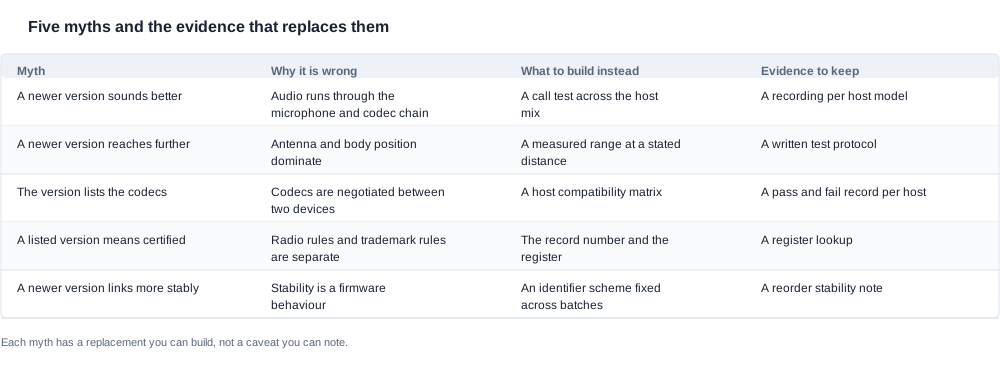
Myth one: V5.4 sounds better on calls. It does not follow. The threshold: if call quality is your requirement, the version is the wrong number to select on. The measurement that settles it is a recording per host model, made with the same script on each candidate, and compared against each other rather than against an absolute. In our own published material the microphone count, the capsule type and the pickup distance are not published for any model, so the version string is frequently the only technical figure a buyer has — which is exactly why it gets over-read. The procedure for that measurement is set out in how to measure smart glasses microphone quality.
Myth two: V5.4 gives a longer range. Range is dominated by antenna design, transmit power, the body of the device and the environment. The threshold: a measured figure under stated conditions, taken in the environment the product is sold into, with the environment recorded. Ours is not published, for the same reason as everything else in this category — we do not hold a number we can stand behind.
Myth three: the version tells you which codecs are supported. Codec support is negotiated between two devices at connection time. A product can advertise a recent version and still land on a narrowband codec with a given phone. The threshold: a compatibility matrix built against the phone models your customers actually own, recording the codec the link settled on for each. If your product depends on wideband voice, this is a matrix question, and skipping it turns into a support cost.
Myth four: a listed version means the product is certified. These are separate things and buyers conflate them constantly. There is radio equipment compliance — in the European Union under the Radio Equipment Directive, in the United States under FCC rules, in the United Kingdom under the UK regime — and there is the Bluetooth trademark and qualification programme, which is a separate system entirely. A product can comply with radio rules without being listed for Bluetooth, and the reverse is also true. Our own catalogue's export-certification page shows ten patent certificates — eight appearance-design patents and two utility-model patents — and names no CE, FCC or RoHS marking, so it publishes no certificate numbers, no issuing bodies and no expiry dates, and the specific model coverage on each is not published either. Treat it as a starting point for verification, not as evidence. The threshold: a record number you can find in a register, and a model string that matches your order.
Myth five: a newer version links more stably. Stability is a firmware quality question. The threshold: two specific checks. First, that the identifier scheme is stable across your reorder, because a custom Bluetooth name that changes between production batches breaks the connection for every unit already in the field — this is the one thing worth checking, and it is a configuration decision rather than a technical one. Second, that reconnection after a lock-and-unlock cycle works on the host models in your market.
The compatibility check, and what it replaces
Rather than comparing version strings, build a compatibility check. Take the three or four phone models and operating system versions that dominate your market, connect each with the sample, and record the connection result, the reconnection after a lock-and-unlock cycle, the audio after a phone change, and whether the codec settles where you expect. That produces evidence about your product in your market, which is the only version of this question worth writing down.
The checklist a buyer can run, and the threshold attached to each step:
- Connection result on each dominant host model — a pass or a fail, recorded per model.
- Reconnection after a lock-and-unlock cycle — the behaviour that generates most tickets.
- Audio after a phone change — the case where a customer replaces a handset.
- The codec the link settled on — the row that closes the argument about call quality.
- The identifier scheme across two batches — checked before the reorder, not after it.
- The behaviour in the target environment — the room, the vehicle or the site where the product is actually used.
Six steps, and none of them is a version string. The total cost of running them is a day and a small number of units, and it replaces an entire column of comparison that never had evidence in it.
What the version is genuinely good for
Having spent most of this article taking the version apart, it is worth being precise about what it is still good for, because a buyer who throws it out entirely has made a different mistake.
It is a good proxy for the age of the platform, and therefore for the cost of supporting it. A product on a newer generation is usually built on a chipset with better documentation, a wider supply base and more supplier choice for the module itself. Over a three-year range programme, that difference shows up as engineering time, not as a feature. A buyer choosing which platform to build a range on has a legitimate reason to prefer the newer generation, and it is a reason about support cost rather than about the customer.
It is a good sanity check on a supplier's documentation. A supplier that cannot state which protocol generation a model implements has a documentation problem that will surface in the radio file, in the certification trail and in the firmware support. This is a useful red flag even though it is not a selection criterion.
It is a legitimate consumer-facing specification. A customer reading a product page wants to know the product is current. Stating the version is informative to them, and it is not misleading as long as the page does not present it as a guarantee of compatibility or performance. The distinction is between stating the version and inferring the behaviour from it.
It is a useful input to a roadmap discussion. When a range is being planned over several years, the generation on the current platform tells the team how much headroom there is before the platform has to be replaced, and that is a legitimate planning input even though it is not a procurement threshold.
Four uses, none of which is "rank the shortlist on it". The version is a platform-age fact, a documentation indicator, a consumer specification and a planning input. It is not a behaviour guarantee, and a purchase decision that rests on it is resting on a row with no behaviour content.

The warning that applies to the replacement evidence
Even the replacement evidence is not comparable across suppliers unless the method travels with it. A codec recorded on one phone model in one city is not comparable with a codec recorded on a different phone model on a different network. A reconnection count measured on a bench is not comparable with one measured after a night in a pocket. A range figure measured at a stated distance in an open space is not comparable with one measured in the same space with a body in between. The threshold for every one of these is the same: the method and the conditions are written down alongside the number, or the number is not usable.

Where an uncorrected myth becomes a commercial problem
The shortlist was ranked on the version and the ranking did not survive the sample round. The symptom is a purchase order defended on one basis and questioned on another. The root cause is that the comparison table scored a row with no procurement content. The prevention is to score the outcome the programme needs rather than the row the supplier quoted.
A capability was inferred from the protocol generation. The symptom is a feature on the listing that does not work for a customer. The root cause is that a version was read as a profile list. The prevention is to test the capability on the host mix.
A certification claim reached the packaging. The symptom is a market surveillance question after launch. The root cause is that "compliant" was treated as a record. The prevention is to obtain the number before the artwork is released.
The identifier scheme was allowed to drift between batches. The symptom is a wave of reconnection problems that correlates with a production date rather than with a software release. The root cause is that the Bluetooth name was treated as a cosmetic decision. The prevention is to fix it in the approved specification and to make a change a configuration change.
A range claim was published without a method. The symptom is returns concentrated in one environment and reviews describing the same behaviour. The root cause is that an unmeasured figure became an expectation. The prevention is to publish a figure you measured, with its conditions, or none.
What the negotiation is actually about once the myths are corrected
With the version out of the scoring, the negotiating space moves to the rows that were previously invisible. The number of configurations in the first order, the number of markets, the artwork round count, whether the supplier will run the compatibility check against your customers' phone mix rather than against its own test set, and whether the supplier funds a second sample round. Certification cost and the laboratory time behind it remain fixed in character per family and per market, and the radio version itself has no room at all, because it is a property of the platform the supplier built.
The documents worth attaching to the purchase order are the qualified host list, the compatibility check results with their method, the record number for the certification claim, the identifier scheme as a fixed specification, and the inspection criteria with their pass lines. The clauses worth writing are the notice obligation on any radio, firmware or naming change, the re-issue obligation on the documentation pack, and the warranty set against a written failure criterion.

A myth-free shortlist, and the limits of our own published position
This is a synthetic scenario rather than a client project, and its purpose is to show the sequence in which the decisions are made.
Assume a brand's product manager is choosing a Bluetooth audio platform for a field-service line, and is being told by a distributor that the version row decides it. Two candidates are on the table, one published as V5.3 and one as V5.4, and the manager's draft recommendation is the V5.4 model.
Step one: the chain check. The manager works out which chain governs the outcome the field-service channel actually cares about — the assistant responding in a noisy plant. That chain runs through the microphone and the audio processing, and the version sits two steps away from it. The second candidate's V5.4 row therefore contributes nothing to the decision, and the manager drops it from the scoring.
Step two: the criterion. The criterion becomes the microphone and audio behaviour in a plant environment, measured with the same script on both candidates. The measurement procedure is the one described in the microphone quality material, and the spec-sheet reading is set out in the microphone quality spec sheet explained.
Step three: the compatibility check. The manager runs the six-step compatibility check on both units across the four phone models the field teams actually use. The V5.4 candidate fails the reconnection test on one of them. The V5.3 candidate passes all six. The ranking has now reversed on evidence rather than on a version string.
Step four: the firmware question. The manager also checks the identifier scheme across the two production batches the supplier has already produced, and confirms the Bluetooth name is stable. This is the one version-adjacent check worth making, and it costs one question.
Step five: the order. The order goes to the V5.3 candidate, and the Bluetooth version appears in the specification as a description and in the listing copy as a consumer-facing specification, because it is meaningful to a customer reading it. It does not appear in the internal justification, because it did not decide anything. The advanced considerations that fed into the decision are covered in microphone quality advanced considerations.
Our own published position, and what we will not do with it
We publish the Bluetooth version our catalogue states per model, and we do not publish range measurements, codec matrices, reconnection stability figures, microphone counts, capsule types, pickup distances, module part numbers, profile lists, multipoint figures, update methods or qualification references, because those are not in our published material. We would rather a buyer run the compatibility check above than select on a version string and discover the gap in returns.
We publish Bluetooth V5.3 on the K01 and the K02, and V5.4 on the D11, the D12, the LC-105-1, the LC-105-2, the G07, the YK12, the YKC02, the D17, the ZH12, the A07, the electrochromic entry and the AR entry. The AI camera glasses family, the bone conduction entry, the A05 and the A06 publish no version.
Our source material shows an export-certification page of ten patent certificates, eight of them appearance-design patents and two utility-model patents, and names no CE, FCC or RoHS marking, so it publishes no certificate numbers, no issuing bodies and no expiry dates, and the specific model coverage on each is not published. We publish no frame weight for most models in the range; the only weight published anywhere in the catalogue is 158 g for the MT6 glasses unit, excluding its foldable charging case, and the case capacity there is 1200 mAh. Nothing attached to any product we support is a claim that vision, health or eye protection works.
The request that would let us be more useful to you
Send us the phone models your customers use most and we will tell you which questions in the compatibility check actually matter for your market, and which of them our own documentation can answer. The full treatment of connectivity and what it means for a purchase sits on the Bluetooth connectivity page.
Send us the phone models your customers use most and we will tell you which questions in the compatibility check actually matter.


