

A radio version is the one specification on a sheet that a buyer cannot revise later without revising the product. Everything else can be changed — a colour, a case, a lens, an application screen, a cable in the box — while the product stays the same product. The Bluetooth version is a silicon decision, and moving it means moving the module, the conformity position and the firmware story together. For a brand that already has units in the field, that turns the question from "is a newer version better" into "does a refresh survive contact with the fleet we have already shipped". The four compatibility checks below decide that, and the cost ledger decides whether the answer is worth acting on.
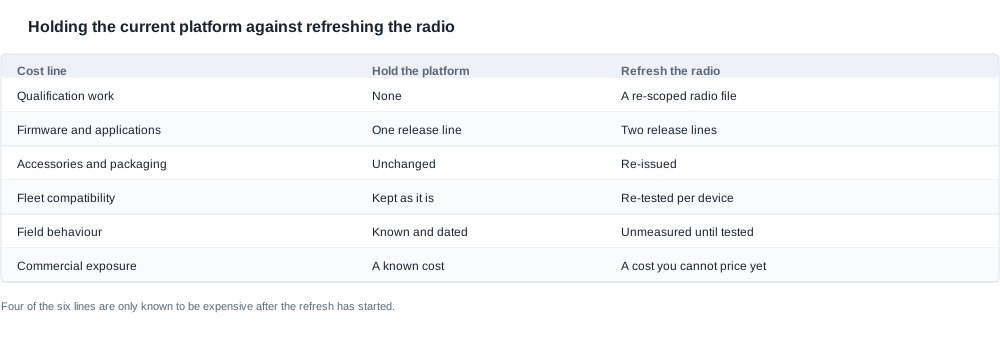
Smart glasses bluetooth version: what a refresh changes
A refresh is not a firmware task, and treating it as one is the most expensive misjudgement available at range level. A radio module brings its own parameters with it: the operating band, the transmit power, the antenna arrangement and the module's own certification. A module with a different output power is a different radio product in the eyes of any conformity assessment, and the test reports behind the product were issued against the module that was in it at the time. So a refresh means a re-scoped module, a re-scoped conformity assessment, a fresh assessment of the antenna arrangement, and a re-test of everything that touches the radio — which in practice means the link-up behaviour, the connection stability and the power consumption.
The power consequence is the one that reaches the product page. A module with better radio efficiency can support a longer runtime claim, and a module with a worse one can cost the product an hour of it. This is part of why the rated runtime figures in this catalogue are not comparable across models: the radio differs, the cell configuration differs, and the workload differs, and a buyer who compares two runtimes without checking the cell configuration underneath is comparing three variables at once.
The fleet consequence is the one that is least visible at the planning stage and most expensive after it. Units already shipped keep the radio they shipped with. New units carry a new one. Both populations sit in the same channel, under the same brand, in front of the same customers, and the difference between them is invisible to the customer and visible to your support team. The questions this raises — whether the two populations can share an application, whether a paired device can migrate between them, whether the accessories differ — are the subject of the next section, and they are the reason a refresh is a product decision rather than a purchasing one.
There is also a regulatory layer arriving underneath all of this, and a buyer planning a platform decision today should know about it. The EN 18031 series is scheduled to become a mandatory component of CE marking for radio equipment from 1 August 2025, which is after this article's publication date and therefore not a requirement today. What a buyer can do now is ask what the manufacturer's position is on vulnerability handling and on encrypted communications, because that is what the requirement will be asking for. Our EN 18031 notes cover the framework.
The honest summary of the first cost is that a radio refresh is a re-issue of the product's identity at the regulatory level, with the product's appearance, price and marketing unchanged. That is why it is under-estimated: nothing about the change is visible in a showroom.

Four compatibility checks that decide whether a refresh is survivable
A refresh fails on compatibility far more often than it fails on cost, and the four checks below are the ones that have to be answered before the refresh is approved rather than after the engineering work has started.
The first check is application continuity. Does the refreshed platform run the same application build as the installed one, or a parallel build that has to be supported alongside it? A second application line is a permanent cost — every feature, every store update and every support script is written twice — and it is invisible in the quotation because it appears in your engineering organisation rather than in the supplier's. Ask what the application version is, whether one build covers both radio platforms, and what happens to a customer whose device is updated to the new platform while their phone still holds the old one.
The second check is paired-device continuity. What does a customer who has owned a unit for eighteen months have to do when the new platform ships? If they lose their paired devices, their settings and their stored content, the refresh becomes a support event with a revenue consequence rather than an internal one. Ask whether the data that links a unit to a phone is stored on the unit or in the application, whether it is tied to the radio configuration, and whether a customer can move from an old unit to a new one without re-establishing everything.
The third check is mixed-population operation. Can a fleet hold both populations at once, and can one application manage both? A fleet buyer issuing new units to a mixed group of existing staff is the hardest case, and it is the case that the range page never mentions. Ask whether a single application build can see and manage both platforms, and whether anything in the fleet workflow — a shared session, a device list, a management console — assumes a single radio version.
The fourth check is accessory and packaging continuity. A refresh that changes the charging interface, the case, the cable or the model code creates a new consumable and a new packaging artwork, and it fragments the accessory stock that is already in the channel. It also changes what the customer receives back if they return a unit, and it changes the barcode, which touches the inventory system, the retailer listing and the warranty administration. Ask which physical parts change, whether the model code changes, and what the packaging lead time becomes, because packaging is frequently the longest lead time in the whole programme.
Underneath all four checks is a fifth question that is easy to forget and expensive to discover late: what happens to stock that has already been produced against the old configuration? Finished units, packaged units and component inventory all carry a cost that is sunk at the moment of the decision, and a refresh that does not account for them converts a platform decision into a write-off.
The questions to ask before you commit to a refresh
The four compatibility checks are the substance, and the questions below are how they are put to a supplier or to your own engineering team. Asking them in this order is deliberate, because each answer either settles the decision or tells you which check to run next.
- Does one application build cover both radio platforms, and for how long will it?
- Where is the data that links a unit to a phone stored, and is it tied to the radio configuration?
- Can a customer move from an old unit to a new one without re-establishing their setup?
- Can a fleet operate both populations under one management workflow?
- Which physical parts change, and does the model code change with them?
- What is the new packaging lead time, and how does it compare with the current one?
- Does the change move the product out of the scope of the existing conformity assessment?
- What is the notice period you will receive before the module is changed, and who bears the cost of re-qualification?
- What happens to finished units and to components already committed?
- Does the current module carry an end-of-life notice, and on what date?
The last two questions are the ones that turn a platform discussion into a dated decision. An end-of-life notice is a fact that arrives on someone else's timetable, and a refresh chosen before the notice arrives is a decision you made; the same refresh after the notice arrives is a reaction. The difference in cost between the two is usually the difference between a planned refresh and an emergency one, and it is entirely a function of whether the question was asked early.
A useful discipline is to write the answers into the same document as the published catalogue rows, so that the decision is made against evidence rather than against recollection. The Bluetooth version supplier verification article sets out the document-and-sample checks in detail, and the questions above are the refresh-specific subset of that list.

Weighing a refresh against holding the platform you already have
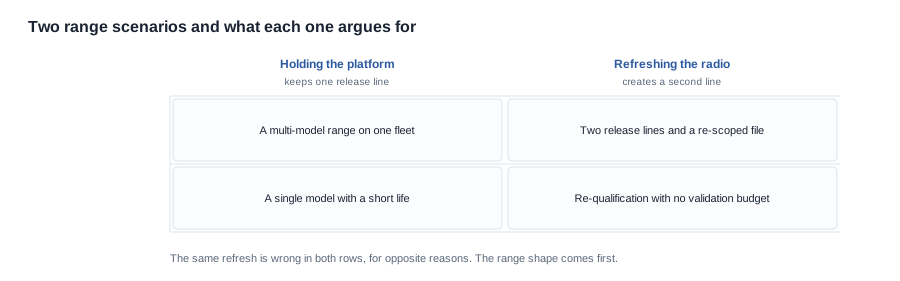
The reason to hold a platform is not sentimental and it is not technical. A platform with several models on it amortises its qualification, its firmware, its accessories and its packaging across more units, which lowers the effective cost of every model that uses it. A brand building a small range on one platform gets a simpler tier structure, one release line to support and one set of test reports to manage. That advantage is real, it grows with volume, and it is the strongest argument for holding.
The reason to refresh is equally practical and equally narrow. The module vendor's own end-of-life notice forces the question regardless of preference. A destination market may require a configuration the current module cannot satisfy. And the product brief may now need a capability — simultaneous connections, a particular profile behaviour, a throughput figure — that the current platform cannot deliver. In all three cases the trigger is a constraint rather than a preference, and that distinction is the decision rule: refresh when the thing forcing the refresh cannot be bought another way, and hold when the reason is a version number.
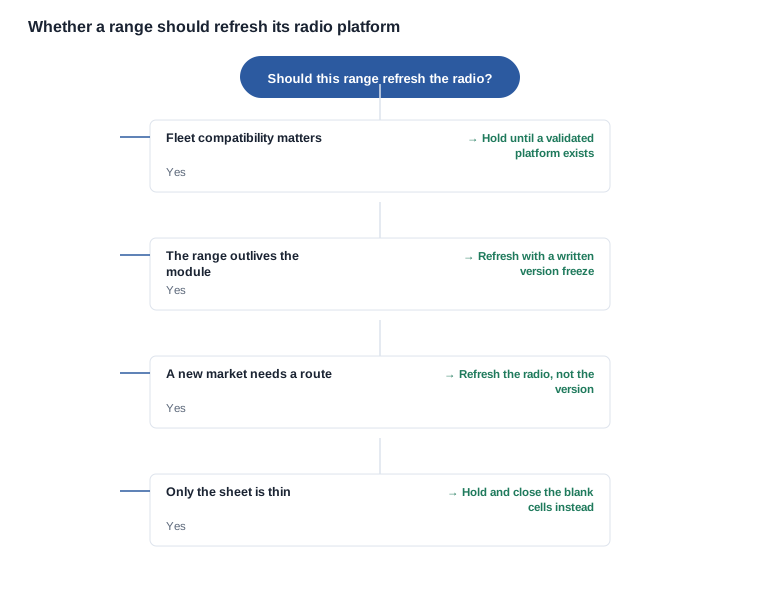
The decision chart puts the four forces in the order they should be considered. Fleet compatibility matters most, because it is the one that touches customers who have already paid. A range that outlives the module should be refreshed with a written version freeze, because the module's own lifecycle will otherwise decide the date for you. A new market needing a new route means refreshing the radio itself, not merely re-stating the version. And if the only reason for the discussion is that the specification sheet appears thin, the correct answer is to hold and close the blank cells with a request, because a refresh costs far more than the paperwork it replaces.
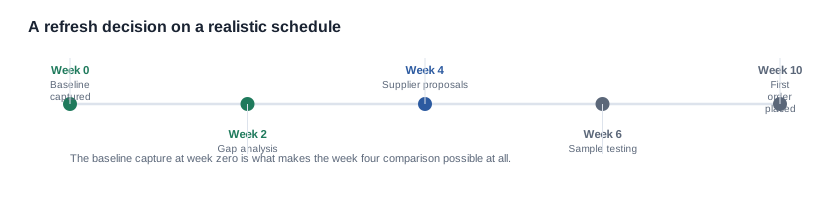
The schedule above is the part buyers are most often unprepared for. A refresh that is approved in week four and ordered in week ten has already lost the production window it was supposed to recover, because the sample testing, the conformity work and the packaging lead time do not compress. The baseline capture at week zero is what makes the week four comparison possible at all, and it is the step that gets skipped when the schedule is already behind — which is exactly when a comparison is most needed.
One last point on the ledger. The cost of holding is not zero either: a platform held too long keeps a firmware line alive that nobody wants to support, and a platform held on an end-of-life module eventually stops being an option. The correct comparison is not between a fresh platform and a stale one, but between the full cost of the refresh and the full cost of holding for one more year, including the qualification work, the second firmware line, the accessory fragmentation and the commercial exposure of a radio behaviour nobody has re-measured.
How to evaluate the two options against the same criteria
Comparing a refresh against holding is a trade-off evaluation, and it goes wrong in a predictable way: the refresh is costed precisely because it has a scope, a quotation and a date attached to it, while holding is costed loosely because it is the option nobody has to justify. The fix is to evaluate both against the same five criteria, with the same effort on each side, and to write the result down in the same form.
The first criterion is one-time cost: the qualification work, the tooling and engineering changes, the packaging rework, the sample programme and the inventory write-down. The second is recurring cost: the additional firmware and application lines, the additional test reports to keep current, the accessory set that now has to be stocked in two variants. The third is compatibility exposure: what happens to the installed base, what happens to the fleet workflow, and what happens to the customer who buys a new unit and cannot pair it with the one they already own. The fourth is schedule exposure: how long each option takes, and how each interacts with the packaging and the production window. The fifth is evidence quality: how much is actually known about each option's radio behaviour, and how much is assumed.
That last criterion is the one that usually decides the outcome in practice, and it is the one that gets skipped. Holding means holding a behaviour that has been measured on a fleet already in the field, which is real evidence. Refreshing means buying a behaviour that has not been measured at all, because the new module's radio behaviour under your load, in your environment, against your host devices, is unknown until somebody tests it. The refresh trade-off is therefore never between two known quantities; it is between a known quantity and an unknown one with a schedule attached to finding out.
The practical criteria for deciding when to refresh come down to three questions. Is there a constraint that the current platform cannot satisfy — an end-of-life notice, a market requirement, a capability the product brief now needs? If not, the answer is to hold, and the specification gaps should be closed by request rather than by a module change. If there is, is the compatibility exposure acceptable, which means the four checks above have been answered rather than assumed? And if both answers are yes, has the decision been made at range level rather than model by model, because a refresh that arrives one model at a time leaves a range with two of everything and a reason nobody can later explain?
How our own range splits across radio platforms, and what it means
Our published position is that a Bluetooth version is one specification a buyer should settle at range level and in writing, and the reason it is so often overlooked is that it appears to be a footnote. In our own catalogue the split is visible and worth knowing: the K01 and the K02 publish V5.3 on a 90 mAh × 2 configuration with roughly eight hours of rated use, while the YKC02 and the G07, the D11 and the LC-105-2, the A07 and the D17, the LC-105-1 and the D12, and the YK12 and the ZH12 publish V5.4 across cells from 55 mAh × 2 to 115 mAh and runtimes from about six hours to about twenty.
Two models on an older version inside one family is not a crisis. It is a decision that was never made, and it is better made deliberately than discovered in a renewal cycle. The argument for leaving the older pair where it is is the amortisation argument above: they are already qualified, they already have a firmware line, and they already have packaging. The argument for moving them is the European positioning argument — the newer generation carries encrypted-communication capability that maps onto how a European buyer will think about the product — and that argument is expensive to defer because it gets more expensive as the certification route for the older platform has to be supported in parallel for longer.
The same discipline applies to the other side of the range. Fourteen rows publish no Bluetooth version at all: the eleven camera models, the two lens-format rows and the bone conduction entry. A buyer who refreshes a camera platform is not choosing between two versions, because neither is published; they are choosing whether to close the radio file by request or to change the module, and the first of those is normally the correct answer.
One practical consequence follows from the split, and it is the reason the version has to be settled at range level. A range built on one version has one certification story, one firmware story, one accessory set and one set of test reports to manage. A range built on two by accident has two of everything, and the cost of the second of each falls on the buyer who has to reconcile them at every renewal. The trade-off is a real one — a small range on a single platform has a simpler structure than a mixed range — and it is settled by volume and by range life rather than by the version numbers themselves.
We publish the version for each row where the catalogue states it and nothing beyond it. We will not publish a module model, an output power or a measured connection behaviour for any product in this range, because none of them is published, and we will not tell you that a newer version makes a product better. It makes a product's compliance position stronger and its flexibility larger, and it costs a re-scoped radio.
Tell us the target markets, the volume, the current platform and how long the range needs to live, and we will come back with the published rows, the platform structure and the questions we can close for you directly. How the family divides by radio version is covered in which model to pick, the audio platforms are listed on the bluetooth audio glasses range page, and how a range is normally sequenced sets out the schedule question in full.
Related reading
- How the family divides by radio version — which model to pick
- The security requirement that is arriving — EN 18031
- How a range is normally sequenced — lead time
Tell us the target markets, the volume and how long the range needs to live, and we will come back with the platform structure.


