

Smart glasses Bluetooth version: the radio questions that decide a connectivity programme
The radio version is the least interesting line in a quotation and the one with the longest tail. It decides which devices a customer can connect to, it decides which approval route the product follows into each market, and it decides most of what the support burden becomes in year two. All three consequences are invisible at the point where the buyer reads the version number and moves on.
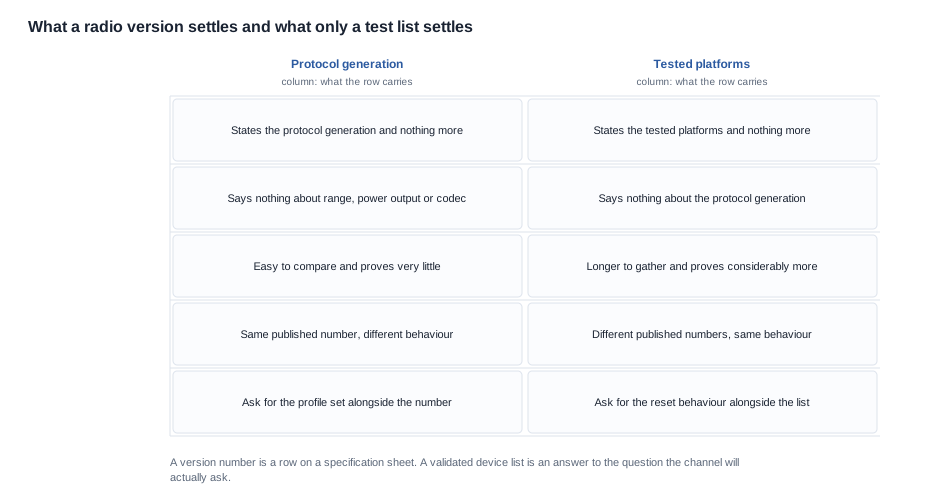
The conclusion for a procurement manager is that the version number is not the thing to ask for. A version states what the chipset is capable of; it does not state what has been tested, and it does not state what a customer in a particular channel will actually be able to pair with. The question that decides a connectivity programme is a validated compatibility list, and the version number is a line item inside that list rather than a substitute for it.
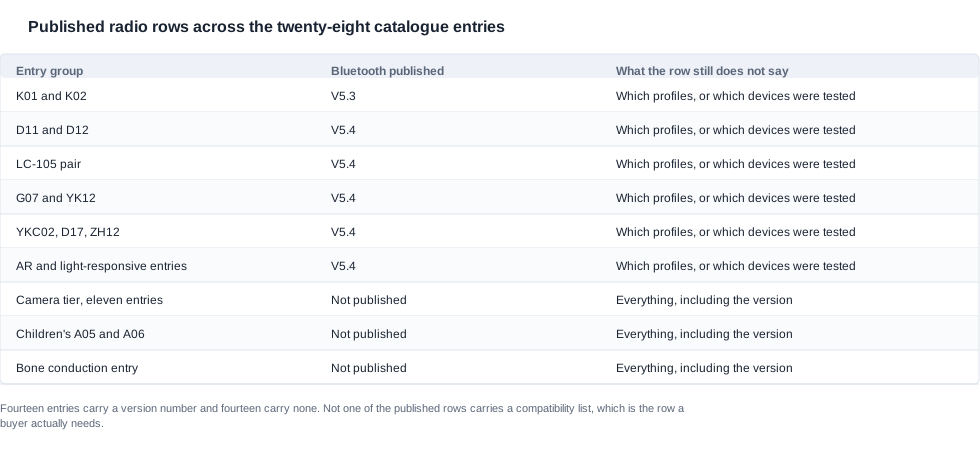
There is a second conclusion, and it is about reading our own range carefully. Fourteen of the twenty-eight entries in our catalogue publish a Bluetooth version. The K01 and the K02 publish V5.3. The D11, the D12, the LC-105-1, the LC-105-2, the G07, the YK12, the YKC02, the D17, the ZH12, the AR entry and the light-responsive entry publish V5.4. The other fourteen publish no radio version at all: every one of the eleven camera models, the A05 and the A06, and the bone conduction entry.
That split is worth reading carefully rather than as a quality ranking. The two V5.3 models are the K01 and the K02, and they publish a 90 mAh by 2 cell configuration with roughly eight hours of runtime and magnetic charging. The V5.4 models next to them, the D11 and the D12, publish a single 100 mAh cell with roughly seven hours and Type-C charging. So the older protocol in our range sits on the longer published runtime. We publish that as it stands and we do not present the version split as a quality argument, because in this range the version and the published runtime point in opposite directions.
The five rows that decide a connectivity programme
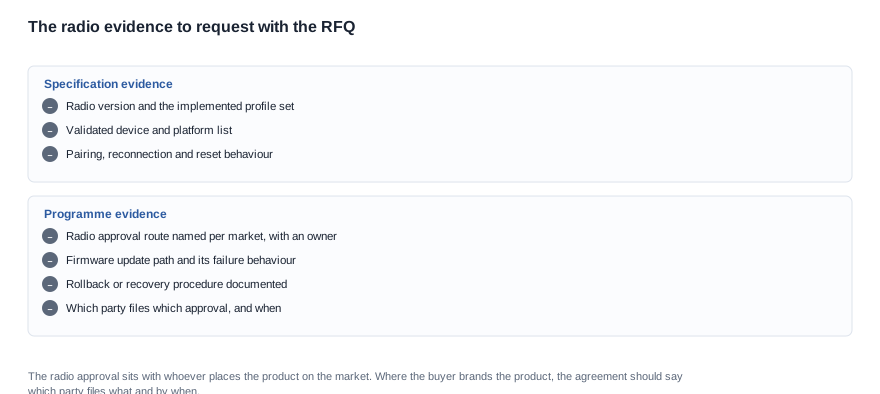
The version and the implemented profile set, together. A version number alone is not a specification, because a radio can implement a fraction of what its generation allows. Ask for both in one answer, and ask for the profiles that matter to the channel: the audio distribution profile for an audio product, the hands-free profile for a call product, and the file transfer profile if the channel expects it.
The validated compatibility list. Not the version, and not a general claim of compatibility with a platform. A list names the platforms and device families that were actually tested against the configuration. This is the row that separates the manufacturers from the resellers, and it is the row a buyer can use to compare two quotations on something meaningful.
The connection and reconnection behaviour. How the link is initiated, how many devices are remembered, what happens after a reset, and what happens when the connected device has been replaced. These are the interactions that generate the support contacts in the first month of a programme, and they are rarely documented.
The radio approval route per market, with an owner and a date. This is a gating item rather than a cost item, and it is one of the longest waits in the chain. Where a programme targets several markets, each route is separate, and the first one usually gates the rest of the documentation.
The firmware update path and its failure behaviour. A device that can be updated but cannot be recovered when an update fails is a device that becomes a return. Ask for the rollback or the recovery procedure, not only for the update method.
A sixth row is worth adding if the programme is branded, and it is the one that most often gets missed: which Bluetooth Design Number covers the model, and who holds it. The trademark qualification is separate from the radio authorisation, and the identifier is a Declaration ID — formally a Design Number since the QPRD v5 revision — with the conformance testing run at a qualified test facility. A buyer who has not asked who holds the identifier for a private-label programme has not finished asking.
Who carries the radio approval risk in a branded programme
The reader here is a brand-side product owner working with a procurement manager, a channel buyer building a private-label range, or a compliance owner who has just discovered that the approval route for one market is longer than the production schedule. The situation is one of three: comparing quotations that quote different radio positions, opening a new material number for a market with a defined approval requirement, or taking over a programme where the radio paperwork belongs to a different entity.
The allocation of that risk is the first thing to settle, because in a private-label programme the radio obligation can sit in three different places and the difference is a schedule of weeks. Where the factory places the product on the market under its own name, the factory holds the radio approval and the buyer inherits a product that is already compliant. Where the buyer brands the product, the buyer's obligations become direct, and the agreement has to say which party files what, with what identifier, by when. And where a distributor imports and places the product under its own name, the distributor becomes the party carrying the obligation, and the agreement has to reflect that rather than assume the factory's position.
The practical consequence of getting this wrong is a programme that stops at the border. A shipment arrives with documentation that names a different entity, or names a model that does not match the units, and the goods are held. This is not a theoretical failure: it is the most common schedule failure in this category, and it happens because the radio paperwork was treated as an administrative detail at a point where the brand structure had not been decided.
There is a second risk holder that buyers forget, which is the customer whose devices the product pairs with. A connectivity feature is a promise about other people's hardware, and that promise is made by the buyer through the listing rather than by the factory through a datasheet. If a customer in the channel cannot pair the product to the phone model they already own, the return arrives attributed to the glasses, and the buyer has no visibility into the compatibility evidence because nobody asked for a list.
There is a third and quieter risk holder, which is the support team. Radio behaviour is where the "it worked yesterday" contacts come from, because the state of a connection changes after a reset, after an operating system update on the customer's phone, or after a firmware update on the device. A programme with a documented connection and reconnection behaviour has a support script; a programme without one has a support cost that nobody has budgeted.
Where the cost of a radio configuration sits in the schedule
The radio is a gating item rather than a cost item, and that distinction changes how it should be handled commercially. The route has a duration and a cost, and neither is compressible by the factory, so it belongs in the schedule as an external dependency with a date, in the same category as a custom lens, a custom cell or a certification route.
The first cost is the approval itself, per market and per configuration. In the European Union the relevant instrument is the Radio Equipment Directive (EU) 2014/53/EU, which is the directive that covers radio equipment; the EMC directive (EU) 2014/32/EU is a different instrument and the two are frequently confused in supplier correspondence. The EMC side of the same assessment runs through the EN 301 489 harmonised standards, which are standards rather than the directive, and mixing the two up is a reliable way to receive an incomplete file. A buyer who writes the correct instrument number into the request gets a faster and more accurate answer.
There is a second regulatory point that catches branded programmes, and it is worth naming because it is often the reason a radio-approved product is still not sellable. A current radio is not the same thing as a compliant product. The European cybersecurity requirements that apply to certain categories of radio equipment — the EN 18031 series — sit alongside the radio approval rather than inside it, and the evidence for them is a separate assessment against a separate model. Asking for the radio route alone can produce a product that has cleared the radio and has not cleared the rest.
The third cost is the re-test that follows a configuration change. Changing the antenna, the housing, the radio module or the firmware can invalidate the radio approval, and the re-test is charged per configuration. This is the line that compounds across a range, and it is why a programme with four colourways and one sealed variant is not one radio position.
The fourth cost is the firmware freeze and the update-path work. If a brand needs its own firmware on a branded radio, that is an engineering dependency with a schedule attached, and it is cheaper to schedule early than to add later.
The fifth cost never appears on a quotation: the connection-related returns. A radio that connects unreliably in the environments the channel actually uses produces returns that are not defects and never appear in the defect rate. The defence is the same as everywhere else in this category: a documented behaviour and an acceptance criterion.
So the buyer's negotiating space sits in the configuration definition, the firmware scope, the entity that files the approval and the acceptance criteria for connection behaviour. It is not in the price of the radio module.


Verifying a radio answer before the purchase order
Verification here combines documents with a short physical test, and the physical test is the part that produces evidence a buyer can show a channel.
Step one: ask for the version and the implemented profile set in one answer. A supplier who quotes a version without the profile set has given a generation, not a specification. The profile set determines what the product can actually do, and it is the row that a listing should be built on.
Step two: ask for the validated device list rather than the version number. Ask where the list is held and how current it is. A list that is two years old describes a market that has moved, and a list that covers only the platforms the factory tested with describes a narrower market than the one the channel sells into.
Step three: confirm the radio approval route per market, with an owner and a date. Ask which instrument applies in each market, who files it, in whose name, and what the identifier is. If the buyer brands the product, this is the moment to establish which party files.
Step four: test connection and reconnection on a sample unit. Include the cases that generate support contacts: a first link, a reconnection after the phone has been locked, a connection after a device reset, a connection after the phone has been replaced with a different model, and a connection in the environment the product is sold into rather than on a bench. Write down what happened, because the answers become the acceptance criteria and the support script.
Step five: ask what happens when a firmware update fails. A documented update path with a rollback or a recovery procedure is the difference between a recoverable problem and a return. If the answer is that there is no rollback, ask what the recovery procedure is.
Step six: put the identifiers and the criteria into the purchase order. The Design Number and who holds it, the approval route and its owner, the profile set, the validated list as an attachment, the connection behaviour, the update path, and the defect remedy for a unit whose radio behaviour does not meet the agreed criteria.
How radio programmes fail
The version quoted as compatibility. A version number was compared with a competitor's validated device list and the comparison was published internally as a result. The root cause is that a generation was treated as a test record. The control is to require the validated list and to compare on that basis.
The connection that nobody tested. The connection flow behaved differently on the platform the channel sells on. The root cause is that the sample evaluation was done on a bench with one phone. The control is to add platform-specific connection tests to the sample evaluation, including a second phone model from the same channel.
The approval route started after production. The gating document route was scheduled after the production slot was booked. The root cause is that the approval was treated as a documentation task rather than as a schedule dependency. The control is to start the radio route at the same time as the rest of the documentation and to carry it as an external wait with a named owner.
The failed update with no rollback. A customer bricked a unit and it was returned as a defect. The root cause is that the update path was specified as a method rather than as a recovery procedure. The control is to require a documented update path with a rollback or a recovery procedure, and to test it on a sample unit.
The paperwork in the wrong entity's name. A shipment was held because the approval named a different party than the one placing the product on the market. The root cause is that the brand structure was never written into the documentation request. The control is to establish the placing entity, the filing party and the identifier before the first production slot is booked.
The identifier nobody held. A private-label programme reached the artwork stage with no Design Number assigned. The root cause is that the identifier was requested last. The control is to ask for it in the first round and to treat the launch date as derived from it.
A designation handed over at the artwork stage is an ordinary oversight, not grounds for moving the order. It is grounds for asking for the number in the first round, while the launch date is still open.

The terms a radio programme can move, and the ones it cannot
The commercial shape of a radio programme is unusual in that most of the money is in time rather than in price, and the negotiating capital is therefore best spent on schedule and scope rather than on unit price.
The configuration and the firmware scope are the live commercial numbers. Where a radio differs between configurations, ask whether they are separate orderable configurations with their own part numbers, and commit to a configuration count rather than a unit count. On the firmware side, the number of releases before production, the update delivery method and the recovery behaviour are all workable points, and a brand that needs its own firmware on day one should say so at quotation stage rather than after the freeze date.
The number of markets is negotiable in structure. A programme that opens one market first and adds others later carries a smaller documentation burden than one that opens all of them at once, and the option is usually cheaper than the full set. Ask what the incremental cost and elapsed time of the second and third markets are before committing to a list.
Sample cost, evaluation unit quantities and first-article inspection allowances are negotiable and frequently given away. Under pressure on a first order these are easy to obtain and cost the supplier very little. A radio programme in particular benefits from more evaluation units, because the connection behaviour varies by unit and by phone.
The acceptance criteria for connection behaviour are negotiable in wording and fixed in substance. A supplier will argue about the test sequence and the number of retries. The criterion itself, and the consequence of missing it, are the parts that should not move.
Certification cost and certification time are fixed. The radio route is a per-market, per-configuration cost and a queue at the test laboratory, and pressing on either produces a longer schedule rather than a shorter one. The cybersecurity evidence that sits alongside the radio approval is a separate assessment with its own cost. A re-test caused by a configuration change is charged per configuration, which makes it the line that compounds across a range.
The radio module and the approval route are not commercial variables. If a market requires an approval under a given instrument, no negotiation changes which instrument applies. What negotiation can do is change the number of configurations, the number of markets, the firmware scope, the size of the first order, the documentation obligations and the acceptance criteria that bind them.
The clauses worth having in the agreement are these. The radio version and the implemented profile set, written as configuration attributes. The validated compatibility list, attached. The Design Number, and who holds it. The radio approval route per market, with the filing party and the owner named. The connection, reconnection and reset behaviour. The firmware update path with its failure behaviour. And a change-notification clause covering the radio module, the antenna, the housing and the firmware.
A worked example: a brand entering a second European market
This is a worked case rather than a client project. That order is the point of it.
Assume a brand that already sells a private-label audio line into one European market, with the factory placing the product on the market under the factory's own name, and the factory holding the radio approval. The brand now wants to place the product under its own name in a second market. The constraint that matters is not the radio itself. It is that moving from a factory-placed product to a brand-placed product transfers the approval obligation, and nobody in the brand's team has done that before.
The first move is to establish the entity question explicitly, because everything else depends on it. The brand asks the factory three things: who holds the radio approval for the existing product, whether the existing approval can be extended to a new placing entity, and what the identifier situation is. The answer is that the approval would need to be refiled in the brand's name, that the Design Number needs to be held or licensed for the branded configuration, and that the conformance testing would have to run at a qualified test facility against the branded model designation.
The second move is to open the route before the artwork. The brand asks for the route, the owner and the date in the same round as the quotation, and it asks the factory for the EN 301 489 evidence as a separate item from the radio approval so that the two are not confused. It also asks about the EN 18031 cybersecurity evidence for the branded configuration, because a current radio is not a compliant product and the brand does not want to discover the second exercise after the first one is closed.
The third move is the compatibility question. The brand asks each supplier for the validated device list rather than the version number, because the channel sells on a small set of phone models and the brand needs to know which of them were actually tested. One supplier's list covers the channel's phones and states the firmware revision it was tested against. The other gives a version number and a general statement. The brand now knows that the second quotation is not comparable with the first, and it prices the schedule risk accordingly rather than the unit price.
The fourth move is the physical test, done properly and early. The brand buys evaluation units and tests pairing, reconnection after a reset, and reconnection after the phone has been replaced, using two phone models from the channel and doing it in an environment with more radio traffic than an office bench. It records the results, and the recorded behaviour becomes the acceptance criteria in the order and the support script.
The fifth move is commercial. The brand commits to one market for the first filing and asks what the second market's incremental cost and elapsed time are, and the factory prices the second route rather than absorbing it. The brand takes that route because it can now compare two dated options, which it could not do before the questions were asked.
The result is a brand that knows what it holds, a route with a date rather than an assumption, a compatibility position it can put in a listing, and a second market priced as a decision rather than discovered as a delay.
What our catalogue publishes about Bluetooth, and what it leaves open
The published material on connectivity is the part of the specification we can stand behind, and everything else belongs in the supplier's own file. We publish the rows our catalogue states, we mark the open rows as open, and we will not fill an open row with a typical value from a general data sheet.
These are the rows we do not publish:
- The implemented profile set is not published for any entry.
- The validated compatibility list is not published for any entry.
- The connection, reconnection and reset behaviour is not published.
- The firmware update path and its failure behaviour are not published.
- The Bluetooth Design Number, and who holds it, are not published.
- The radio approval route per market and the filing entity are not published.
These are the rows our published data does settle:
- Fourteen of the twenty-eight catalogue entries publish a Bluetooth version, and fourteen publish none. Every one of the eleven camera models publishes no radio version, and neither do the A05, the A06 or the bone conduction entry.
- V5.3 is published on the K01 and the K02, which publish a 90 mAh by 2 cell configuration, roughly eight hours of runtime and magnetic charging.
- V5.4 is published on the D11, the D12, the LC-105-1, the LC-105-2, the G07, the YK12, the YKC02, the D17, the ZH12, the AR entry and the light-responsive entry.
- The charge times published alongside those entries are two hours or less on every one except the D17 and the ZH12, which publish about one hour, and the rated runtimes run from roughly six hours on the slim-temple audio models to roughly eight hours on the LC-105 pair.
What we will not do is infer a codec, a range or a power figure from a version number, and we will not present the V5.3 and V5.4 split across our own range as a quality argument when the cell capacities behind those models point the other way. What we will do is take a use case, a configuration and a target market, and tell you which parts are settled, which are open, and which have to come from a sub-supplier.
The bluetooth connectivity pillar carries the longer treatment, reading a supplier's claims covers the language used in quotations, establishing the behaviour yourself covers the physical test, and the assumptions to avoid is the shortest of the four. The bluetooth audio glasses range is where the published radio rows sit, and bluetooth SIG certification covers the identifier and qualification side.
The action to take this week
Ask for the validated compatibility list, not the version number, and ask for the implemented profile set alongside the version in the same answer. Those two rows are the ones a competitor's datasheet cannot substitute for.
Then settle the entity question before anything else is scheduled: who places the product on the market in each destination, who files the radio approval, in whose name, and who holds the identifier. Write the four answers down, because they determine the route, the owner and the date.
Finally, buy evaluation units and test connection, reconnection after a reset and reconnection after a phone replacement, using the phone models the channel actually sells and in an environment with real radio traffic. Record the results and put them in the order as acceptance criteria. Send us the model, the quantity and the target market and we will tell you which of the published rows apply and which questions are the ones we would put to the factory ourselves.
Related reading
- Reading a supplier's claims — bluetooth version manufacturer claims
- Establishing the behaviour yourself — bluetooth version real world performance
- The assumptions to avoid — bluetooth version buying mistakes to avoid
- bluetooth connectivity
- bluetooth audio glasses
- bluetooth SIG certification
Send the configuration, the quantity and the market, and we will say which parts of the radio specification are settled and which are yours.


