

Smart glasses bluetooth version smart glasses buying mistakes to avoid cluster around one habit: treating a radio version as though it were a product characteristic. It is a statement about which Bluetooth standard the module was built to, and almost every buyer decision that rests on it — the price, the feature set, the battery life, the market access — rests on something the version does not determine.
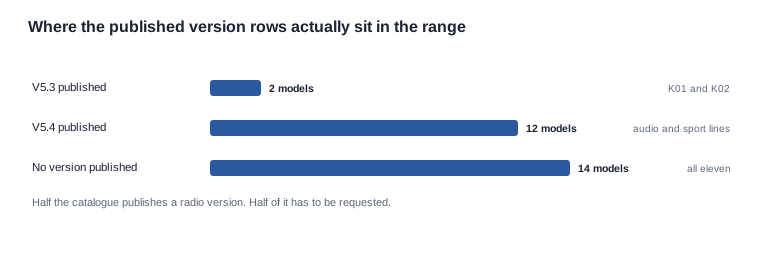
Our published position is narrow and it should be read before anything else in this article. We publish Bluetooth V5.3 on the K01 and the K02, and V5.4 on the D11, the D12, the LC-105-1, the LC-105-2, the G07, the YK12, the YKC02, the D17, the ZH12, the A07, the AR glasses entry and the AI electrochromic entry. Fourteen of the twenty-eight models publish no version at all, and eleven of those are camera models. We publish no range figure, no codec, no multipoint behaviour, no deep-sleep current and no design number for any model.
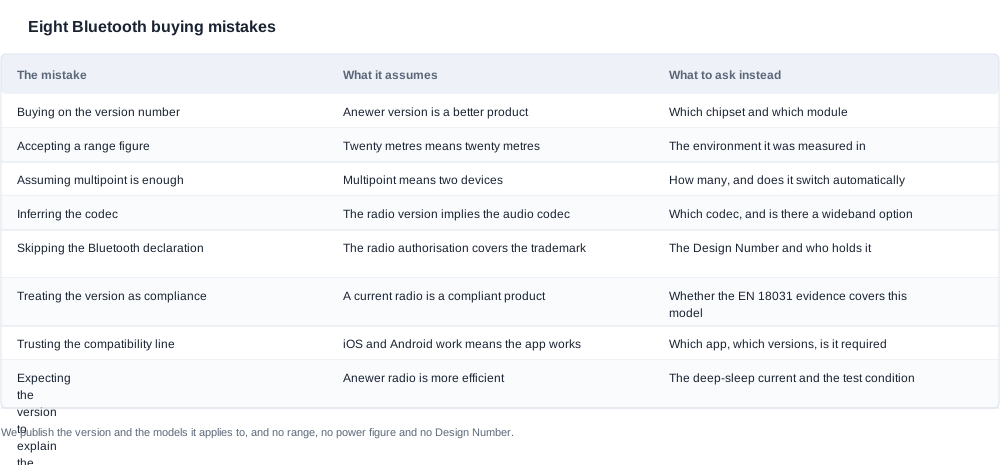
Smart glasses bluetooth version: four mistakes and their shared root cause
Each of the four below is a way of letting the version answer a question it was never asked. Read as a set they share one cause: the version is the most visible row on the sheet, and the most quotable.
Mistake one: reading a version number as a performance score
The newest version is not automatically the better product, because the radio is a component and what the customer experiences is the whole system. Two models that both publish V5.4 — the LC-105-1 on a 55 mAh dual-cell architecture with magnetic charging and a rated runtime of about eight hours, and the D17 on a 115 mAh single cell with Type-C charging and a rated runtime of about seven hours — sit behind an identical radio generation with completely different power budgets, charge paths and duty cycles. The version tells you nothing about which of them will suit a programme.
The same error appears in three other forms, and they are worth separating because each one is easy to catch.
Ranking a shortlist by version. A shortlist ordered 5.4 above 5.3 is ordered by the manufacturer's procurement history. In our range the version corresponds to no other published product difference — not to the cell capacity, not to the charging interface, not to the hours figure — so a ranking built on it is a ranking with nothing behind it.
Reading a range out of the version. "Twenty metres" is the most quoted and least informative figure in this category, because the environment is always omitted. Twenty metres through open air, twenty metres down a corridor, and twenty metres with the device on a body and the phone in a pocket are three different claims, and the body case is the one that decides whether a customer keeps the product. Range is an output of transmit power, the antenna configuration and the environment, and the version is not one of those three.
Inferring the codec, or the battery behaviour, from the version. The radio standard and the audio codec are separate decisions, and a device can run a current radio while negotiating only the baseline codec, which caps call quality well below what a wideband codec delivers. In the other direction, a newer radio is not automatically more efficient in a device this small, because the radio is one load among several — the controller, the camera module and the speaker chain are the others. The figure that decides the overnight loss is the deep-sleep current, and we publish none of it for any model.
The replacement question in every one of these cases is the same: which chipset, which module part number, what transmit power, which codec and which profile. None of those is derivable from a generation number.
There is a structural reason the error persists, and it is worth naming because it affects how a buyer organises a comparison. The version is the only row that is easy to compare across suppliers, so it becomes the column that sorts the table — and a table that sorts on an uninformative column produces a shortlist that nobody chose deliberately. The discipline that prevents it is to decide in advance which column sorts the table, and to write down what that column is. If the column is the cell architecture, the charge path and the workload, then the version is a filed fact and the shortlist is built from the rows that decide outcomes. If the column is the version, the shortlist has been built on the manufacturer's component choices.
Mistake two: treating a compatibility statement as a test result
"Works with iOS and Android" is a statement about an application and a procedure, not about the radio. The useful question is which application, which versions, and whether the application is required for the features the listing claims. A product that connects on both platforms and whose first-run experience does not match the instructions will be reviewed on the first-run experience.
Multipoint is the second version of the same mistake, and it is the one that costs the most in a programme that manages devices for a customer. Multipoint means more than one device can be held at once, and the interesting questions are how many, whether the audio switches automatically when one device starts making noise, and whether the device remembers more than two. A pair of glasses that holds two connections but will not move audio from the phone to the laptop without a manual step is a different product from one that will, and no version number distinguishes them.
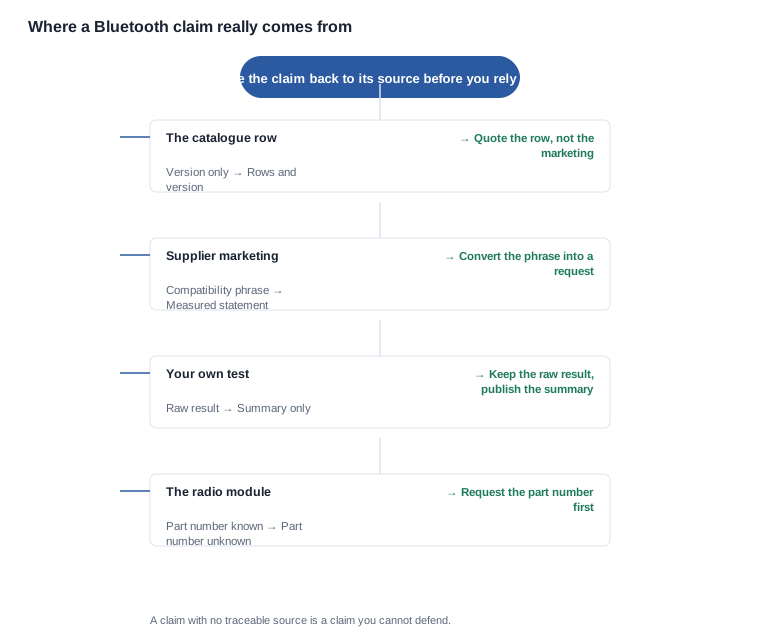
The correction is a device list rather than an adjective. Name the host models, name the operating system versions, attach the date and the image level, and state which combinations were tested and which were not. A compatibility statement without that list is a slogan, and a slogan is the thing a customer is most likely to quote back in a review.
Two consequences follow for procurement. First, the device list is an input to the test, not an output, and it has to be agreed with the supplier before the test rather than assembled from whatever the customer complains about. Second, the request to a supplier has to be specific — a named device list, a request for the raw result rather than a summary, and a request for the failures as well as the passes. A supplier who will return raw results is telling you that the qualification exists.
A device list worth testing against has three properties, and the third is the one most often missing. It names the host models, it names the operating system versions, and it names the share of the customer base each one represents. Without the third, the list is a technical exercise with no commercial meaning: a platform that covers two per cent of the customer base and fails is a support line, while a platform that covers thirty per cent and fails is a programme. The share is what converts a radio qualification into a decision, and it is the number a supplier will never volunteer.
Mistake three: forgetting that the case is a second radio
A product that ships with a charging case puts two radios from the same model into the same environment, and most buyers price the case as an accessory and forget that it participates in the radio environment. We publish case capacities of 900, 1200 and 1400 mAh across the range, and the case's own radio behaviour and connection count are not published for any model.
The four questions that close this are short. Does the case have its own Bluetooth identity, which means it appears as a separate entry in the customer's device list? Does it connect independently of the device? How many connections does each of them hold? And is the case's radio active while the device is being used?
The answers change the product in three places. They change the listing, because a two-identity product needs two identities explained. They change the support script, because a customer who cannot tell which entry is which will call. And they change the qualification, because a coexistence result obtained with the case nearby is not the same result as one obtained with the case absent.
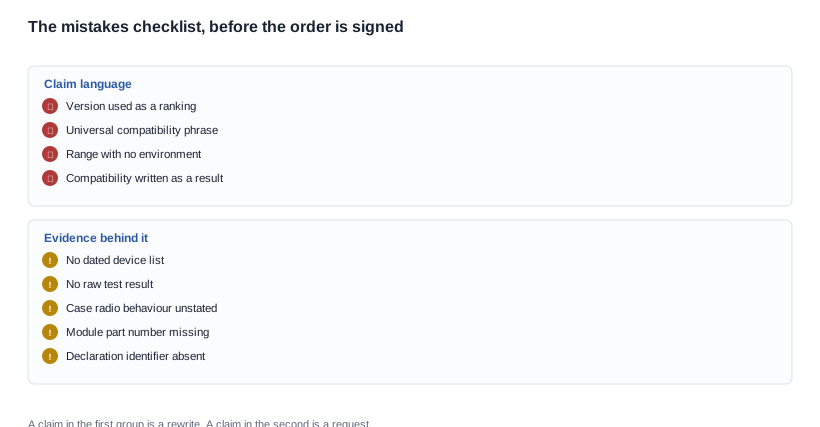
The mistake here is not that the case is ignored; it is that it is ignored in a way that is invisible until the customer owns two of them. The remedy is cheap and has to happen before the copy is written.
The wider environment adds a second dimension that the case makes worse. A radio has to coexist with the other 2.4 GHz traffic in the room, and the traffic in a retail floor, a warehouse or an office at peak time is orders of magnitude above what a test bench produces. A case in the pocket adds a third radio to that environment. None of this is visible in a version number, and all of it is visible in a range figure that carries an environment, a distance and a unit count — which is why the three together are the useful package rather than any one of them alone.
Mistake four: assuming the version you quoted is the version that ships
A version is agreed, sampled, listed and shipped, and three separate things can move in between. Each of them breaks the same assumption in a different way.
The module can change underneath the version. A part-number substitution keeps the version string and changes the behaviour. This is why the module part number belongs in the purchase order and the build sheet, and why a version number alone is not a freeze. The check is a build sheet line, and it is the check that catches a substituted platform before it reaches a customer.
The declaration is not the same instrument as the approval. Using the Bluetooth trademark and the protocol requires a Bluetooth SIG qualification, and the identifier is a declaration ID, formally a design number, with the conformance testing run at a qualified test facility. The radio authorisation and the trademark declaration are two separate instruments, and a supplier who holds one does not automatically hold the other. The replacement question is which design number covers this model, and whether your brand can inherit it rather than qualifying from scratch.
A current radio is not a compliant product. The cybersecurity requirements in EN 18031 have been a mandatory component of the CE mark since 1 August 2025, and they ask for a security and privacy risk assessment, testing and documentation, and a vulnerability handling process. None of that is a property of the Bluetooth version, and a product with a 5.4 radio and no evidence is exactly as exposed as one with a 5.3 radio and no evidence. The replacement question is whether the radio inside this model is covered by the EN 18031 evidence set, and by which document.
The commercial exposure of getting this wrong is not the re-qualification. It is the channel: a listing that promised a radio generation and delivered a different one has to be withdrawn, and the inventory behind it has lost its market position. Which is why the freeze term, the notice obligation and the module part number belong in the agreement, and why a version quoted in a specification without them is a quote you will have to honour twice.
Three clauses close it, and they are specific enough to be written today. A clause naming the module part number as the controlled component. A notice obligation on any change to the module, the host stack or the radio behaviour, with a period that your own lead time can absorb rather than one the supplier chooses. And a clause stating the freeze term, which should cover the replacement cycle of the channel rather than the life of the product. Without all three, the version in the specification is a number that a supplier can change without a conversation, and the conversation then happens with a customer instead.

The correction table: what each claim actually rests on
The eight claims below are the ones that arrive by habit. Each of them has a defensible version, and the defensible version is always narrower than the original.
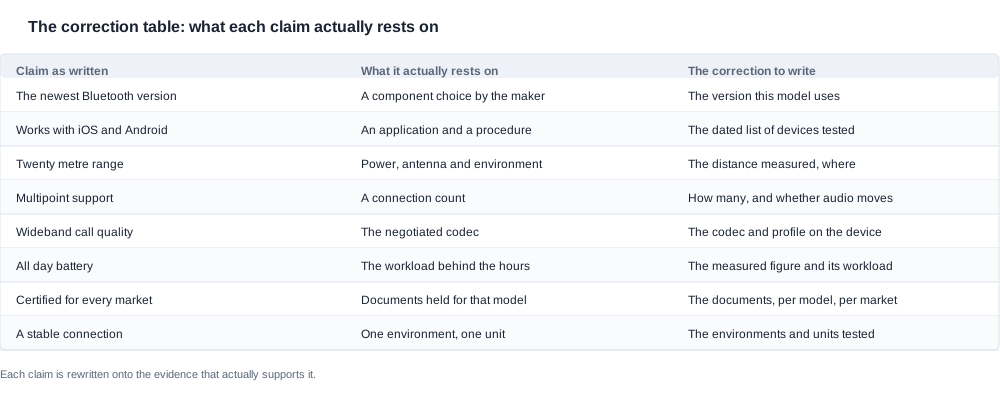
Three properties of the table are worth naming. The corrections are not weaker claims; they are narrower ones, and a narrow claim is one that can be defended by a document. The corrections do not require new engineering — every one of them is available as a request to a supplier, and most of them exist already in the factory's records. And the corrections are cheaper, because the cost of a narrow claim is a sentence in a specification while the cost of a wide one is a return, a review and a document retraction.
Running the correction across a whole specification sheet takes one afternoon and produces two lists. The first is the set of claims that can be rewritten now, using evidence that already exists in the factory's records and in your own test documentation. The second is the set that cannot, which is the request list. What matters is that the two lists are kept apart, because a claim that cannot be rewritten yet still has to be removed from the listing while it is unverified — it just cannot be replaced with a better version. The failure mode is to leave the unverified claim in place because the replacement is not ready, and that is how a wide claim survives a process that was supposed to remove it.

What a corrected specification looks like in practice
Before, in the kind of sentence that reaches a supplier's brochure rather than a procurement file:
This model supports the latest Bluetooth 5.4 standard, offering a stable connection with a range of up to twenty metres, and is compatible with all iOS and Android devices. Multipoint allows two phones to be connected at once, and the built-in battery delivers all-day use.
After, with every phrase placed on the evidence that supports it:
The radio is a Bluetooth 5.4 module, part number as listed on the build sheet. The model was connected against the host devices listed in the compatibility record, dated and identified by image level, with the untested combinations listed as untested. The connection count and the audio routing behaviour are as recorded in that document. The case, supplied with the model, presents its own identity and its own connection behaviour as described in the same record. The measured runtime and the workload behind it are recorded separately, and the charging interface and case capacity are as published for this model.
The second version is longer, which is the point: it is longer because it is specific, and every clause in it can be checked against a record. It also survives the two questions that end most claims in this category — what happens when the module changes, and how do you know — because both answers are already contained in the document it points to.
Getting the correction accepted internally is a separate exercise from making it, and it has its own failure mode. The marketing function will resist the loss of the wide claim, because the wide claim is the one that wins the comparison on a shelf. The argument that usually settles it is not about accuracy but about exposure: a wide claim that turns out to be unsupported is a retraction, a stock write-down and a support conversation, and all three of those are measurable while the narrow claim is not measurable at all. The narrow version is defensible, and defensibility is what the argument is really about.
What we publish beside the version, and what we will not infer
The boundary we hold: we publish the version because the catalogue states it, and we publish the empty rows next to it rather than filling them with typical values from the industry. We will not infer a codec, a range or a power figure from a version number, and we will not present the 5.3 and 5.4 split across our own range as a quality argument when the cell capacities behind those models point the other way.
There is a second reason for the same discipline that is worth stating plainly. Half the catalogue publishes no radio version at all, and the missing half includes every camera model. A programme that assumes a version for those models is not making a small error; it is filling eleven rows of a compliance file with a number that nobody published, and those rows are the ones a customs query or an audit will ask about.
What we can do is take a specification sheet and mark every Bluetooth claim on it as verifiable, testable, or neither — and then run the testable ones against your device list, in your environment, on a sample set, and give you the record. The marking is worth doing before the sample order rather than after it, because the claims that turn out to be neither verifiable nor testable are the ones that have to come out of the listing copy, and removing them late is a reprint. The technical background is under bluetooth connectivity, the audio platforms are on the bluetooth audio glasses page, and the compliance instruments are under bluetooth SIG certification.
Related reading
- Reading a supplier's claims — bluetooth version manufacturer claims
- Establishing the behaviour yourself — bluetooth version real world performance
- The questions a version cannot answer — bluetooth version limitations and drawbacks
- The rows that decide a shortlist — bluetooth version buying checklist
Send us the Bluetooth rows in a supplier specification sheet and we will mark each of them as verifiable, testable, or neither.


