
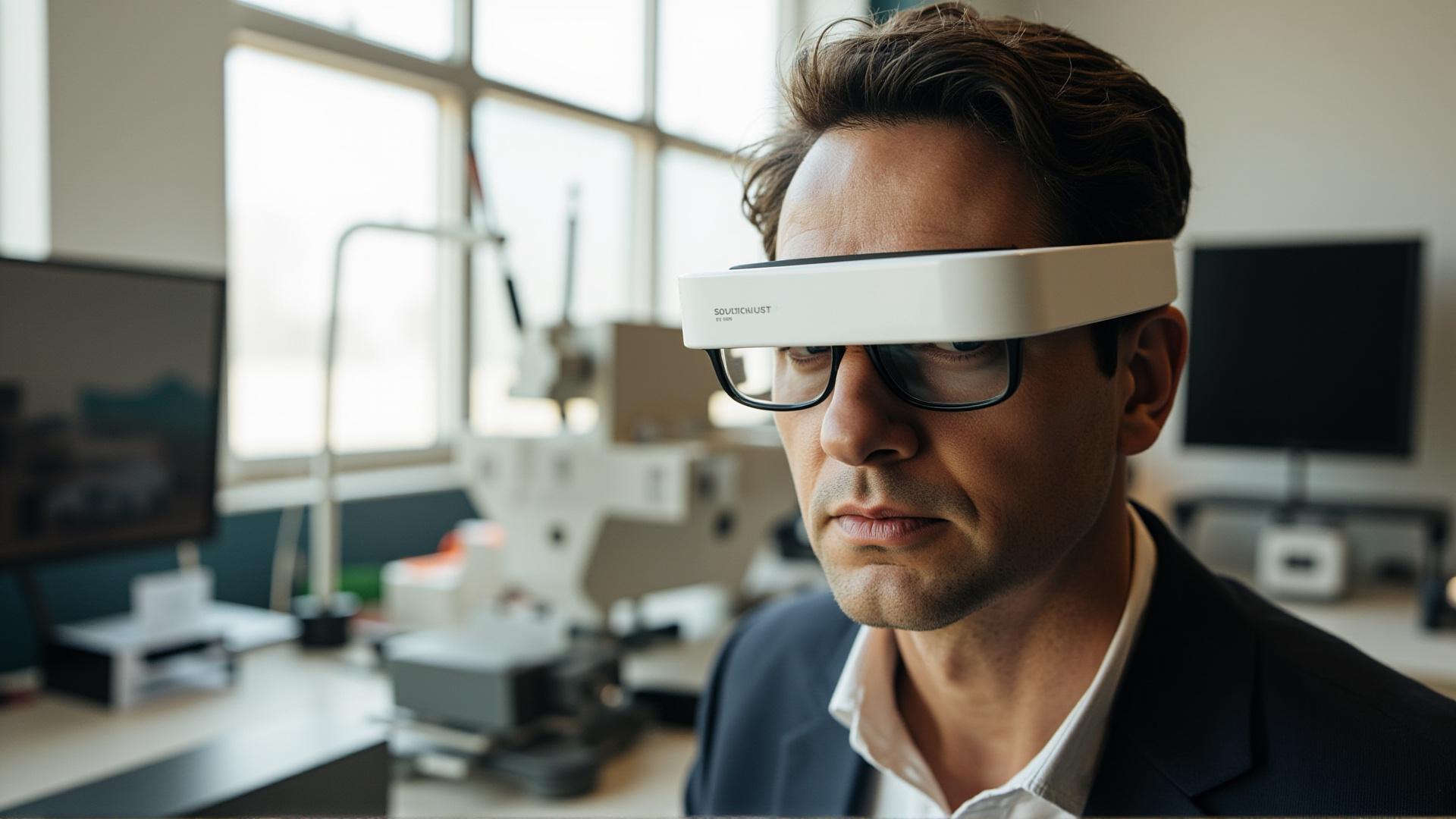
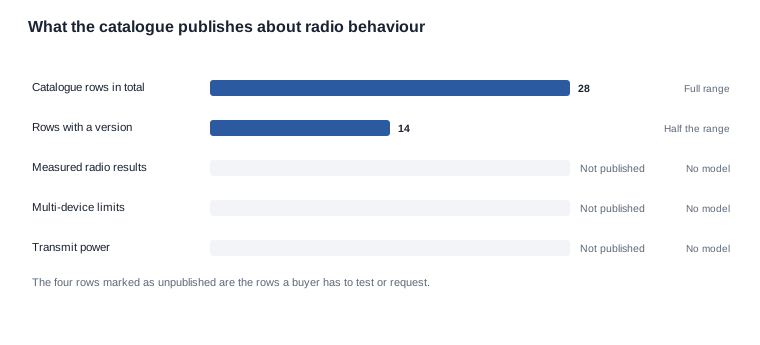
A published Bluetooth version constrains what a device can do. Only a measured sample establishes what it does, and the two are not the same kind of statement. Our catalogue publishes a Bluetooth version on 14 of its 28 rows — two at V5.3, twelve at V5.4 — and publishes no measured radio behaviour at all: no range figure, no dropout rate, no coexistence result, no multi-device limit. That leaves the honest position with two parts, and a buyer needs both. The specification tells you which questions are worth asking, because it fixes the radio generation and therefore the feature set the device was built against. The sample tells you the answers, because stack capability is an upper bound and the antenna, the power budget and the firmware decide the result.
Smart glasses Bluetooth version: prediction and its limit
The version predicts a class of behaviour, not a number, and the published rows make that concrete. Two models in the catalogue both publish V5.4: one runs a 55 mAh × 2 configuration with a rated runtime of about six hours, the other a 290 mAh cell with a 1400 mAh charging case and a rated runtime of about seven hours. The radio generation is identical. The headroom behind it is not. A buyer who expects a V5.4 model to behave like a flagship because of the version is extrapolating from a row that does not carry that information, and the inference will fail in whichever direction the cell happens to point.
The cell configuration predicts the standby behaviour more reliably than the version does. Deep-sleep current is what sits between uses, and it is one of the few radio-related quantities that is benchmarkable across the industry rather than within one supplier's own catalogue. We publish it for no row in the range, which makes it a question for the supplier and one more reason the sample matters.
The version does predict the compliance path, and this is where it earns its place in the file. A radio inside a product sold into the European Union puts that product inside the Radio Equipment Directive (EU) 2014/53/EU, with the EN 18031 series cited as the harmonised standard for the cybersecurity requirements that apply where the product processes personal data. A radio sold into the United States needs an FCC Part 15 equipment authorisation. A radio using the Bluetooth trademark and the Bluetooth protocol needs a Bluetooth SIG qualification, which is a separate instrument, answered by a different organisation, and carried by a separate cost. None of that is a performance matter, and all of it is more often the thing that actually holds up a launch.
The host side is part of the product
One thing a version number quietly hides is that a wireless product is two devices. The glasses are one end and the phone is the other, and the behaviour a customer experiences is produced by the negotiation between two radio stacks that belong to two different organisations. The supplier controls one of them and the operating system vendor controls the other, which is why the same unit can behave differently against two phones from the same manufacturer running different builds.
For a buyer, that has a practical consequence for how the evaluation is scoped. The radio version is a property of the device you are buying. The behaviour is a property of the combination. If your customer base is concentrated on one phone family, the evaluation should be concentrated on the builds that family is actually running, and the number of builds you test is a commercial decision rather than a technical one — each additional build is another week of evaluation and another row in the acceptance criteria.
The same logic applies to the update cycle. A phone that updates its radio stack on a schedule your product does not control will change the behaviour of your product without any change to the product. That is not a defect and it is not something a version freeze can prevent, which is why the update duty in the supply agreement and the update behaviour on the host are two separate items and both need to be on the record.
The place where no Bluetooth version is printed is the camera half of the range. The eleven camera models — the MT6 and the MT5, the CY03 and the V03, the S7 and the KY06, the V06 and the L2 Utral, the V03 Pro and the L1 Pro, and the CY05 — publish no radio version at all. That is precisely the class of product whose radio carries a sustained load rather than an idle one, so the specification cannot even set a ceiling on what to expect. For a camera model, the version row is not a weak input; it is an absent one, and the only route to a usable expectation is a sample and a procedure.
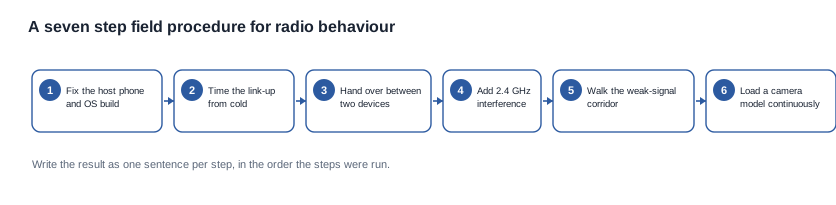
Six procedures that turn a Bluetooth specification into field evidence
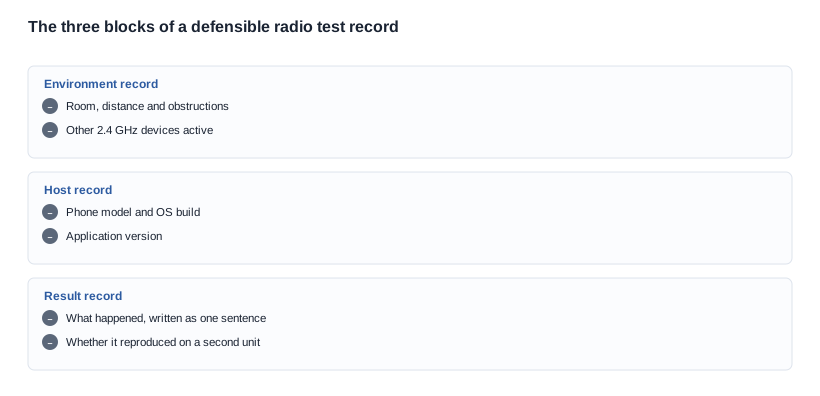
A measurement is only worth what its conditions are worth, so the first thing to fix is the baseline: the phone model, the operating system build, the application version and the unit under test. Radio behaviour is negotiated between two stacks, and the same unit behaves differently against different builds. A result without that baseline attached is not transferable to the next delivery, and it cannot be compared against a result the supplier produces later.
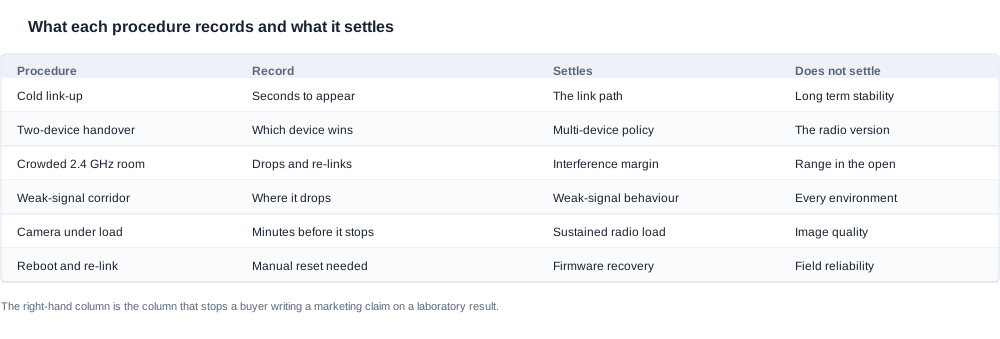
- Cold link-up. Power the unit down, then start it and time the interval between the connection control and the phone listing it. Do it at least three times. The first attempt after a cold start and the steady-state attempt are different numbers, and the difference is what a customer experiences as unreliable.
- Two-device handover. Connect two phones in turn and let the unit hold both. Change which device is active and record which one wins and whether the change is automatic. The simultaneous-connection limit is not published for any row in the catalogue, so this procedure is the only way to learn it, and for a product issued to a fleet it is one of the most commercially important numbers in the whole evaluation.
- A crowded 2.4 GHz room. Run the same link-up with a wireless router, a laptop and a phone all active on the same band. This is the case that separates a radio that works from a radio that works in a showroom, and it is the one most often skipped because it requires a specific room rather than a bench.
- The weak-signal corridor. Walk the unit out of range along a corridor rather than across open space, and note what the unit does at the boundary: a clear disconnect, a stuttering link, or a silent failure that only the phone notices. Write the result as a sentence with the environment attached, because the distance on its own means nothing.
- Reboot and re-link. Power-cycle both ends and observe whether the unit restores the connection on its own or needs a manual reset on the device. Auto-recovery is a firmware decision rather than a radio decision, which is exactly why a version number tells you nothing about it, and it is one of the few behaviours a customer notices daily without ever being able to name it.
- Sustained load on a camera model. On any model that captures, record continuously for as long as the product brief would require and note where it stops. This is the procedure that exposes an unpublished radio version, because a radio under sustained streaming load behaves differently from the same radio carrying idle audio, and the catalogue publishes nothing about either case.
Two further records belong with the six. Note the battery level at the end of a working day, in the state the unit was actually left in, and compare it against the catalogue's rated runtime; the difference between those two numbers is the most direct way to see how a stated condition differs from a real shift. And record whether each result reproduced on a second unit. A behaviour seen once on one sample is an anecdote; the same behaviour seen twice on two units is a characteristic.
Preparing the evaluation before the sample arrives
The procedures are simple, and the part that decides whether they produce anything is the preparation, which happens before the unit is in your building. Decide the host list first: pick the two or three phone models that account for most of your volume and test against those, rather than against whatever happens to be on the desk. A supplier's own evaluation will often use a current flagship because that is what the engineering sample had to hand, which is why a buyer who tests against the volume mix sometimes sees different behaviour from the one in the supplier's report.
Then decide the repeat count before you start, because it is much harder to defend a number that was collected until the result suited. Three repeats of the cold link-up, three of the handover, and at least two units per candidate will produce a range rather than an anecdote. Write down the acceptance condition in advance — for example, that the unit must recover automatically within a stated number of seconds in at least two of three attempts — and agree it with the supplier before the results exist. An acceptance condition written after the results are known is a negotiation, and it is the point at which the evaluation stops being evidence.
Two more practical points carry more value than they appear to. Keep the recordings and the logs, because they are the only material that can be re-read later when a field issue arrives and somebody asks whether the behaviour was ever observed before. And record the firmware and application versions of the sample alongside the radio observations, so that when the supplier ships a revised build six months later, the earlier result remains attributable to a specific state of the software rather than to the model name in general.

Reading a Bluetooth test result without turning it into a claim
Turning a set of observations into numbers
Once the six procedures are run, the results still have to be reduced to something a buying decision can use. The useful reduction is not an average, because an average hides exactly the case that generates a complaint. Report three numbers per procedure instead: the typical result, the worst result observed, and the count of failures across the repeats. A unit that links up in two seconds in two attempts and needs a manual reset in the third has a different commercial value from one that links up in two seconds three times, and only the third number reveals the difference.
The second half of the reduction is to attach a consequence to each figure. A re-link that takes four seconds after a reboot is a delay. A re-link that requires a manual reset on the device is a support contact, and a support contact per user per month is a cost line, not an inconvenience. Writing the consequence next to the measurement at the time of the test is what converts an engineering observation into an argument a finance team will accept, and it is much easier to do while the result is in front of you than three months later when the sample has been returned.
The most valuable output of an hour of testing is a sentence you would be willing to defend in a supplier discussion, in a listing page and in a claim to a customer. Something in the form of "the connection held through a nine-metre corridor with two walls and one router active, dropped once when the phone rang, and reconnected automatically when the phone rang again". That sentence is defensible because it states the condition, the observation and the count. "Bluetooth 5.4" is not defensible, and cannot be, because it describes a standard rather than a device.
That distinction has a commercial consequence that buyers often underestimate. A performance statement written as a version number can only be copied from a catalogue, so it says nothing that a competitor's catalogue does not also say. A performance statement written as a measured sentence is specific to the unit, to the firmware and to the conditions, and it is the only kind that supports a product page claim, a retail listing or an after-sales argument. If the measurement is never written down in that form, the evaluation produced no asset at all, however long it took.
There is a second way results get overstated, and it is worth naming because the procedure cannot fix it: a single measurement is a claim about one moment. A range figure needs repeats, and the repeats should be reported as a range with the best case and the worst case visible, because the worst case is what generates the support ticket. If a supplier declines to let you run the procedures at all, that is information too, though not conclusive on its own, since factories have legitimate reasons to restrict sample handling and shipping. Ask instead for a written description of the coexistence behaviour, the auto-reconnect behaviour and the link-up procedure. That is less than they have to give you in full and considerably more than a version string.
Where an unstable radio turns into a cost
The commercial exposure of a radio behaviour is not in the specification, it is in the afters. A unit that occasionally refuses to connect produces a return, a support contact and a replacement, and the three of those are borne by the brand rather than by the factory unless the acceptance criteria say otherwise. For a product sold at volume through a channel, the afters cost is often larger than the unit cost, and it is the reason a purchase decision that appears marginal on price is not marginal at all once the radio behaviour is known.
There is a second exposure that is easy to miss. A product whose radio behaviour is unpredictable cannot be supported with a written instruction, so every case becomes an individual investigation, and an individual investigation costs far more per case than a scripted answer. If the radio behaviour is settled before the order, the afters script for the most common question in the category can be written once and reused. If it is not settled, the script cannot be written at all, and the business carries the cost of the unanswered question indefinitely.
The third exposure is the one that lands on the engineering team rather than the afters team. An unstable radio produces a defect report against a product that is functioning correctly according to its specification, and those reports are difficult to close because there is no requirement to fail. A written acceptance condition solves this as well: once the requirement exists, a report becomes a report against a requirement rather than an opinion about quality.
What our catalogue does not publish about Bluetooth performance
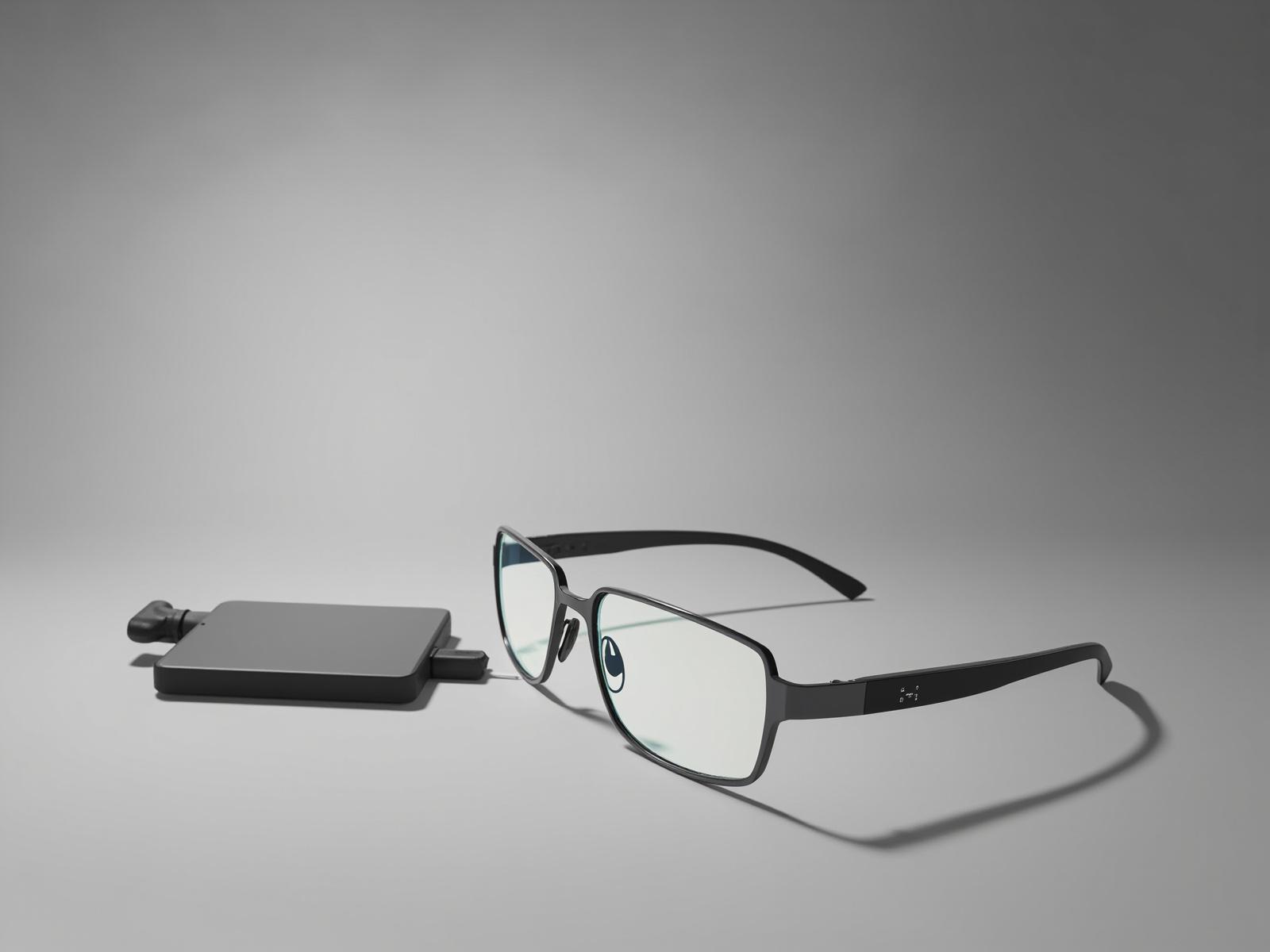
Stated plainly: a radio version is a constraint and not a performance claim, and we will not present the V5.3 and V5.4 split across our own range as a quality argument when the cell configurations behind those rows point the other way. The K01 and the K02 publish V5.3 on a 90 mAh × 2 configuration with roughly eight hours of rated use, and the G07 and the YK12 publish V5.4 on a 55 mAh × 2 configuration with roughly six hours. If the version were the deciding factor, the order of those rows would be the reverse. It is not, and we would rather say so than let a buyer infer otherwise.
We publish no measured radio behaviour for any model in the range: no range figure, no dropout rate, no coexistence result, no multi-device limit, no deep-sleep current, no transmit power and no antenna configuration. We publish the version because the catalogue states it, and we publish that we publish no measurements, because that is equally true and equally useful to a buyer planning an evaluation.
What we will not do is quote a range, describe a reconnection behaviour, or state a connection outcome for any model, because none of them is published to us. Nor will we tell you that a newer generation makes a product better. It makes a product's compliance position stronger and its flexibility larger, and it still leaves the antenna, the duty cycle and the firmware to decide the result.
What we can do is run the procedures with you. Send us the host devices you intend to support, the destination market and the use case, and we will run the six procedures on a sample against your own conditions, record the result in the three blocks above, and tell you plainly which observations are consistent with the published rows for that model and which are not. We will also tell you what a sample can and cannot establish: a sample is evidence about a unit, not about a batch, and any claim about a defect rate has to come from production data rather than from an evaluation desk.
How these results fit into a candidate comparison
Radio results are most useful when they are compared on the same procedure, at the same time, against the same host list. A candidate that was evaluated last year on a different phone, in a different building, against a different procedure cannot be ranked against one evaluated this month, and comparing them will produce a conclusion that neither supplier's data supports.
Where that is the situation — and it is common, because buyers evaluate at different times for different reasons — the honest move is to re-run the procedures on the older candidate rather than to argue about which result is more representative. The cost of re-running six procedures on one unit is small next to the cost of ordering a production run against a comparison that cannot be defended.
Two outputs of this work are worth carrying into the quotation. The first is the acceptance condition, written so that it can be measured on a delivery as well as on a sample, with the procedure, the host list and the repeat count stated inside it. The second is the list of observations that the sample did not settle, carried forward as open items with a named owner. A candidate that failed one procedure is a normal evaluation outcome and is normally fixable; a candidate that failed a procedure which was never run is a sourcing decision you have made without evidence.
The wider radio background sits under bluetooth connectivity, the audio platforms whose rows we can describe in full are on the bluetooth audio glasses range page, and the paperwork side of the radio is set out in bluetooth version supplier verification.
Related reading
- The questions a version number cannot answer — bluetooth version limitations and drawbacks
- Comparing two platforms on the same axis — how to compare bluetooth versions
- The compliance instruments that sit behind the radio — bluetooth version certification requirements
Send us the results of the six procedures and we will tell you which of them are consistent with the published figures for that model.


