
A camera result without its conditions is not a result, and almost every camera result in this category is reported without them. Our catalogue publishes the resolution tier, the cell capacity, the charge time and the rated runtime for every camera platform in the range, the charging method for seven of the eleven camera models and the case capacity for five, and it publishes no sensor model, no field of view, no video format, no frame rate, no stabilisation method and no low-light figure. That combination means the only route to usable evidence about the imaging is to run a structured evaluation and record it properly, field by field.
Nine fields make that record, and each one is there for a specific reason: a missing field is what makes a result unusable later, usually by somebody who was not present when it was produced.
Smart glasses camera technology: results without their conditions
A camera behaves differently on a different day, in a different room, with a different build, at a different distance, and the difference is large enough that a result recorded without those conditions cannot be reproduced. That is not a laboratory nicety; it is the ordinary behaviour of an automatic exposure and an automatic focus system, both of which respond to the scene in front of them. The same unit produces a completely different image in a studio and on a street at dusk, and neither result is wrong.
Two published facts in this catalogue make the point concrete. The first is that the rated runtimes are results rather than specifications: the camera models publish between about five and about eight hours, and about six to eight hours, and about seven hours, across four different cell capacities, with no stated conditions anywhere. Those numbers are useful precisely because their limits are known — they describe a product under conditions the catalogue does not name. A camera evaluation recorded with the same discipline is worth exactly as much as the runtime figure, and exactly as little if the conditions are missing.
The second published fact is that the resolution tier is a count rather than a measurement. Eight MP and 13 MP describe how many pixels a frame contains, and they describe nothing about how large those pixels are, how much light each one gathers, or how the image behaves when the light is poor. A record that says the unit produced an 8 MP image and stops there has recorded the one thing that was already known before the unit arrived.
There is a commercial reason to insist on the conditions as well as the technical one. A camera finding is only useful to a buying team in one of three situations: as a comparison against another unit under the same conditions, as a reference against a later delivery of the same configuration, or as evidence in a discussion with the supplier. All three require attribution. An unattributed camera finding cannot be used in any of them, which means an evaluation recorded carelessly has produced a feeling of confidence rather than a piece of evidence.
There is a second reason to record the conditions that has nothing to do with repeatability, and it is the one that matters in a buying team. A camera evaluation is the only part of a sourcing process that produces information nobody else has. The catalogue rows are published, the supplier's own test reports are published, and the price comparison is arithmetic — but the observation that the assembled product behaves in a particular way under a particular workload is new information, and it only stays new information if it is recorded somewhere other than in somebody's memory. A buying team that evaluates a camera and writes nothing down has paid for the evaluation and kept the feeling.
The transferability test is the simplest way to check a completed record: could a reader who was not present repeat the result? If the light level, the distance, the settings, the firmware and the operator are all written down, they could. If only the conclusion is written down, they could not, and the record is an opinion with a table attached.

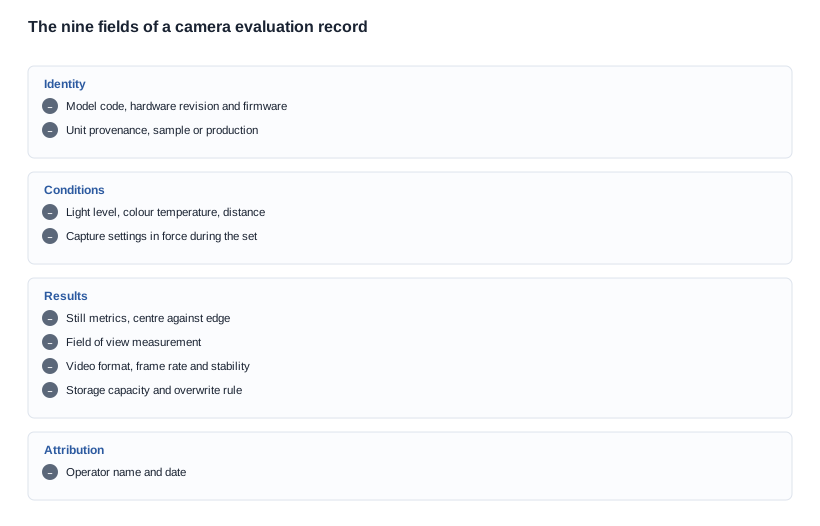
The nine fields of a camera evaluation record
The nine fields fall into four blocks, and the order is the order in which they should be filled in.
Whether a record is complete can be judged against three criteria, and they are worth applying before the record leaves the building rather than after. The first is repeatability: could a second person, in a different room, on a different day, produce the same finding from the same unit? The second is attribution: can every line be tied to a specific unit, a specific firmware build and a specific person? The third is comparability: can the finding be placed next to a finding from another model, or next to a delivery of the same model, and mean something? A record that fails the first criterion is an opinion, one that fails the second is unattributable, and one that fails the third cannot be used to decide anything. Most incomplete records fail all three at once, which is why the template feels repetitive when you fill it in for the first time.
How to evaluate a supplier's camera capability, then, is partly a question of documents and partly a question of records, and the two are not interchangeable. The documents tell you what the configuration is. The record tells you what that configuration did. When a buyer has the document but not the record, they can answer questions about the product and cannot answer questions about the behaviour, and the two sets of questions are not equally important — the behaviour is what the customer will experience. The questions to ask before you order therefore include the one that sounds most like a formality and is not: may we run the nine fields on the evaluation unit, and may we run them again on a unit from the first delivery.
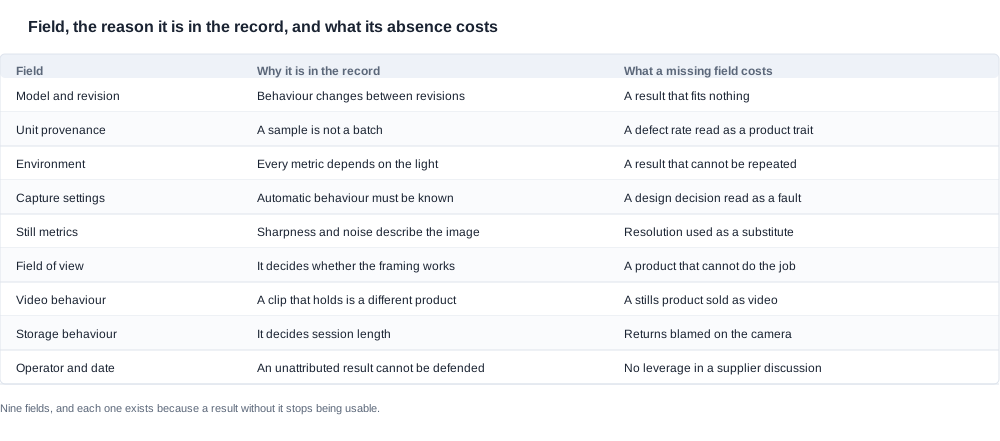
Identity, first, because everything after it depends on it. The model code, the hardware revision and the firmware version identify what was tested. Imaging behaviour changes between revisions, sometimes for the better, and a result attributed to a model name rather than to a revision cannot be attributed to anything. The second identity field is the unit's provenance: which sample it was, where it came from, and whether it is a production unit. A sample is evidence about a unit. It is not evidence about a batch, and the difference becomes decisive the moment somebody decides whether a defect rate is a product characteristic or an artefact of the sample.
Conditions, second, because they are cheap to record and impossible to reconstruct. The environment field carries the light level, the colour temperature and the subject distance. The capture settings field carries the mode, the resolution and any quality setting in force. Automatic behaviour has to be known before it can be judged, because an auto exposure that appears generous in one scene and flat in another is a design decision rather than a defect, and a record that omits the settings will have that decision logged as a fault.
Results, third, and this is where the description of an image actually lives. The still metrics field carries sharpness at the centre against sharpness at the edge, colour consistency and the noise visible in the shadows; resolution is not one of those rows, and a record that only lists the pixel count has not described the image. The field of view field carries a ruler measurement with the distance recorded, which takes five minutes and a sheet of paper and decides whether the product works for first-person capture at all. The video field carries the format, the frame rate, and whether the recording holds through a full minute of movement, because a clip that stutters is a different product from one that does not. The storage field carries the capacity, what happens when it fills and the export path.
Attribution, last and never omitted. Who ran it, and when. An unattributed result cannot be defended in a supplier discussion, and a result from six months ago describes a different product.
In order, the nine fields are:
- Model code, hardware revision and firmware version. Identifies what was tested.
- Unit provenance. Sample or production unit, and where it came from.
- Environment. Light level, colour temperature and subject distance.
- Capture settings in force. Mode, resolution, quality setting, automatic behaviour.
- Still metrics. Sharpness at the centre against sharpness at the edge, colour consistency, shadow noise.
- Field of view measurement. Ruler measurement with the distance recorded.
- Video behaviour. Format, frame rate, and whether a full minute of movement holds.
- Storage behaviour. Capacity, what happens when it fills, and the export path.
- Operator name and date. Who ran it, and when.
The record is deliberately dull. It has no place for adjectives, and every field is either an identifier, a measurement or a condition, which is what makes it usable by a buyer who was not in the room.
Turning a completed record into an acceptance criterion
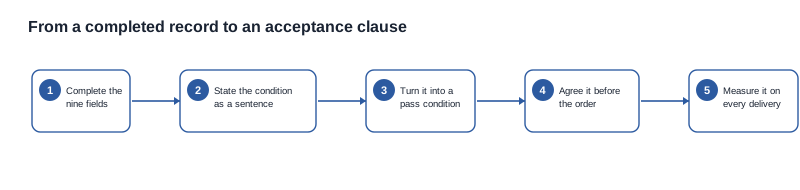
A record is an internal document. An acceptance criterion is a commercial instrument, and the conversion between them is where camera programmes either gain or lose their leverage.
The conversion has four steps. State the condition as a sentence, so that the requirement is stated in the same language as the finding. Turn it into a pass condition, so that somebody can measure it on a delivery rather than interpret it. Agree it before the order, while the conversation is still open. And measure it on every delivery, because a criterion that is only applied to the first sample is a criterion that has already been broken by the second delivery without anybody noticing.
A hypothetical case illustrates the conversion. Take a hypothetical buyer comparing two camera models for a first-person content product, running a structured evaluation on both. Suppose the record shows that the first model captures a full minute of movement without interruption at the published frame rate, transfers a one-minute clip to the phone in the time recorded on the transfer sheet, and holds a field of view measured at the stated distance; and that the second model stops recording before the minute is complete under the same conditions. The finding is not "the first model is better". The finding is a sentence: the second model does not hold a full minute of continuous capture under the tested workload. That sentence becomes a pass condition — a full minute of continuous capture, measured on the delivered unit, under a stated workload — and it becomes a clause in the supply agreement.
What the conversion changes commercially is worth stating plainly. Without a criterion, the finding is an opinion that a supplier can decline to accept, and a defect reported against an opinion is a dispute. With a criterion, the same defect is a report against a requirement, and it is closable. The difference between the two is the difference between a sample programme that produces leverage and one that produces a feeling that something was off.
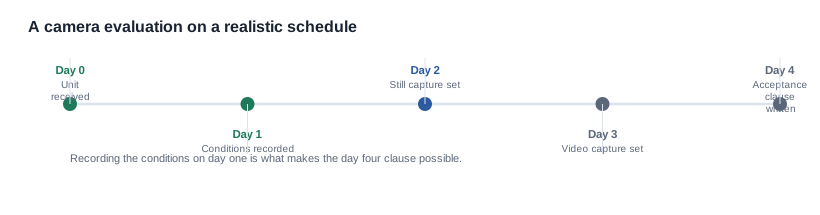
The schedule above is the one that works, and the reason it works is that the conditions are recorded on day one rather than reconstructed on day four. Four days is enough for a first evaluation of one or two models, and it is short enough to be repeated on the next configuration, which is what turns it into a process rather than an event.
Five questions have to be answered before a record becomes a criterion, and a buyer who skips them will produce a clause that cannot be measured on a delivery:
- What exactly is being required — the behaviour, not the impression, and not the pixel count.
- Under what conditions it is required, so that the measurement can be repeated on another unit.
- Who measures it on a delivery, and with what equipment.
- What the pass condition is, stated so that two people would agree on the result.
- What happens when it fails, which is the clause that turns a criterion into a commercial instrument.
The fifth question is the one most often left implicit, and it is the one that decides whether the work was worth doing. A criterion without a consequence is a preference, and a preference written into a supply agreement is a clause that will be renegotiated the first time it is inconvenient.
The cross-check against the published rows belongs at the end of the evaluation, not the beginning. Take the completed record and compare it with the published configuration for that model: the resolution tier, the rated runtime, the cell capacity, the charging method and the case configuration. A finding that contradicts a published row is either a measurement error or a discovery, and both are worth knowing. A finding that agrees with a published row confirms that the catalogue and the unit are describing the same product, which is a smaller result than it sounds — it is the precondition for every other comparison being meaningful.
What a case study template cannot establish
The template is a tool for producing repeatable evidence, and it is worth being explicit about the four things it cannot do, because each one is a common over-claim attached to evaluation work.
It cannot establish a defect rate. A sample is a unit, and a handful of units is not a population. A defect rate comes from production data over a defined period, and any record that implies otherwise should be treated as a misuse of the template rather than as a finding.
It cannot fill the seven open camera rows. The template records what was measured; it does not manufacture a specification. A completed record gives you a sensor part number, a field of view measurement, a video format, a stabilisation status, a storage rule, a duty cycle and a processing location — for the unit you tested, under the conditions you recorded. Those seven rows still have to be requested in writing for the production configuration, and the record is what you compare their answers against.
It cannot validate a certification document. The camera technology certification requirements discussion covers what the conformity file has to contain, and nothing observed on a bench substitutes for a document issued against a named configuration.
And it cannot make two different models comparable unless they were measured under the same conditions. That is the single most common way a camera case study produces a misleading conclusion: two units, two days, two rooms, two conclusions, presented as a ranking.
It is also worth saying where the template sits in a wider due diligence process, because it is one instrument among several rather than a substitute for them. The template produces behavioural evidence about a unit. A document review produces evidence about a supplier's file and its coverage of the models you are buying. A commercial review produces the price tier, the minimum order, the lead time, the tooling and the warranty position. The total cost of a camera programme is made of all three, and a template that is mistaken for the whole of the assessment will produce a well-documented decision about the wrong thing.
The practical way to combine them is to run the template against the configuration you intend to buy, and then to check whether the configuration you evaluated is the configuration you have quoted. In this category that is not a formality. The V03 and the V03 Pro differ in charging interface and lens configuration; the CY05 and the L1 Pro, and the CY03 share a cell capacity and a case capacity but sit at different resolution tiers; the L2 Utral carries a case that can be 900 mAh or 1400 mAh and a Type-C charging interface; and the MT5 and the KY06 have cases whose capacity is not published at all. A result measured on one configuration and a quotation for another is not a result about the thing you are buying, and the template's identity fields are what catch that.
There is one further boundary about the record itself. It is internal evidence. Publishing the conclusion without the conditions invites the reader to generalise it, and a conclusion published without its conditions is how a sample result ends up being presented as though it described a production batch. The how to test camera technology protocol covers the test side of this, and the camera technology common mistakes discussion covers the errors that appear once the results are being written up.
When to run the template is itself a decision, and the wrong answer is to run it on every candidate because it is thorough. The right answer is to run it when a candidate has survived the documentary screen and reached the sample stage, and to run it on the two configurations you would actually buy rather than on all eleven camera models. Two configurations, nine fields, five working days, and a written criterion afterwards is a camera evaluation programme that a buying team can afford and a supplier will recognise as fair. The alternative — a sample on every candidate and a record on none — produces a buying decision with no evidence behind it and a supplier conversation with nothing in it.
There is a second timing point. The template is worth running twice: once on the evaluation sample, and once on a unit from the first production delivery, under the same conditions. The second run is what converts the criterion into something you can actually enforce, because it is the first run that proves the production configuration behaves the way the sample did. Suppliers generally accept that second run, because it is a measurement rather than an inspection, and it is the point at which the acceptance clause stops being an aspiration and starts being a fact.
That is the point of the whole exercise, and it is worth saying in one sentence what a buying team should be able to do with a completed template. It should be able to hold a supplier to a requirement, defend a price comparison against a rival's specification, explain to a customer why the product behaves as it does, and show an internal stakeholder why a configuration was chosen. If the record does not support those four things, the fields that would support them are the ones that are missing, and the template tells you which ones they are.
It is worth being precise: we publish the resolution tiers and the electrical rows because they are in our catalogue, and we publish the empty imaging rows with the same prominence, because that is the honest description of what we hold. We will not fill an imaging row with a typical value from the industry, and we will not present a sample result as though it described a production batch.
What we can do is check a completed template against the published rows for that model and tell you which findings are consistent with the published configuration and which point at something the product description should be saying. The imaging context is under camera and imaging, and the camera models are listed on the ai camera glasses range page.
Send us a completed template and we will tell you which findings are consistent with the published rows and which need to be stated in the product description.


