
Smart glasses camera technology smart glasses common mistakes all share one structure: a buyer takes a specification that is true of cameras in general, applies it to a camera mounted in a pair of glasses, and sources on the result. A phone camera that records at a given resolution is not a camera that records at that resolution, and a pixel count is not an image quality claim. Seven mistakes, and our own catalogue is the reason several of them are so easy to make.
The second reason they are easy to make is that the mistakes are individually reasonable. Each one starts from a true statement and stops one step short of the question that actually matters. The remedy in every case is the same shape: replace the assumption with a row that has to be requested in writing, and with a measurement that has to be run on a received unit.
Smart glasses camera technology: seven mistakes, one cause
The shape of the mistake
Take a specification that was written for a different device — a phone, an action camera, a security camera, a webcam — and apply it to a camera that is mounted in the front of a temple and pointed by a moving person. Nothing in the transferred specification is factually wrong in its own context. What is wrong is that the context changed and the specification did not.
That is why these mistakes are hard to catch in a review. A spreadsheet full of 8 MP and 13 MP values passes every internal consistency check. The failure appears later, in the field, as a return reason that no defect report can explain, because the unit is doing exactly what it was always going to do.
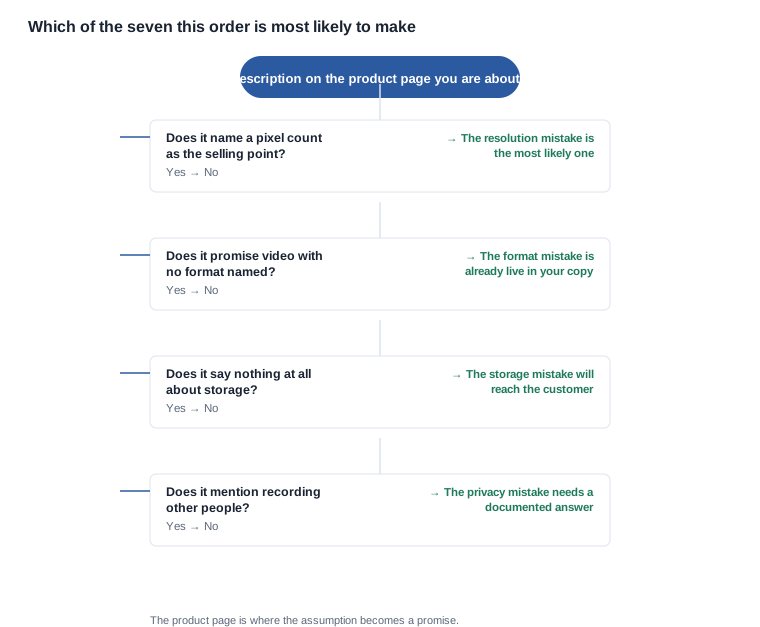
The fastest way to catch one is to look at the product page you are about to publish and ask, for each claim, which row on the sheet supports it and what that row leaves out. If the answer is a scenario rather than a specification, one of the seven mistakes is already in the copy.
The three that concern the specification
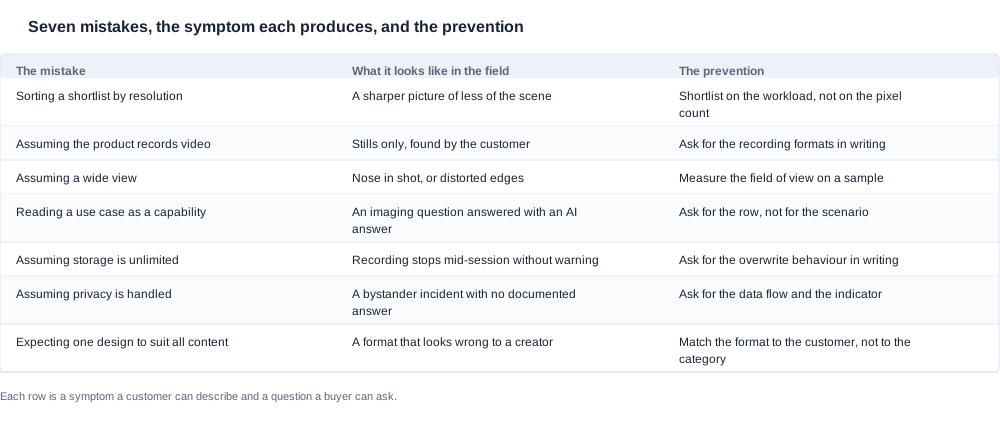
The first three are about the numbers: the resolution, the assumption that the device records video, and the assumption that the view is wide. The fourth and fifth are about the product: reading a listed scenario as a delivered capability, and assuming storage is unlimited. The sixth is about privacy. The seventh is about expecting a single design to suit every content use.
The mistakes about the specification: resolution, video format and the view
Mistake one: comparing on resolution
Resolution tells you how many pixels the sensor can record. It does not tell you how large they are, how much light each one gathers, how wide the lens sees, or how the camera behaves at dusk. An 8 MP sensor with large pixels can produce a better image than a 13 MP sensor with small ones, and neither the pixel size nor the sensor model appears anywhere in our catalogue.
Our catalogue publishes exactly two camera tiers: 8 MP across the MT5 and the V03, the CY05 and the CY03, and the KY06 and the V03 Pro, and the V06 and the MT6, and 13 MP on the S7 and the L2 Utral, and the L1 Pro. Eleven camera models in total, and no sensor model and no pixel size for any of them. A shortlist sorted by resolution is a shortlist sorted by a number that carries very little information on its own.
The question that replaces the assumption: which sensor is fitted, as a part number. That single string settles the pixel generation, the plausible low-light behaviour and the era of the design, and a supplier who can answer it has the measurement infrastructure behind everything else.
Mistake two: assuming it records video
This one is worth dwelling on, because a camera glasses platform that records stills only is a genuinely different product from one that records video, and the two are sold with the same word.
Our catalogue publishes the camera capability, the cell capacity, the charge time, the rated runtime and the charging method. It publishes no video format, no video resolution and no frame rate for any model. A buyer who assumes 1080p at 30 frames is assuming a number that is not published, and a customer who receives a device that records stills only finds out immediately. The mistake is worse than an unfavourable assumption, because it propagates: it goes into the listing copy, into the sample order, into the channel training, and into the return reason analysis.
The question that replaces the assumption: what recording formats does it write, at which frame rates, and in which container. Ask it in writing, before the listing is drafted, because the answer changes the copy.
Mistake three: assuming a wide view
A lens mounted in a frame has to fit inside a frame, which means a moderate angle rather than a wide one. Below roughly 70 degrees the device struggles to capture what a person perceives around them, and above roughly 100 degrees the edges distort visibly in a first-person clip. We publish no field of view for any model.
This is also the mistake with the cheapest remedy in the whole set. It is a five-minute measurement with a ruler on a sample unit, it can be done by a procurement engineer without a laboratory, and it is the number most likely to change a sourcing decision outright, because it decides whether the product works for first-person video at all rather than only for stills.
The question that replaces the assumption: what is the field of view, and in which convention — diagonal, horizontal or vertical. The convention matters as much as the number, because a horizontal 90 degrees is a diagonal of roughly 110 degrees.
The mistakes about the product: scenarios, storage and privacy
Mistake four: treating a listed scenario as a capability
Our catalogue lists AI real-time translation among the scenarios for the camera range, alongside first-person content creation, hands-free calling, meeting capture and daily snapshots. These are situations the hardware supports. They are not specifications the hardware delivers, and the difference between the two is exactly the difference between a scenario line on a catalogue page and a line on a competitor's technical datasheet.
Reading a listed scenario as an imaging specification is the most common misreading of our own catalogue, and it leads a buyer to ask a camera question and receive an AI answer. The supplier hears the question about image quality, understands it as a question about the assistant, and answers the question that was actually asked.
The question that replaces the assumption: which row on the sheet corresponds to the scenario. If there is no row, the scenario is marketing, and the copy that depends on it is a claim without evidence.
Mistake five: assuming storage is unlimited
We publish no storage capacity for any model, and we publish nothing about what happens when the storage fills: whether the device overwrites the oldest file, stops recording, or refuses. A device that stops recording silently in the middle of a session is a support case and a one-star review, and a device that deletes the oldest file without saying so is worse, because the customer cannot tell whether the file was never taken.
For a category in which the camera is the main reason to own the product, the storage behaviour is not a specification detail. It is the difference between a primary capture device and a secondary one.
The question that replaces the assumption: what is the capacity, in which format, and what happens when it fills. Then confirm it on the received unit by filling the storage deliberately.
Mistake six: assuming privacy is handled
A camera in glasses records people and places continuously and without a deliberate act of pointing. Where the footage goes, whether it transfers to the phone, whether it reaches a service, in which jurisdiction and who can retrieve it are all questions we do not answer, because we publish no data-flow detail for any model in the range.
This mistake has a compliance dimension rather than only a commercial one. EN 18031, the cybersecurity standard that has been a mandatory component of the CE mark since 1 August 2025, requires a security and privacy risk assessment for radio equipment in scope, and a device that captures images and audio sits at the higher-risk end of that scope. The general product safety regime, applicable since 13 December 2024, adds user information requirements, which for a recording device means instructions that say the product records.
The question that replaces the assumption: where does the data go, is there a recording indicator, and is the risk assessment available for this configuration. A buyer who cannot answer the first of these cannot finish the product page.
Mistake seven: expecting one design to suit all content
The first-person format has consequences that are not defects. The camera points wherever the person's head points, so the frame in the shot is whatever they were looking at a few seconds earlier. Movement is in the shot whether the creator wants it or not. And the person's own voice is the closest and hardest source in the recording.
A buyer sourcing on the assumption that a camera glasses platform is a small action camera is sourcing the wrong product, because the value is in what the format enables — hands-free, first-person, with audio — and not in the image. The remedy is not a better camera; it is a decision about which content customers the product is for.

How a specification mistake becomes a return, and what it costs
The path from an absent row to a return
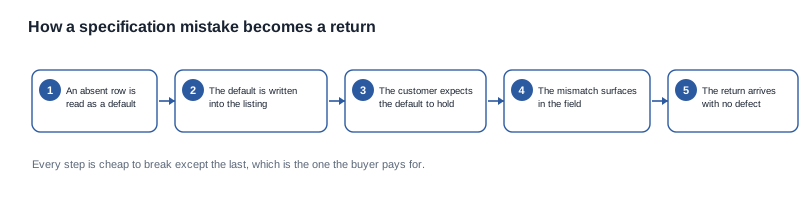
The path has five steps, and each one is cheap to break. An absent row is read as a default. The default is written into the listing. The customer forms an expectation from the listing. The mismatch surfaces in the field, usually in the first week of use. The return arrives, and because the unit is not defective, it arrives with no fault and no remedy.
The step that hurts is the last one. A supplier who ships units that do not match the published copy has not shipped defective goods; they have shipped goods that do not match the contract, which is a much harder conversation for a procurement team to have than a defect claim, because the evidence is the buyer's own marketing.
The total cost of a listing mistake, beyond the unit price
The financial damage of one of these mistakes is rarely the unit price. It is the relisting time, the channel credit, the customer service handling, the returned stock that cannot be re-listed because the copy was wrong, and the price of the next order. The cheapest prevention in the whole set is the request list: six rows, asked for in writing, before the sample order.
The three-step defence
Ask for the six imaging rows before the quotation is compared, so that two suppliers are answering the same questions. Write the acceptance criteria while the answers are pending, because the criteria do not depend on the answers. Run the protocol on the received units and against those criteria, not against the supplier's description, so that the sample produces evidence rather than confirmation.
Which stage catches each mistake
The seven mistakes do not all surface at the same point, and a procurement process that only checks at the sample stage will have already written four of them into the listing copy. Mapping them onto the stages makes the checks specific rather than general.
- The resolution mistake is caught at the shortlist stage, and only by refusing to rank on the pixel count. It is the cheapest to catch and the easiest to let through, because the tier is the only imaging figure in the published data and it is therefore the one a shortlist naturally sorts on.
- The video format mistake is caught at the request stage, by asking for the recording formats in writing. It becomes expensive at the listing stage, where the copy has already promised moving images, and it is terminal at the field stage, where the customer returns a unit that works exactly as built.
- The field-of-view mistake is caught at the sample stage by measurement, and it should be caught there because no written answer is as reliable as a ruler against a received unit. It is worth the effort even though it is the most expensive of the seven to check, because it is the one that can disqualify a product outright rather than degrade it.
- The scenario-as-capability mistake is caught at the listing stage, by checking every claim on the page against a row on the sheet. It cannot be caught earlier, because the catalogue genuinely lists the scenarios, and it cannot be caught later, because by then the copy is published.
- The storage mistake is caught at the sample stage by deliberate exhaustion, and it is the one most often deferred because a buyer assumes the customer will not fill the storage. It should be caught there, because filling storage deliberately is a ten-minute operation and discovering the behaviour from a return is a channel-wide event.
- The privacy mistake is caught at the request stage, where the data-flow answer either exists or does not, and it surfaces publicly if it is missed, because a bystander complaint is not a private return.
- The one-design-fits mistake is caught at the shortlist stage, by deciding which content customer the product is for before the camera module is specified. It is caught latest of the seven, because by the time it appears, the module, the firmware and the channel have all been configured around the wrong premise.
The pattern in that list is worth stating plainly: three of the seven are caught before the sample arrives, and only two of those can be caught from published data. That is the real argument for writing the request list rather than waiting for a quotation to compare.
The cost of catching them late
A mistake caught at the sample stage costs a sample order and a week. A mistake caught at the listing stage costs a listing withdrawal, a relisting and a channel correction. A mistake caught in the field costs the unit, the freight, the refund, the customer service handling and the credibility of the next listing — and, because the unit is not defective, the refund is usually granted voluntarily. None of these costs appears in the unit price, which is why a buyer who negotiates on price alone can be very precise about the wrong number.
The other late cost is contractual. If the acceptance criteria were never written, the buyer has nothing to hold the supplier to, and the conversation in month six becomes a disagreement about what was agreed, conducted without a record, against a supplier who has no incentive to concede. The criteria are not paperwork for its own sake; they are the only thing that makes the first five stages worth doing.
The questions that prevent the seven mistakes
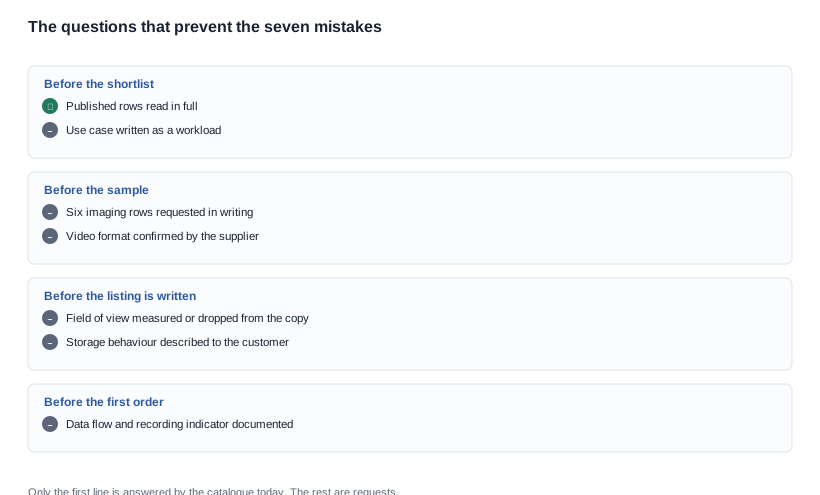
The checklist above is deliberately short. Each of its lines closes one of the seven mistakes, and none of them can be answered from a catalogue page — which is the whole point of writing them down.
Two further habits are worth building into a procurement process, because they catch the mistakes that no question list covers. The first is to write the product page first and the specification second, and then check every claim on the page against a row on the sheet. A claim with no row is a claim you cannot defend. The second is to make the acceptance criteria part of the purchase order, so that a lot that misses them is a lot the buyer can refuse rather than a lot the customer returns.
The specific rows our own catalogue can answer
Not many, and naming them is more useful than implying the rest are available. For the eleven camera models we publish the cell capacity, the charging interface, the charge time, the resolution tier, the rated runtime, and the case capacity for five of the seven models that ship with a case. We publish the weight for one model in the entire catalogue, the MT6 at 158 g for the glasses unit including the battery and the camera and excluding the foldable charging case, and the case weight is not published. We publish IP54 on two camera models, the V06 and the S7, and on no others. We publish no sensor model, no field of view, no video specification, no stabilisation status, no storage figure and no data-flow detail for any camera model.
What we will not rank, and what we will do instead
The boundary we hold: we publish the resolution tiers and the electrical rows because they are in our catalogue, and we publish the empty imaging rows with the same prominence, because that is the honest description of what we hold. We will not rank our 13 MP platforms against our 8 MP platforms on image quality, and we will not present a listed scenario as a delivered specification. We will also not describe a resolution figure as an image quality statement, because a pixel count is a quantity and not a quality.
What we can do is narrow a shortlist by workload and check a sample against the published rows. The imaging detail is under ai camera glasses imaging, the models are on the ai camera glasses page, and the sample protocol is in how to test camera technology.
Related reading
- The measurement protocol — how to test camera technology
- The evidence structure — camera technology case study template
- The compliance consequence — camera technology certification requirements
Tell us the content scenario and we will tell you which of these seven is the one most likely to be made on your order.


