
Smart glasses camera technology: the questions that decide
The camera is the feature that makes a smart-glasses order expensive, and the questions buyers ask about it are usually the ones that cannot be answered from a catalogue. They ask which resolution the sensor is, and the catalogue does publish that: eleven of our models carry a camera, eight of them at an 8 MP resolution class and three at 13 MP. That is a useful fact and a dangerous one, because the resolution class is the least useful number in the comparison and the easiest to build a business case on. Two cameras at the same resolution class are not equivalent, two cameras at different resolution classes are not ordered, and a buyer who has selected on the megapixel figure has selected on the one row in the row-set that has the least to do with the photograph.
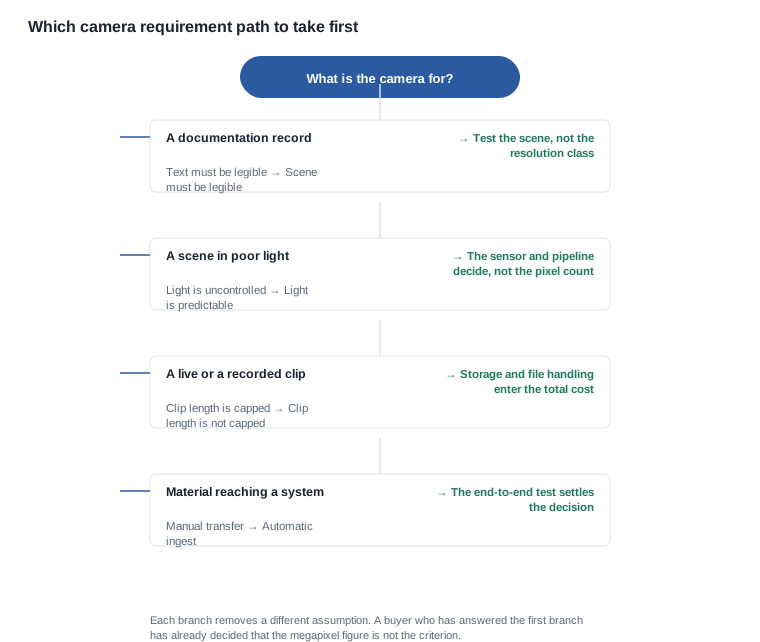
The questions that actually decide the order are four. The first is what the camera is for in the buyer's product — a documentation aid, an inspection record, a content tool, a proof-of-delivery record — because the answer determines whether the resolution class matters at all, and a buyer who needs a legible record at arm's length has a very different requirement from one who needs a wide scene in poor light. The second is what the product is allowed to record and where that material goes, which is a design and documentation question that has to be settled before the order because it changes the packaging, the listing and the support material. The third is what the camera does when the storage fills, how long a single recording runs, and what format comes out, because those three answers determine whether the product works in the customer's workflow or produces unusable files. The fourth is the claim, and it is the one that decides the return rate: whether the listing says the camera takes photographs, or whether it says the camera takes good photographs, and what evidence supports the second version.
- What is the camera for in the buyer's product? A documentation aid, an inspection record, a content tool or a proof of delivery, and the answer decides whether the resolution class matters at all.
- What may the product record, and where does the material go? A design and documentation question that has to be settled before the order, because it reaches the packaging, the listing and the support script.
- What happens when the storage fills, and how long does one recording run? These three answers determine whether the camera produces usable files in the customer's workflow.
- Is the claim a function or an outcome? "Takes photographs" and "takes good photographs" are different commitments, and only the first of them is straightforward to test.
The commercial weight of the camera is disproportionate to the attention it gets. A camera adds an image sensor, a lens assembly, a storage path, a signal chain and a substantial share of the bill of materials, and it adds a documentation scope that an audio-only product does not have. It also adds a return category that is harder to settle, because a customer who says the photographs are poor is making a judgement, and a supplier who says the photographs meet the specification is making a different judgement, and neither conversation is productive unless there was a written acceptance criterion before the first shipment.
The technical background is on the AI camera glasses imaging page and the product scope is on the AI camera glasses range. The testing method is developed in the camera testing article, the commercial structure in the camera cost factors article, and the documentation side in the camera certification article.
Eight megapixels and thirteen, and what the label does not say
The eleven camera models in our catalogue sit in two resolution classes. Eight of them publish an 8 MP class: MT6 and V03, V06 and MT5, and V03 Pro and KY06, and CY05 and CY03. Three publish a 13 MP class: S7 and L2 Utral, and L1 Pro. Two of the eleven — V06 and S7 — are the only models in the whole catalogue that carry an IP54 ingress marking, and both of them are camera models, which is not a coincidence and is discussed further below.
The important thing about a resolution class is that it is a statement about the sensor's output, not about the photograph. The photograph is the output of the lens, the sensor, the image pipeline, the encoder and the storage format, and a resolution class tells a buyer almost nothing about any of the other five. A larger sensor in poor light produces a better photograph than a smaller one with more pixels, and a sharper lens on a lower-resolution sensor produces a better photograph than a soft lens on a higher one. This is why a comparison of two camera models on resolution alone is not a comparison; it is a sort by a number that correlates with the photograph weakly and inconsistently.
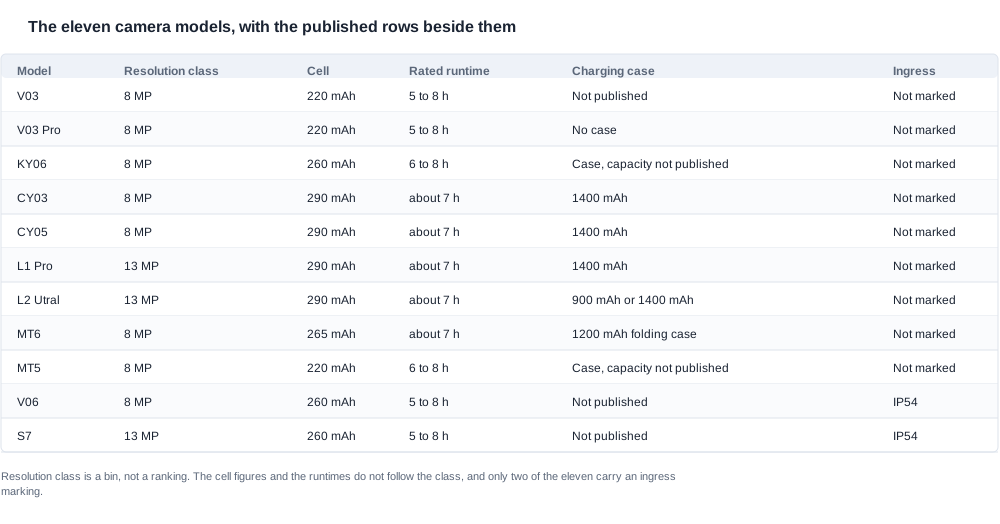
The table above sets the eleven camera models against the rows the catalogue does publish. Read it for structure rather than for a ranking, because the catalogue does not contain the information a ranking would need. The interesting patterns are: the cell figures cluster between 220 and 290 mAh with no relationship to the resolution class; the rated runtimes cluster between five and eight hours; the case is a meaningful differentiator, with three models carrying a 1400 mAh case, one offering 900 mAh or 1400 mAh, one carrying a 1200 mAh folding case, two carrying a case whose capacity is not published, and V03 Pro carrying none; and the ingress marking appears on exactly two models.
The one weight the catalogue publishes in this entire product family belongs to MT6, and it has to be read precisely: 158 g is the weight of the MT6 glasses body, including its 265 mAh cell and its camera, and excluding the folding charging case. The catalogue publishes no bare frame weight for any model in the range, and no weight for the case itself. A buyer who needs a weight for the model in front of them should ask for that model's weight directly, and a buyer who reads the 158 g figure as a frame weight will produce a specification that the product cannot meet.
Resolution tier, and the trap of comparing it across models
The trap in comparing camera models on resolution class is worth examining in detail, because it is the comparison most likely to be made and least likely to survive contact with a sample.
The first issue is that a resolution class is not a quality ranking. It is a bin, and a bin contains products with different lens quality, different sensor generations, different image pipelines and different amounts of processing. Two products in the same bin can differ more in output than a product in a higher bin does, particularly in low light, where the sensor's physical size and the pipeline's noise handling dominate over the pixel count. A buyer who has written "13 MP preferred" into a requirement document has written a preference for a bin, not for an outcome, and the supplier's response to it will be whichever product in that bin is cheapest.
The second issue is that the class does not predict the field of view, and the field of view decides the use. A documentation camera that has to capture a form at reading distance and a scene camera that has to capture a room are different products, and the lens is what decides which one a camera is. The catalogue publishes no field of view, no lens focal length and no optical stabilisation figure for any model. That is a real gap for a buyer choosing on imaging, and it is the gap that the sample has to close.
The third issue is that the two resolution classes in our catalogue correspond to genuinely different product positions, not to a premium tier. The 13 MP models — L1 Pro and L2 Utral, and S7 — sit alongside the 8 MP models in the same catalogue with the same cell figures and comparable runtimes, and two of the models with the best-published ingress protection in the whole range are in the lower class. The correct reading is that the camera is one specification among several in these products, and that the buyer has to decide how much of the requirement it carries.
The questions about what the camera records
A camera on a product that is otherwise an audio device changes the compliance and the commercial position, and the change is often underestimated because it is not a radio question. The radio requirements apply because of the Bluetooth, and for a camera product those run through the Radio Equipment Directive (EU) 2014/53/EU and the supporting standards. The camera adds a different set of obligations, and they are commercial ones before they are legal ones.
The first is what the product is used to record. A camera on a device used in a workplace, a retail environment or a public space engages data protection expectations and, in some jurisdictions, rules about recording identifiable people. A buyer in this category needs a defensible position on that, and the position has to reach three places: the product documentation, the packaging and the listing copy. A product that records by default and says nothing generates the kind of customer contact that becomes a regulatory one.
The second is whether recording is continuous, triggered, or user-initiated, and that is a product design decision with a cost attached. A continuously recording camera needs storage, needs a file-management path, and needs a clear indicator. A user-initiated camera needs a shutter and a confirmation, which is a control on the temple and a state in the firmware. A trigger-driven camera needs a sensor or a button and a sensitivity setting. The catalogue does not publish which of these applies to any model, and a buyer who does not ask will discover the answer from a returned unit.
The third is what happens to the material after capture, which for a product sold into a business workflow is the question that decides whether the camera is useful. A file that lands on a phone and then has to be found, transferred and filed is a workflow cost. A file that is automatically indexed by time and location is a workflow benefit. The catalogue publishes nothing about the transfer path, the format, the folder structure or the metadata, and the difference between those two outcomes is larger than the difference between the two resolution classes.
Verifying a camera claim on a single sample unit
A camera can be evaluated without a laboratory, and the method that works is a fixed scene rather than a fixed target. The reason is that a buyer's application is a scene — a form, a shelf, a machine, a room — and a test that reproduces the scene tells the buyer something about the application while a test on a printed chart tells them something about the lens.
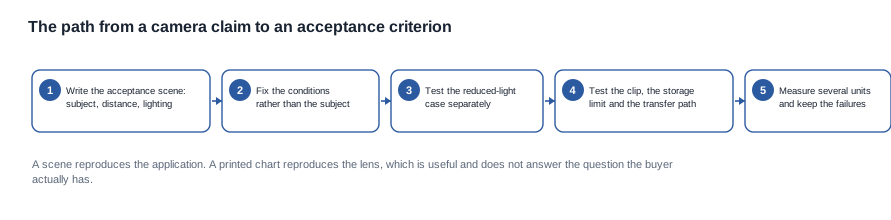
Step one: write the acceptance scene before the sample arrives. Name the subject, the distance, the lighting condition and the application. "Legible form text at 400 mm under office lighting" is an acceptance criterion that can be failed or passed. "Good camera" is not a criterion, and a supplier who agrees to it has agreed to a return rate.
Step two: fix the conditions rather than the subject. Same room, same time of day, same lighting, same distance, same file size and format for every unit tested. Change one thing at a time, and write down which thing changed. This is the discipline that separates a test result from an impression, and it is the difference between evidence a supplier can be held to and evidence that only convinces the person who was present.
Step three: test the low-light case separately, because it is where resolution class misleads. Photograph the same scene with the lighting reduced to a defined level. If the higher-resolution model produces a darker, noisier file in that condition, the buyer has learned something more useful than any specification sheet would have told them, and it is exactly the condition a field or inspection application runs into.
Step four: test the clip behaviour and the storage behaviour. Record for longer than the product's published or apparent limit, and find out what happens. Fill the storage and find out what happens. Test a file transfer to the target device and a file transfer through the target workflow. These three tests are cheap, they take minutes, and they are the ones that surface in a support queue afterwards.
Step five: measure on more than one unit, and keep the failures. A single unit that produces a good photograph proves that the camera works. Several units from a production lot, with the failures recorded, is what a warranty is priced on and what a return rate is forecast from.
The questions about clips, storage and format
Three specifications decide whether a camera product works in a workflow, and none of them appears in our catalogue. Buyers should expect to source all three from the supplier directly.
The first is clip length. A product that records in fixed-length segments, a product that records until storage is full, and a product that limits recording to a single take are three different products. The limit matters because the workflow does: an inspection record of forty seconds and a record of four minutes are not interchangeable, and a product that silently stops at a boundary produces files that look truncated.
The second is where the material goes and what format it takes. A file that has to be converted before it can be used is a step in somebody's process. The question to ask covers the container, the codec, the resolution of the recorded video, the still-image format, and whether the files carry a timestamp and a location. Every one of those is a line in a listing that a technical buyer will ask about.
The third is storage capacity and what happens when it fills. Capacity is a hardware specification; the behaviour at full storage is a product behaviour. A product that refuses to record, a product that overwrites the oldest file, and a product that silently drops the newest file are three different products, and the third is the one that loses a record that a customer needed.
The commercial dimension of all three is that they determine the accessory and the service lines around the product. A camera that needs a transfer cable, a card reader, a docking station or a monthly storage service has a different total cost from one that does not, and the total cost is what a buyer should be comparing.
The imaging failures that only appear in the field
Four camera-related failures recur after launch, and each has a symptom, a root cause and a prevention that costs nothing before the first shipment.
The claim outruns the sensor. The symptom is a return cluster with a description that mentions the photographs. The root cause is copy written from the resolution class rather than from the measured output, so the listing promises a quality the pipeline does not deliver. The prevention is to write the claim from the acceptance scene, using the language the test supports.
The product works in the demo and fails in the customer's light. The symptom is returns from one site, or one country, that do not recur elsewhere. The root cause is that the acceptance scene was lit the way the buyer's own office is lit rather than the way the customer's site is. The prevention is to run the acceptance scene in the target environment at least once before the order is released for production.
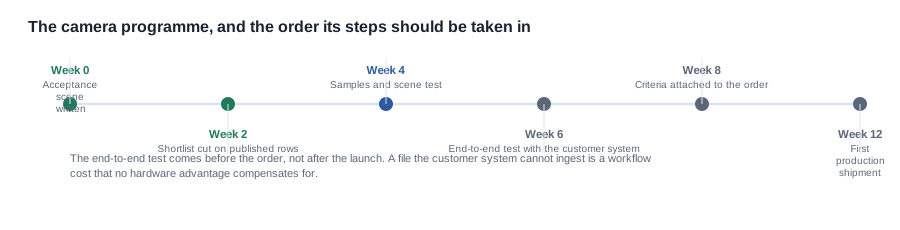
The files are unusable in the customer's system. The symptom is that the hardware works and the records still do not reach the workflow. The root cause is that the format, the transfer path and the metadata were never tested against the customer's own system. The prevention is to run one end-to-end test with the customer's system in the loop, which is a half-day of work and routinely the cheapest test in the programme.
The product records more than the customer is comfortable with. The symptom is a customer request for a configuration change, or a privacy query that the channel cannot answer. The root cause is that the recording behaviour was never specified and defaulted to something the buyer's customers did not expect. The prevention is to specify the recording behaviour, the indicator and the documentation as part of the order, and to write the same description into the listing.
Pricing a camera programme and documenting it
The commercial structure of a camera programme has three layers and they behave differently. The variable layer is the unit price, where the sensor class and the lens are the main cost drivers and where a buyer who has selected on the resolution class has usually bought the more expensive bin without a reason. The setup layer is tooling, the first-article camera work and the image pipeline integration, and this is where a camera programme differs from an audio-only one: the tooling and integration cost is higher, and it is less likely to be amortised because a camera configuration tends to be the one that stays fixed while the rest of the range changes.
The third layer is the recurring layer, and in a camera programme it is often larger than in an audio programme because of the storage, the transfer and the support. It includes the accessories, the transfer equipment, the service cost of handling files and the cost of the returns that the camera generates. A buyer who builds a business case on the hardware price alone will find the difference in the warranty line.
A buyer comparing two camera quotations should work through a short checklist before comparing any prices: which model satisfies the acceptance scene, which rows are published for that exact model, which documents cover the configuration, and which recurring costs the camera adds to the total cost. A shortlist built in that order is comparable between suppliers; a shortlist built on the resolution class is not, because the class is the one row that does not describe the photograph. The trade-offs the buyer is actually making are explicit at that point — the cost of the higher bin against the cost of a pipeline that is aggressive in low light, the cost of a larger case against the depot storage it requires, the cost of a sealed model against the warranty exposure in a wet environment. Those are the questions to ask, and the red flags are short: a resolution class offered as a quality claim, a weight quoted without saying whether it includes the charging case, and an acceptance scene the supplier has not agreed to in writing.
Four terms are worth asking for explicitly. The first is a written acceptance criterion for the imaging, attached to the order, so that a lot that fails it is a lot the buyer can refuse. The second is the full published row set for the exact model, so that a substitution between an 8 MP and a 13 MP model is caught at receipt rather than in the field. The third is a change-control obligation that names the camera, the lens and the sensor as configuration items, because a change to any of them invalidates the imaging acceptance and the product description. The fourth is a statement of the recording behaviour and the file format, so that the documentation in the listing and the product in the box agree.
One cost is not negotiable in any useful sense. The radio conformity work for a camera product runs through the Radio Equipment Directive (EU) 2014/53/EU, and the cost and the duration of that work are a property of the test laboratory rather than of the order size. The camera adds a different fixed obligation: the material documentation for the storage medium and the battery, including the transport summary under UN 38.3 for the fitted cell, which is a per-cell and per-product exercise. The useful question is not whether a supplier can compress either of those timelines; it is whether the documents cover the exact model, the exact configuration and the exact markets the buyer is shipping into, because a camera product that arrives with documentation naming a different sensor is a product that cannot be cleared.
A camera shortlist, walked through
What follows is hypothetical: it sets out the decision sequence, not a result taken from a client engagement. Assume a channel buyer supplying an inspection and documentation product to three industrial sites, where the recorded material has to reach the customer's quality system automatically. The constraint that matters is not the camera; it is that a previous supplier's units produced files the customer's system could not ingest, and the channel was the one that absorbed the complaint.
Step one: the acceptance scene is written first. The buyer describes the scene in the customer's terms — a component on a bench under site lighting at a stated working distance — and defines what a usable record looks like. At this point the resolution class drops out of the decision entirely, because the scene is legible or it is not, and a class cannot tell the buyer which.
Step two: the shortlist is cut on the physical product. The buyer eliminates on the rows that are published and that matter operationally: the case configuration, because a site that returns units to a depot overnight needs a charging route; the ingress marking, because two of the eleven camera models carry IP54 and the sites are not all indoors; and the cell configuration against the shift length. Three models survive.
Step three: the sample round measures the scene. One unit each, the same scene, the same lighting, the same distance, plus a reduced-light run of the same scene. The 13 MP model is recorded in the file with its resolution and its low-light behaviour, and the buyer writes down the actual result rather than the class. In this hypothetical, the higher class does not win, because the scene is legible in the lower class and the higher class is being penalised by a pipeline that is aggressive in low light.
Step four: the end-to-end test runs against the customer's system. Files are captured, transferred and ingested into the customer's own quality system, without conversion. This is the test that the previous supplier never ran, and it is the one that produces the evidence the channel needs.
Step five: the claim and the documentation agree. The listing describes what the camera records and where the material goes, the packaging carries the same statement, and the order carries the acceptance scene, the pass criterion and the change-control obligation. The marketing photographs are taken with the product in the customer's environment, not in a studio.
The walk-through did not select a resolution class. It selected a configuration whose output the customer's system can ingest, which is the only version of "the right camera" that was ever going to matter.
What our catalogue publishes about imaging
We publish the resolution class for each of the eleven camera models, the rated runtime, the charge time, the cell configuration, the charging interface and the case configuration where the catalogue states one, and the ingress marking for the two models that carry it. We do not publish sensor size, lens focal length, field of view, optical stabilisation, the video format, the clip length, the still-image format, the storage type or capacity, the field of view at any focal length, or the low-light performance. We do not publish a frame weight for any model, with one narrow exception that we state carefully: the catalogue gives the MT6 glasses body as 158 g, including its cell and camera and excluding its folding case, and it gives no weight for the case and no bare frame weight for any model in the range.
That is the honest limit of what we can put in a catalogue, and it is not a small limit for a buyer choosing on imaging. What we will do is tell you which camera configurations exist, which of them carry the published rows, and where the catalogue is silent so that the question reaches a supplier who can answer it. If the imaging requirement is specific, the productive next step is to write it as a scene, a condition and a pass criterion, and to put it in front of a supplier willing to be measured against it. The AI camera glasses imaging page is where the published position is set out in more detail.


