

Smart glasses sourcing risk in this category is mostly a documentation problem, and the useful way to approach it is backwards: start from the risk you are worried about, name the document that would close it, and then decide what you are going to do if that document does not exist. That last step is the one that separates a programme from a discovery. A supplier who cannot produce a document is not withholding paperwork. They are telling you that a specification you have asked for does not yet exist, and whether that is acceptable is a commercial decision you should be making deliberately rather than finding out at the border.
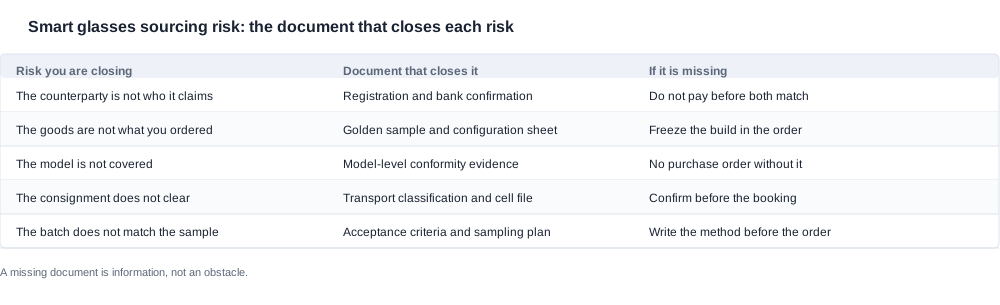
The rule that makes this workable is simple. A document either closes a named risk or it does not, and a document that closes no named risk is not evidence, it is correspondence. This article sets out the five families of document a buyer in this category should collect, the order to collect them in, the four tests that distinguish evidence from decoration, and what to do in the two cases that most often go wrong: the document does not exist, and the document exists but covers the wrong thing.
Smart glasses sourcing risk and the document that closes each risk
Who this is written for and what they are deciding
The reader is someone buying on the brand side, a channel buyer or an importer. The situation is one of three: a quotation has arrived and the buyer has to know what to ask for before signing; a programme is open and a file has to be assembled before a destination market can be served; or a shipment has been stopped and somebody has to reconstruct, quickly, which piece of paper was missing.
In each case the decision underneath is the same. It is not "does this supplier have certificates". It is "which of the things I am actually afraid of will this file close, and what do I do about the ones it does not". A buyer who frames the request as a list of certificates collects a pile. A buyer who frames it as a list of risks collects a file that can be handed to a customs broker, a compliance colleague and a finance team without a further conversation.
The specific fears that generate these requests are well known to anyone who has run an import programme in this category, and they are worth naming in the order a buyer meets them:
- The goods arrive and do not match the approved sample.
- The model turns out not to be covered by the evidence the supplier quoted.
- The consignment is held because a transport classification was never agreed.
- The contract entity and the paying entity are not the same one, and nobody noticed.
- A certificate has expired between the order and the sale, and the renewal was nobody's task.
Every one of those has a document that closes it, and every one of them is cheap to close before the order and expensive afterwards. A buyer who writes these five down before sending a request will get a better file back than a buyer who asks for certificates in general, because the supplier can answer a risk instead of guessing at a category.
Why the same specification produces different files
Two buyers can send the same supplier the same request and receive two very different files, and the difference is not honesty. It is how the request is framed.
Ask for "the certificates" and you receive whatever the supplier considers to be certificates, at whatever level of generality it holds them. Ask instead for "the evidence that covers model X in configuration Y for market Z, in a form a broker can file" and you receive a specific artefact or an honest answer that it does not exist. The second request also tells you something about the supplier, because the quality of the refusal is itself informative: a refusal that names the gap, the market and the lead time is more useful than a document that quietly does not cover your model.
The second reason files differ is that the source of the document is not always the party you are talking to. A test report may be held by the cell supplier. A Bluetooth qualification may be held by the module vendor. A declaration may sit with a sub-contractor who assembles the finished unit. A buyer who assumes the factory holds everything will wait on a document that is not in the factory's possession, and will conclude the factory is unreliable when the file is in fact simply somewhere else.

Five document families, and the order to collect them in
The entity set: who you are actually contracting with
Company registration, the registered business name, the bank account details, the export registration and the economic operator registration number. The purpose is not diligence for its own sake. It is to establish that the entity you are contracting with, the entity you are paying, and the entity that will appear on the customs paperwork are the same one, or that you have a written explanation of the relationship.
Most of the trouble in this family comes from a group structure rather than from anything dishonest. A treasury account held by a sibling entity is common and legitimate. What is not legitimate is discovering it at the first payment. The document that closes this risk is a short one — registration for one entity, bank confirmation for the paying entity, and a written note explaining the relationship between them — and it should be the first thing you ask for, because every other document in the file is worthless if the counterparty is not who it claims to be.
The product set: what the model is, and what covers it
The model-level conformity evidence: the certificate numbers, the models the evidence actually covers, the issuing bodies, the validity dates, the test reports behind the markings, and the Bluetooth qualification for the exact product rather than for the module family.
This is where the distinction that causes the most damage sits. A document that covers a product family is a genuinely different document from one that covers your exact configuration, and only the second one is what a customs broker, a retailer or a market surveillance authority will ask for. The "which models are covered" line is not administrative detail. It is the line that decides whether the document you have is the document you need.
The process set: how the thing will be built and changed
The configuration sheet, the firmware baseline, the change-notification commitment, the acceptance criteria, the sampling plan and the inspection arrangement. These are the documents most often not filed at all, because they usually live in the order and in the correspondence. That is precisely why they are the easiest to lose and the most expensive to reconstruct.
Within this family the golden sample is the cheapest and the most useful. One unit, built to the production configuration, signed by both parties and retained, converts every later dispute into a comparison. When a claim arrives eighteen months later, the question is rarely "who is right" — it is "is this the same build", and the golden sample answers that in seconds while a memory-based argument does not.
The logistics set: what has to be true for the goods to move
The export registration, the packing list, the commercial invoice format, the transport classification for the configuration, the UN 38.3 test summary for the cell, the insurance arrangement and the incoterm. These documents determine whether a shipment clears, and they are the ones most often assembled after the booking rather than before it.
Every model in this catalogue runs on a lithium cell, so the transport classification and the cell documentation are not a formality. Two details in this category deserve particular attention. First, a device that ships with a charging case carries a second cell, and the second cell changes the declaration, the packaging, the declared shipping weight and the classification question. Second, the box content is a configuration decision rather than a packaging decision: our catalogue publishes a charging case of 1400 mAh for the CY05 and the CY03, and the L1 Pro, 900 mAh or 1400 mAh for the L2 Utral, and a 1200 mAh folding case for the MT6, publishes that the KY06 and the MT5 ship with a case whose capacity is not published, and publishes that the V03 Pro has no case at all. Four camera models — the L1 Pro and the CY03, and the MT6 and the CY05 — publish a case capacity without publishing the charging method, so the interface itself is a document you have to request.

The commercial set: what you are buying and what happens if it is wrong
The pro forma invoice, the payment terms, the credit terms, the warranty terms and the returns path. A pro forma invoice that describes the product as a model name rather than as a configuration string is not enough to define what a deposit is buying, and it is also not enough to define what you will receive.
The four tests that separate evidence from decoration
How to tell a document that will hold up
Every document in the file should survive four questions. These questions are asked of a file, not of a person, and they are asked in the same order every time.
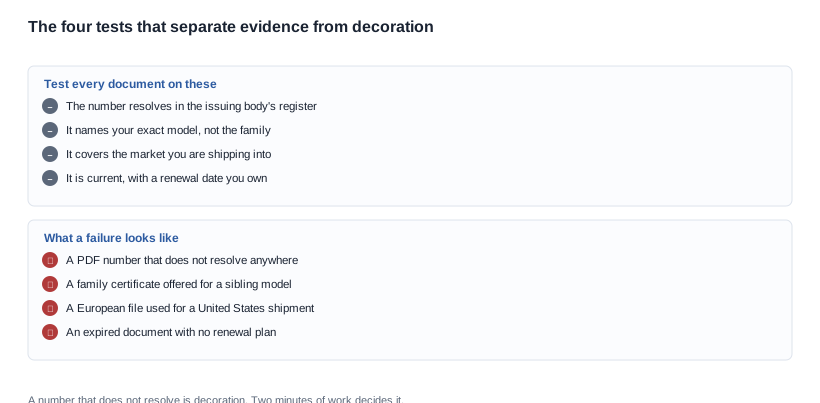
Does the number resolve? A certificate number that resolves in the issuing body's own database is evidence. A number that appears in a PDF and resolves nowhere is decoration. The distinction takes two minutes to test and it is the single highest-yield check in the file, because a non-resolving number is the most common way a copied document survives several years without anybody noticing.
Does it name your model? This is the coverage test, and it is where family documents fail. Read the list of covered models and find yours. If your model is not on that list, the document is about a different product, whatever the introduction says.
Does it cover your market? A European file is not a United Kingdom file and is not a United States file. In the European Union the framework includes the General Product Safety Regulation (EU) 2023/988, which has applied since 13 December 2024, and the EN 18031 series, which has formed a mandatory part of the CE mark since 1 August 2025. The United Kingdom runs UKCA and UK RoHS as a parallel route. The United States requires an FCC ID under Part 15, obtained through a laboratory recognised by the FCC and permanently marked on the product and the packaging. Three markets, three file shapes, and a document for one of them is worth nothing in the other two.
Is it current? A document with an expiry carries a renewal task, and a missed renewal turns into a product that cannot lawfully be sold in that market from that date. The renewal task needs an owner and a date in your own calendar, not in the supplier's.
The two cases that go wrong most often
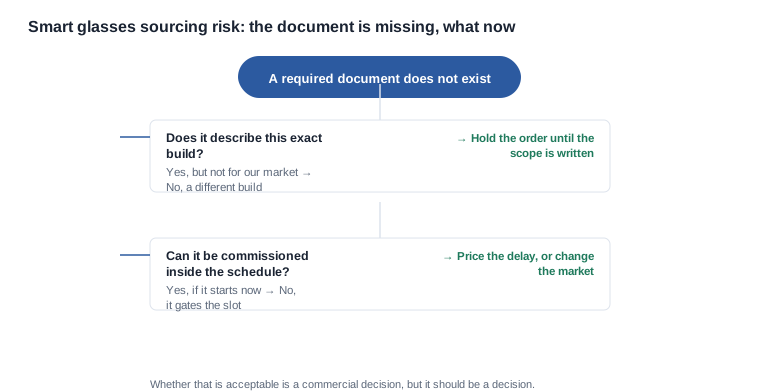
The document does not exist. The honest response to this is a scope conversation, not an argument. Ask three things: what would it take to create it, how long would it take, and what does it change about the date? If the answer is that it cannot be created inside your schedule, then you have a decision in front of you — change the market, change the model, or accept the risk in writing with an owner attached. What you must not do is leave the gap open and discover it later.
The document exists but covers something else. This is the more common failure and the more expensive one, because the file looks complete. A family certificate offered for a sibling model, a test report written for an earlier build of the same product, a European file used for a United States shipment: in all three cases the buyer has a document, has filed it, and has no protection. The way to catch it is to read the covered models, the dates and the market on every document, in the same session, rather than accepting the file as a whole.

A delivery schedule for a file that does not exist yet
The commercial terms that decide whether a file is worth anything
A documentation request that is not attached to a commercial term is a favour. The terms that turn a file into something enforceable are ordinary contract clauses, and they are worth putting in the order rather than in a separate agreement.
The evidence delivery schedule is the first of these: which document, for which market, for which model, by when, with a named owner. The document-holder clause is the second: it states who holds the original, who can produce it after the goods have left, and how long it is retained. The scope change clause is the third: it states what happens to price and schedule when a destination market changes its requirements, and who carries the cost of reopening the work.
These are negotiable and, in our experience, the first two are granted more readily than buyers expect, because they cost the supplier very little and they remove the buyer's biggest source of schedule anxiety. Where they are refused, that refusal is itself informative about how the supplier's file is managed.
The acceptance criteria and the claim period belong in the same set, because a document set without them produces a file you cannot act on. An acceptance period that ends before the goods arrive is not an acceptance period, and a claim period that begins at delivery rather than at acceptance leaves you with no route to reject goods that arrived damaged.
A worked example of a file being assembled
The following is a hypothetical case, written as a reasoning exercise rather than as a client project, and no client is described. The model, the quantity and the markets are assumed so that the sequence can be followed.
A buyer wants a camera model with a charging case in the box, for two markets, with a first order in the low thousands of units. The supplier's catalogue publishes the model and the case capacity, and publishes that this model's charging method is not stated. The buyer's first request is a general one and returns a general answer.
The buyer restructures the request. The entity set goes first, because a file attached to the wrong entity is not a file. The product set follows, with the question "which models are covered" written into the request rather than left implicit. The logistics set is raised next, with a direct question about the charging method for this configuration and about the second cell in the box, since the case changes the transport scope of the whole consignment. The process set is agreed last, because it depends on knowing exactly what is being built.
What comes back is smaller than the buyer expected and more useful. Two of the requested items do not exist for this configuration. One is held by a sub-supplier and will need a written authorisation to release. One has a renewal date inside the programme's life. Each of those is now a known item with a date and an owner, rather than a surprise with a shape.

Where our own published material stops
Stated plainly: we publish the rows our own documentation supports, and we mark the rows that are open. For a camera model, that means the cell capacity, the resolution class, the charging interface where it is published, the rated runtime, the charge time, the case configuration, the Bluetooth version where it is published, and the customisation scope.
What we do not publish is worth stating just as precisely, because a buyer who knows the boundaries of our file can plan around them.
We do not publish per-model certification rows, certificate numbers, issuing bodies or validity dates, and our catalogue contains no CE, FCC or RoHS text at all. The catalogue's export-certification page is a company-level page, not a per-model table, so it cannot be used to infer that any particular model carries any particular mark. Model-level conformity evidence for a given configuration is therefore something we produce and hand over, not something you can read off a web page, and we will say plainly when an item has to be commissioned rather than issued.
We also do not publish the frame weight of the range, the sensor part numbers, the field of view, the ingress test report numbers, or the AI implementation details. One published weight exists in the catalogue, and its scope matters: the MT6 unit is published at 158 g, which is the glasses body including its battery and camera and excluding the folding charging case, and the weight of the case itself is not published. No bare frame weight is published for any model, and we would rather tell you that than quote a typical figure you cannot verify.
Two more open rows are worth naming because they change what you have to ask for. The catalogue does not publish a Bluetooth version for the camera models, so that is a request rather than a reading. And the bone-conduction entry publishes an amplification-gain figure of 35 dB; whether a product carrying that figure may be sold into a given market is a regulatory question to be answered before the order is placed, and it is not a question any specification sheet answers for you.
What to send us so the answer can be given in writing
The sourcing risk section covers who carries which risk across the whole chain, and a worked factory audit shows these document gaps appearing in sequence on a real file. The camera and audio range is where the published configuration rows live, the certification checklist advice covers the document request as a process, and the red flags of a trading company explains why the entity set is worth collecting before anything else.
If you want this applied to a specific configuration, send four things: the model, the configuration, the quantity and the destination markets. Then ask us one question — which of the five families above do we already hold for that configuration, which are held elsewhere, and which have to be commissioned. We will answer with a list and a date rather than a general assurance, because the list is the part you can put in front of a broker, and the date is the part you can put in front of a launch plan.


