

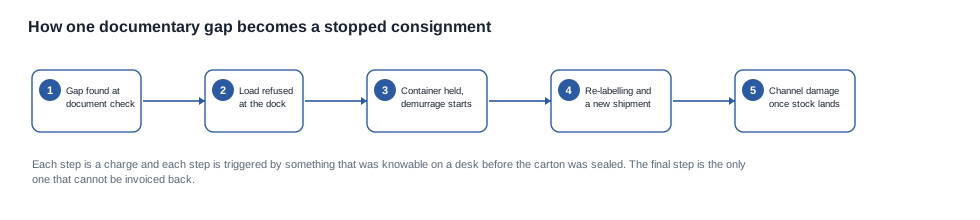
Most certification mistakes do not fail quietly. They stop a container at a border, which costs a demurrage charge, a storage fee and a relationship with a customs broker you may need next week. The five below account for most of them, and all five are checkable before the goods are packed. The useful thing about this list is that every entry is a documentary fault rather than a technical one, which means the detection cost is an hour of reading rather than a laboratory.
Smart glasses certification checklist: the five mistakes that stop a shipment
Why the failures surface at the border rather than at the factory
The factory has a quality process. It has an inspection, it has a packing line, and it has a control on the specification of the unit that goes into the box. None of those processes is designed to check the relationship between a declaration and a carton, because the declaration is written once and the cartons are printed in runs, and nothing in the production routine forces the two to be compared.
That is why these faults travel. They are created in the paperwork, they travel with the goods, and they are found by a party who has never seen the factory and has no interest in the commercial relationship. The broker, the carrier and the market control authority are all looking at the same short list of things: does this document cover this product, does this product match this label, and is the person named on the paperwork reachable.
A useful way to think about the cost is that the border is where an unresolved question becomes an invoice. Before the border, a documentation gap is an email. After it, the same gap is a demurrage counter that runs every day the question stays open, and a re-listing decision that is not in your control.
The five mistakes and what each one costs at the dock
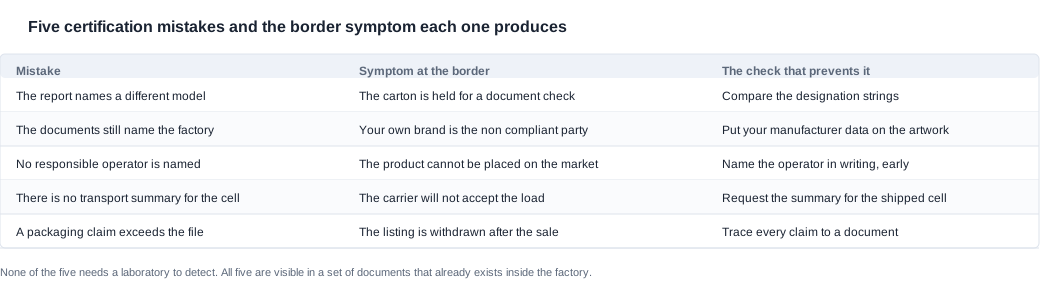
The five are set out in the order in which they tend to be found, and each one is written as the symptom, the cause and the check that prevents it.
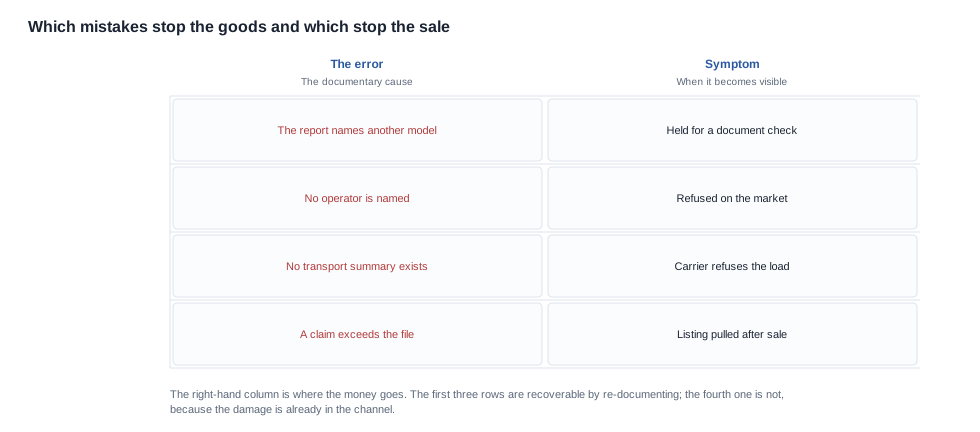
The report covers a different model than the carton. Symptom: the consignment is held for a document check while a broker tries to reconcile a designation. Cause: the document was written for an earlier build of the same product. Check: compare the designation strings.
The documents name the factory and the cartons name your brand. Symptom: the importer's own declaration is found to be inconsistent with the technical file. Cause: the file was never re-issued against the brand. Check: confirm the manufacturer data on the artwork matches the file.
No responsible operator is named. Symptom: the product cannot be placed on the market even though the paperwork is complete. Cause: the decision was made months earlier and nobody owned it. Check: ask for the name, the address and the contact route, in writing.
There is no transport summary for the cell. Symptom: the carrier declines the load. Cause: transport documentation was treated as a market access item. Check: request the summary for the exact cell in the carton.
A claim on the packaging exceeds the file. Symptom: the listing is challenged after the product is already on sale. Cause: the claim was written by someone who had not read the file. Check: trace every printed claim to a document.
The first three stop the goods. The last two stop the sale, and the fifth is the only one of the five that cannot be fixed by re-documenting.
Who carries the cost of a hold, and why that sets the urgency
The demurrage and detention charges that accumulate while a consignment is stopped are usually payable by the party named on the booking, which in a first order is very often the brand rather than the factory. That allocation is what makes a documentary gap an expensive event rather than an inconvenient one, and it is worth understanding before deciding how urgently to chase the answer.
The cost of a hold is not only the charge on the container. It is the storage, the re-offer, the second freight booking, the re-labelling or re-printing, and the delay to a launch window that was set for a season rather than a day. It is also the argument, because the factory has to produce a document it may not hold and may not have kept, and the longer the question stays open, the less likely it is that the answer arrives in a form the broker will accept.
There is a second cost that is harder to invoice and harder to argue about. A customs broker who has once had a document query on your shipment will price the next one more defensively, will ask for the file earlier, and will quote a faster route at a higher rate. That is a reasonable response, and it is permanent for as long as the relationship lasts.
The practical conclusion is that the four checks at the end of this article exist to move a cheap, internal activity to the front of the programme. Reading a file on a desk costs an hour. Finding the same gap at a border costs a week of demurrage, a relisting decision and a harder relationship with the party that handles your freight.

Mistake one: the designation on the report and the designation on the carton
Why a suffix added during ordering causes it
This is the single most common cause of a held consignment, and it is common because it is trivial. A test report covers a designation. A purchase order and a packaging artwork cover a different one, because a suffix was added during ordering, or a configuration name was written in the brand's own wording, or the artwork was updated for a new colourway and the report was never re-issued.
Nobody notices, because the two strings look the same to the person who wrote them and completely different to the person who reads them aloud at a document check. The manufacturer field, the model field and the label on the unit are three separate places where the string is written, and a change to one of them does not travel to the others.
Our own published material is a fair illustration of why this happens. One camera model appears under its own name while a second string sits alongside it on the same page, and the two children models at the 40 mAh tier carry identical published parameters, which makes them very easy to confuse in a file even though they are separate products. Neither of those is an error in the product. Both of them are exactly the kind of thing that produces a designation mismatch downstream.
The ten minute check that finds most of these
Take the exact designation string from three places — the test report, the purchase order and the packaging artwork — and compare them character by character. Not approximately, not by eye from a printed page: character by character, in a document, with the three strings in a column.
Two details make the check work. First, the case configuration and the colourway count, because a file that treats them as distinct makes them part of the designation rather than a variant of it. Second, the order of operations: the check belongs before the sample goes to a laboratory, where a mismatch costs a re-issue, and not after, where it costs a re-print and a second freight booking.
This is the highest value ten minutes in a first-order programme, and the reason is not that the check is difficult. It is that every other mistake on this list is found later, by a stranger, at a cost that is charged to you.
Mistakes two and three: the manufacturer on the documents and the operator nobody named
Mistake two, where the obligations sit with your brand
If your brand is placing the product on the market, the obligations attach to your brand, and the labelling has to say so. Where the documents still carry the factory's name and the cartons carry yours, the mismatch is discovered by the party that has the least appetite to resolve it.
In the European Union this runs through the Radio Equipment Directive (EU) 2014/53/EU and through the traceability requirements of the General Product Safety Regulation (Regulation (EU) 2023/988, applicable since 13 December 2024), which add manufacturer identification and a responsible economic operator in the market to the product and packaging requirements. The point of the requirement is not bureaucratic. It exists so that a regulator, a consumer or a recall can identify the party responsible and reach it, and a document naming a company that is not the party placing the product on the market defeats the entire purpose of it.
The commercial version of the same problem is the question of whether a supplier's file can be used by an importer at all. In some cases it can, with a transfer arrangement and a translation. In others it cannot, and the answer determines whether you are buying a product that is ready to sell or one that needs a compliance project attached to it before the first unit ships.
Mistake three, the operator who has to be named and reachable
GPSR requires a responsible economic operator in the European Union for the party placing a product on the market. It has to be named on the product or on the packaging, it has to be reachable, and it cannot be a name that appears nowhere else. A name on a website, a contact form, or a third party that has never heard of the product does not satisfy it.
This is the mistake that gets made early and discovered late, because the decision about who is the operator is taken at the start of a programme by someone who will not be in the room when the product launches. It is also the mistake that is invisible on the factory side, since the factory frequently has no obligation in your market and no reason to have appointed anybody.
The check is narrow and the answer has to be concrete: the name, the postal address, and a route by which a regulator or a consumer can make contact. If the answer is that the arrangement is still being finalised, write it into the purchase order as a condition with a date, because the packaging artwork cannot be printed before it is settled, and the artwork is what carries the name.

Mistakes four and five: the cell file and the claim the file cannot support
Mistake four, a transport document rather than a market access one
The battery transport documentation is not a market access document, and that distinction is what causes it to be forgotten. A buyer who works through the radio route, the safety route and the chemistry route can complete all three and still arrive at a carrier with nothing to present, because transport evidence is not part of any of those routes.
A lithium powered product needs a test summary and a packaging arrangement satisfying dangerous goods rules before it can be offered to a carrier. Discovering this at booking costs a sailing cycle, and the sailing cycle is the part of the schedule that is hardest to recover, because the goods are finished, the cartons are printed and the space has been booked.
The complication in this category is that the cell configuration is not a single value. Our own published range is instructive: the charging method is magnetic on seventeen of the twenty-eight models, Type C on seven, and it is not published at all for the CY05 and the MT6, and the L1 Pro and the CY03, and a configuration that ships with a case is a different consignment from one that ships as a bare device. Ask about the case separately, every time, and ask which cell the summary names.
The battery transport framework covers the document set, and it is worth reading alongside the market access file rather than after it, because the two are settled by different people in the factory and they fail at different points in the shipment.
Mistake five, a packaging claim the file cannot support
A product that says "waterproof" on the box, or names a Bluetooth qualification, or states a battery duration the file does not evidence, is a claim a market control authority can act on. The point is not that the claim is a lie. It is that nobody in the chain established which document was supposed to support it, and once it is printed, supporting it is a separate project.
The designation IP54 is the clearest example, and it is worth being precise about it because the imprecision is the problem. IP54 means protection against water spray, not immersion. Describing an IP54 model as waterproof is a claim the file cannot support even when the marking itself is accurate and even when the marking is correct. In our own catalogue the IP54 marking appears on the V06 and the S7, and no third-party test report number is published behind it, so a buyer who needs substantiation has to ask for the report and a buyer who cannot get it should describe it as a marking.
The same logic applies to a published battery duration and to a Bluetooth version. A duration is a tested figure with a method behind it, and a version is a listing in a public database that can be looked up rather than a claim on a carton.

The four checks to run before the carton is sealed
The check list in one page
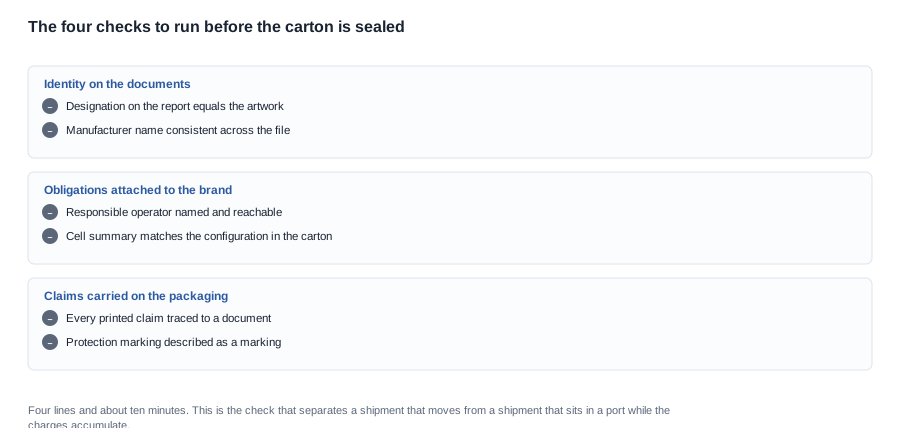
Four lines, about ten minutes, and they prevent the class of failure that costs a container charge.
- Designation string on report, purchase order and artwork: identical. Compared character by character, with the case configuration and colourway counted where the file treats them as distinct.
- Manufacturer name and responsible operator on cartons and documents: consistent and reachable. The operator named on the packaging is the same party, with a postal address and a contact route that a regulator could use.
- Battery transport documentation: exists, current, and matches the shipped configuration. Including the case, if a case travels in the box, and including the state of charge rule if one applies.
- Every claim printed on the packaging: traceable to something in the technical file. A protection marking described as a marking, a duration described as a rated figure, a radio version described as a listing.
Run these against the documents you intend to sign, not against a summary of them, and run them before the cartons are printed rather than after. A check that happens after the artwork is locked is a check that has already cost money.
What to do when a check fails
A failed check is not a reason to cancel an order, and treating it as one is how buyers lose good suppliers over problems that have ordinary solutions. It is a reason to convert an open item into a condition, a date and an owner.
Where the designation is wrong, the remedy is a re-issued document naming the correct string, and the question of who bears the re-issue cost is a commercial point worth settling in the order rather than after the invoice arrives. Where the operator is not named, the remedy is a decision, and it should be dated. Where the cell evidence is missing, the remedy is a document request with a response deadline that sits before the booking date, not after it.
And where the claim cannot be supported, the remedy is to change the claim. That one is often the hardest to recommend and the easiest to achieve, because the artwork is a decision rather than a test, and the cost of changing a line of copy is nothing compared with the cost of withdrawing a listing.
How we handle the certification mistakes buyers ask us about
We will not supply a reference from memory
We do not publish certificate numbers, issuing bodies or validity dates, and we will not supply a reference from memory. Individual identifiers are not published in our documentation, and a plausible-looking number is worse than an open gap, because an open gap gets chased and a plausible identifier gets used until the moment it is checked.
What we will do is tell you which frameworks apply to a given model in a given market, what evidence we hold for a given configuration, and where a packaging claim would exceed what the evidence supports. If you send us your artwork we will tell you which lines we cannot back, and we will do it before the artwork goes to the printer rather than after.
The mistake we see most often in our own catalogue
If this list is worth reading, it should also be honest about where the faults in it originate, and in our case several of them sit in our own published material.
The IP54 marking on the V06 and the S7 is a catalogue annotation with no third-party test report number published behind it. The charging method for the L1 Pro and the MT6, and the CY03 and the CY05 is not published at all. The unit weight appears for one model only, and it is the weight of the MT6 glasses body at 158 g including the 265 mAh battery and the camera and excluding the folding charging case, with no bare frame weight published for any model in the range. The Bluetooth version is published for the audio and motion models but not for the camera models, where the catalogue carries no version line at all.
Each of those is a place where a buyer's listing can run ahead of the evidence, which is why we would rather a buyer asked us for the document than assumed one existed. The certification checklist sets out what to request, and the supplier verification article covers how to check a claim once it arrives. The cost drivers article covers the variables that make these checks expensive or cheap depending on how early they are run.
Sending us a model list and a destination market
Send the model list, the destination market and the artwork or listing copy. We will tell you which of the five mistakes above applies to your programme, which documents we hold for the models involved, and which claims in your copy we cannot currently support.
Send us the model list and the destination market and we will tell you which of these five applies to your order.


