

The belief that certification is paperwork to be filed after the goods are made is the most expensive one in this category, and it is expensive because the compliance work and the production work are not parallel. They are sequential, and the sequence runs the wrong way for a buyer with a launch date. This is a guide to what actually sits on the critical path for a smart glasses programme, and how to move it off it. The short version is that a model with no file has a lead time of its own, that the artwork is an input to the test rather than an output of it, and that a buyer who asks for a per model conformity position inside the quotation removes most of the uncertainty before it becomes a delay.
Smart glasses certification checklist: why it sits on the critical path
Compliance work and production work run in sequence, not in parallel
Most buyers plan a launch date from the production side: the tooling is ready, the materials are ordered, the line runs for a number of days and the goods are ready. The compliance work is then expected to fit around that, which is the assumption that breaks.
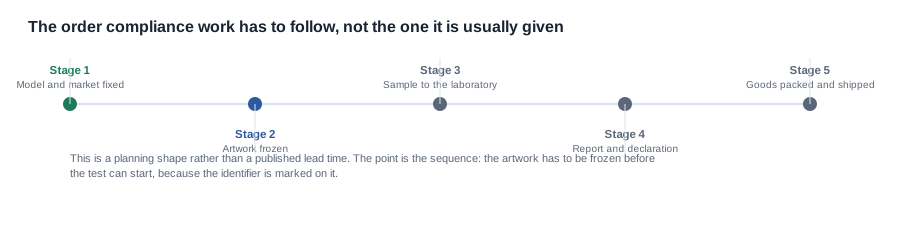
The reality in this category is that the compliance work contains steps that must happen before the goods can be finished at all, not after. The artwork has to carry permanent identifiers before the print run, and the identifiers are the output of the test. The sample that goes to the laboratory has to be built before the report exists, and the report has to exist before the declaration can be signed, and the declaration has to exist before the cartons can be printed with the right content. In a model that has never been assessed, that chain runs from the first sample to the last carton, and the production schedule is downstream of all of it.
This is not a criticism of any factory. It is a description of the sequence, and the reason it matters is that a buyer who understands the sequence can plan it and a buyer who does not will discover it.
The four beliefs that cost the most time
Four beliefs recur in this category, and each one costs time in a different way.
"Certification is a formality at the end." It is not a formality at all, and in most markets it is not something the factory can do for you at the end. A product that has shipped and then failed clearance has to be recalled, re-labelled or re-certified, and the cost is not the certification.
"The supplier's certificate covers my product." Often it does not. A declaration organised around the company is not the same as a file that names your model, and the difference is only visible when a customs broker asks for the model number.
"A new market takes the same time as the first one." It can, but only if the model is already covered and the new market's file is a country level document. If the model is new, the two run in sequence.
"The file can be assembled in parallel with production." For a model that is already certified, it can. For a model that is not, it cannot, and a buyer who plans it in parallel discovers in week six that the goods cannot ship.
The first belief costs money, the second costs a shipment, the third costs a launch window, and the fourth costs a season. None of them can be resolved by a faster factory.

What actually sits on the critical path for a given order
The four cases and the compliance item each one triggers
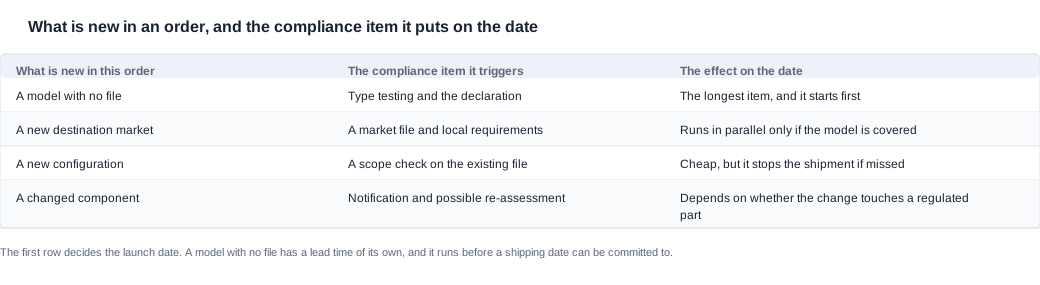
The critical path depends on what is new in a particular order, and there are four cases that cover most programmes.
| What is new in this order | The compliance item it triggers | The effect on the date |
|---|---|---|
| A model with no file | Type testing and the declaration | The longest lead item, and it starts first |
| A new destination market | A market file and local requirements | Runs in parallel only if the model is covered |
| A new configuration | A scope check on the existing file | Cheap, but it stops the shipment if missed |
| A changed component | Notification and possible re-assessment | Depends on whether the change touches a regulated part |
The first row is the one that decides a launch date, and it is the row that a buyer can establish in a single question: has this model, in this configuration, been assessed for this market before. If the answer is yes, the programme is a scope check and a production run. If the answer is no, the programme has a compliance lead time that runs before the production schedule can be committed to a shipping date.
The fourth row is the one that catches programmes that were on track. A component change that was made for a good commercial reason, a second source for a cell, a different firmware build, can reopen a file at exactly the point where the schedule has no slack left.
The two artefacts that decide whether a date can be set
Two artefacts decide whether any date can be committed, and neither of them is a document held by the factory.
The first is the artwork. The United States position is the clearest illustration: the FCC identifier is obtained through a laboratory recognised by the FCC, the process is commonly quoted at around two to three weeks, and the identifier is permanently marked on the product and on the packaging. That last point is what makes it a schedule item rather than an administrative one. The mark has to be on the artwork, so the artwork has to be finalised before the test starts, and artwork that is not final means the packaging is reprinted.
The second is the sample. Not a demonstration sample and not a marketing unit, but a unit built in the configuration that will be assessed, because the assessment is carried out on that hardware. A buyer who has a beautiful evaluation sample and no unit in the shipping configuration has not removed the sample step from the critical path, they have added one.
The artwork decision, which is the item that moves the whole date
Why permanent marks are a packaging input
The artwork is the most underestimated item in this category, and the reason is that it does not look like a compliance activity. It looks like a packaging activity, which is why it usually sits with a designer rather than with the compliance function, and why the date it needs is not on the compliance schedule.
The dependency runs backwards from the usual assumption. The identifier is the output of the test. The identifier is permanent and appears on the product and on the packaging. The test therefore cannot start until the artwork is settled, because the artwork has to be final for the identifier to be marked. And the print run cannot start until the identifier exists, because a carton printed without it cannot be corrected.
In the European Union the position is different in kind rather than in timing. The General Product Safety Regulation (EU) 2023/988 has applied since 13 December 2024 and reaches consumer products and products designed for professional use that later reach the consumer market. The Radio Equipment Directive 2014/53/EU remains the framework for radio equipment, and the EN 18031 series of harmonised cybersecurity standards has formed a mandatory part of the CE mark since 1 August 2025, with three specifications published on 30 January 2025 covering secure communication, end to end encryption, secure storage and user consent, and the processes for handling and patching identified vulnerabilities. A Bluetooth product has a cybersecurity file as well as a radio file, and both need a per model technical dossier.
The United Kingdom is a parallel route rather than a copy of the European one, with UKCA and UK RoHS.
What freezing the artwork actually means
Freezing the artwork is not a design decision. It is a supply chain decision, and it has four components that all have to be settled before the test starts.
The permanent marks have to be identified, and the identity of the mark determines when it can be obtained. The importer or responsible economic operator details have to be settled, because they are printed on the packaging and because they are a decision that usually belongs to the party placing the product on the market rather than to the factory. The language set for the destination market has to be settled, because the instructions and the labels have to exist in the right language before the print run. And the model designation has to be fixed, because a designation that changes after the artwork is locked changes the document and the carton together.
Freezing the artwork is the single most effective move available to a buyer in this category, and it is also the one that requires the buyer to make four decisions early rather than one decision late. That is a good trade.

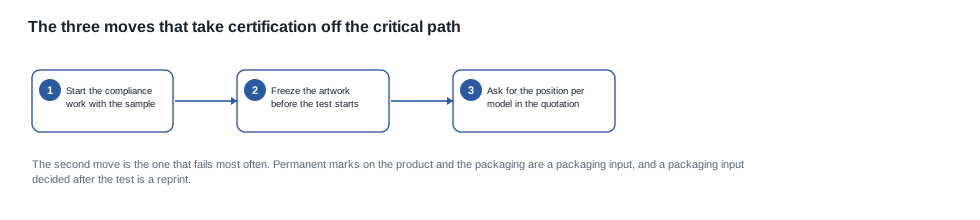
The three moves that move certification off the critical path
Start the compliance work with the sample, not after the order
The sample and the type test are the same hardware, and a buyer who builds the first units specifically to be tested gets two things from them. The first is the test. The second is a unit in the shipping configuration that can be retained and compared against the production batch later, which is the only artefact that can arbitrate a disagreement about what was approved.
The sequencing point is the one that matters. The compliance work starts when the sample is built, which means it starts in parallel with the production lead, not after it. The work that remains downstream of the test is limited to the declaration, the carton print and the paperwork handover, and all three are short.
Freeze the artwork before the test, not after it
Already covered above, and worth repeating because it is the move that most often fails. Permanent marks on the product and the packaging are a packaging input, not a packaging output. This is the single most common cause of a compliant product that ships with the wrong label, and it is entirely avoidable.
Ask for the compliance position per model in the quotation
A quotation that lists the model and its conformity status is a different document from one that says the company is certified, and the first one saves a month. The per model position is what tells a buyer whether the programme has a compliance lead time at all, and it is the only way to know before the deposit rather than after it.
The three moves have one thing in common. Each of them moves a decision earlier, into a point where the decision is cheap, and none of them requires the supplier to do anything unusual. That is worth knowing when a programme is under pressure, because the available moves are the ones that were available at the start.
They are not of equal value, and the order is worth keeping in mind. The artwork freeze is the largest of the three, because it removes the only step that cannot be recovered by a reprint later. Starting the compliance work with the sample is the second, because it converts a serial dependency into a parallel one. Asking for the per model position in the quotation is the smallest and the easiest, and it is the one that tells you whether the other two are even necessary.

The two cases where the date is not the problem
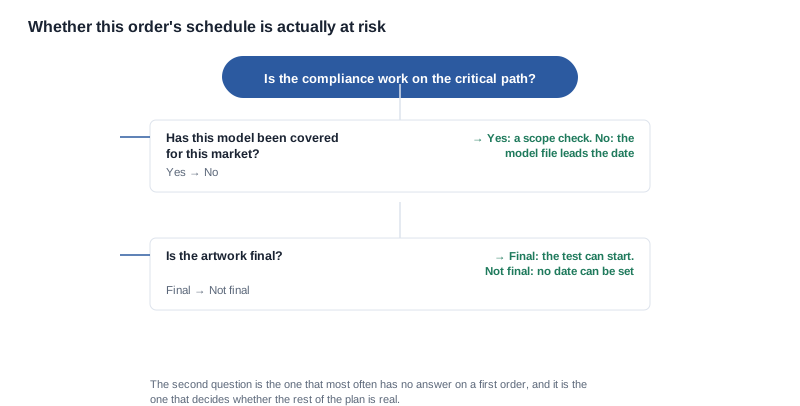
There are two situations where compliance does not move the schedule but stops the order entirely, and both are worth identifying early because neither is a timing problem.
A model with no conformity position at all
A model with no conformity position at all cannot be made compliant by waiting. In our own documentation the children's line has no conformity position recorded, and the requirements for children's eyewear in Europe and the United States are additional to the standard ones. That is a decision about the product and the market, and it belongs before the purchase order rather than in the schedule.
The distinction is important because a programme can absorb a delay and cannot absorb a determination that changes the product. If the answer is that the requirements are additional to the standard ones, then a launch date is not the variable being negotiated.
A published description that does not describe the function
A product whose published description does not match its function is a marketing problem before it is a compliance one. The AR entry in our catalogue is published with a 100 mAh cell, magnetic charging, a Bluetooth version 5.4 and about eight hours of rated use, and no augmented reality functionality is described in the published entry at all. A listing that implies otherwise is a claim ahead of the product, and it is the kind of claim that a documentation review will not catch because the documentation is not the problem.
The correction is a copy correction, and it should happen before the listing is written rather than after it is challenged. The catalogue entry is what the factory can evidence; anything beyond it has to be evidenced separately or removed.
How we report a certification schedule against a real order
What we publish and what we do not
We publish the per model specifications a compliance file is built around, and we mark the rest as Not published: the sensor part numbers, the ingress test report numbers behind the IP54 marking, the certification numbers with their model coverage, and the AI implementation details. In our own documentation the export-certification page carries ten patent certificates — eight appearance-design patents and two utility-model patents — and its content is images rather than text, the catalogue names no CE, FCC or RoHS marking, no per-model certification row exists anywhere, and no model level specifics are published for any model, which we will say plainly rather than dress a company level page up as model level coverage.
We will give you, for a specific model and a specific destination, what we hold, what we do not, and what has to be obtained and by whom. Where a regulatory question rather than a certificate is the issue, we will tell you that it needs a legal opinion rather than pretend the certification file answers it.
On lead time specifically, we will not publish a number for a programme we have not run. A quoted duration for a model that has never been assessed is a guess, and a guess in a schedule is more expensive than an open item, because the programme is planned around it.
The five questions that establish a date
These five questions are what turn a compliance conversation into a schedule, and they are worth sending in one message at the start of a programme rather than piecemeal as each stage arrives.
- Has this model, in this configuration, been assessed for this market before? The answer decides whether the programme has a compliance lead time of its own or is a scope check.
- What has to be decided before the artwork can be frozen? The answer is usually a short list of names, details and language sets, and each item on it has an owner.
- Can the unit used for testing be the unit in the shipping configuration? If yes, the sample step comes off the critical path; if no, add a build cycle.
- What is the position for the model in your published material, and what is still pending? This is the per model question that separates a file from a company level claim.
- Which items in this programme are determinations rather than documents? Anything that answers "not applicable, this is a legal question" belongs in the programme as a decision with an owner, not as a task with a date.
The fifth question is the one that changes the plan most, because a determination cannot be accelerated by a factory working faster. It has to be made by somebody with the authority to make it, and the programme is built around that date rather than around a laboratory.
The position on the two entries that need a legal opinion
Two entries in our published range are not schedule questions. The children's models, the A05, the A06 and the A07, have no conformity position recorded, and the applicable requirements depend on the destination market and on the claims made.
The bone conduction platform carries a published amplification figure of 35 dB, which is an assistive hearing level. That is a regulatory question that no certificate answers, and a buyer who puts that model into a product line without a legal opinion is making a product decision rather than a procurement one. We will flag it and we will not pretend the certification file disposes of it.
Sending the model, the market and the launch window
Send the model list, the destination market, the quantity band and the launch window, and we will tell you which parts of the programme have a compliance lead time, which are a scope check, and which are a determination that has to be made before a date can be set at all.
The certification checklist section sets out the full document list, the buyer's checklist gives the order in which to run the checks, the camera and audio smart glasses range shows the configurations the schedule depends on, and practical advice on the certification checklist covers how to run the same checks against any supplier. For the parallel question on production consistency, how quality consistency affects lead time covers the other half of a date.
Send the model, the market and the launch window and we will tell you which part of the compliance work is actually on the critical path.


