

Smart glasses quality consistency affects lead time through the gates it puts on the production schedule, and a lead time quoted without its gates is a number the buyer cannot use. The practical rule is short: every consistency control is either a hold that adds calendar time or a document that removes one, and the controls worth paying for are the ones that sit at the front of the schedule. A frozen configuration, a first-article check built inside the pilot run, and a retained sample per lot are cheap in days and expensive to omit. A tightened incoming inspection at the end of production is cheap in days and expensive in money. The order of these decisions, not the unit price, sets the delivery date a channel partner can be given. This page sets out the gates, what each one waits for, the inputs a lead time quotation leaves out, and how to evaluate a schedule before you order.
Smart glasses quality consistency and the production schedule
The lead time question this page answers
The reader is someone buying on the brand side, a channel buyer or an importer who has a lead time in a quotation and does not know what to do with it. The programme has a date attached to it — a launch, a retail season, a shipping slot, a festival — and the quoted lead time does not obviously fit. The anxiety is rarely about the unit price and almost never about the specification. It is about a date that cannot be moved, and a factory that says the date depends on the order quantity and the current schedule, which is not an answer a buyer can plan around.
Three decisions sit underneath that anxiety, and they have to be taken in this order. The first is which controls the programme will have, because a control added at the front of the schedule and a control added at the back have very different effects on the date. The second is where the schedule risk will be carried, which is usually the incoming inspection and the final release, because both sit after the point where the cost of a slip is highest. The third is what the contract says happens when a gate produces a failed result, because the alternative to a written answer is an improvised one, and improvised answers are the ones that move the date.
The failure mode to avoid is treating the lead time as a supplier characteristic. In this category it is not, because the catalogue publishes no lead time for any of the twenty-eight models. What the catalogue does publish is charge time — up to two hours on twenty-six models and about one hour on the D17 and the ZH12 — and the charging method, which is magnetic on seventeen models, Type C on seven, and not published at all on four camera models. Those rows describe the work at the end of a line, not the elapsed time from order to delivery, and a buyer who has been given a delivery date in place of a schedule is negotiating in the dark.
Why a lead time is never one number
Three different intervals get called the lead time in a smart glasses quotation, and they are confused with one another constantly. The first is the manufacturing interval, from the point the build starts to the point the lot is finished. The second is the quality interval, from the point the first unit is built to the point the lot is released, which includes every gate and every rework that the gates trigger. The third is the delivery interval, from release to arrival, which includes packing, booking, customs and inland transport.
A supplier quoting the first interval when the buyer is planning against the third is not being deceptive; the two are simply different objects, and only the second one is the one that the consistency programme controls. This is why "how does quality affect the lead time" has a precise answer: it affects the quality interval, it does not directly affect the manufacturing interval, and it reaches the delivery interval only through the release paperwork and through the rework that a failed gate causes.
There is a second reason the number feels unstable. A lead time quoted for a first order describes a different programme from a lead time quoted for a repeat order, because the first order carries the setup — the configuration sheet, the artwork proof, the packaging proof, the first-article build and the first round of review — and a repeat order carries none of it. A buyer comparing a first-order quote against a repeat-order quote, or against a competitor's repeat-order quote, is comparing two different objects and will draw a conclusion about the factory that the factory's process does not support.

The gates that sit on the critical path
The schedule below is the standard set of consistency gates for a camera-model programme, in the order they occur. It is deliberately sequenced so that the gates which can be compressed cheaply come first and the ones that are expensive to compress come last.
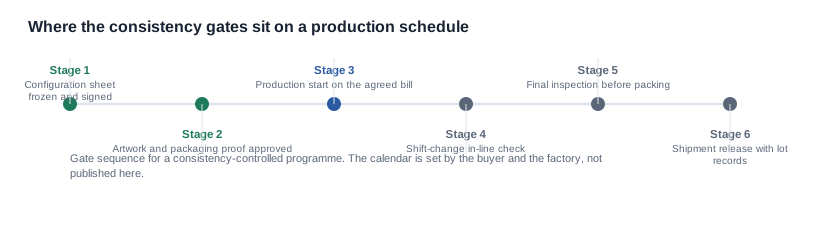
Gate one: the frozen configuration
This is the cheapest gate on the list and the one most often skipped. Before the build starts, the buyer and the factory agree what is in the unit: the cell, the case option, the charging interface, the colour, the firmware build, the packaging, and the accessories. Each of those is a published variable in the catalogue, and each one is a way for two units of the same model designation to differ.
The catalogue makes the point with three examples that are easy to check. The L2 Utral is published in two case options, at 900 mAh and 1400 mAh, so "the L2 Utral" is not a specification until the case is named. The V03 Pro is published in three colours and the V06 in four, so a two-colour plan is two configurations, not one. And the four camera models whose charging method is not published — the MT6 and the L1 Pro, and the CY03 and the CY05 — are four models where the charging accessory has to be specified in words rather than read from a line. A gate that takes an afternoon removes the largest source of variation from the schedule, because a lot that has to be held because a case option was ambiguous is a lot that has to be held again if the pairing is found at the final inspection.
Gate two: the first article
The first-article check answers one question: does the unit the factory is about to build match the unit the buyer approved? It is worth putting early, because a first-article check that happens after the pilot run has already consumed the pilot run.
The economics are the reason it moves. A first article built inside the pilot run costs a unit and a technician. The same check performed on the first shipment of a production order costs the whole shipment, because the order is held until the result is judged. That is the difference between a delay measured in hours and a delay measured in the whole production cycle, and it is the single most common way a consistency programme quietly extends a delivery date.
The published rows define what the first article has to match, because each camera model has a fixed set of published characteristics: a resolution tier, a cell capacity, a charging interface or an explicit absence of one, a case option, and a published runtime band. The 290 mAh cell on the L1 Pro and the L2 Utral, and the CY03 and the CY05, the 265 mAh on the MT6, the 220 mAh on the V03 Pro and the MT5, and the V03, the 260 mAh on the S7 and the V06, and the KY06. Eight models sit in the 8 MP tier and three in the 13 MP tier, and a first article checked against the wrong tier is a check that will pass a unit the buyer did not want.
Gate three: the in-line check
The in-line check is a small sample taken during the run rather than at the end of it. Its value is not statistical; it is temporal. A check taken at the change of shift tells the factory whether the remaining production is worth continuing, and a check taken only at the end tells the factory what it already built.
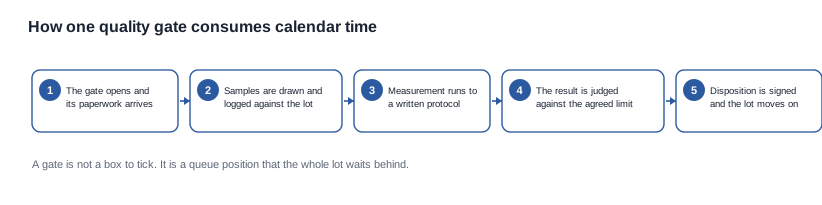
A gate is not a box to tick. It is a queue position that the whole lot waits behind, and the five steps inside it — paperwork arriving, samples drawn and logged, measurement run to a written protocol, the result judged against a limit, and the disposition signed — are the reason a gate that is described as "quick" can still move a delivery date by days.
This is the gate most sensitive to the acceptance rule, because the rule has to exist before the check is meaningful. A sample with no limit attached produces a number and no decision, and a decision made without a limit is a negotiation rather than a control. The criteria have to be written in advance, which is also the reason this gate compresses poorly: writing a limit, agreeing it and getting the result back all take time, and none of that time disappears if the rule is written late.
Gate four: the final inspection
The final inspection is the most expensive gate and the one most often assumed to be the main control. It is not. A final inspection applied to a lot whose configuration was frozen and whose first article matched is a verification step that usually passes quickly, because the variation that would have caused a failure was removed before the lot was built. A final inspection applied to a lot where the configuration was never frozen is a dispute waiting to happen, and the dispute is resolved by holding the lot, which is the schedule's largest single risk.
There is a second reason the final inspection is expensive: it happens after the value has been added. Every unit in the lot has already consumed material and labour, and a rejected lot has to be reworked, re-inspected and re-released. The practical question to ask a supplier is not whether the final inspection exists but what happens to the lot on the first failure, and the criteria that answer it are set in the purchase order.
Gate five: the release paperwork
The last gate is the least visible and the one that most often causes a date to move with no dispute at all. A lot cannot be released without the records that tie it to the configuration, and a record that is assembled after packing rather than during production is a record that will be assembled late. A lot identifier, a bill of materials version, the first-article result, the in-line results and the final inspection result are five documents, and each of them has to exist before the release is signed.
The discipline that compresses this gate is mundane: collect the records as they are produced rather than at the end. A factory that photographs the first-article result and uploads it the same day has removed a day of chasing from every lot, and a factory that keeps the paperwork in a folder until the shipment is packed has added one. This is not a capability gap. It is a habit, and habits are the cheapest schedule lever in the whole programme.

What a quoted lead time leaves out
The four inputs nobody puts in the quotation
A lead time quote normally covers manufacturing and nothing else. Four inputs to the delivery date are routinely left out, and a buyer who has not asked about them is scheduling against a number that cannot be met.
- The setup interval. The first order carries the configuration sheet, the artwork proof, the packaging proof and the first-article build, and the second order carries none of them. Two quotations for the same model at the same quantity are not comparable if one is a first order and one is not.
- The approval loop. Every artwork round and every packaging round is a cycle that ends when the brand answers, and the length of that cycle is set by the buyer's own review process, not by the factory. A supplier who quotes a schedule that assumes a same-day approval is quoting a schedule that assumes the buyer's behaviour.
- The release paperwork. As above, the time between the final result and the signed release is a document chase, and it is entirely under the factory's control.
- The destination market route. The regulatory route for the destination market has its own cycle, and in the European Union it runs through the Radio Equipment Directive (EU) 2014/53/EU. That cycle is a consequence of the requirement and it is not negotiable, so a schedule that leaves no room for it is a schedule that will be late.
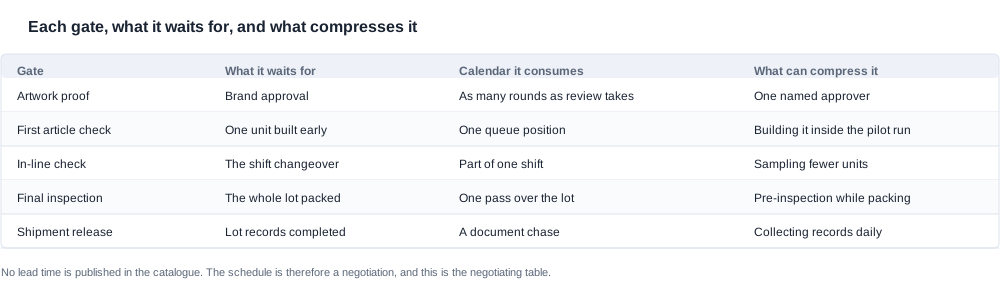
The table is the negotiating table rather than a description. Each row names a gate, the thing it waits for, the calendar it consumes and the one thing that compresses it, and it is worth noticing that the compressor in every row is a decision rather than a machine. That is the argument to make in a lead time negotiation: the schedule is not fixed, but every compression available has to be paid for somewhere, and the buyer should decide where the payment goes.
Reading a lead time against the catalogue
The catalogue can tell a buyer whether a quoted schedule is internally coherent, even though it publishes no schedule of its own. Charge time is published for all twenty-eight models, so a buyer can ask whether the quoted production window allows the charging step to be completed and tested on every unit, and whether the units that ship with a case have the time to be paired and checked. It can also tell the buyer which models are the hardest to schedule: the four camera models whose charging method is not published at all, because the logistics of that step have to be agreed rather than assumed, and the camera models that ship with a case, because a case-and-unit check is a separate operation with a separate failure mode.
The runtime bands add a second check. Five camera models are published at about seven hours, four at five to eight hours and two at six to eight hours. A programme that assumes a full working shift of use and a model published at five to eight hours has a wider band than a programme that assumes a half shift and a model published at about seven hours, and a buyer who has not noticed the band has not priced the field complaints that the band produces.

Compressing a schedule without losing control
The levers that work
Four levers compress a schedule without weakening the programme, and all four are decisions rather than expenditures. The first is to move the gates earlier: a first-article check built inside the pilot run, an artwork proof approved before the build rather than after it, and a configuration sheet signed before the purchase order. The second is to run the reviews in parallel rather than in series, so that the artwork proof, the packaging proof and the configuration review are open at the same time instead of one after the other. The third is to fix the sample size and the limit before the production run rather than during it, because a limit agreed after a result has been seen is a limit that has been fitted to the answer. The fourth is to collect the records as they are produced, which is the cheapest lever of the four and the one most often left on the table.
Two more levers are worth naming because they are commonly proposed. A supplier that offers to skip the first article in exchange for a shorter date is offering to move a cost from the schedule to the field, and the trade-off should be refused in writing rather than accepted verbally. A buyer who offers a premium for a shorter interval is buying schedule certainty with money, and the same money spent on the first-article gate usually buys more, because the gate removes rework rather than compressing a queue.
The levers that cost more than they save
Three apparent savings are traps. Increasing the incoming sample size tightens the receiving cycle without touching the variation that is generating the returns, so the receiving cost rises and the delivery date does not improve. Pressing the factory for a shorter build interval compresses a queue and increases the risk of an in-line failure, which is a longer delay with a more expensive lot. And agreeing a dispatch date before the final result is available replaces a schedule with a hope, and the result of that trade is a date the buyer has to explain to a channel partner.
The general principle is worth stating because it applies outside this category: a schedule saving that removes a control is a loan, and the loan is repaid in rework, in complaints and in a returns reserve that somebody has to justify. The sign that a schedule has been optimised this way is a final inspection that takes longer than it should and a first article that nobody can find.
Failure modes on a production schedule
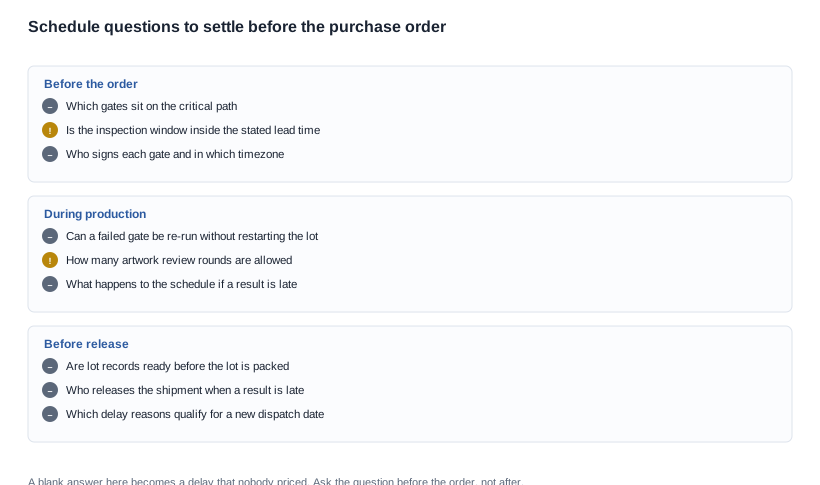
Four failures reach a buyer as a schedule surprise, and each of them is visible in advance if the criteria are written down. The checklist above is the set of questions to ask before you order, and a blank answer on any line of it becomes a delay that nobody priced.
The date that assumed a same-day approval. The factory's schedule was built on a one-round artwork approval and the brand's review process took three. The control is to state the number of allowed review rounds in the purchase order and to name one approver, so that the approval loop has a defined length.
The hold that was never planned for. A first-article result fails, the lot is held, and there is no written rule for what happens next, so the re-inspection and the re-work are improvised. The control is to write the first-failure rule into the order: what is re-tested, how many units, and what the new dispatch date is.
The paperwork that arrived late. The lot was finished on the agreed day and the shipment moved three days later for a record that could have been produced during the run. The control is to name the record set at the start and to require it with the release.
The gate that stopped the line. An in-line check fails and the factory stops the line rather than continue, because the rule does not say what to do with the units already built. The control is to state the disposition — rework, scrap or segregate — for each failure point, so that a failure stops a lot rather than a line.
A purchase scenario, and what we publish
A schedule worked through
The worked case below was built to carry an argument about dates, not to report an engagement. No customer is named and no order is claimed; the camera model, the fixed launch date, the three artwork rounds and the single approval contact are all assumed, so that the sequence from a quoted date to a defensible one can be followed step by step.
A brand has a launch date that cannot move and a quotation for a 13 MP camera model with a lead time that fits only if everything goes exactly as described. The model is one of the three in the 13 MP tier, the cell is 290 mAh, the published runtime is about seven hours, and the case is one of the 1400 mAh options published for the L1 Pro and the CY05, and the CY03. The brand has no configuration sheet, no first-article step, and a review process with three approvers.
Step one is to pull the schedule apart into the three intervals it actually contains, because the quotation is quoting the manufacturing interval and the brand is planning against the delivery interval. Step two is to add the setup interval the quotation omits, and the three artwork rounds, and the release paperwork, and to name the regulatory route for the destination market as a fixed constraint rather than an assumption. Step three is to decide the gate set: a configuration sheet naming the cell, the case, the interface, the colour, the firmware build and the packaging; a first article built inside the pilot run; an in-line check at the change of shift; a final inspection; and a record set collected as the run proceeds. Step four is to price the trade-offs: the first article inside the pilot run costs a unit and a technician and removes a possible hold on the whole lot; the alternative — a first-article check on the first production shipment — saves nothing and risks the date. Step five is to write the failure rules, so that a failed in-line check stops a lot rather than a line and a failed first article has a defined re-inspection and a new dispatch date.
The result is a schedule that is longer on paper than the quotation and shorter in practice, because the version of the programme that fits the date is the one where the gates are in the right places. No factory visit was needed at any point, and what the exercise produced is a set of agreements rather than a set of assurances.
What we publish, and what we will not quote
Here, the schedule is a negotiation and the catalogue is a specification, and the two should not be confused. We publish the electrical rows and the configuration rows exactly as the catalogue states them — the colour availability, the charging interfaces, the cell capacities, the case options and the resolution tiers, the published runtime bands, the charge times and, for one model, the whole-unit weight with its exclusions — and we publish the absence of lead times, tolerances, defect rates, capacity data and certification records with the same prominence. We do not publish a lead time for any model, because a lead time depends on the order quantity, the configuration, the current schedule and the destination market, and a number that depends on all four is a conversation rather than a specification.
The rows we do not publish for this category are these: production and line capacity, on-time delivery history, defect and rework history, per-model certification records and their validity dates, ingress test report numbers, sensor models, acoustic measurements, cycle life ratings, and the weight of any model other than the MT6. Where a model has no published figure, the answer we can give is a question for the supplier rather than a number from us. Two limitations belong in any schedule, because both of them are asked about before an order rather than after one: the IP54 marking on the V06 and the S7 is a catalogue annotation rather than a report-backed claim, and the catalogue text carries no CE, FCC or RoHS marking for any model. Both are answered by a document request, and a document request sent before the build does not move the date.
What we can do is take a quoted date, a model and a destination market and tell you which gates the quoted interval has to contain, which of the published rows the configuration sheet has to name, and where the schedule is most likely to fail. The general treatment of the subject is at the quality consistency glossary, the scheduling context is at how production capacity affects lead time and the traps are at production capacity mistakes to avoid. The pillar page is quality consistency and the product range is at AI camera glasses.
The action to take now. Send us the model, the configuration, the destination market and the date you have to hit, and we will tell you which gates that date has to contain, which of the published rows the configuration sheet has to name, and where to negotiate. A schedule that is built on the gates in the right order is worth more than a date that is quoted shorter and delivered later.
Related reading
- The general treatment — smart glasses quality consistency
- The capacity and scheduling context — how production capacity affects lead time
- The traps — production capacity common mistakes
Send us the model, the destination market and the date, and we will show you the gates that date has to contain — the scheduling structure behind smart glasses quality consistency, without a single invented lead time.


