

Most certification checklists are lists of documents. This one is a form with a status column, because the useful question is not "do you have this document" — it is "what is the state of each item, and who owns the gap". A buyer who sends a document list gets a pile of PDFs of unclear relevance; a buyer who sends a form gets a picture of the programme that can be compared across suppliers in an afternoon, and that can be diffed against the last order to show exactly what a configuration change cost in evidence terms.
Smart glasses certification checklist: why a status field beats a document list
The difference the form makes in practice
A request for "certification documents" has no natural answer. The supplier sends what exists, the buyer cannot tell what is missing from what was not asked for, and the file ends the week in the same state it started. A request for a status against a named line for a named model has a natural answer, and the answer has a small vocabulary: held and current, held but undated, not held, or open with an owner and a date.
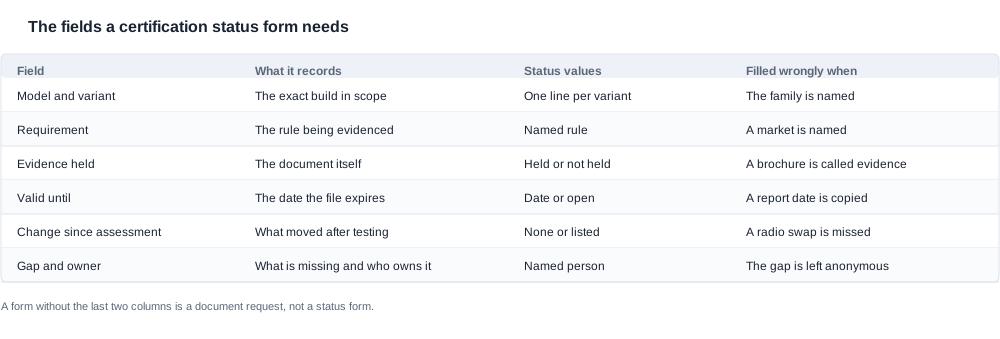
The second thing the form does is make the scope explicit before any supplier answers. The buyer writes the models, the configurations and the destination markets into the form and sends it as a form. A supplier then has to respond line by line, and a line they cannot answer becomes visible as an open row rather than as an absence in an attachment.
The statuses have to stay coarse
Fine-grained statuses create the appearance of precision that a supplier will fill in optimistically, and the result is a form that is complete and useless. Four statuses are enough to drive a procurement decision, and the whole set has to sit on one line in an email for the form to survive contact with a supplier's sales team.
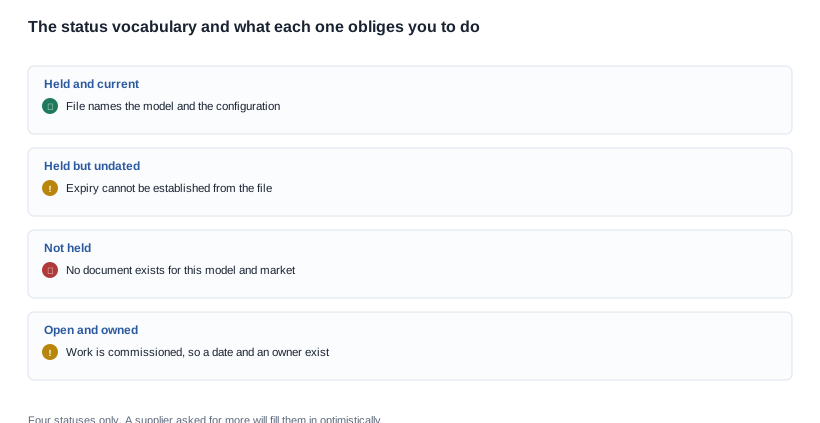
The wording of each status matters more than it seems. "Held and current" asserts that the file names the model and the configuration and has no expiry the buyer could establish otherwise. "Held but undated" says the document exists but the buyer could not establish an expiry from it. "Not held" is the honest negative. "Open and owned" is the one that moves the programme forward, because it carries a name and a date.
A supplier who will not fill in a row at all is giving you information about how the process works, and it is worth weighing that before commissioning the work rather than after.
The two fields that get filled in wrongly
"Valid until", because dates get copied from the wrong document
This is the field most often populated with a number that came from a different source. The date on a test report is copied across as though it were the expiry of the coverage, but a report may cover a sibling configuration, and a test report can carry a date that relates to the test rather than to any obligation the buyer inherits.
The field should be filled from the document that establishes the coverage, and if the document does not state one, the honest entry is that the expiry cannot be established from the file. That answer reads as a gap, and it is the right one. A supplier who cannot produce a date for the coverage has told you something about the depth of the file.
"Change since assessment", because four substitutions never feel like certification changes
The second field, and the one with real consequences, is what has moved since the assessment. The radio module, the antenna path, the battery and the housing are the four changes that reopen work, and all four are easy to overlook because each is made for a commercial reason and none of them feels like a certification question at the moment it is decided.
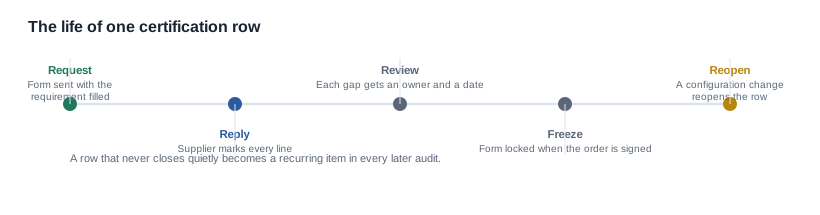
The test for the field is whether the supplier can produce the four answers without going to check it. If the supplier says "no change" immediately and confidently, the answer may be right, but it should be confirmed against the purchase order rather than taken from a sales reply. If the supplier hesitates, the hesitation is the answer: the configuration record is not kept current, and that is a finding about the file rather than about the product.
The six fields that carry the decision
| Field | What it records | Status values | Filled wrongly when |
|---|---|---|---|
| Model and variant | The exact build in scope | One line per variant | The family is named |
| Requirement | The rule being evidenced | Named rule | A market is named instead |
| Evidence held | The document itself | Held or not held | A brochure is called evidence |
| Valid until | The date the coverage expires | Date or open | A report date is copied |
| Change since assessment | What moved after the assessment | None or listed | A radio swap is missed |
| Gap and owner | What is missing and who owns it | Named person | The gap is left anonymous |
The last row is the one that makes the form usable in a programme rather than in a conversation. A gap with a name attached and a date against it becomes a task with a due date. A gap recorded as a gap becomes an item that reappears in every subsequent audit, and nobody ever closes it because nobody owns it.
The fields worth adding only when the programme needs them
Two additions earn their place on larger programmes. The first is a column for the market, because the same model can be covered in one market and open in another, and a form with a single market column hides that. The second is a column for the cost of closing each open row, which does not need to be a number — a name and a rough band is enough to let a buyer decide which open rows matter.
Neither is worth adding to a first enquiry. A form that carries eight columns gets answered with two.
The fields that do not belong on the form
A column for the supplier's marketing name is a trap, because it invites a supplier to answer in its own vocabulary and the buyer to compare two forms that mean different things. A column for a pass rate is worse, because a rate is not a property of a model; a product either has a document covering it or it does not. And a column that asks whether the product is "certified" invites an answer that describes the range rather than the line, which is the failure the form exists to prevent.
How a form comes back: optimistic, incomplete and family level
The reply that answers the range instead of the line
This is the most common failure and the hardest to spot, because the form comes back complete. Every row is marked, the supplier has clearly done work, and the answer is a general statement repeated on each line: the product line is certified, the file is available on request, the company holds the necessary approvals. Every row has been answered and no row has been answered.
The detection is mechanical. Read the row that should be hardest and check whether the answer contains the model designation, the configuration and the market. If the answer to that row contains only the product family and a general statement, the whole form was answered at family level, and every other row inherits the same weakness. The remedy is to ask again for one row only, with the model designation written into the request, and to see whether the supplier can produce a document or repeats the general statement.
The status that means "probably"
A second failure is the status that is technically accurate and practically useless. "Held" tells you a document exists. It does not tell you that the document names the model, that it covers the configuration, or that the coverage has not expired. Three buyers in the same week can each read "held" differently, and the comparison between two suppliers' forms becomes a comparison of their optimism.
The correction is to require the evidence field and the configuration field to be filled independently of the status. A row cannot be "held and current" without saying which document is held and which build it covers. If the supplier cannot separate the two, the form is asking for a summary rather than a status, and the summary should be rejected and the form re-issued with the two columns clearly separated.
The gap that is assigned to nobody
The third failure is a gap row with no owner, or with an owner who is not the person who can close it. "Pending further clarification from the factory" is a gap with an owner, because the factory is a party. "To be confirmed" is a gap with no owner, because nobody has been told to confirm it. The distinction survives translation into a task tracker, which is exactly where these forms end up.
The correction is a rule rather than a request: a gap row with no named person is returned unanswered. Suppliers respond to this faster than to almost anything else in a procurement file, because a named owner is now visible inside their organisation and the cost of leaving a row without one moves onto them. It also makes the buyer's position at the point of signature much stronger, because the open items are visible rather than implied.
What to do with a form that comes back partly filled
A partly filled form is the normal result, not a failure, and the handling decides whether it becomes useful. The rows that came back empty are the rows that tell you what to do next, so the first job is to sort the form into answered rows, rows answered at family level, and rows that were not attempted. The third group is the fastest signal in the whole exercise, because a supplier who has skipped a row has told you something they did not have to tell you.
The practical sequence is to return the form with the empty rows marked and a single question attached to each one. Not a general request for "more information", which produces a general reply, but a row-by-row question: does this model exist in the file set, and if so under which designation; does the coverage include the charging case; does the change since assessment cover the current cell. Each question can be answered in one line, and each unanswered line becomes a specific item in the negotiation rather than a vague sense that the documentation is incomplete.
Where the gap is genuinely work rather than a filing error, it moves from the form into the commercial conversation. That is the point at which the form stops being a procurement instrument and becomes a scope document, and it is discussed in the section below.

How to run the form so it produces a comparison rather than a conversation
The order that makes the form worth running
The value of the form comes from running it the same way against more than one supplier, which means the sequence has to be fixed and the buyer's part has to be prepared before anything is sent.

- List the models and the configurations in scope, one line per variant. The buyer's own commercial intent has to be on the line, because a supplier answers against a named build.
- Fill in the requirement column before sending. Writing the applicable framework against each row is the buyer's work, and doing it first prevents the reply from being framed as a set of documents the factory happens to hold.
- Send the form with a named deadline and an instruction to mark every line, including the lines that cannot be answered.
- Read back every open row with a named owner and a date. An open row with an owner is work; an open row without one becomes a recurring item in every later audit.
- Compare the completed forms side by side. The comparison is the output, not the individual forms.
- Keep the completed form, because the diff against the next order is a precise statement of what a change cost in evidence terms.
Running it once against something you already hold
The form is much more useful if you complete it once for a product you have already shipped, before you run it against a new supplier. That first pass takes about an hour and it calibrates what a complete answer actually contains, because you already know the configuration and you can ask questions that make sense.
After that calibration, the same form against three suppliers takes under an hour each and produces a comparison rather than three separate conversations. It also gives you the vocabulary to ask a specific follow-up, which is much harder when you have never seen the field completed by anyone else.
The other benefit of the calibration pass is that it shows you where the form is too coarse. A row you always end up splitting in two is a row that wants a second field, and adding that field once is cheaper than asking for it on every order.
What the diff between two forms tells you
Keep the completed forms, one per order, in the same folder as the purchase orders. The next time a configuration changes — a new colour, a case added to the box, a firmware build under your own application — the diff between the previous form and the new one is a statement of what that change cost in evidence terms.
That statement is the one that usually gets skipped. The commercial discussion moves to "can we absorb this change", and nobody has a number for the certification work the change triggers, because the question was never asked in a form. A diff turns it into a bounded question, and a bounded question is one a factory can quote against.

What the completed form changes commercially
Scope becomes a line in the quotation
Before the form exists, the certification scope of a programme is an atmosphere. Everyone in the conversation believes it is covered, the cost sits in a general allowance, and the first time anybody calculates what the programme actually costs, the number is different from the one in the quotation. The form replaces the atmosphere with a scope: a set of models, a set of markets, and a set of open rows.
Once the scope is written down, it can be quoted. A supplier can price the work required to close the open rows, the buyer can compare that price against another supplier's scope rather than against a general claim, and both sides can tell whether a proposal covers the same programme. This is the single most valuable thing the form does commercially, and it is worth more than any document it collects.
A held document and a commissioned document are priced differently
The form separates two things that are usually bundled into one line called "certification". A document that already exists for the exact model and configuration has a cost of zero and a lead time of zero, and its only risk is whether it covers what you are ordering. A document that has to be commissioned for a new model, a new market or a changed configuration is a project with a fee, a duration and a dependency on the factory's own schedule.
Buyers who cannot separate these two end up paying for work that has already been done, and end up assuming that everything in a supplier's file set costs the same. The form's status vocabulary does the separation for you: held and current is one category, open with an owner and a date is another, and the second one belongs in the programme plan with the same weight as a tooling lead time.
The scope that is worth paying for
Two questions decide whether the scope in front of you is worth what it costs. The first is whether the markets in it are markets you are actually going to sell into, because an unnecessary market is a cost the buyer chose and it is the easiest saving available anywhere in a compliance budget. The second is whether the models in it are models you are going to order, for the same reason and with the same weight.
The third question, which suppliers rarely ask themselves, is whether the scope can be reused. A file set that covers a configuration and can be extended to a sibling configuration is worth considerably more than one that has to be rebuilt for every variant, and the difference shows up in the second order rather than the first. If a supplier can tell you which configurations in the programme share a file, that is a better answer than a discount on the first one.
Where our own position sits in this form
We will complete this form for a given configuration and destination market, including the rows where the status is not held, because a form with honest negatives is worth more than one with optimistic positives.
Certificate numbers, issuing bodies and validity dates are not published in our documentation, and the form asks for them per model rather than presenting them as standing facts. Where we hold nothing against a row, the status says so and the gap row names it. Our published certification position is that the catalogue carries a company-level export-certification page whose content is images rather than text, that the catalogue text names no CE, FCC or RoHS marking, that no per-model certification row exists anywhere, and that no model-specific identifier is published for any model, and we would rather show that as a row than dress it up as a completed one.
We will also tell you where a change you are considering would reopen existing work — the radio module, the antenna path, the battery or the housing — because that is more useful than a completed form. The certification checklist covers what each framework requires, and the supplier verification article covers how to check a single claim once you have it.
Related reading
- Supplier verification — checking a claim
- When you can skip — the four gating questions
- EU market entry — frameworks by destination


